Thursday, May 25, 2017

First in Asia? I think so.

15420972_10154801899996202_7335747756948652321_n

I have a habit of always being connected to things, but never quite being there when the big events happen. So it is again with the absolutely huge ruling from Taiwan's highest court stating that not allowing same-sex couples to marry was unconstitutional. 

There are both good and problematic things about the ruling, but before we get into that, can we just take a minute to jump up and down and celebrate? This is HUGE. Let's just take a few minutes not to undercut that with doubts and rainclouds and just celebrate something good for a bit, 'k?

I mean it - I happen to not be in Taiwan right now, but before I could even get into the meat of this ruling, I immediately flicked off Airplane Mode upon landing at Heathrow (we have a connection to Athens that we're still waiting for), knowing the ruling would be out today, and went straight for the news. I was so happy to read those two three little words - "rules in favor" - that I started crying and jumping up and down on an escalator. Sometimes you've just got to be all holy crap holy crap oh my god holy crap congratulations Taiwan oh my god we did it we did it oh my god oh my god holy crap good job Taiwan wow wow wow wow WOW wow WOWWWW wowowowowowowowowow yayyyy!!! yayayayay yay yay yay YAY YAY YAY!!!!!

We've earned it. Celebrate, and don't feel bad about that. I am so proud to call Taiwan my home today. Good job.

I haven't been able to read the whole ruling yet - walking across an airport in tears will make that hard - but let's start with the good, because we deserve some good.

The good is that the court ruled that the civil code laws barring same-sex couples from marrying, and I quote, "are in violation of both the people’s freedom of marriage as protected by Article 22 and the people’s right to equality as guaranteed by Article 7 of the Constitution", and gave two years for the Legislative Yuan to amend the law accordingly. The mood across the country appears to be one of celebration, and yes, this ruling is historic as it is the first high court in Asia (as far as I am aware) to hand down such a ruling. Taiwan looks set to be the first country in Asia to realize marriage equality.

It is enough to make one cry, and I did.

More of the good: I do think this means that same-sex couples will get equal rights. To pass an additional civil code regulation allowing "civil unions" but not giving those civil unions the full equal rights of opposite-sex married couples would violate the spirit of the ruling and be open to challenge, and I'm sure the legislature knows that.

So, while it would not be optimal to call same-sex unions 'civil partnerships' and categorize them separately, if equality is the goal, then we need to stay focused on that. The court said clearly that the order of the day is equality, and if that means a bit more of a battle to change civil partnerships (which, by court order, must be equal, no? I'm no lawyer but this seems obvious to me?) to 'marriage', then that will still be a battle to end separate categorizing during which same-sex couples have equal rights. Again, that's not ideal, but it's a damn sight better than the alternative of no marriage equality at all.

I do also think this means Taiwan will be the first country in Asia to realize marriage equality. While I suppose it is possible for another country to get there sooner, I highly doubt this will happen. First, because no other country in Asia seems interested in beating Taiwan to this particular finish line, though activist groups in many certainly would like to see marriage equality become the norm in their respective countries (and if you don't think most Asian countries have activist groups because you stereotype Asia as uniformly conservative, you don't know Asia), the attitude I generally perceive is one of it either not being on the radar for any given country. I could also imagine other countries essentially waiting for someone else to take this step - perhaps more Asian nations will finally realize equality, but none seems as eager as Taiwan to be the first.

If the Legislative Yuan does nothing in these two years, after that time marriage equality will be de facto legal. I do not think any other country in Asia is within two years of this. Frankly, even if they were, isn't more equality for more people the true end goal, rather than the distinction of being "first"? Yes, it would be helpful for Taiwan's international image, but remember, the goal is not accolades but equality and the more of it the better. I just don't see the point in fretting too much about this.

Now for the potentially bad:

Just because anti-equality groups seem to be quiet today doesn't mean they're going away. They can't do much about this - which is why I'm happy it went through the court and not the legislature - but they'll probably push for delays, for 'civil partnerships', for whatever they can push for to oppress LGBT people for their own selfish reasons (yes, if you are anti-equality, your personal dislike of LGBT people driving your desire to keep them from attaining equal rights is selfish and it is bigoted). Two years is a long time, and it remains to be seen whether the DPP will get this over with soon or hem and haw and let it become an electoral issue. I really hope it's the former, because the goal is equality as soon as possible. Alternatively they could wait out the two years and just let marriage equality become de facto legal.

And, remember, despite what Facebook chatter is saying, this does not mean marriage equality is automatically legal right now - more needs to be done.

But this is huge, and we all deserve a good drink, a good dance, a good hug, a good cry, and a good party. 


I am so happy for you, Taiwan. So, so happy. 


Saturday, May 20, 2017

I have a crush on Indiana Jones's mom


My first sighting of Taiwan was years before I actually moved here.

I was 19 years old, on my way to a study abroad program in India, and our plane from Los Angeles had a brief scheduled stop at Taoyuan Airport. As we cruised in, I saw rugged green mountain peaks jutting out from swirling white clouds and mist.

It was lovely, like coming across slabs of rough green and white quartz while hiking, but more vivid. Yet it was my first glimpse of Asia and second time to travel to another continent; it intrigued me.

Even Taoyuan Airport was of more interest then than it is now: a glass wall installation of Chinese calligraphy, a few shops, a new smell - my first whiff of the many scents of Asia which, while all different, are all entirely unlike those of North America. Perhaps now I find all this somewhat unimpressive - after all, who is impressed by Taoyuan International Airport? - but at the time I was taken.

One of my fellow India-bound students commented: oh, hey, we're in the Republic of China, cool! 

Cool!

I knew that the People's Republic of China and the Republic of China were different entities, but I did not fully grasp all I did not know. I did, I admit, think of Taiwan as the place where Chinese culture had been "saved and preserved". Worry not, I grew out of that absurd notion. I thought to myself that, although this time we would not leave the airport, I would very much like to explore the Republic of China someday. The thought was, to quote my nascent inamorata, inchoate. But it was there.

I didn't go immediately - we stopped in Kuala Lumpur and explored the city for the day, went on to Chennai, then Mahabalipuram, then Madurai, India, where my entire worldview was turned on its head. I returned to the US and finished my degree, fighting what I thought might have been a touch of depression but was actually a compound case of senioritis and the travel bug. I went to China - the People's Republic of China, the other one - traveled around Southeast Asia, returned to India, then the US, then worked a stultifying office job for a few years.

And then, it was time. The opportunity was there in that I finally had the freedom and savings to explore this Republic of China, and I was fast realizing that what I thought was a temporary, curable travel bug was actually a chronic illness whose only cure was to leave and basically not come back.

Only then did I realize I wasn't going to the Republic of China at all; I was moving to Taiwan, or perhaps Formosa. But this was no China. 

I am now an English teacher by profession, but I like to think (pretend?) that I am also much more than that.  

* * *

Why am I telling you this? 

Because almost exactly 100 years ago, the object of my affection boarded a boat in Manila bound for Nagasaki, passed Taiwan and noted how beautiful the cliffs plunging into the sea appeared:

Formosa, that little-known island in the typhoon-infested South China Sea, so well called by its early Portuguese discoverers - as its name implies - "the beautiful". Indeed, it was the beauty of Formosa that first attracted me....I shall never forget the first glimpse that I caught of the island as I passed it...there it lay, in the light of the tropical sunrise, glowing and shimmering like a great emerald, with an apparent vividness of green that I had never seen before, even in the tropics. During the greater part of the day it remained in sight, apparently floating slowly past - an emerald on a turquoise bed....

My desire to learn at first-hand something of the aborigines of Formosa remained, therefore, more or less an inchoate inclination on my part, and I turned my attention to other things. Then, curiously enough, as coincidences always seem curious when they affect themselves, a few months later...came an offer from a Japanese official to go to Formosa as a teacher of English in the Japanese Government School in Taihoku [ed: present-day Taipei], the capital of the island. 

Girl, I already want you.

You floated by, I floated over, but we both had the same thought - there is a reason why they call this the Beautiful Island, and I would like to explore it. We both set that thought aside for years, and then, for both of us, the right circumstances presented themselves. 

You even came as an English teacher, but you were so much more than that. 

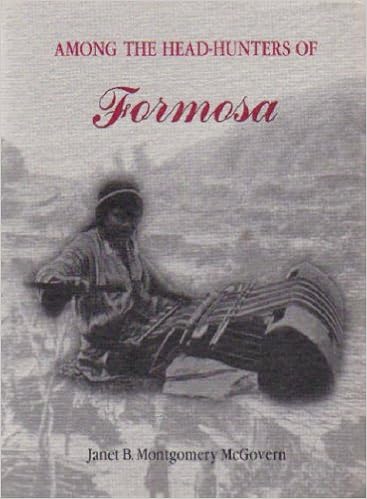
Let this be a lesson to those who would disparage all English teachers as losers, wash-ups, backpackers and weirdos: the single most awesome foreign woman to ever alight in Taiwan and write the classic but oft-forgotten Among the Head-Hunters of Formosa, merely because she was inclined to do so and found the place beautiful as she passed by once, was also an English teacher.

You were not wealthy (in fact, it appears you often published for general interest of of necessity, which may have affected your reputation enough to keep you from publishing in more scholarly circles). You were absolutely a wanderer, absolutely fearless, and absolutely unapologetic. 

Brendan pointed out that you were the mother of William Montgomery McGovern, the possible inspiration for Indiana Jones. Although he did what a lot of adventurous male scholars were able to do at that time, whereas you bucked all sorts of expectations of women, let alone female scholars, and wrote a classic book on Taiwan, he has a Wikipedia bio, but you do not (guuuurl, I am gonna fix that for you, because you are my person.) 

I am not concerned with your son, nor am I concerned with Indiana Jones. It's easy to have a crush on Indiana Jones. I have a crush on his mother who, by dint of what she did despite the sexist time and society in which she was born, was so much more of a bad-ass. 

I can only lament that we were born a century apart. And that I like men, but that hardly matters: I'll make an exception for you, my star-cross'd love. If you weren't dead, that is. 

I am not going to recount the entire book for those of you reading this. It is available online, on Amazon, and can occasionally be found in Taipei (try The Taiwan Store). You will learn quite a bit about the indigenous people of Formosa: for a time, it is likely that nobody in the world knew more about them than Janet B. Montgomery McGovern. I especially enjoyed the marriage customs wherein a lovelorn "swain" (and yes, I adore the old-timey English usages) would play a small mouth harp or create a twenty-bundle monument of firewood for a woman's cooking pot in order to win her hand - and that she still had absolute right of acceptance or refusal.

Brendan and I decided to get married by basically saying to each other:
"We should get married, yeah?"
"Sure, that sounds cool."


So, this was nice. 

But why am I so enamored with Janet McGovern?

She came to Taiwan as a single woman in a time when that was fairly rare - and when it was done, it was usually by missionaries. I love that she had no interest in being a missionary. She never seems to have become fluent in any one Formosan language, but picked up some of many different, rare tongues: more than wealthier expats with more resources today often manage to do for just one language, which is far more well-known, with more learning resources created for it, yet isn't even the native tongue of this country. 

She trusted head-hunters that full-grown men, both foreign and local, were terrified of, and was in turn offered trust, kindness and hospitality. She had such a no-nonsense, take-neither-shit-nor-prisoners writing style (I like to think I also have that style, updated for a new century?) that you could see, emanating off the page like waves of hot steam, that she was also a take-neither-shit-nor-prisoners woman. She totally DGAF before it was cool for women to NGAF. 

Homegirl even said this to a Japanese official, in 1917: 

I explained that obviously I was not a Japanese, also that I was not at all certain that I was a lady, and that if the distinction between coolie-woman and lady lay in the fact that one walked and the other did not, I much preferred being classed in the former category. 

...Suddenly the light of a great idea seemed to dawn upon him. "Ah," he exclaimed exultantly..."but they will say you are immoral, and Christian ladies do not like to be thought immoral."

This struck me as being amusing - for several reasons.
"Yes," I said, "and who is likely to think me immoral?"
"Oh, everybody," he answered impressively. "And they will publish it in the papers - all the Japanese papers in the city, and in the island," he emphasized, "that you are immoral."

...."I am afraid I must continue to go on my wicked way without the protection of your companionship," I said; "and if 'they' - whoever 'they'  may be - annoy you with questions as to the object of my excursions into the mountains....tell them 'Yes' to anything they ask about me," I said, "if that will set their minds at rest."

GIRL. 

All I can say is this: Among the Head-Hunters of Formosa is an interesting book for its time-capsule like quality of describing Taiwan as it was in 1917, and is interesting for what one learns about the indigenous of Formosa, from a qualified anthropologist, although I would imagine much of the information is out-of-date.

But, I am a woman who once saw the beauty of Taiwan in passing and was inspired by that alone to make it my home, who DGAF or at least tries not to. I have some private but very few public role models of highly competent, fierce women  of knowledge and training - remember, I am trained at the graduate level in Education, though I do not claim the same level of ferocity that Ms. McGovern clearly possessed - who have called Taiwan home among a sea of Western men, some exceptional but most mediocre. I loved this book, then, for reasons entirely separate from its ethnographic riches.

I also love it because I'm not alone. Janet B. Montgomery McGovern walked this path a century ago, and although she ended up at a different destination, so many of her landmarks are familiar to me even now. I have a deep sense of sympathy, although the experience does not mirror mine, of being the woman who should have run the whole show and had movies made starring characters inspired by her, only for that prize to go to her son.

My inamorata is not perfect. She consistently refers to non-aboriginal cultures as "more civilized", although she points out later in the book that the indigenous people she visited themselves viewed other cultures who don't keep promises as 'savages' and themselves as the farthest thing from. I won't excuse this by pointing out that it was a common line of thinking a hundred years ago. I will simply apologize as I like to think she would apologize now, were she still alive. Formosa may still be "little-known", almost as much now as then, but things have changed.

McGovern herself seems to grasp this toward the end, where she questions whether the "civilized" world would be better off, or how different it would be, if they followed the moral and social mores of the people she routinely refers to as "savages", and opines that, at least, it might not be worse: you might lose your head, but your community would provide for you, and everyone would say what they meant and keep their word. She also considers the idea of a matrilocal, matri-potestal "gynocracy" and what an evolution within such a system might have meant for Europe - in this part, you can see a glimmer of first-wave feminism shining through, and I love it.

Perhaps she goes too far in the other direction, making indigenous communities out to be more perfect - more "simple" in their "primitive" ways - than I think any society can actually be, but at least she considers it, which is more than I suspect many of her white male contemporaries were ever able to wrap their minds around.

And I have to admit, as I have said above, I have a bit of a crush on her, and this is my paean - no, my love letter. 

What even is this nonsense from Reuters again

Seriously, Reuters, what is your problem? 

This fistful of garbage was linked to by a friend for some reason, and I feel like it's worth taking ten minutes to conduct a quick review of how to spot anti-Taiwan bias (or "who cares about Taiwan" bias), something that pervades huge swaths of the media. 

Let's take a look, and laugh together.

Taiwan President Tsai Ing-wen is signaling she needs more give and take from China to rein in hardliners on an island China considers its own, officials say, but Beijing is unlikely to budge months before its five-yearly Communist Party Congress.


"Hardliners"?


Wanting your country which is already independent to continue to be that way without the threat of war is not a hard-line stance. Not that many of us want a formal declaration of independence right now (well, I do, but I know I can't have it and I've made my peace with that). We know it's impossible for the time being, but are working toward it happening, peacefully, someday. How does this equate to being a 'hardliner'?

But Beijing is "unlikely to budge" - they are not "hardliners" though, because...

...why?

As she marks one year in office on Saturday, Tsai, leader of the ruling independence-leaning Democratic Progressive Party (DPP), is facing a surge in anti-China sentiment amid pressure from Beijing on the proudly democratic island to bow to its "one China" policy.

1.) It's not "anti-China" sentiment, it's "pro-Taiwan" sentiment. Not wanting your country to be annexed by an aggressive neighbor doesn't make you "anti" that country, or rather, doesn't make you that any more than is reasonable. If the US up and decided that it was just going to take over Canada tomorrow, the Canadians who didn't want that to happen would not be "anti-US". This entire way of writing makes Taiwanese who simply love their country - in an engaged and informed way, not a jingoistic one - seem like the bad guys, and annexation seem like the reasonable move. As though wanting to keep a reasonably successful and mature democracy with the human rights and freedoms that entails rather than be subsumed against one's will by a dictatorship that regularly tortures, terrorizes and deprives its citizens makes one, well, a "hardliner". What? Seriously...what? 

2.) Not even a twinge of criticism or even a deeper look into what it means for China to pressure another country to bow to it? I thought we left behind the idea of tributary states in the colonial era, but I guess not


It is becoming more difficult to hold the line against independence-minded constituents and even tougher for Tsai to offer concessions to Beijing, one senior government official told Reuters on the condition of anonymity.


Why should Tsai have to offer 'concessions' to a country that IS TRYING TO TAKE OVER HER COUNTRY AND ISN'T EVEN HIDING THAT FACT??

JESUS. 


"President Tsai's attitude is that she is very determined to maintain the status quo of democracy and cross-Strait relations," the official said, referring to the body of water separating the two sides.


Wait, did JR Wu just mansplain to us what the Taiwan Strait is? Or what 'strait' means? Really? 


China has claimed Taiwan as its own since defeated Nationalists fled to the island in 1949 after losing a civil war with the Communists. Only a handful of countries recognize Taiwan as a country, making it ineligible, for instance, for membership of UN organizations.


While this is an improvement over the old-school nonsense "China and Taiwan separated in 1949" phrasing, it still makes it sound as though Taiwan had been Chinese before the KMT fled there. Which, if you read like even one freakin' book on Taiwan - just one, really - you will know is not the case. 


In recent weeks, Tsai has given a series of interviews after a half-year break and taken to Twitter to talk about Taiwan being shut out of a UN health meeting and made her first extensive comments on the detention of a Taiwan activist in China.


OK, so Confucius McDoorknob here can't even bring himself to call Lee Ming-che a Taiwanese activist. He has to be a Taiwan activist. Being Taiwanese is not a thing, apparently? 


At least 70 percent of Taiwanese do not accept the "one China" policy, with 58.4 percent blaming Beijing as being the more provocative of the two since Tsai took office on May 20 last year, according to a poll by the Cross-Strait Policy Association, which is comprised of prominent academics and bipartisan figures.


It's hard to pinpoint the exact problem in wording here, but the implication one gets from the paragraph taken as a whole is that it is somehow a problem or a negative thing that the Taiwanese do not "accept" a policy that aims to annex their country, that their own government doesn't sincerely espouse, that is being forced on them by a foreign entity. It would, again, be like saying "at least 70% of Canadians do not accept the US's One-America policy" without critiquing that statement, thereby implying that this number is somehow worryingly high rather than showing a majority of people are reasonable and prescient. If anything, this number is lower than I'd like to see.

I would have to look into this, but you can't be more specific than "at least 70%"? Why not?

Maybe my uneasiness at this paragraph is enhanced by what directly follows it: 


"My concern right now is that on some level of cross-Strait relations, a collision is about to begin," said Fan Shih-ping, an association member and a political science professor at National Taiwan Normal University.

Oh, there will be a collision most likely. All we can hope for is that it doesn't result in all-out war. But putting this here draws a direct line in the reader's mind from that "at least 70%" of Taiwanese who won't accept that big ol' dickful of annexationist nonsense that China is trying to cram in their mouth to this "collision", implying it is their fault for not wanting to be annexed and therefore being, to quote Wu again, "anti-China". No attempt at all to explore who the real antagonist here is (SPOILER ALERT IT'S CHINA). 


A spokesman for China's Taiwan Affairs Office said last week everything wrong with the current relations could be blamed on the DPP and its refusal to accept "one China".
"No matter what new flowery language the DPP comes up with, it can't shift its responsibility for this reality," spokesman An Fengshan said.

No attempt to critique this? None? Not even a few words to deconstruct what An Fengshan is saying? Tearing apart pro-Taiwan sentiment but silently accepting Chinese annexationism?


It was 10 days before Beijing confirmed Li had been detained for security reasons, but so far it has not disclosed Li's whereabouts and last month canceled his wife's visa to stop her from going to China to look for him.


Not even one word on the very clear truth that these "security reasons" are likely bogus, or even an implication that they may be? 

Tsai has said both sides should look for a "new model" for ties but has not defined it, a senior DPP official said, mainly to show Beijing she is open to ideas.
"I hope Chairman Xi Jinping, as a leader of a large country and who sees himself as a leader, can show a pattern and flexibility, use a different angle to look at cross-Strait relations, and allow the future of cross-Strait ties to have a different kind of pattern," Tsai told Reuters in an interview last month.
China's biggest fear is that Tsai does something rash, like call an independence referendum, said a Beijing-based Western diplomat. That would give the hardliners in the Chinese military an upper hand for a forceful response, he added.


AAAAAHHHHH Tsai CAN'T "define" this new model because no matter what she says China will insist the problem is that Taiwan is being recalcitrant. It doesn't matter. China will always blame Taiwan for China's own aggression. She has to keep it vague, China is forcing her to. 

And not even one bit of inquiry into the unlikelihood of Tsai - who is the least 'rash' leader I've ever seen, she's a brick, not a typhoon - doing something 'rash'? Implying that she very well may?

China has never ruled out the use of force to bring Taiwan under its control.


So you're just going to report that without questioning it, without investigating it, without critiquing it? It's not that it's untrue, it's that the media takes it at face value without reporting to the public all that it implies, e.g. that China is quite literally threatening to violently annex another sovereign state, and that nobody seems to be calling them on that. In fact, they are a country that wants to be seen as a major global power - if not the major global power - and yet they think this sort of behavior and rhetoric is acceptable. This portends a massive shift in what we consider the values of developed/leading countries, and what it means to be a superpower and steward on a global scale. This quite literally means that an ascendant China shifts our entire moral compass, on a worldwide scale, away from democracy, freedom, human rights, peace through diplomacy and respect for territorial sovereignty. HOW IS THIS NOT FUCKING TERRIFYING and yet you are not even asking the question let alone attempting to answer it. It's just taken as normal and that is even more terrifying. 


Tsai and the DPP understand that before China's party congress in the autumn, Chinese President Xi won't be able to offer breakthroughs in ties even if he wanted to, Taiwan sources say.


Not a peep about how Xi's "inability" to "offer" breakthroughs is indicative of a horrifying level of dysfunctionality at the highest levels of government in China? Again, to remind you, a country that wants to set the standard for what it means to be a world leader? Do you not even want to engage with what this means?

Did you take two seconds to compare the picture you painted of Tsai and the Taiwanese majority - "hardliners", "might do something rash", "anti-China sentiment" - who are quite peaceful, not rash, and not trying to take over another country or start a war, with how you painted Xi Jinping and the CCP, who are trying to take over another country and very well may start a war? If Xi "can't offer a breakthrough", then he is dealing with hardliners, and not ruling out the use of force means they might do something rash, and they are absolutely anti-Taiwan, but you never say that. You give them a pass, while Taiwan over here is just trying to keep the peace and not get a thousand missiles launched right up its ass while maintaining its territorial integrity like any other country, and you make them sound like complete nutjobs.

A journalist's job is not only to report the facts, but to consider carefully the implications of those facts and report situations as accurately as possible, even if this does not mean two sides get equal airing of their views. You are not only not doing this, you are doing the opposite of this.

This is your job. It shouldn't be, but for now it is.

Do your job better. 


One foreign representative based in Taipei said the party congress and how ties develop between China and the United States, Taiwan's most important political ally, were variables Tsai could not control.
"She's got to map out all the pressure points and try to mitigate them," he said.

So, like, we're not criticizing Xi for being "unable" to do anything for Taiwan when China is the aggressor in the first place, but we are talking about how this is all on Tsai, when Taiwan is the country under threat?


Did anyone - anyone at all - from the writer to the editor to the copyeditor to the guy who pressed the key to publish this trash heap stop to think for one second what this sounds like?


Christ, Reuters.


You suck and I hate you.

And you folks reading at home, this is what I mean when I say the media is biased against Taiwan and terrified of China.