Wednesday, February 14, 2018

Island of Women

IMG_0557
"I want much more than this provincial life!" 


I'm a little punchy after doing so much work for grad school and finishing my first teacher-training program (as the trainer, not trainee), so please forgive my flights of fancy, mostly dreamed up in the shower.

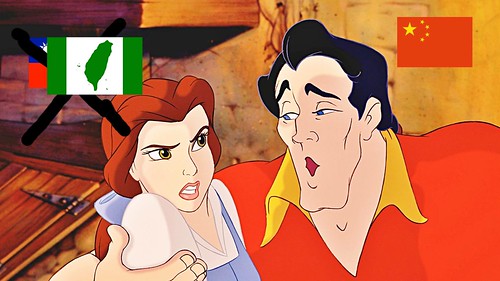
With that out of the way, I invite you to recall Beauty and the Beast, the animated classic that hasn't aged particularly well in terms of feminist themes. One thing that does strike me, though, is how Belle's worming away from Gaston without ever overtly telling him to just get bent - even though her disgust is palpable - flattering him even, when she shouldn't have to, as she removes him tidily from her home - is about as perfect a cinematic metaphor for the way Taiwan deals with China (at least when not under KMT rule) as any I can find. Faced with a bully and a cohort of villagers who aid rather than stop him from tormenting her, Belle (literally "beautiful woman") deals with him the only way she can, even though she deserves much, much more than some provincial life.

Consider this: when we watch that movie, we all like to think of ourselves as sympathetic viewers. At the very least, we want to think we'd be Belle's father or the kindly village bookseller. Nobody thinks they are just another villager helping a predator corner a woman who isn't interested.

Not to be too oblique about where I'm going with this, but if you replace Belle with Taiwan, Gaston with China and the villagers who abet his predatory behavior with literally the rest of the world - most of whom probably aren't even aware of the role they are playing - well...

Consider this as well: when we hear about real-life cases of men treating women badly, or of women simply being ignored or their concerns dismissed - their words not even really heard let alone considered - we like to think we're "the good guys" who are "better than that", who support women, listen to them and take them seriously. Sometimes we are. Often, though, we're just a bunch of casually sexist villagers who let perpetrators get away with cruelty.

Here's my point: we (by "we" I mean "other countries, including the West, and liberal thinkers around the world") want to think we're doing right by women, and we want to think we're doing right by Taiwan. In fact, we're failing both, and for similar reasons - the way the West dismisses women and the way it dismisses Taiwan have a lot in common. No, really. Hear me out.

Women have been historically treated badly in liberal circles (and in conservative ones too, but that's a different topic), from abolitionists who valued Black men's lives and rights over those of any (including Black) women's to the Civil Rights movement to the LGBT rights movement. (Even today, women's rights leaders' historical legacies are called out, and rightly so, for their white supremacy, but Black and abolitionist leaders' legacies are not called out for their sexism).  For a movement that exhorts women to join because their views are best aligned with feminist ideology, they just haven't been too great to the female gender.

Considering the issues facing women often requires a level of abstract thought that people don't seem to want to engage in. Not only are women not a small, homogenous group, it's also that the issues facing us express themselves differently depending on background and context, and connect in unexpected ways. Here's an example: to really understand what women face, you have to consider things like the relationship between the wage and achievement gap at work and sexual harassment in the workplace - two related issues that nobody seems to have put together until recently. Thinking in this way, connecting these kaleidoscopic issues, is daunting and unappealing. It requires standing up for what is right, even if the "right" values are abstract with abstract benefits, whereas there are clear real-world incentives to stay in the good graces of the old boys' clubs.

Maybe, for a lot of people, it's just easier to be dismissive - to not listen, or pretend the problems we face don't exist.

Professional connections matter - money is money - and men's stories are told louder than women's. And it's easy not to hear voices that are not given space to speak out by dominant narratives.

Liberalism has been just as unkind to Taiwan. From valuing peace over justice (especially abroad) to creating false equivalencies between divergent value systems to not even realizing that there are gaps in Western education on Taiwan to believing narratives spun by non-experts in the media, we've created a belief system that excuses and apologizes for Chinese Communist brutality and dismisses - either by explaining away or not listening to - narratives from Taiwan. After all, they're all Chinese, right? We've insisted on diversity and respect in our own countries while flattening the other half of the world into the image the Chinese government wants to promote, and we don't even realize we're doing it.

In short, we treat Taiwan the way we treat women. That is, like garbage.

Thinking about Taiwan requires a similar level of abstract thought - it necessitates understanding a complex history to the ins and outs of identity among people who, from 10,000 miles away, "all look the same" to the average Westerner (though most would never admit it). It requires not only understanding KMT and CCP history, but also understanding indigenous, local, Southeast Asian and Japanese history as well as the identity issues behind home rule and de jure independence movements. It requires looking beyond economic incentives and the dominant narratives peddled by China about culture, identity, history and what is rightfully theirs. It means acknowledging that, although there is some relativity between cultures and some things that cannot be compared and ought not to be judged from a Western cultural lens, that there is also a line between right and wrong, and winning doesn't always make one right. It requires deciding to stand up for what is right even when there are clear incentives to selling Taiwan out. Abstract notions such as self-determination, self-identification, freedom and democracy may not be as straightforward as the clear world of business and trade, but their absence will manifest in very real ways if Taiwan loses this fight.

But money is money, and China is very loud - it's easier for a lot of people to explain away Taiwan. To dismiss it, if one is listening at all. After all, it's easy not to hear voices that are not given space to speak out by dominant narratives. 

Of course, if Taiwan is the feminine that we dismiss, ignore, ask to supplicate because it's easier than angering a large, powerful country, then of course China is masculine. And it is - it controls the narrative, it has the voice (and it just will not shut up), the muscle and the money. Not to get too Daoist because I'm not into religion, but if Taiwan is yin, China is very, very yang.


This idea of China as masculine (and dominant) and Taiwan as feminine (and ignored or unimportant) isn't a new concept. In Taiwan's Imagined Geography, Emma Teng devotes a whole chapter to conceptualizing Chinese thought (in the time period she covers, although it's just as true today) as "masculine" - Confucian, patriarchal, and often consciously so - and perceptions of Taiwan as "feminine". That is, an "Island of Women" where many indigenous tribes had matriarchal, matrilineal, uxorilocal practices and often had female chiefs. This was also a common conceptual device to link Chinese culture to being morally upright, powerful, and civilized, and Taiwan to being barbaric and - although Teng doesn't say this directly - weak.


Despite a brief interlude in the worst years of the 20th century, China has more or less upheld this domineering patriarchy, this masculine hermeneutic (can I use that word that way?) as its driving national narrative, affecting business and politics.


IMG_0628
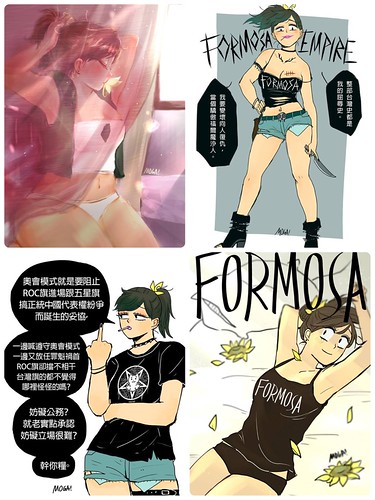
Images from Moga (魔魔嘎嘎) used with permission of the creator -


Go check them out, they do great work!

Taiwan, on the other hand, seems to have leaned into feminine self-representation. I don't have any decisive links for you right now, but consider how China talks about itself: 5000 years, Confucian values, strong country desiring global hegemony. Now consider how Taiwan talks about itself: the beautiful island. In one of my favorite comics, China is male, the ROC is androgynous, and Formosa is a voluptuous woman. I will also point out something that struck me recently as I thought about the subtler themes in Shawna Yang Ryan's Green Island. While the protagonist's father (representing Taiwanese political ideology, including notions of freedom and sovereignty) was absent for a portion of the novel and never really recovered from his incarceration, her mother (representing the land of Taiwan, including home and family) was always there. It's not offhandedly that, as a young woman, that same mother quotes Du Fu, saying "國破山河在" - the country is broken, but the mountains and rivers remain.

It is not a great leap to see that, despite China's talk of two sides of one family "reuniting" (huge barf on that link, by the way), in fact, it wants to be the domineering patriarch, forcing Taiwan into the role of feminine supplicant. It wants to be the controlling husband to Taiwan's obedient wife.

It doesn't take much to further leap to the realization that, if China is masculine and Taiwan is feminine, the West is treating them exactly as we treat the genders. We listen to China. We give them space. We try not to upset them, and respect their feelings even when they are disingenuously upset or being blatantly unfair. We try to explain away their worst behavior. We treat them the way we treat men.

And Taiwan? We treat her as we do women: we ask her to take up less space (by literally giving her less diplomatic space). We ask her to keep China calm, to bend and contort herself - whatever it takes to keep that man happy. His happiness is key - her discomfort is not important. Whether or not it's fair doesn't matter, and the more abstract problems beneath this remain unexamined. When Taiwan tries to speak up, we get annoyed, because what she says might anger Big Man China. It's much easier if she pipes down - after all, why does she have to be such a bitch anyway? So shrill. Doesn't she see this would all be easier if she just stopped making trouble?

China just likes you, Taiwan. He just thinks you're cute. It's a compliment, jeez, can't you take a compliment? You should smile more, Taiwan. He doesn't mean to be sexist, that's just how China is. I know, I know, but just be nice. You catch more flies with honey, Taiwan. God, Taiwan, why do you have to be so difficult? So many countries have it worse than you. Why not just give him a chance?

(American) Conservatives are just as bad about this as liberals, by the way. They are often, though not always, more pro-Taiwan than their liberal counterparts, but it has more to do with Masculine America challenging Masculine China for dominance in Asia. It's two chest-thumping men fighting over a beautiful island woman as a projection of their influence and power. Or, considered another way, their support of Taiwan is almost always translated as support of the Republic of China - just another masculine, militaristic power structure. Buddies protecting buddies. Bros before hoes. (In this metaphor, the US and the KMT are bros, local Taiwanese independence movements are the...you get the point).

It's not about Taiwan - the feminine Formosa - at all.

We quite literally dismiss and ignore Taiwan the same way we ask women to keep quiet and push them aside.

In other words...

And for once it might be grand
To have someone understand

I want so much more than they've got planned...

Monday, February 12, 2018

Lurid Pink Pomegranates

27858548_10156145023086202_2604172009836362523_n
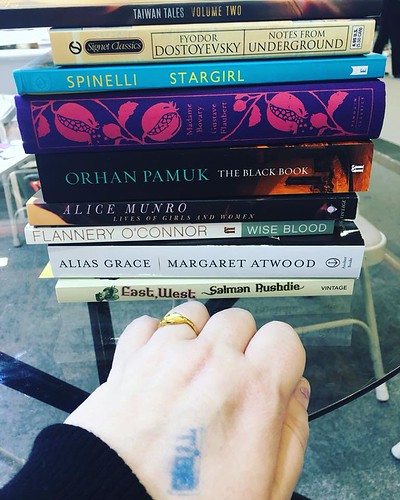
My haul from the 2018 Taipei International Book Exhibition


Just so you know, this story has very little to do with Taiwan, though it comes around in the end. 


I started taking a greater interest in my parents' bookshelves in high school. They were voracious readers and book collectors, and had some fine and rare editions, but also quite a collection of paperbacks from the 70s that browned by half a shade every year. You could have measured my age by their wear and coloring.

Bored with homework - I never really did it, it just didn't seem necessary - I idly picked up a dusty copy of Madame Bovary one afternoon and slid right into a world of century-old female dissolution.

Two things were true then. The first was that I was a broad-shouldered, wide-hipped teenage girl: not fat (then), but certainly not lissome. You could tell I was either going to grow up to be strong and intimidating, or soft and...not. (I like to think I ended up being soft and intimidating, personally). I wasn't pretty, but I was outspoken, nerdy and weird. Sort of like now, but less refined in how I channeled that energy.

The second was that I obviously knew what sex was. I'd read quite a few dime-a-dozen romance novels just for fun. The ones from the library one town over, of a slightly higher caliber (better sex) than the ones that cost $1.99 at the supermarket. But, especially as you'll be shocked to hear that I didn't exactly have a parade of boyfriends in high school, I knew nothing of sexual politics - who and what society calls degenerate and why, gender-based power and subjugation, all of it - or sex and the human condition.

What I mean is, big girls from small towns tend not to know a lot about the world.

As you can imagine, I drank the sweet, sexy French corruption of Madame Bovary as I emerged from the worst trials of the gauntlet of puberty the way a small-town athlete slugs Coke after a match.

Soon after I began reading, at school we were tasked with an open book report: find a book we'd like to read - any book - and write about our impressions of it. I was already reading Madame Bovary, so I decided I may as well write about it. My English teacher didn't object, but he did call my parents. A small high school in a small, almost entirely Catholic town? She wants to read a book that doesn't exactly scream Family Values? Best to check.

I was in the room when Mom took the call. "Yes, we know. She's already reading it. Yes, of course she can. She can! She got it from us!... Hah! Thanks for checking, but what kind of people do you think we are? Do you think we're..hmph...parochial?"

And that's how, as my classmates stole their dads' racy magazines (this was in the nascent years of the Internet, before we all looked for porn online), I ended up writing an ear-reddening book report about 19th century French smut.

Except it wasn't really smut.

More obtuse readers might mistake Madame Bovary for a morality play, in which Flaubert sits in judgment of the spiraling depravity of a convent-educated beauty who could not accept a simple, clean country life. If that were true, it would have been read and tossed by a bored big-hipped girl from a small town without a second thought. But no - Flaubert was well aware of the limitations women faced in his day, and how that could lead to a woman venting frustrations she couldn't even communicate to herself let alone to those around her by making a series of escalating bad choices. It was quite possibly my first encounter with a man who understood this, and was sympathetic. Of course, it took years to really sink in.

It struck me how it was never made clear whether Emma Bovary was highly intelligent or just an average person who fancied herself high-minded: as it was with all women, her intelligence was just that irrelevant to her life, her marriage and her social environment. It also struck me that the issue was never that she couldn't accept her lot, but that she was never able to seek a life that suited her.

As I grew up and moved away, I had more opportunities than Emma Bovary and took them - and yes, privilege played a role in that. I am an educated middle class white girl after all. In any case, I refused to apologize for my more libertine tendencies - why should I? After all, cheese is available - and when I encountered a person or force trying to limit me, remembered Ani DiFranco's old nugget o' wisdom, which Emma herself might have expressed if she'd been better equipped to do so: you may be able to keep me from ever being happy, but you're not going to stop me from having fun. (Hey, it was the late '90s).

And that is how a work of 19th century French smut which wasn't really smut likely influenced my decision to eventually move to Taiwan. The alternate-universe girl who didn't see a future version of herself in Madame Bovary if she didn't insist on something better is probably not very happy.

And that is how I found myself buying an expensive hardcover edition at the Taipei International Book Exhibition, which ended this past weekend. I took one look at those lurid pink pomegranates on the binding and thought, "hey, I have lurid pink pomegranates on my binding, too!"

What I mean is, that book is a part of my formative years. And I ought to own nice editions of the books that have influenced me.

Sunday, February 4, 2018

Re-learning Taiwan

IMG_0283When you think of tourism in Taiwan - domestic and, to some degree perhaps, international - you probably think of at least a few of these:

- Night markets
- Old streets
- Local crafts (e.g. woodcarving or porcelain)
- Regional foods (e.g. 肉圓 in Zhanghua and mochi in Hualien)
- "Taiwanese" culinary cultural icons (think the toilet restaurant and bubble tea)
- Shopping and eating in Taipei, including the massive ATT4Fun and eslite
- Hiking, cycling etc.
- "Cultural creative parks" like Songshan Tobacco Factory and Huashan
- The National Palace Museum
- Tourist destinations like Jiufen, Alishan, Sun Moon Lake, Tainan, Kenting and Taroko Gorge
- (Maybe) Chiang Kai-shek Memorial Hall
- Indigenous festivals and dances
- Temple festivals

Some of these are great - Tainan is unimpeachably fantastic, though perhaps growing a bit gentrified or at least on the cusp of it happening - and the outdoor sports are bar-none amazing.

For the rest, though, slowly and steadily most of the pleasure I might have once been able to derive from them has been chipped away over the years as I seek to learn more about Taiwan.

Night markets are still kinda great, but a lot of the "famous" foods are made famous by savvy promotion rather than actual deliciousness, and with the piling on of food scandals over the years, I can never be quite sure that the snacks I'm getting are safe to ingest.

I appreciate the attempt to preserve the architecture of Taiwan's old streets - and some still do a reasonably good job of this (Hukou, Xiluo and Xinpu are still quite nice, and Dihua Street is still on the right side of fun, although I worry the scales will tip). Yet, a number of them have been turned into shopping drags selling touted "local delicacies" and shop after shop of "traditional items" (think old-fashioned kids' toys and wooden massage implements). They're basically all the same, nothing local or special about them.

Those local crafts? Well...I can't say I'll be buying any Taiwanese wood products or returning to Sanyi anytime soon. And Yingge sells some lovely ceramics, but historically was more known for making bricks, not fine vases.


Regional foods? Michael Turton has already covered that minefield:

All over Taiwan, if you say a city name, like Changhua or Hsinchu, people associate a food with it automatically (ba wan and mi fen). Even foreigners know many of these associations. This attitude is common in Taiwan, but it is rare in the rest of the world....

Why? It’s political, of course. In most countries tourism consists of local history and nature. I grew up in Michigan, where we visited the Upper Peninsula and state parks for nature, and local battlefields and forts for history. No one ever suggested that the state’s prodigious cherry production should be its key association. But in Taiwan, the food association functions to keep locals from associating places with their history, and thus, developing associations with local history that in turn would support and build local identities… Hence, in Taiwan, local domestic tourism is not historical tourism, but food tourism.

I'll add to that some ethical issues: I love bluefin tuna, but...well...hmm. Okay maybe not.
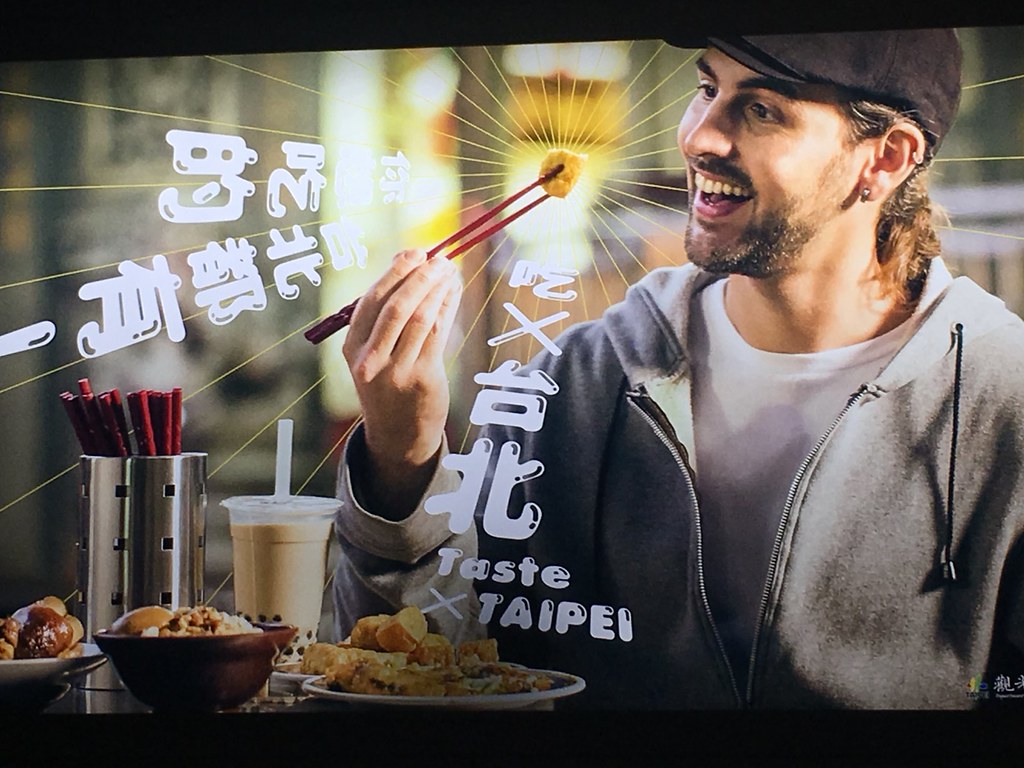
All I gotta say about the toilet restaurant is UGH not the toilet restaurant again, and I do like bubble tea but the aforementioned food safety scandals make me a bit wary of it. Also, it's way too easy to weirdly exoticize it as some Mystical Eastern Thing that Asian People do that Civilized Countries Have Just Discovered.

IMG_5914
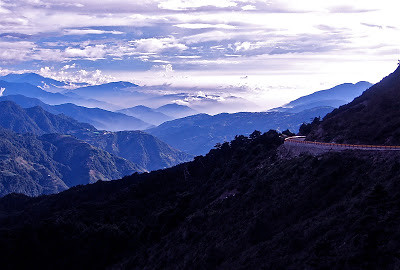
Hehuan Mountain is gorgeous - and not on the list of "famous tourist sites" in Taiwan
(sorry for the low-res photo, I took it years ago and had to gank a low-quality copy from a previous post)

Let's machine-gun through the rest of that list quickly.

Shopping in Taipei? Eslite is a huge international company, not a plucky local chain (and frankly their selection of English-language books tends towards the pedestrian, and they have a weirdly tiny selection of English-language books about Taiwan). Those Xinyi malls? I've been complaining for years that good local street-side restaurants that give Taipei its atmosphere are being gobbled up into one massive East District food court, and I do not like it one bit. For example, Opa Greek Taverna was great. Then it moved to ATT4Fun, and it's kind of terrible. We never go anymore. The Diner was a lovely place in a lane of Dunhua Road with some outdoor seating (there is still one on Rui'an Street but little-to-no outdoor seats). Now it's a big restaurant in a mall. Blech.

Those "cultural and creative parks" are pretty corporatized and rarely house the most innovative artists in Taiwan. Songshan, for example, has a Liuligongfang (or at least it used to - I haven't been in awhile and it may have closed) and is bordered by yet another eslite.

ALL THE STUFF IN THE NATIONAL PALACE MUSEUM COMES FROM CHINA IT'S NOT EVEN TAIWANESE UGH. 

(I mean it's fine to visit if you are interested in Chinese history but don't go there thinking you are going to learn about Taiwan. I generally don't recommend it to visitors who are interested in Taiwan, only those who are primarily interested in China.)

And I don't even think I need to tell you what the problem is with Chiang Kai-shek Memorial Hall.

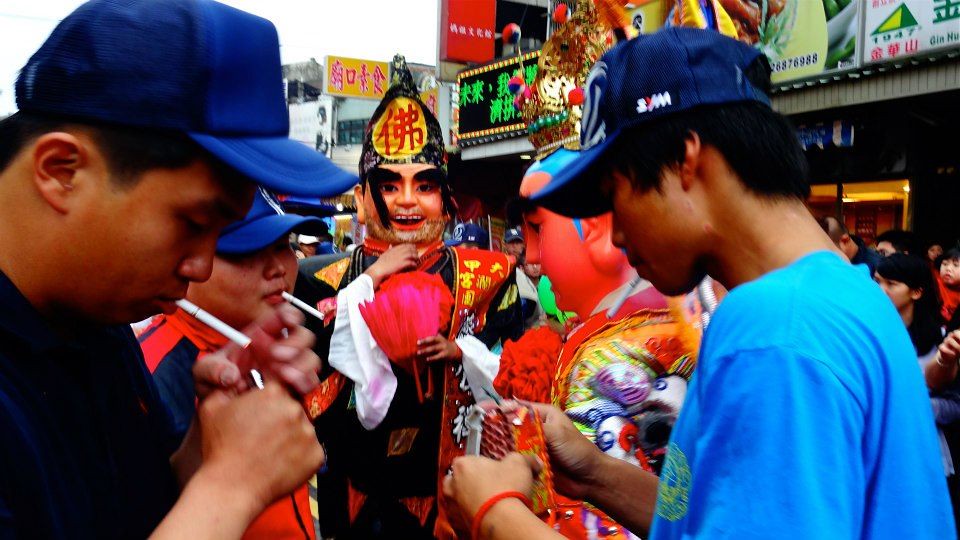
Temple festivals? Watch out, it's not always what you think.

And are you really sure you want to go to an indigenous festival where you might not be welcome, to see performances by tribes who have been unfairly historically stereotyped as good at three things: singing, dancing and drinking?

And almost all of the famous tourist destinations listed above have been disfigured by tourist infrastructure, with Sun Moon ****ing Lake being among the most degraded. From one side you can't even see the lake from most parts of the town unless you stay in one of the expensive - and often not very good - hotels ringing it (the good ones are very expensive). Taroko is still beautiful, but marred by controversy and a very ugly cement factory with its management that has very ugly morals. Jiufen has lovely views but is so blighted with tourists that it can be difficult to enjoy these days. 

936483_10151630122296202_673257132_n

* * *

So where did that leave me, once I came to these realizations? That everything I liked about Taiwan was a sham? That Taiwan has nothing of interest for tourists? That everything good about Taiwan was invented to keep the country from discovering its real roots?

No.

I was depressed for a time, once it really hit home that so little of what is commonly touted about Taiwan actually embodies Taiwan's strengths, and much of it has been co-opted by forces I'd rather not encourage (like the encroaching uniformity of the old streets and the ghastly tourist infrastructure in scenic spots. I figure themed restaurants aren't hurting anyone). It can be hard to take, learning that things you thought you liked had all of these layers of complexity and undercurrents of problems that make them difficult to keep loving.

I had to tear it all down to build something better - because this country has so much more to offer than sun cakes and Sun Moon Lake. I had to quite literally re-learn Taiwan so I could talk about it for what really makes it great, not just the tourist hype that is so often riddled with problems.

I won't tell people not to go to Taroko or even Alishan (I will generally advise against Sun Moon Lake but if a tourist chooses to go, they might not have an awful time), but I will recommend they go not just to Tainan - god I love that city - but to direct their attention to the national parks, the East Rift Valley, relatively quiet areas of natural beauty like Hehuanshan, Lishan, the Taoyuan grassland/Wangkengtou/Caoling Old Trail part of Yilan, and of course Taiwan's stunning outlying islands. I haven't been to Green Island yet but Matsu, Kinmen, Lanyu Island, Penghu - I love them all. I'll send them to the eastern coast of Pingdong and down to Cape Eluanbi, but have them avoid Kenting itself (there are better beaches anyhow). I'll send them to Lukang, which still has something of a small-town feel, or to explore the smaller towns of Hsinchu county by car. I'll only bring them to Jiufen on a weekday, and if we go I'll insist we hike up to the Japanese shrine above Jinguashi ("yeah you thought Taiwan was Chinese but this ain't Chinese at all"), or approach the town from the Xiaotzukeng Old Trail.

There is so much to see and do in Taiwan - take it from me, someone who's done a lot here, and yet has never actually been to Alishan - that you can have a fantastic time even if you don't go to Sun Moon Lake or buy mochi in Hualien. (Feel free to buy taro cakes in Dajia, just make sure you go to the smaller shops and get them fresh from the oven, stay away from the prepackaged ones which are...fine.)

And it's enjoy the food - just enjoy it for its own sake, eat good stuff where you find it, without buying too much into the "local food as local identity" hype. Some foods really are local - you aren't going to get better milkfish congee than in Kaohsiung, and you can't beat eel noodles or shrimp roll rice in Tainan. You just can't.

I'm still not sure how to promote this Taiwan - the Taiwan I re-learned - to the world. International tourists are more into things like the National Palace Museum than, say, an architectural history of Taipei or learning about Taiwan's vibrant civic engagement, not to mention what Taiwanese history and current political issues have to teach (and warn) the rest of the world. It took years of ripping away beliefs instilled by tourism promotion to see what makes Taiwan worthwhile, a dedication visitors generally don't have (though the number of visitors who come for awhile and end up staying is surprising. We all know that person who'd planned to come for a month and backpack and now lives here full-time, or the one who came to "teach English" [heh] for a year or two and move on who is still here a dozen years later...ahem.)

But now that I know what I've re-learned, I can certainly try.