Saturday, August 25, 2018

The Good, The Bland and the Authentic: A Hakka Stir-Fry Journey

39978163_10156672844911202_2177125141455044608_n


Months ago, I picked up Cathy Erway's The Food of Taiwan, cooked a bunch of my favorite Taiwanese dishes from it, and wrote about the experience. I structured it as a discussion of how it feels to be a foreigner who calls Taiwan home improving her ability to cook Taiwanese food, but also of what makes a Taiwanese dish both "good" and "authentic". Something might be "good" but not taste particularly like a dish as it's usually served in a region (for example, I like the Taiwanese take on ma po doufu 麻婆豆腐. I think it's good, but it doesn't taste anything like what I used to eat in Guizhou and Sichuan). Or, something might be "authentic" - maybe your 92-year-old Hakka grandmother in Yangmei made it - but, as I noted to a friend, not everyone's Hakka grandma is necessarily a good cook.

Of course, the best dishes tend to be both: they're deeply rooted in their places and cultures of origin, and also made well.

I also considered the tendency of Westerners to have endless variations of their own food, while thinking food of other cultures only had one "correct" form, and any deviations from that particular way of preparing it were somehow "wrong" and "inauthentic". Of course this isn't true. Different cooks across Taiwan cook the same dishes in slightly different ways, just as cooks might do from Ohio to Iowa.

With that in mind, I want to return to the Hakka stir-fry (客家小炒) recipe in The Food of Taiwan. There was a discussion on this in the "books about Taiwan" Facebook group I manage about the various aspects of the recipe, and also on my personal page. I complained about the inclusion of carrots and the lack of garlic greens, the lack of rice wine, the way the pork belly was sliced (not into matchsticks as is common in Taiwan, but into slices and pre-cooked), and the lack of specification about the squid, which it is implied in the recipe may be fresh squid. And, I'd like to add, the sparing use of "light soy sauce". Some of my friends - all Hakka - were horrified. Other commenters thought this recipe would make it easier for non-Taiwanese and those not in Taiwan to make a version of the dish, and it was therefore fine.

To me - caveat: someone who is very much not Hakka - this just doesn't produce the Hakka stir-fry I've eaten in Taiwan. It just...doesn't. Maybe it's "good" (I made the recipe, I thought it was...fine. Totally acceptable) but it didn't strike me as at all "authentic". It just wasn't the lip-smacking, flavor-intense dish of greens and chewy matchsticks of tasty pork, tofu and squid that I've come to know and love.

Of course, there's an added issue when you're not just a non-Hakka cooking Hakka food, but a non-Taiwanese cooking a Taiwanese dish. I know I can cook good food, but if I'm going to fry something up and call it authentic, it has to really taste authentic. There is less space for me to spin my own variation on something and call it "Hakka stir fry" (or anything Taiwanese that I might make). If I change things up too much, but claim to be making a particular food from a particular place and culture, I not only become culturally appropriative (not appreciating the host culture) but also forfeit any claim I may have to seeking to better understand Taiwan through learning how to make this food with my own hands.

So, last night, I decided to try again. Instead of using Erway's recipe, I just grabbed the first search result off iCook, just to see how it played out. I cribbed a few of the better elements of Erway's recipe: the use of ginger and chili bean sauce. Hakka friends had told me these were acceptable flavor enhancers and I thought they worked well. I also cooked up the ginger, garlic (not garlic greens) and white parts of the scallions in a little oil before adding the pork.

I also soaked the dried squid in Shaoxing rice wine (紹興酒) with a little water added because that would otherwise require a LOT of Shaoxing wine rather than water, because that's what my friend says his Hakka wife's family does. That's pretty legit.

Notably, this recipe called for matchsticked pork cooked in a wok (not boiled), thick soy sauce (醬油膏) rather than light soy sauce (add the chili bean sauce at the same time if you like), sugar, reconstituted dried squid rather than fresh squid, garlic greens along with the celery and scallions, and rice wine. And absolutely no carrots.

I stuck mostly to the iCook recipe to see if it would produce a Hakka stir-fry that was both "good" and "authentic" - and you know what? It did!

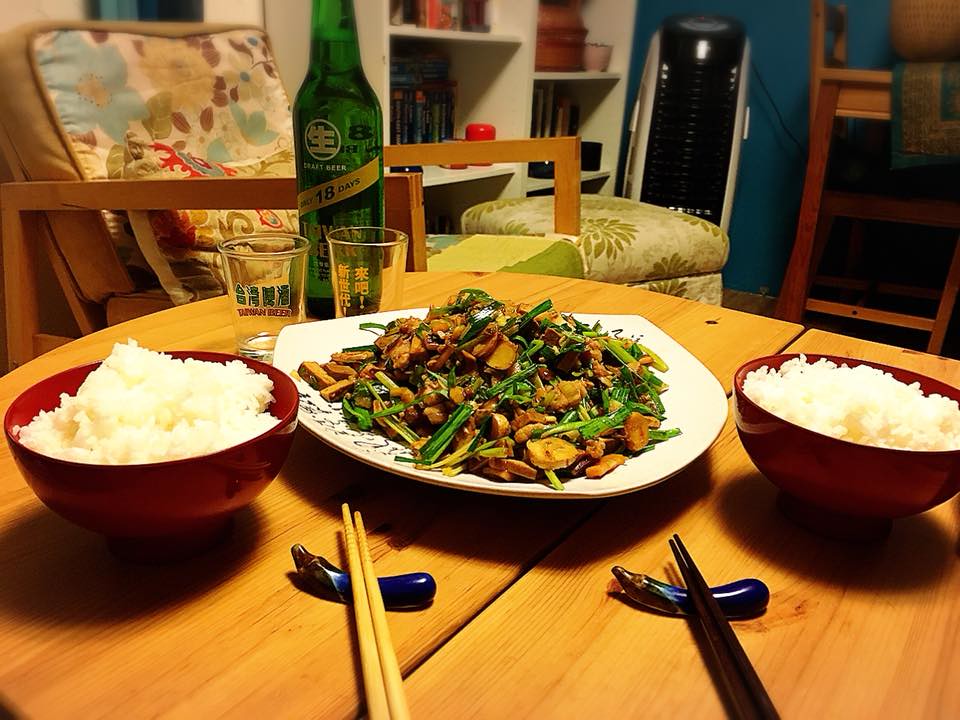
39981538_10156672844906202_3757115778541813760_n

Looks pretty solid, no? This not only tasted great, but tasted (and looked) like something I'd get in an actual restaurant in Taiwan.

Contrast that to the result of using Erway's recipe (though I didn't quite follow it - I did use dried squid, I did matchstick my pork, and I did use garlic greens rather than carrot because I have principles). Same "food photography" filter, same level of photo editing:
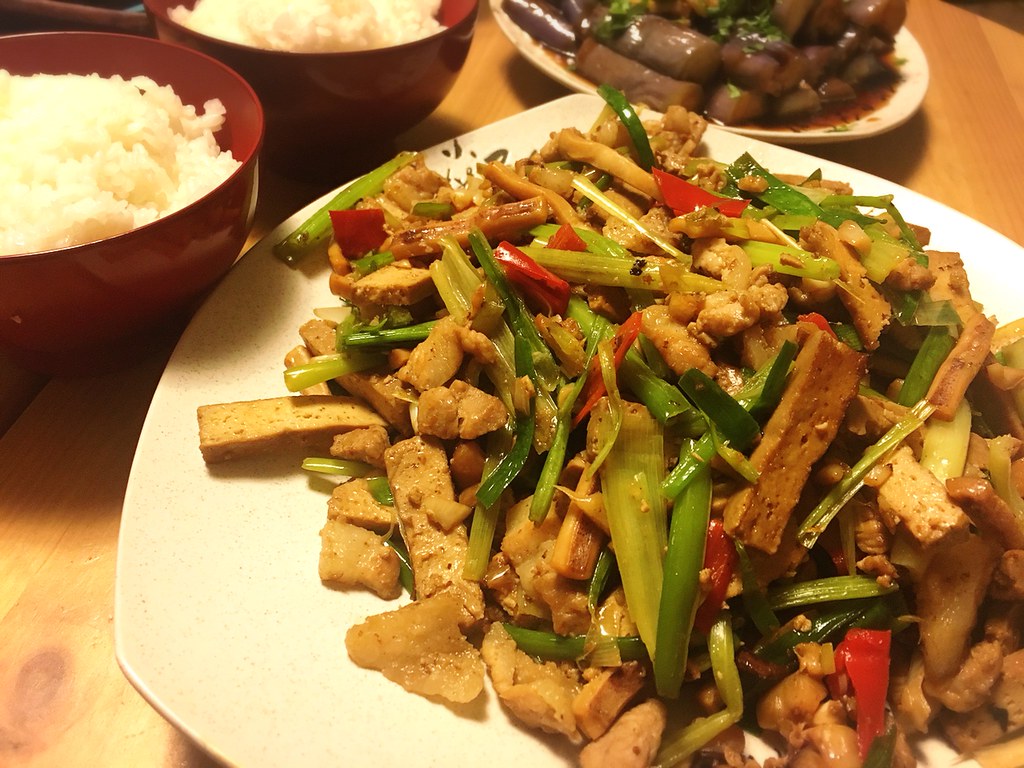

IMG_2092


Seems fine, right? But it was a lot blander. It didn't have that thick coating of slightly sweet, soy-based deliciousness tinged with the subtle enhancement of rice wine that the stir-fry I made last night did.

Now, that's not the end of the story. That friend's Hakka wife, from Miaoli? Her family apparently fries up each ingredient separately "to make sure each one is cooked to the peak of fragrance and texture", and doesn't use dried tofu (though she concedes it's an acceptable addition. I happen to like it.)

She's actually Hakka - her version is certainly more "authentic" than mine. And though I've never tried it, I can be pretty damn sure it tastes better, too. I don't believe there's anything genetic about cooking: one doesn't get to be good at cooking Hakka food just because one is Hakka, but I didn't grow up in that culture. I didn't eat this dish as a kid. My family doesn't run a restaurant in Miaoli. There's a lot of experience-based knowledge that I can't have. I accept that.

In the end, though, I can make a pretty okay Hakka stir-fry too, and I do think there's a "way" to do that where "good" and "authentic" intersect.

I am a firm believer in seeking to understand other cultures (not appropriating them), and I appreciate it when certain cultural knowledge - like how to cook commonly-served dishes - is made accessible. I don't think I have to be Hakka to make Hakka stir-fry, or Korean to make kimchi, or Mexican to make flautas (though I'd hesitate to attempt to make a profit doing so). But, if we're going to seek to understand through cooking, we do have to at least attempt to produce the real thing. No carrots, no long slices of pork, no fresh squid, no light soy sauce. Otherwise, we're just making stir-fry and pretending it's 客家小炒. We congratulate ourselves, but have learned nothing.


Here's my full recipe for White Lady Makes Hakka Stir-Fry: 

1 pack of pork belly (五花肉)from the supermarket, sliced into matchsticks (I never get up early enough to go to the traditional market)
3-4 scallions (青蔥) , white and light green section sliced, green sections sliced into thin matchsticks
1 large garlic green (蒜苗) - white bulb section sliced, green sections sliced into matchsticks
1-2 roots (which have several stems) of Chinese celery (芹菜), de-leafed (though you can chop and add the leaves too) and matchsticked
1 pack dried tofu (豆乾), cut into matchsticks
1 dried squid (魷魚乾), soaked in Shaoxing wine (紹興酒) with a little water for a few hours or overnight, with tentacles, sliced up into pieces about the same size as the pork - cut against the grain so it won't curl up when stir-fried
2 cloves garlic (蒜頭), chopped
1 thumb of ginger (薑), in coins
A little neutral-tasting oil (沙拉油) - don't worry about using a little. The fat from the pork will give the dish a satisfying oiliness
1-2 tsp sugar (to taste) (糖)
2 tbsp thick soy sauce (醬油膏) - this is the secret to getting the sauce to stick to the meat/tofu
2 tbsp chili bean sauce (optional) (辣豆瓣醬)
1/4 cup rice wine (米酒)
powdered white pepper to taste (白胡椒粉)

Cook up the garlic, garlic green bulb (the white part), white part of onion and ginger in a little oil until fragrant. (I use medium gas, which would be high on an electric stove.)
Add pork and cook until pink disappears
Add tofu and cook for a minute
Add squid and cook for a minute
Add rice wine, toss
Add thick soy sauce, sugar, white pepper and chili bean sauce, toss till well-coated and it starts to stick to the meat/tofu/squid
Add all remaining greens, cook briefly until slightly wilted

Serve immediately over white rice.

Boom! Done.

Thursday, August 23, 2018

A little light sado-masochism: my eyes are bleeding

Masochism because I read this despite knowing what was inside, sadism because I'm sharing it with you.

Inside a fairly innocuous article about reducing scooter emissions on a niche website few people read,  among other wonky English ("Taiwan praises itself to have the highest motorcycle density in the world?" Okaay), we get this (emphasis mine):


Different from other countries that plan to introduce a ban, Taiwan that officially belongs to China, does not only intend to block more fossil-fuelled vehicles from taking to its roads but has effectively written the proposal into law already.


AAAAAAAAAAAAGGGHHHHHHHHHH UUUUUGGHHHH MY EYES MY EYES THEY'RE BURNING MAKE IT STOP. 


Okay. Whew. So.

What's interesting to me about this is that the source material, a thin wisp of an article on Xinhua, doesn't even use this language. Content creator Nora Manthey added it in for literally no reason at all, except to be a jerk to Taiwan I guess.

Also, "officially" according to whom? Who decides what's "official" for the entire world? There's China's claim, but that's limited to China. What is "official" about this, and who are the officials in question who say so? Where are their offices?

That's what worries me: even in these little articles on niche industry websites on totally unrelated topics, even when Chinese state media which is obligated to be anti-Taiwan - as it's controlled by the Communist Party - doesn't put language like that in articles that are used as source material, even when it's just a totally innocuous thing where the content mill worker has no reason at all to include such language and probably has no political position him/herself on the issue, this crap still ends up in articles like this. 

I truly have no idea why. Any thoughts? Anyone?

I don't even have to tell you that Manthey is wrong, if you're reading Lao Ren Cha, you already know that. But just in case you didn't:

The status of Taiwan is undetermined. Under pretty much any interpretation of international law this is the case, and a case can also be made that it is sovereign (it has its own government, military, currency, contiguous territory etc.) The series of treaties and agreements following the end of WWII did not put to rest the status of Taiwan; the only ones that explicitly refer to it as belonging to China (such as the Cairo Declaration) are non-binding. Major powers do not recognize China's claim on Taiwan, they merely acknowledge that the claim exists (this is a common source of confusion). I could go more into the history of this issue - e.g. Taiwan's status 1945-1949, the Japanese colonial era and the treaty that put that into motion, Taiwan's status as a colonial holding of the Qing - but I don't need to.

You know, just in case ya weren't already aware.

Tuesday, August 21, 2018

So, who cut ties with whom (and why)?

I know, I was going to continue my previous post, but this came along, and I can't resist.

I generally avoid commenting on which checkbook ally has cut ties with Taiwan on any given day, because it's always the same story, and never a very interesting one. These allies not helpful in any way that matters to Taiwan - are they going to stand with us if China invades? (No.) Are these countries our biggest trading partners? (No.) Does Taiwan stop being a de facto independent state if it has no diplomatic allies? (No.)

But even more problematically, they recognize Taiwan in a sort of "what is the real China" decades-out-of-date death dance in which they're only recognizing Taiwan as the legitimate sole government of China. Which it isn't.

So, generally speaking - whatever.

But El Salvador is an interesting case. Why?

El Salvador hadn't abandoned Taiwan yet. It asked Taiwan for "an astronomical sum" of financial aid, and Taiwan cut ties with El Salvador. 


Of course, that's not the whole story. I'm sure there was a competing offer from China. I don't know what that offer might have been, but friend of mine pointed out that there was a delegation from El Salvador in Beijing not long before this happened. "It was known" that this was where things were going. So, Taiwan took the only step available to it.

And it did so for good reasons (the headline sucks - we'll get to that later): El Salvador wanted money for a port project that Taiwanese engineers deemed infeasible (and which Chinese companies were, from what I hear, bidding for), Taiwan is worried about developing countries' debts to China, and apparently the ruling party wanted funding from Taiwan to help it win elections, which is a story so slimy you could break a leg trying to navigate it. And, of course, Taiwan just doesn't want to play dollar diplomacy any more.

Beijing or no Beijing, these are actually very good reasons to say goodbye to one's allies. And Taiwan at least tried to at least seem as though it made the call. 


In that light, assuming the story coming out of Taiwan about this "astronomical sum" is true, this looks a lot more like blackmail than diplomacy. I applaud Taiwan for not playing that game.

That's the real story here - people have asked, every time we lose another ally, whether it really matters. The government has just given its answer: it doesn't. It knows that if Taiwan is going to defend itself against China, it won't be because a few, as one person put it, "statelets" recognize Taiwan. It will be defended if it can keep up the morale of its own people to be willing to "stand on a hill with a gun" and fight for it, bullet by bullet. It would also help if the international community saw it as worth defending regardless of who recognizes it.


So let's look at some of the, um, "journalism" this particular severance has generated.

First, we have the one - one! - article that at least gets the subject and object right: "Taiwan Cuts Ties With El Salvador", though of course (being Focus Taiwan) it doesn't tell the whole story. It can't. 


Then, we have a piece by Lily Kuo (reporting from Beijing - couldn't they have handed the whole piece to the guy who is actually in Taiwan?) with the headline:

 "Taiwan Further Isolated As El Salvador Switches Allegiance To China"

...leading everyone who didn't read the article (that is, almost everyone) with the impression that the same old narrative was playing out, and Taiwan was sitting around with its thumb up its butt looking on stupidly as yet another friend ran away.

If you read the article - which I did - it does note fairly early on how things actually took place:


Taiwan’s foreign minister, Joseph Wu, said on Monday that Taipei had terminated bilateral ties with El Salvador and was recalling all staff from the country.

According to Wu, El Salvador had been asking Taiwan to provide an “astronomical sum” in financial aid for a port project that Wu said would leave both countries in debt. Meanwhile, Taiwan had received reports that El Salvador was considering establishing ties with Beijing in exchange for investment and aid.


This is solid. So why was the headline so misleading? Which unqualified editor thought such a headline was acceptable?

Unfortunately, the piece also includes this (stupid) gem:


Relations between China and Taiwan have reached a low under Tsai, who belongs to the Democratic Progressive party, which advocates independence for the island. Since her election, Beijing has ramped up efforts to poach Taiwan’s allies. Now, just 17 countries recognise Taiwan, after Burkina Faso and the Dominican Republic cut ties and recognised Beijing instead earlier this year.


Let's see, in this steaming turd heap of a paragraph, we have:

1.) An assumption that the problem with relations with China is Tsai, not China. Tsai hasn't done anything to foster tensions with China. China is doing everything possible to create tensions to hurt Tsai. No wonder her popularity is sinking - she's not perfect on the domestic policy front, but with garbage like this, people think she's riling up China, too - when her dealings with China are actually one of the strongest points in favor of her administration. People want a president who will stand up to China when it matters, but who will not rock the Chinese economic boat. For Taiwan, that is not possible, and China is playing that card hard.

2.) An implication that "advocating independence for the island" is somehow a bad thing, or that this, not Chinese bullying, is the real thorn in the side of Taiwan-China relations

3.) No redux of the actual story behind Taiwan's decision (which doesn't look good for Taiwan, but would at least interesting related information about what China was up to and the steps Taiwan took to deal with it more proactively. All we have are some "reports" mentioned above, and then a lot of information about previous diplomatic switches that, while useful to the non-expert, are tangential.)

These parts are a bit better: 


The latest diplomatic switch leaves Taiwan further isolated on the international stage as Beijing continues to put pressure on the self-governed island that operates under its own government, currency, and military. Beijing claims Taiwan is an inseparable part of China and will not maintain ties with any country that has formal diplomatic ties with Taiwan....


China has also pressured companies to take sides. This year China’s aviation authority demanded foreign airlines, including American Airlines, Air Canada, Lufthansa, British Airways, and Qantas to change any descriptions of Taiwan as a non-Chinese territory.


Sure, there is a lack of explanation of China's role in Taiwan's decision, leaving us with the previous half a sentence about some "reports" to lead readers to understand how the story goes from "Taiwan cuts ties" to "Beijing is trying to isolate Taiwan".

But, I will say that I appreciate that it moves away from the old "separated in 1949" nonsense; that's an improvement. It talks about Beijing as the main antagonist. Good.

Yet, as with most pieces, it goes on to talk about what Beijing wants, without talking about what Taiwan wants, only mentioning (above) that the ruling party "advocates independence for the island" - nothing about why the Taiwanese would vote in such a party (could it be that...they want independence too? Who woulda thought? Nobody outside Taiwan apparently, because they're reading such shoddy news reports.)

Nothing about why the DPP might advocate for independence to begin with. Nothing about why unification with China might be seen as a bad idea in Taiwan. Nothing about how all of these allies recognize Taiwan as "China", not as "Taiwan", and are not necessarily important allies. So, of course the rest of the world has a skewed view of what's actually going on here.

I won't bother digging into the trash heaps of the other articles, but here are some headlines just to show you how skewed the story the West is hearing really is:

El Salvador Breaks Ties With Taiwan To Favor Beijing (wrong subject/object order, guys)

El Salvador, Taiwan Break Ties As China Isolates Island Foe (Taiwan isn't a foe of China - China is a bully to Taiwan. In any case, why is Beijing treated as a lead actor in this story?) - with the same headline in the Washington Post, which includes some useful information alongside the same old 1949 nonsense, and a paragraph about Xi Jinping's ambitions that are only tangentially related to the real story.

Taiwan loses third diplomatic ally this year as El Salvador breaks ties (again with the subjects and objects. You could have told this story in a way that acknowledges Taiwan's proactive choice, while still noting that it was forced into that choice, rather than pretend it sat by passively.)

Channel News Asia starts with an okay headline (Taiwan Says Breaks Ties With El Salvador), only to dive deep into the trash pile in the actual article.

Internationally, outside Asia, only the Wall Street Journal gets it right:

Taiwan Cuts Diplomatic Ties With El Salvador

So now, thanks to poor reporting, we have the rest of the world thinking Taiwan is passively letting itself be eaten away, when in fact, Taiwan is trying to flip the table on this tired story. It's doing so in a weak way, playing a weak hand, but it's trying nonetheless. It matters that despite being pushed into this corner, Taiwan is trying to at least seem more proactive about it, but nobody is listening.

Even when Taiwan tries to change the narrative others have forced on it - however imperfectly - it gets pushed down. Why bother trying to take control of your own story when nobody is paying attention anyway?