Wednesday, August 29, 2018

This whole "English as the second official language" thing

0-2


So you've probably heard that Premier William Lai has promised to make English the "second official language of Taiwan", with the idea that English, being an international language, will help raise Taiwan's visibility and competitiveness.

You may also recall that Lai enacted the same policy when he was governor of Tainan - this is clearly some sort of pet favorite project of his. Of course, if you've been to Tainan, you might notice that English isn't particularly widely-spoken there. That's not a critique of the programs in place, it's an observation from my trips there: the program may be fantastic, but I have not personally noticed a city-wide improvement in English proficiency.

This leads me to wonder whether Lai likes this particular policy because it looks sweeping and potentially transformative, it looks forward-thinking (and specifically focused on a world outside China), but is ultimately toothless. There will be no accountability when language proficiency goals aren't met, which is great for him.

And they will not be met, because the Ministry of Education, at the national level, doesn't know how to set second language proficiency goals that are based in real-world communicative competence. I doubt any study providing reliable data about overall English proficiency in Taiwan will be done.

Hell, forget communicative competence - I'm not even sure scores will go up on the crappy, useless, garbage English exams they've got now.

(Oh, sorry, I should use professional terminology. The tests lack most types of validity, are inauthentic, are so indirect as to be thoroughly unable to measure real-world ability, tend not to test at the discourse level and often don't even make sense.)

I don't mean to imply that I disagree with the general idea of making English a second official language. Many countries have English as one of their official languages, including India, the Philippines and Nigeria. At first glance, it also seems as though these countries do have high(er?) rates of actual English speakers.

That said, those same countries also tend to have a colonial history that is intertwined with English, which Taiwan does not. Generally, English as one of the official languages in those countries happened because of that colonial history, so while there may be correlation, there's no proof of causation. English-medium education in those countries is more likely to exist regardless of official language policy.

I'd still be otherwise on board though: there is a lot of evidence to support the idea of bilingual education, if this is where the policy were going to lead (but it's almost certainly not going to lead there.) A big question in multilingual education is whether policies create learners of languages, or users of languages. I would be strongly supportive of evidence-based, professional-led (as in, actual language teaching and second language acquisition professionals, not ministry officials with general Education degrees) movement towards an English education policy that sought to create users of languages, with assessments and measurements designed accordingly. (Check out the Routledge Handbook of Multilingualism for more on multilingualism in general, including this topic.)

If you want to know why Taiwanese kids study English constantly yet so many can hardly speak it, look right past your folk theories (though some are better than others) and look straight at that. Taiwan as a nation, whether in buxibans or the formal education system, simply does not seek to create language users. Target that, and you've cut the whole damn knot.

That's not likely to happen, however. Even if the programs in place in Tainan are good - and I have it on solid authority that they are, despite a lack of data about their overall effect on English proficiency in the city - national-level obstacles in how language education is viewed in Taiwan will almost certainly make it difficult to roll-out an effective, modern program nationwide.

The overall reliance on exams create absolutely terrible learning benchmarks (benchmarks themselves not necessarily being bad things, it depends on how they are designed and applied). Teacher training, when it is good, can't make up for this due to the pressure to give in to negative washback (I haven't read the material in that link but Kathleen Bailey is reliable, so I feel confident posting it).

The main issue, to my mind, is the overwhelming negative washback of the stressful national high school and university entrance exams. There is already some indication that the exams create a situation where elementary school teachers feel free to implement communicative language teaching (CLT - which is hardly a new concept; it was developed in the 1970s) whereas teachers at the junior high school level and above feel more pressure to teach using older methodologies that they feel better prepare learners for the test (rather than preparing them to actually use English).

If something so mild and mainstream as CLT can't even be successfully implemented nationwide at all grade levels, I don't see how a more innovative curriculum might overcome this obstacle.

This is not a criticism of the teachers themselves. I began my own teacher training career believing teacher training in Taiwan was abysmal; now I've seen enough of their knowledge base and classroom practice I have a more optimistic view. My only gentle critique is that there is a heavy focus on the Applied Linguistics/SLA side of teaching, and not enough on pedagogy/methodology/classroom management and how to apply them.

Others who would have a strong basis of knowledge for evaluating teacher cognition (including their knowledge of how to teach), who have talked to teachers in other contexts in Taiwan, tend to agree: the teachers may well know what they are doing, but there are a lot of barriers to being able to implement their ideas in the classroom.

However, I see no evidence that people in charge of managing language teachers and curricula at the national level know what they are doing, or can handle pushback from more traditionally-minded critics. That's not going to change overnight, and the best-trained teachers in the world will struggle with that hurdle.

On the plus side, multilingualism is not necessarily subtractive - the Taiwanese government got that wrong when they made it illegal for kindergartens to employ foreign teachers (which doesn't necessarily mean the same as not allowing English to be taught in them; I can't find any sort of law against that, but that was certainly what they were going for). The government assumed English would be subtractive and take away from local identity, when it never had to be that way.

Learning a second language at any stage - even at the stage where it could be a second native language, or L1 - doesn't take anything from knowledge of one's other L1. It may take a little longer for both native tongues to develop fully, with a long intermediary "interlanguage" stage, but research clearly shows there is no adverse long-term effect. (For more on this, I recommend Lightbown and Spada's How Languages Are Learned).

If adding English as an "official language" does not have to be subtractive to local languages, then wouldn't it be additive? As in, gaining an additional skill on top of the linguistic competencies one would gain simply being born and raised Taiwanese? Research does show that additive environments produce more successful learning outcomes. I would hope so, but I do question why English is prioritized for "official" status over Taiwanese Hokkien, Hakka or any indigenous languages as languages actually spoken natively in Taiwan. It's hard to make the case for English being an additive rather than subtractive language competency when it is being pushed to the forefront ahead of other neglected local languages. That's close to the definition of what it means to be subtractive!

A final thought: there will be people complaining about this policy as "linguistic imperialism" - I see where they're coming from, but I take a more, let's say, postmodern view. Modernism states that English can only be introduced as a language in a colonial or postcolonial context exploitatively: that it is always subtractive, never additive, and always seeks to overlay this new identity of "English speaker who therefore conforms to Western/Inner Circle norms" onto whatever original culture exists in any given place.

Look...sure. But Taiwan isn't some poor postcolonial backwater exploited by the West - it's a developed democracy exploited by China (where the idea of Mandarin as an official language originated!) If anything, Mandarin is more of a linguistically imperialist language to have as an 'official language' than English!

Taiwan, rather, tends to use English in an 'appropriative' way: those who really learn it want to learn it so they can use it to their own ends, to meet their own goals. Those goals might be as lofty as disseminating a message - perhaps writing an op-ed for the Washington Post about Taiwanese identity - or as workaday as advancing in a chosen career. Taiwanese use of English is far more in line with a postmodern, World Englishes or English as a Lingua Franca model of second language use than a "linguistic imperialism" model.

So, there ya go. This could work - it could be a great idea. We could come together to create a language learning paradigm that created users of English rather than just learners. We could torpedo the language exams, because they are useless trash. We could turn English into something additive to Taiwanese culture - and use it as yet another way to differentiate Taiwan from China.

But we won't, and Taiwan will probably suffer for it. Whatever might have caused the disconnect between Tainan's attempts to implement innovative English curricula and my anecdotal observation that proficiency has not improved, it likely exists at the national level as well and will cause the same problems.

Even now, I notice it is difficult for my students to effectively talk to foreigners (they generally get better after they work with me). Many have expressed a desire to promote Taiwan abroad. Some are actively trying to do this, or hoping to, but they come up against their own language competency limits, and get discouraged. It takes longer to communicate effectively when this happens, and people just don't have the time. As a result, the 'case for Taiwan', the soft power of the Taiwanese people themselves, never quite makes it out of the larval stage. And I see little to suggest that Lai's grand vision for English is going to help those who want to grow wings, because there is no indication that there is a plan to overcoming the obstacles it will face.

Sunday, August 26, 2018

Crazy, Rich Nations

IMG_6812
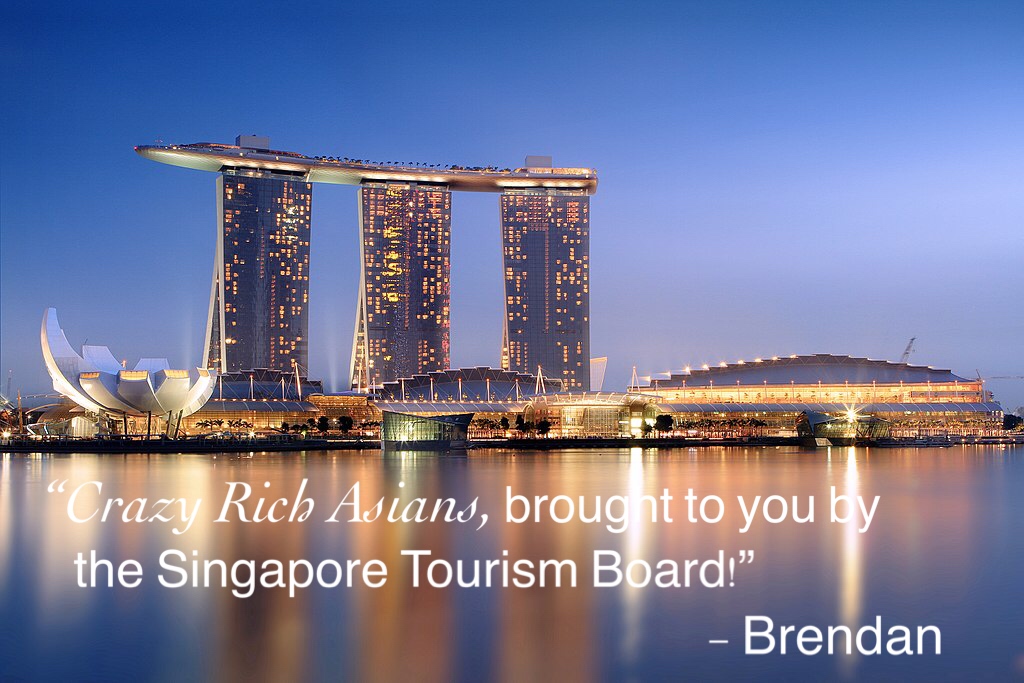
Original photo from Wikimedia Commons
(to be fair this movie has actually made me want to return to Singapore, but mostly for the food)


You probably think I'm writing in to comment on Crazy Rich Asians because it's a cultural moment and it'll be good traffic for Lao Ren Cha. I'm not - I don't expect this will even be one of the more popular posts. I just have some thoughts on the movie and I'd like to share them.


It took me a few hours, because my mind was completely cleaned out by Henry Golding's golden washboard abs, but I'm over it now* so here we are.

Let me get one thing out of the way first: I really liked the movie, so let's talk about that first. If you don't care, scroll through a few paragraphs to get to my concerns. 

Why did I like it? Because despite some Chinese viewers thinking it "presents a stereotypical view of Asians" to Western audiences, I actually think it smashes these stereotypical views.

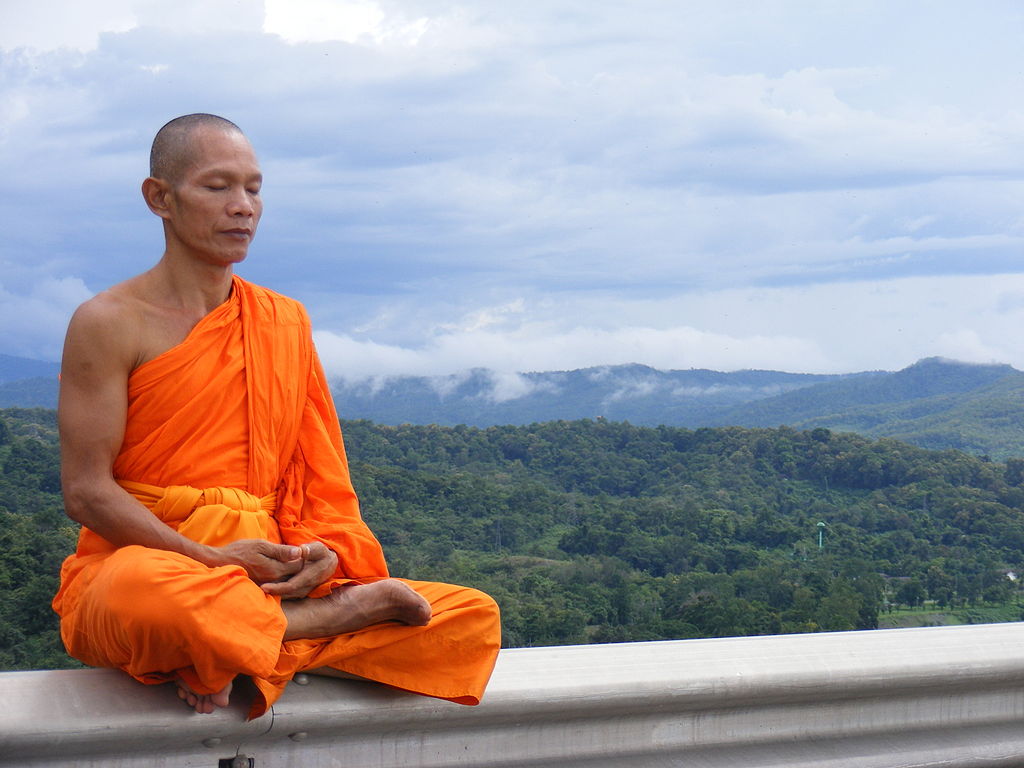
I can assure you, of my friends and family who have never been to Asia, very few of them think that Asians live like the Crazy Rich Asians. Most of them think "Asian" and they think "poor and full of gongs" or something. You know, like:


1024px-Phra_Ajan_Jerapunyo-Abbot_of_Watkungtaphao.
from Wikimedia Commons


Maybe with a dragon or some "ancient Chinese art of kung fu" thrown in. But definitely poor. To many Westerners, only the West is rich.

I am also reasonably sure a large percentage of people I know back home think that the only reason I don't live in a straw hut in a rice paddy and wear a conical hat to work is because I live in a city, which they might well imagine as some cement buildings scattered among the straw huts.

So, y'know, I'm actually happy to see a representation of Asia that doesn't look like the only people who live there are rice farmers or monks and their only purpose outside Asia is to run Asian restaurants and dispense religious wisdom to white protagonists. I live in a pretty developed country in a continent that, for much (but not all) of its breadth, is developed. It's about time the West woke up and realized that. Asians are not all still-suffering victims of Western imperialism (in Taiwan and elsewhere, there are currently-suffering victims of Chinese imperialism, but I'll get to that.) Much of Asia really is criss-crossed by ultra-wealthy families, many of whom claim Chinese ancestry, and all of whom know each other.


To imply otherwise is to say "what? but don't you like gongs and monks? Why are you wearing Versace? Don't you have some traditional robes? Don't let the white man force you out of the rice paddy!"

Which...barf.  


It's also about time they woke up and realized that Asia can't be described with a single word (like "collectivist" or "Confucian" or "ancient") - there are good, decent, down-to-earth people (like Astrid and Colin) and selfish jerks (like Eddie and Amanda), and people who think they are good and decent and self-sacrificing who are in fact kind of selfish (like Eleanor, in a way). You know, like everywhere else in the world.

I also liked it because, while people are writing about how it pits Western and Asian values (does it, though? I'll get to that too), I find it plays with the fundamental rightness of feminist values, and how they can exist in any cultural setting, adjusted to the needs and goals of women in any given culture. When I think "family values", even in an Asian context, I think "values that lift up everyone in the family, with everyone negotiating, cooperating, giving and receiving for the benefit of all, including women", not "women must always sacrifice for the family". That's a feminist value that can exist in Asia - Rachel even references those words in reference to a game of mahjong!

And I'm fine with it being called Crazy Rich Asians even though it's really only about "ethnic Chinese" - a good book needs a snappy title and Crazy Rich Overseas Chinese in Singapore...isn't. It's not a National Geographic documentary, after all. (Anyway those seem to skew toward the poverty and gongs, too - all the stuff Westerners like to feel both guilty over and enchanted by. Not a real place full of real, mostly normal people.) It's not about "Singapore" or "diverse Asia". It's about a group of crazy, rich and crazy rich people. Can't it just be that? Can't something be set in Asia and feature an Asian cast and be about something other than social justice?

I liked it despite the criticisms I've heard from some media and my social-justice oriented friends: that it only shows one kind of Asian (the only dark-skinned or even non-Chinese Asians we see are working in service positions), that despite it not being scheduled to open in China, that it presents a problematic pro-China orientation and presents a view of Chineseness that is frighteningly close to Communist Party ideology - an idea I'll quote from liberally in a moment - that of course it ignores deeper issues of inequality in Singapore.

Or, as my husband joked on the way home, "I'm happy now that we know what the inside of a typical Singaporean home looks like, since we have always stayed in hotels on our trips there!"

All of these things are true, and I can't wholly ignore them. They are very real:

From Kirsten Han writing for the Hong Kong Free Press (linked above and again here):


The Young family, for example, sit around and make jiaozi, a dumpling from northern China that’s unlikely to be part of the traditions of a long-established Chinese Singaporean family, since most of the Chinese who came to Singapore came from the southeastern coast.

It’s also odd that Nick Young’s grandmother, the elderly matriarch of the family, speaks perfect Mandarin, while the women one generation below her speak Cantonese—in real life, it’s far more likely to be the other way around, especially given the Singapore government’s efforts to restrict the use of dialects and promote Mandarin.


and:


On her trip, Rachel Chu learns the difference between the Asian American and Asian experience. But there isn’t an “Asian experience”, per se. It’s not as simple as East versus West, as the symbolism of the film’s mahjong game suggests. Even within tiny Singapore, we see diverging Chinese experiences every day. If anything, it’s the Chinese Communist Party in the People’s Republic of China that seeks to obscure these differences in their efforts to engender feelings of sympathy or even loyalty to the party through the idea of racial unity.


YUP. Hey Westerners - did you know that was a thing? It totally is.

This is echoed in Catherine Chou's piece in The News Lens (also linked above and here):


Repressive government initiatives to solidify Mandarin as the region’s common tongue have been so successful in Singapore, Taiwan, and China that Hokkien and Cantonese are now routinely mistaken in popular culture as mere dialects of Mandarin.

Mandarin thus functions in the movie just as it does in government policies: as an artificial marker of class and sophistication. Cantonese, and especially Hokkien, are used as signifiers of marginality and lower status.


Holy fishguts, this is spot on.

This isn't only a problem in Singapore - it's also a deep social divide in Taiwan. For a few generations now, the KMT colonizers (yes, colonizers) have promoted Mandarin as the lingua franca of Taiwan, a country they believe is "a part of China" but which a.) isn't, b.) fuck you, KMT and c.) was never a place where Mandarin was a native tongue, before it was forced on the Taiwanese. To do this, they not only made it punishable in some circumstances to speak Taiwanese Hokkien (and caused one to be 'under suspicion' in others), but made it so that Mandarin was the language of the upper classes, with Hokkien being the language of "ignorant farmers" (無知農夫). The language of the gauche. The language of the excluded.

And believe me, the point has always been to explicitly exclude. How do you get people who speak a totally different language, and who might rebel, to accept you as their sovereign masters? Make 'em think their language is merely a coarse dialect of the common tongue you share, and you are the learned scholars who have come to educate them in your common tongue's purer, better form. 


In the film, the good-hearted, nouveau riche Gohs (who, in their kindness, though perhaps not in their campier qualities, remind me of Taiwan a little) speak Hokkien, and are excluded from "society". The posh, old money Youngs should speak Cantonese, but instead speak Mandarin. Peik Lin points out the 'class' differences explicitly, but Western audiences aren't likely to notice the linguistic ones.

This leads to another concern I have: Taiwan is mentioned in Crazy Rich Asians, but it's always a sidebar. China gets a not-quite-appropriate quote at the beginning of the film (a point that Kirsten Han made in HKFP), Singapore gets the "Lives of the Rich and Famous" treatment: Taiwan, on the other hand, is portrayed as just another place where rich Chinese might live and do business with other Chinese - despite it being qualitatively different not just culturally, but economically. Taiwan isn't Singapore or Hong Kong - it's not rich and shiny. It's not a waking dragon like China. It is remarkably unpretentious and down-to-earth. Even its shiniest district - Xinyi - is only a little shiny, and not really at all glitzy.

I like it that way, but it does spell out for me the differences between "countries that cooperate with Chinese cultural imperialism" and "countries that tell China to eat it". And, as a smart friend of mine recently wrote in a paper you will almost certainly never read, a key difference between who can have a close relationship with the PRC and who must be suspicious of them and look for other options is whether or not China respects that country's borders. China and Singapore can be close, because China isn't threatening to invade it. Taiwan must be wary, and so Taiwan is shoved eternally, unfairly to the sidelines.

So, Singapore can sign on to this movie that promotes a certain ideal of "Chineseness" within its borders if it wants to. Singaporeans of Chinese heritage can call themselves Chinese, if they want, and claim common cultural roots with Chinese people in China. The movie clearly portrays those roots inaccurately, but Singapore isn't going to lose its sovereignty over it.

But there is no room for Taiwan as it is in the Chinese world of Crazy Rich Asians: it can try to claim its place as part of the "family", which many in Taiwan would like to do given their ancestral roots in China. But that means being eaten alive by the Communist Party's insistence that being Chinese means you are a part of China, are loyal to China the CCP and follow certain cultural prescriptions decided by China the CCP. Or, it can deny its links to China and Chinese cultural heritage, but always feel a sense of exclusion.

The CCP has, like Eleanor Young, made it so there is no winning hand for Taiwan: it can't turn away from the "Chinese" cultural roots that many would like to claim without being kicked out of the "family", but it can't claim its place at the table without being subsumed by China.


It's also worth noting that the values touted as "Asian" in the film were common in the West just a few generations ago - they're not "Asian", they're..."traditional". Therefore, the values that eventually stand up to "traditional" ones in the film aren't "Western", they're "modern". 

Considering this, even if there were a way for Taiwan to win this game, in the version of "Asia" that Eleanor (though not necessarily the movie as a whole) puts forward where "Asian" is (falsely) conflated with "traditional", there is no room to be both Asian and liberal/progressive. If "Asian values" include self-sacrifice, choosing family and duty over love and a whole pallet of misogyny, where the gay cousin is accepted - but not entirely (the actor who plays Oliver Tsien says of the character, "he knows he’s an outsider in his own family just by being queer") - 
where is the space for an Asian country like Taiwan that has, say, decided to enshrine marriage equality into law, has a strong social movement culture and actually attempts (though not always with success) to enforce gender equality laws in the workplace?

In short, in the version of Asia that Crazy Rich Asians puts forward, where traditional values are accepted unanimously by all, where does a country like Taiwan fit in? It's almost as if certain other, larger, crazier, richer nations don't want that country to exist at all...


So...I liked the movie. It was fun. It was well-made and well-acted. It was more thoughtful than a romantic comedy needs to be. It's a breakthrough moment for portrayals of Asian characters in film.

But I also...didn't. Because the portrayals of what it means to be "Chinese" in it are entirely the brainchild of a crazy, rich nation. And even if it wanted into this 'family' of Chineseness, Taiwan would always be rebellious, gay cousin Oliver. Though far less accepted for who she is.

Western academics and commentators love to point out that overarching cultural narratives are usually promulgated by the most powerful members of a group, and exclude the least powerful. We've become good at spotting this in our own cultural contexts: what it means to be American is projected as a white person's view of Americanness, what it means to be a businessperson is a male view of business culture, the notion of what "romance" means is a straight one, etc.

It's about time they realized that this happens in Asia too, and what it means to be "Chinese" or even "Asian" is a narrative that the Chinese government is actively trying to control - and of course, they are the ones with power. And money. Also, they (the government) are freakin' insane.

*not really over it, but I'm still fundamentally a Freddy Lim girl

Saturday, August 25, 2018

The Good, The Bland and the Authentic: A Hakka Stir-Fry Journey

39978163_10156672844911202_2177125141455044608_n


Months ago, I picked up Cathy Erway's The Food of Taiwan, cooked a bunch of my favorite Taiwanese dishes from it, and wrote about the experience. I structured it as a discussion of how it feels to be a foreigner who calls Taiwan home improving her ability to cook Taiwanese food, but also of what makes a Taiwanese dish both "good" and "authentic". Something might be "good" but not taste particularly like a dish as it's usually served in a region (for example, I like the Taiwanese take on ma po doufu 麻婆豆腐. I think it's good, but it doesn't taste anything like what I used to eat in Guizhou and Sichuan). Or, something might be "authentic" - maybe your 92-year-old Hakka grandmother in Yangmei made it - but, as I noted to a friend, not everyone's Hakka grandma is necessarily a good cook.

Of course, the best dishes tend to be both: they're deeply rooted in their places and cultures of origin, and also made well.

I also considered the tendency of Westerners to have endless variations of their own food, while thinking food of other cultures only had one "correct" form, and any deviations from that particular way of preparing it were somehow "wrong" and "inauthentic". Of course this isn't true. Different cooks across Taiwan cook the same dishes in slightly different ways, just as cooks might do from Ohio to Iowa.

With that in mind, I want to return to the Hakka stir-fry (客家小炒) recipe in The Food of Taiwan. There was a discussion on this in the "books about Taiwan" Facebook group I manage about the various aspects of the recipe, and also on my personal page. I complained about the inclusion of carrots and the lack of garlic greens, the lack of rice wine, the way the pork belly was sliced (not into matchsticks as is common in Taiwan, but into slices and pre-cooked), and the lack of specification about the squid, which it is implied in the recipe may be fresh squid. And, I'd like to add, the sparing use of "light soy sauce". Some of my friends - all Hakka - were horrified. Other commenters thought this recipe would make it easier for non-Taiwanese and those not in Taiwan to make a version of the dish, and it was therefore fine.

To me - caveat: someone who is very much not Hakka - this just doesn't produce the Hakka stir-fry I've eaten in Taiwan. It just...doesn't. Maybe it's "good" (I made the recipe, I thought it was...fine. Totally acceptable) but it didn't strike me as at all "authentic". It just wasn't the lip-smacking, flavor-intense dish of greens and chewy matchsticks of tasty pork, tofu and squid that I've come to know and love.

Of course, there's an added issue when you're not just a non-Hakka cooking Hakka food, but a non-Taiwanese cooking a Taiwanese dish. I know I can cook good food, but if I'm going to fry something up and call it authentic, it has to really taste authentic. There is less space for me to spin my own variation on something and call it "Hakka stir fry" (or anything Taiwanese that I might make). If I change things up too much, but claim to be making a particular food from a particular place and culture, I not only become culturally appropriative (not appreciating the host culture) but also forfeit any claim I may have to seeking to better understand Taiwan through learning how to make this food with my own hands.

So, last night, I decided to try again. Instead of using Erway's recipe, I just grabbed the first search result off iCook, just to see how it played out. I cribbed a few of the better elements of Erway's recipe: the use of ginger and chili bean sauce. Hakka friends had told me these were acceptable flavor enhancers and I thought they worked well. I also cooked up the ginger, garlic (not garlic greens) and white parts of the scallions in a little oil before adding the pork.

I also soaked the dried squid in Shaoxing rice wine (紹興酒) with a little water added because that would otherwise require a LOT of Shaoxing wine rather than water, because that's what my friend says his Hakka wife's family does. That's pretty legit.

Notably, this recipe called for matchsticked pork cooked in a wok (not boiled), thick soy sauce (醬油膏) rather than light soy sauce (add the chili bean sauce at the same time if you like), sugar, reconstituted dried squid rather than fresh squid, garlic greens along with the celery and scallions, and rice wine. And absolutely no carrots.

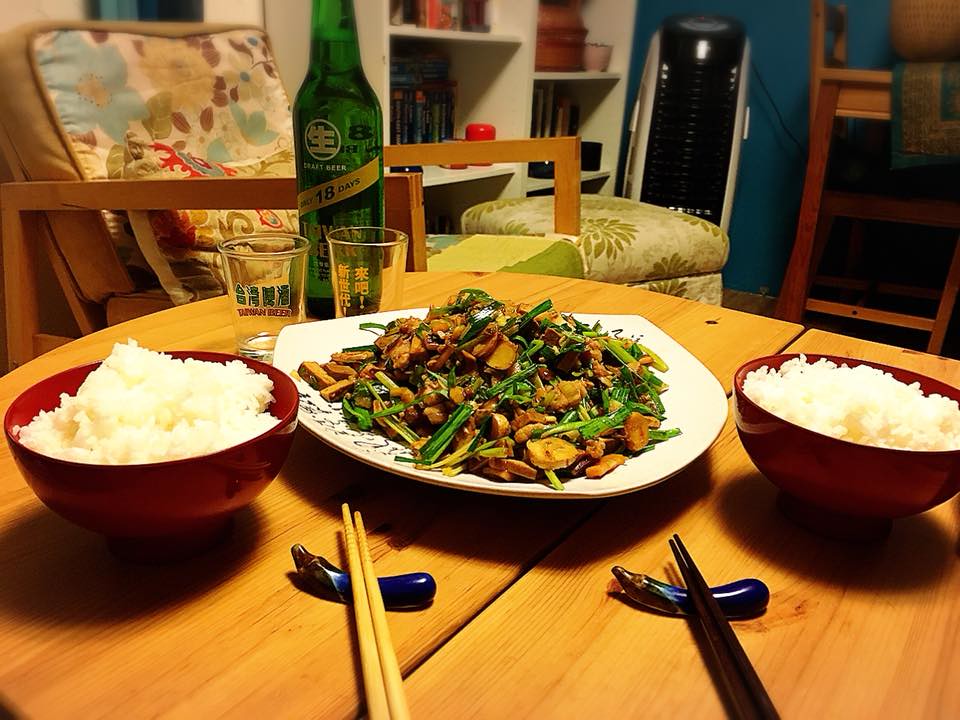
I stuck mostly to the iCook recipe to see if it would produce a Hakka stir-fry that was both "good" and "authentic" - and you know what? It did!

39981538_10156672844906202_3757115778541813760_n

Looks pretty solid, no? This not only tasted great, but tasted (and looked) like something I'd get in an actual restaurant in Taiwan.

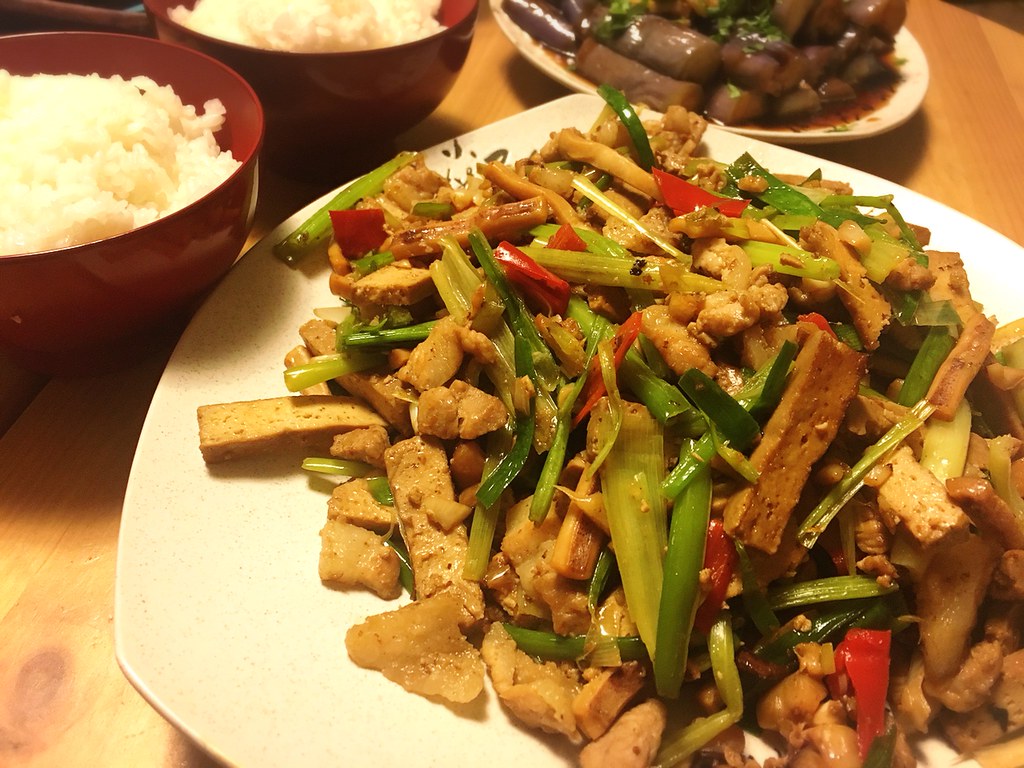
Contrast that to the result of using Erway's recipe (though I didn't quite follow it - I did use dried squid, I did matchstick my pork, and I did use garlic greens rather than carrot because I have principles). Same "food photography" filter, same level of photo editing:


IMG_2092


Seems fine, right? But it was a lot blander. It didn't have that thick coating of slightly sweet, soy-based deliciousness tinged with the subtle enhancement of rice wine that the stir-fry I made last night did.

Now, that's not the end of the story. That friend's Hakka wife, from Miaoli? Her family apparently fries up each ingredient separately "to make sure each one is cooked to the peak of fragrance and texture", and doesn't use dried tofu (though she concedes it's an acceptable addition. I happen to like it.)

She's actually Hakka - her version is certainly more "authentic" than mine. And though I've never tried it, I can be pretty damn sure it tastes better, too. I don't believe there's anything genetic about cooking: one doesn't get to be good at cooking Hakka food just because one is Hakka, but I didn't grow up in that culture. I didn't eat this dish as a kid. My family doesn't run a restaurant in Miaoli. There's a lot of experience-based knowledge that I can't have. I accept that.

In the end, though, I can make a pretty okay Hakka stir-fry too, and I do think there's a "way" to do that where "good" and "authentic" intersect.

I am a firm believer in seeking to understand other cultures (not appropriating them), and I appreciate it when certain cultural knowledge - like how to cook commonly-served dishes - is made accessible. I don't think I have to be Hakka to make Hakka stir-fry, or Korean to make kimchi, or Mexican to make flautas (though I'd hesitate to attempt to make a profit doing so). But, if we're going to seek to understand through cooking, we do have to at least attempt to produce the real thing. No carrots, no long slices of pork, no fresh squid, no light soy sauce. Otherwise, we're just making stir-fry and pretending it's 客家小炒. We congratulate ourselves, but have learned nothing.


Here's my full recipe for White Lady Makes Hakka Stir-Fry: 

1 pack of pork belly (五花肉)from the supermarket, sliced into matchsticks (I never get up early enough to go to the traditional market)
3-4 scallions (青蔥) , white and light green section sliced, green sections sliced into thin matchsticks
1 large garlic green (蒜苗) - white bulb section sliced, green sections sliced into matchsticks
1-2 roots (which have several stems) of Chinese celery (芹菜), de-leafed (though you can chop and add the leaves too) and matchsticked
1 pack dried tofu (豆乾), cut into matchsticks
1 dried squid (魷魚乾), soaked in Shaoxing wine (紹興酒) with a little water for a few hours or overnight, with tentacles, sliced up into pieces about the same size as the pork - cut against the grain so it won't curl up when stir-fried
2 cloves garlic (蒜頭), chopped
1 thumb of ginger (薑), in coins
A little neutral-tasting oil (沙拉油) - don't worry about using a little. The fat from the pork will give the dish a satisfying oiliness
1-2 tsp sugar (to taste) (糖)
2 tbsp thick soy sauce (醬油膏) - this is the secret to getting the sauce to stick to the meat/tofu
2 tbsp chili bean sauce (optional) (辣豆瓣醬)
1/4 cup rice wine (米酒)
powdered white pepper to taste (白胡椒粉)

Cook up the garlic, garlic green bulb (the white part), white part of onion and ginger in a little oil until fragrant. (I use medium gas, which would be high on an electric stove.)
Add pork and cook until pink disappears
Add tofu and cook for a minute
Add squid and cook for a minute
Add rice wine, toss
Add thick soy sauce, sugar, white pepper and chili bean sauce, toss till well-coated and it starts to stick to the meat/tofu/squid
Add all remaining greens, cook briefly until slightly wilted

Serve immediately over white rice.

Boom! Done.

Thursday, August 23, 2018

A little light sado-masochism: my eyes are bleeding

Masochism because I read this despite knowing what was inside, sadism because I'm sharing it with you.

Inside a fairly innocuous article about reducing scooter emissions on a niche website few people read,  among other wonky English ("Taiwan praises itself to have the highest motorcycle density in the world?" Okaay), we get this (emphasis mine):


Different from other countries that plan to introduce a ban, Taiwan that officially belongs to China, does not only intend to block more fossil-fuelled vehicles from taking to its roads but has effectively written the proposal into law already.


AAAAAAAAAAAAGGGHHHHHHHHHH UUUUUGGHHHH MY EYES MY EYES THEY'RE BURNING MAKE IT STOP. 


Okay. Whew. So.

What's interesting to me about this is that the source material, a thin wisp of an article on Xinhua, doesn't even use this language. Content creator Nora Manthey added it in for literally no reason at all, except to be a jerk to Taiwan I guess.

Also, "officially" according to whom? Who decides what's "official" for the entire world? There's China's claim, but that's limited to China. What is "official" about this, and who are the officials in question who say so? Where are their offices?

That's what worries me: even in these little articles on niche industry websites on totally unrelated topics, even when Chinese state media which is obligated to be anti-Taiwan - as it's controlled by the Communist Party - doesn't put language like that in articles that are used as source material, even when it's just a totally innocuous thing where the content mill worker has no reason at all to include such language and probably has no political position him/herself on the issue, this crap still ends up in articles like this. 

I truly have no idea why. Any thoughts? Anyone?

I don't even have to tell you that Manthey is wrong, if you're reading Lao Ren Cha, you already know that. But just in case you didn't:

The status of Taiwan is undetermined. Under pretty much any interpretation of international law this is the case, and a case can also be made that it is sovereign (it has its own government, military, currency, contiguous territory etc.) The series of treaties and agreements following the end of WWII did not put to rest the status of Taiwan; the only ones that explicitly refer to it as belonging to China (such as the Cairo Declaration) are non-binding. Major powers do not recognize China's claim on Taiwan, they merely acknowledge that the claim exists (this is a common source of confusion). I could go more into the history of this issue - e.g. Taiwan's status 1945-1949, the Japanese colonial era and the treaty that put that into motion, Taiwan's status as a colonial holding of the Qing - but I don't need to.

You know, just in case ya weren't already aware.