As anyone who reads about Taiwan knows by now, The View From Taiwan is done. As Donovan Smith noted, the loss is huge. I didn't always agree with the View's views, but more often than not I did, or at least respected the arguments behind them. As official news sources failed to consistently report well on what goes on in Taiwan, The View From Taiwan had become one of the smartest things to read in English to keep up on current affairs. I learned a lot about Taiwan from that blog, including the three most important lessons on advocating for Taiwan that I needed:
First, that the way Taiwanese history and current affairs are narrated, both from the international press and local sources (whether they are KMT Chinese chauvinists or Hoklo ethnic chauvinists), leaves a lot to be desired and almost never, ever tells the whole, accurate story. Don't look at what they say; look at the language they use to say it. Point it out. Especially if it has anything to do with "tensions".
Second, that half the fight for Taiwan on the international stage is about representing Taiwan well. International spectators aren't very good at paying attention to the details of local embroilments and messes, and when they do notice, they aren't very good at incorporating them into an overall arc of right vs. wrong. Don't air our dirty laundry for the world to see when it isn't necessary, when all the rest of the world really cares about is good guys vs. bad guys. Make the case that we are the good guys, not that we can't get our act together (even if, here in Taiwan, we're frustrated that we seemingly can't.) We're David (as in vs. Goliath), not Cletus (as in the slack-jawed yokel). The View From Taiwan has probably been the biggest influencer in what turned me from a Taiwan advocate who was uncompromising even if it made Taiwan look bad abroad, to a Taiwan advocate who understood that our top priority is to get the world on our side.
And third, if you're going to make a hard statement on something, know your facts first. You might still get it wrong - it happens - but make an honest effort to do your research. If you are not intimately aware of the inner workings of something, don't write about it as if you are. Thanks to seeing the background that went into posts on The View From Taiwan, I probably do an hour or so of research for every hard statement I make here. I don't always get it right regardless, but it was that blog that made this blog less a "shouty lady with opinions bloviating in a corner" (though I am that) and more a "shouty lady with opinions who did her homework before bloviating in a corner".
Oh yeah, and blog under your own name. No hiding. Put your own skin in the game, even if just a little.
All in all, it is not an exaggeration to say that without The View From Taiwan, Lao Ren Cha would not exist in the form it does today.
So, you know, thank you for that. *sniff*

Sunday, September 9, 2018


Saturday, September 8, 2018
Of peanuts and monkeys

This is perhaps the third time I've written about this in a week, but I just have more to say.
I've been thinking about a few issues I'd like to [try to] tie together: reactions to my post about how long-termers in Taiwan aren't here for the money but are aware they're being undervalued, the general state of English-language media in Taiwan, and English as a second official language in Taiwan.
When I wrote about long-termers and low pay here, most reactions were supportive. The negative ones landed into two groups: those who think NT$66,000/month is fair, or even good, pay for a job that requires several years' experience, high level skills and (unfairly) a Master's from abroad, and those who said the pay wasn't important because the job would be good for someone who would be in Taiwan for a few years and would likely just want to beef up their resume.
So, let me toss some word salad about why both groups are wrong before I move on.
In terms of fair pay, the fact that pay is too low in pretty much every other sector doesn't make $66k for this sort of job acceptable. If you can make just as much money (or more) as a Dancing English Clown at a cram school, a job that requires no qualifications, experience, education, training, professional development, skills, talent, work ethic or consistent sobriety, why would you seek to improve yourself so that you might qualify for a higher-level job, especially one that states right in the ad that you'll be doing consistent overtime in a stressful environment?
And why would you want to take all of that education, experience and skill to make just about enough money to drink at Bar 7 and live in a shared flat or rooftop cesspit with paper walls, if you have any hope of saving meaningfully? Because after you pay your student loans on that foreign Master's degree and save NT$30k each month, that's about what you can afford, if you have no dependents. If you've gotten a postgraduate degree, learned Mandarin and acquired translation skills and experience, you are probably not 24 anymore, and would rather live like an adult.
Others say that this job is aimed at young Taiwanese Americans spending some time here but not planning to stay, or for those looking for a springboard to gain experience. This also misses the point: first, this isn't a newbie job. This could have been an excellent post for an early-mid-career bilingual professional writer, editor or translator, who might well have stayed on for years improving not only their own work, but elevating the English-language output of MoFA as a whole. It could have been a boon to both some lucky long-termer and to MoFA, who would get excellent work in turn.
That is, if it had been positioned that way: as a good but demanding job with a great salary, rather than as a short-term lark for an ABC kid with a Master's who's in Taiwan.
This whole idea of getting some experience in Taiwan and then leaving actually bothers me quite a bit: there are those of us who wish to stay, and as I've written three times now, we try to contribute and give back to Taiwan in gratitude for what Taiwan has given us. Although I won't spend paragraphs bashing them, I have less respect for those who come, take what they can get from Taiwan, and then leave. It strikes me as a little selfish. I have a more profound appreciation for those who want a fair shake from Taiwan, but also want to give back to this country in a sustained way. And yet, one of those grab-and-go types will probably get this job. MoFA will have a revolving door of people who never really develop themselves and get merely passable work, and Taiwan won't benefit.
Which leads to my next point - if the national government is serious about sweeping initiatives like making English a second official language in Taiwan, it's going to have to shake up its whole attitude toward a lot of things. It can't have a MoFA attitude towards English education, asking for everything and offering nothing.
The government needs to think about employing the right people (which it can attract with the right offers), taking seriously the idea that teaching, writing, editing and translating in English are professional careers that people do over a lifetime and seeking out those people, and basically getting quality by paying for quality in terms of remuneration, benefits and work environment. There are those of us who want to stay, who can do good work, but who aren't going to be attracted by what's currently on offer. We're here and we don't want to go anywhere - if the government is serious about bilingualism, internationalism and multiculturalism, it needs to provide more enticing reasons to stay, and stop creating jobs aimed at grab-and-goers.
And it needs to take those people seriously when they point out the flaws in the status quo vis-a-vis English education in Taiwan: from a poorly-regulated cram school industry to, as a friend pointed out, the fact that students who only learn English in public schools generally don't come out having learned any English, to the way the exam system, through extreme negative washback, hinders the whole process. It needs to hire people who can then develop something better, and that's where long-termers looking to contribute to Taiwan come in. We - not just me, I'm nobody, but we - can actually do this alongside and in support roles to talented, passionate and qualified locals, but only if the will is there. We can't take a grab-and-go attitude.
This isn't true only for the government, but for the education system as a whole: from buxibans to universities, if you want talented educators who can actually help Taiwan achieve English as a second language, you need to not only give those who are already working toward this end a better environment in which to succeed, but to offer jobs that entice talented professionals, not a revolving door of Chads and Braydens who aren't implementing even so-so curricula well, and will go back to Idaho in a few years anyway without seriously considering whether they actually contributed to Taiwan.
Oh yeah, and if you are serious about multiculturalism, how about treating the many Southeast Asians who come here for work with a little more kindness and respect? Even just better working conditions and pay, not being all racist towards them, and not raping or enslaving them would be a good start.
This bleeds over into English-language media as well. Why is Taiwan News, which is essentially a gossip rag peddling the same sensationalist articles translated over from Chinese-language gossip rags, now the most recognized English "news" source in Taiwan? How'd we hit the bottom of that barrel?
Because there aren't very many jobs for talented journalists in Taiwan, either. By all accounts, the Taipei Times made a go of it once, but are now so under-resourced that even if there were talk of updating its website and media strategy for the 2010s and beyond, the resources just aren't there to make it happen. It was (is?) the English-language paper that both the expats and the Taiwan advocate Beltway crowd read, and probably never would have been a huge money-maker given its smallish target audience, but it could have sopped up the market that Taiwan News is currently engaging.
Great people have worked at the Taipei Times - and some have even worked at the China Post (believe it or not) - but they all leave. Few people build a career and stick with it, because the jobs on offer just aren't that great. We all know about the one guy who wrote a whole book on it (though you'll need a nacho bowl for all the shoulder-chips it comes with), but I've heard this from many sources. Low pay, long hours, hardly any time off (typical Taiwanese annual leave, which means not much at all), difficult environment. No wonder the best journalists they hire, if they can attract them, cut their teeth and then leave. The state of English-language news reporting suffers for it.
A friend pointed out that this has real-world consequences: she was talking about racism in Taiwanese society specifically towards Black foreigners (which is absolutely a thing), but it also has international consequences. If Taiwan News is the best we
Could they perhaps accomplish that if they offered better jobs to committed long-termers looking to make a difference?
The long-termers will stick around - most of us, anyway. We'll continue to fight for Taiwan in whatever way we can, and carve out niches for ourselves. I do the work I do (I have no single employer, by design) because I can get some satisfaction that way, and make sufficient money. If Taiwan wants us to come out of our little self-carved niches and join the fight for real, there have to be opportunities for us to build real careers in important and useful places, which offer adult remuneration and conditions for real skills.
If Taiwan engages the long-termers who are looking to contribute more meaningfully (and the locals too), the country will be better for it. Media, education, the government.
But if this work continues to toss peanuts our way, we aren't going to pick them up.
Friday, September 7, 2018
Call Taiwan a "country" in public media. Yes, it really is that simple.
Years ago, I donated to Freedom To Marry, and ended up on their e-mail list. As with all such fundraising emails, I generally delete them without reading (my apologies also to Planned Parenthood, Amnesty International and Animal Welfare League of Arlington). But, I received one today with the subject line "Taiwan", which caught my eye.
Inside, I noticed this:
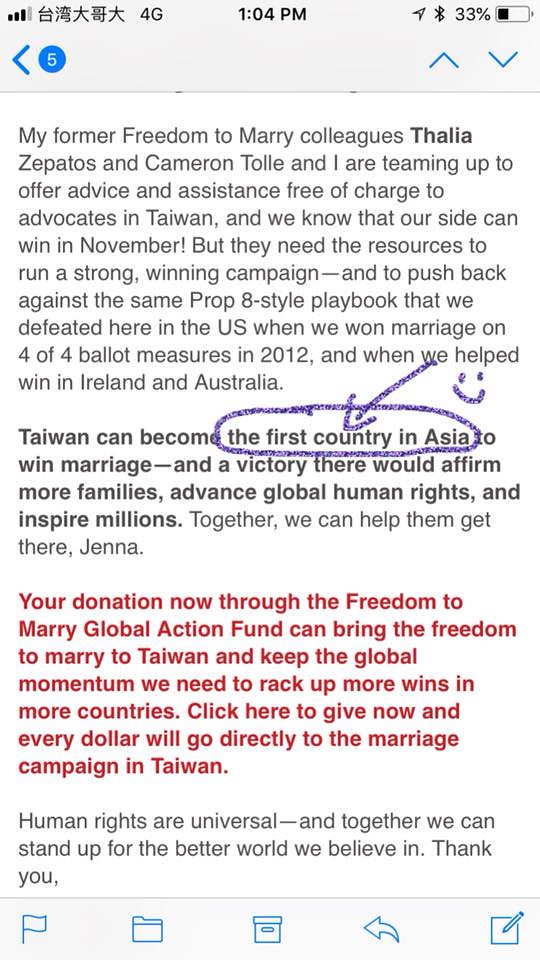
For the first time, I was happy I hadn't bothered to unsubscribe from such lists - if I had, I might not have noticed that Freedom To Marry called Taiwan a "country".
No fanfare, no convoluted wording, no kowtowing, no apologies, no explanation needed, just a country. No trumpets heralding the arrival of new terminology. No considering the feelings of some other country that does not rule this country, as though their opinion means anything at all regarding Taiwan's status as a country.
It is self-governed (and reasonably successfully so, despite some, uh, setbacks and issues), has its own contiguous territory, military, currency, immigration and visa process, postal service...you know, like countries do.
Because it is a country, they called it a country. As rational people would. Simple, effective, accurate.
This is how it should be. Not even a question. It shows how badly the media has twisted itself into knots over some other country's baby-whining about the status of this country. They try to cover it up by saying it's "neutral", "dispassionate", "straight reporting of facts without inserting political stances" when they show such cowardice in avoiding using the word "country" to describe a country, instead employing seemingly-neutral but actually offensive, pro-CCP terms like "territory" and "island" (yes, even "island") to describe Taiwan. Taiwan is not merely a territory - it has everything other countries do - and "island" is a cop-out to appease some other country's opinion of Taiwan rather than denote Taiwan's reality.
It makes sense, too. Despite marriage equality being a somewhat bipartisan issue in Taiwan (there are supporters and opponents on both sides, although the pan-greens and especially the Third Force appear to be a bit more in favor), and despite liberals in the West being kind of hopeless when it comes to understanding Taiwan, the two sides seem to have adopted oppositional "cross-strait" language on the issue. No, really: the anti-gay folks often reach for some version of "it doesn't fit with Chinese culture". The pro-equality advocates point out that this is yet one more issue which shows how different China and Taiwan are. So it makes sense that those of us fighting for recognition of the reality of LGBT+ people will tend to also use accurate, reality-based terms when referring to nations. Reality begets reality.
All that aside, it really is that simple. Just call Taiwan a country. That's all.
You don't have to do anything else, except write "country" instead of some nonsense Beijing-approved word. (Oh, you could also stop using "Mainland", "renegade province" and "separated in 1949", but frankly, using the word "country" basically clarifies all of these terms as untruthful and not descriptive of reality, so it would be natural to toss those out, too.)
The international media might want to take the box of bullshit China is forcing on the world and report as though there might be some value in it, but we can smell it for what it is. Every time we get a breath of fresh air, like Freedom To Marry just referring to Taiwan as what it is, it becomes clearer that you're just helping Beijing pass off some turds in a box.
I mean, come on, international media. We already knew you were a bunch of CCP-appeasers who regularly get up off your knees to make excuses for the way you write about Taiwan, but that others can get it right with so little fanfare really just shows how cowardly you are in starker relief.
Inside, I noticed this:
For the first time, I was happy I hadn't bothered to unsubscribe from such lists - if I had, I might not have noticed that Freedom To Marry called Taiwan a "country".
No fanfare, no convoluted wording, no kowtowing, no apologies, no explanation needed, just a country. No trumpets heralding the arrival of new terminology. No considering the feelings of some other country that does not rule this country, as though their opinion means anything at all regarding Taiwan's status as a country.
It is self-governed (and reasonably successfully so, despite some, uh, setbacks and issues), has its own contiguous territory, military, currency, immigration and visa process, postal service...you know, like countries do.
Because it is a country, they called it a country. As rational people would. Simple, effective, accurate.
This is how it should be. Not even a question. It shows how badly the media has twisted itself into knots over some other country's baby-whining about the status of this country. They try to cover it up by saying it's "neutral", "dispassionate", "straight reporting of facts without inserting political stances" when they show such cowardice in avoiding using the word "country" to describe a country, instead employing seemingly-neutral but actually offensive, pro-CCP terms like "territory" and "island" (yes, even "island") to describe Taiwan. Taiwan is not merely a territory - it has everything other countries do - and "island" is a cop-out to appease some other country's opinion of Taiwan rather than denote Taiwan's reality.
It makes sense, too. Despite marriage equality being a somewhat bipartisan issue in Taiwan (there are supporters and opponents on both sides, although the pan-greens and especially the Third Force appear to be a bit more in favor), and despite liberals in the West being kind of hopeless when it comes to understanding Taiwan, the two sides seem to have adopted oppositional "cross-strait" language on the issue. No, really: the anti-gay folks often reach for some version of "it doesn't fit with Chinese culture". The pro-equality advocates point out that this is yet one more issue which shows how different China and Taiwan are. So it makes sense that those of us fighting for recognition of the reality of LGBT+ people will tend to also use accurate, reality-based terms when referring to nations. Reality begets reality.
All that aside, it really is that simple. Just call Taiwan a country. That's all.
You don't have to do anything else, except write "country" instead of some nonsense Beijing-approved word. (Oh, you could also stop using "Mainland", "renegade province" and "separated in 1949", but frankly, using the word "country" basically clarifies all of these terms as untruthful and not descriptive of reality, so it would be natural to toss those out, too.)
The international media might want to take the box of bullshit China is forcing on the world and report as though there might be some value in it, but we can smell it for what it is. Every time we get a breath of fresh air, like Freedom To Marry just referring to Taiwan as what it is, it becomes clearer that you're just helping Beijing pass off some turds in a box.
I mean, come on, international media. We already knew you were a bunch of CCP-appeasers who regularly get up off your knees to make excuses for the way you write about Taiwan, but that others can get it right with so little fanfare really just shows how cowardly you are in starker relief.
Tuesday, September 4, 2018
And everyone who knows us knows...we didn't come for money
I promised I'd eventually pick up where I left off here, so...
Last month I came across this job posting with MoFA (the Ministry of Foreign Affairs) through the Facebook group of Nihao's It Going (and for those wondering why there is no Lao Ren Cha Facebook group, the answer is that I am old and lazy.)
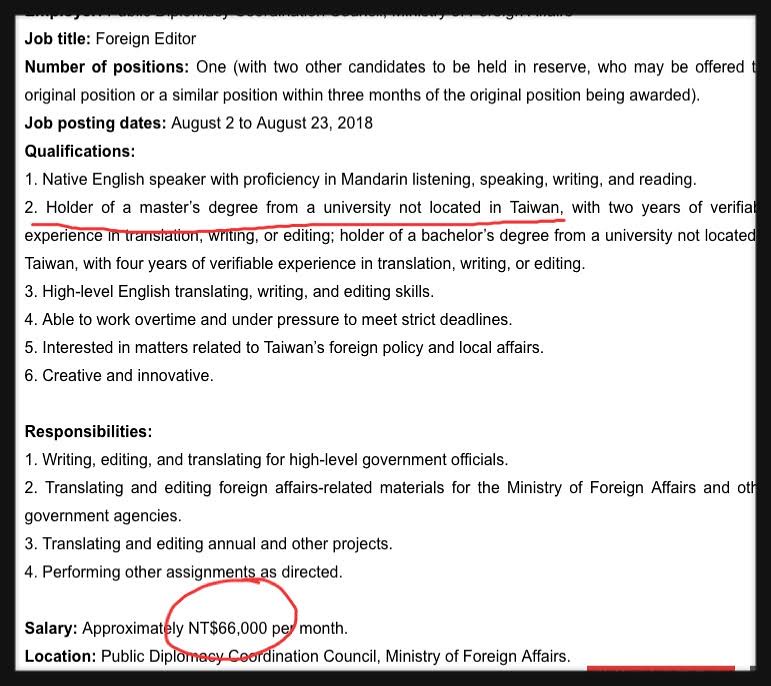
No link because the ad is no longer online. That probably means someone took the job, or they'd have extended the posting dates. It's too much to hope for that MoFA realized how embarrassing that salary offer was and immediately, contritely took the ad down until they could come up with a better offer.
My mouth was agape at the requirement of a Master's obtained outside Taiwan (the hell?), so let's briefly take a look at that. What the hell is going on that the Taiwanese government is announcing openly that Master's degrees obtained in Taiwan are substandard? (I suspect for some subjects, at some universities, they are - but even so, for the government to be openly acknowledging this is horrifying).
Then, look at the salary: NT$66,000/month. And look at what they want for that.
That's...about US$2200/month - enough to live comfortably in Taiwan if you are single or a dual-income couple, but not enough to raise a family. Enough to get by and save a little for some nice vacations, but not enough to save meaningfully for any long-term goals. In 2006, if Kojen (a large buxiban chain) put you - probably a teacher lacking most of this list of qualifications - on a salaried rather than hourly rate, it was NT$60k - not a lot less than this offer, and 12 years ago at that.
Even sadder is that they seem to have enough applications to justify taking the post down from people willing to accept that pay.
In short, it's a joke. So between bouts of laughter, I've been thinking a lot about why I stay - why any foreign talent stays, when the pay is just this damn bad. More importantly, I've been thinking about that means in terms of the greater conversation about brain drain and attracting (and retaining) foreign talent in Taiwan. Or, for that matter, local talent.
Why some people stay anyway is an easy question to answer: for me, it's a combination. My social life is very much here now. I love my friends back in the US, but there is no denying we've grown apart somewhat (this is less of a problem with friends in the UK). Not only do I find it hard to explain what my life is actually like in Taiwan to friends who have never visited.
Beyond that, I simply care about the country. Assuming I wouldn't move back to the US (and I wouldn't, unless I felt I had to), and assuming learning a new language isn't a problem (and it probably wouldn't be - I'm good at that), I find it hard to imagine coming to care about another place as much as I do Taiwan. Korea, Japan and Hong Kong are interesting - as are many places farther afield and outside Asia - but am I really going to start passionately fighting for the concept of Korean identity, or Japanese democracy or discussing Argentinian history in the detail I do about Taiwan? Am I going to start collecting and reading books about Jordan? Probably not.
Leaving aside the mostly-hideous architecture and other endemic, intractable problems here, there's something special about the place. A spark that caught my eye. A streak of rebelliousness that chimes a matching tone to something within me. A real fight, for freedom against oppression, for democracy against dictatorship, for right (if flawed) against absolutely wrong.
I've also come to learn about myself that even if I cannot vote, I must live in a free society, and one where women's issues have at least reached the level of discourse they have in Taiwan. That cuts out more than half the world, including much of the rest of Asia. China is a no-go, so is Vietnam. Hong Kong isn't quite free. Japan and South Korea have bigger issues with sexism than Taiwan.
And it's convenient - I think there's a law somewhere requiring that I say that. Sure. And I really do prefer living in the developed world, and in a place with a first-rate public transit network.
Oh yeah and all my stuff's here and my cats and all that. Sure.
Point is, if all I cared about was money, there are a lot of places I could go, and make lots more of it. Obviously, other priorities keep me here.
Other people have other reasons - perhaps their job is more tied to Taiwan, whereas I could find better work if I were willing to leave. Perhaps they've married locally, or are a specialist in local politics or history (things I am personally interested in, but am not a credentialed expert in), or have invested their whole lives in learning Mandarin or Taiwanese.
There are a million reasons why we accept low pay and generally poor working conditions, from the grounded (say, married locally) or conceptual (caring about Taiwan as a cause worth fighting for).
I'm not trying to defend the offering of NT$66,000/month to someone who would earn three times that, or more, elsewhere. I'm not saying that Taiwan is attractive to foreign talent despite being a place where, in many cases, your career can only go so far. In my own life, I'm grateful for the career boost Taiwan has given me, but I also see the end of the road: the point where I could go further in life (and make a lot more money, and eventually earn citizenship) if I were willing to leave. That hasn't changed.
And if Taiwan really wants to attract foreign expertise, they are simply going to have to offer a better, and better-remunerated, work culture. Period. So who cares why we stay?
Mainly, it matters because it breaks down this myth that talent always, in every instance, follows money. It's one thing to say that Taiwan needs to be more attractive to foreign talent. It's quite another to imply the flip-side of that, as some do: that everyone who is talented therefore leaves, or goes elsewhere to begin with, and those who come and stay must therefore not be desirable talent.
Whether we're talking about locals or foreigners, this is simply not fair. If some of us have other reasons why we stay, it follows that at least some of those who remain will have the talent and expertise Taiwan needs, and we deserve better than to be dismissed as losers for sticking around. I know people among my friends and connections here who are: long-termers a deeply committed teacher of children; a generous friend who gives up heaps of personal time to volunteer in underprivileged communities; several formidable scholars and journalists who, in the face of a low-quality media environment, ensure that information about Taiwan is available in a variety of languages; talented teachers of adults who have the training and experience to remake what it means to learn; public figures who bring like-minded expats together; a migrant rights activist; several writers and artists; several LGBT rights activists and more. So many more. Forget me, I'm just a weirdo with opinions - look at the whole picture.
And yes, there are losers too, and leeches, but we're not all LBHs (Losers Back Home) who can't leave because nowhere else will put up with our bullshit, just because we haven't chased the dollar signs to some other country. We all have our reasons for staying.
Again, so what?
Well, not all of these examples of the creativity, experience and expertise that we bring to Taiwan fit into the little pegs set out by the government. We have a lot to offer, but because we're not necessarily the kind of 'foreign experts' who do chase dollar signs, we don't always meet the qualifications to be considered a 'foreign expert'.
Becoming a 'foreign expert' costs money, especially if you have already built a life in Taiwan, and suddenly find you need to relocate abroad to gain the qualifications you need (hence my problem with the "Master's degree from a university not located in Taiwan" in that ad, although I am obtaining exactly that. Not sure how I'll afford the PhD though, with an entire life that I can't just give up in Taiwan.) Those of us who have other reasons for staying and don't just chase money...tend not to have huge amounts of it.
The way the discussion about immigration and dual nationality rights is going now, it seems most of the Taiwanese government thinks we're all worthless slobs when what they want to attract is "real" expertise, not the slothful degenerates they imagine us to be, showing up to 550/hour classes at Happy Eagle English Scholar's Acadamy still drunk on Taiwan Beer.
It dismisses those of us who came to Taiwan as nothing and built something, even if we didn't quite build it to the exact specifications set out for 'special' foreign professionals. It completely ignores the ways in which we've looked to give back, and the ways we - the ones who stay despite the crap work culture and crappier pay - are the real soft power.
I know it's a bit odd to say "we're not here for the money" alongside "...but really, we need more money". It's true, though. We stay for other reasons, but things absolutely have to get better, or we may start losing the good people who stayed on regardless. Those of us who have good but not 'special professional' situations won't move into these more prestigious jobs if the pay is so paltry.
We deserve better pay and work conditions, just as locals do (and I acknowledge locals need it more). But those who have made something of ourselves here also deserve to be recognized as the people who stayed even when we could have gone elsewhere and earned a lot more, and what that means in terms of the value we add to Taiwan.
Last month I came across this job posting with MoFA (the Ministry of Foreign Affairs) through the Facebook group of Nihao's It Going (and for those wondering why there is no Lao Ren Cha Facebook group, the answer is that I am old and lazy.)
No link because the ad is no longer online. That probably means someone took the job, or they'd have extended the posting dates. It's too much to hope for that MoFA realized how embarrassing that salary offer was and immediately, contritely took the ad down until they could come up with a better offer.
My mouth was agape at the requirement of a Master's obtained outside Taiwan (the hell?), so let's briefly take a look at that. What the hell is going on that the Taiwanese government is announcing openly that Master's degrees obtained in Taiwan are substandard? (I suspect for some subjects, at some universities, they are - but even so, for the government to be openly acknowledging this is horrifying).
Then, look at the salary: NT$66,000/month. And look at what they want for that.
That's...about US$2200/month - enough to live comfortably in Taiwan if you are single or a dual-income couple, but not enough to raise a family. Enough to get by and save a little for some nice vacations, but not enough to save meaningfully for any long-term goals. In 2006, if Kojen (a large buxiban chain) put you - probably a teacher lacking most of this list of qualifications - on a salaried rather than hourly rate, it was NT$60k - not a lot less than this offer, and 12 years ago at that.
Even sadder is that they seem to have enough applications to justify taking the post down from people willing to accept that pay.
In short, it's a joke. So between bouts of laughter, I've been thinking a lot about why I stay - why any foreign talent stays, when the pay is just this damn bad. More importantly, I've been thinking about that means in terms of the greater conversation about brain drain and attracting (and retaining) foreign talent in Taiwan. Or, for that matter, local talent.
Why some people stay anyway is an easy question to answer: for me, it's a combination. My social life is very much here now. I love my friends back in the US, but there is no denying we've grown apart somewhat (this is less of a problem with friends in the UK). Not only do I find it hard to explain what my life is actually like in Taiwan to friends who have never visited.
Beyond that, I simply care about the country. Assuming I wouldn't move back to the US (and I wouldn't, unless I felt I had to), and assuming learning a new language isn't a problem (and it probably wouldn't be - I'm good at that), I find it hard to imagine coming to care about another place as much as I do Taiwan. Korea, Japan and Hong Kong are interesting - as are many places farther afield and outside Asia - but am I really going to start passionately fighting for the concept of Korean identity, or Japanese democracy or discussing Argentinian history in the detail I do about Taiwan? Am I going to start collecting and reading books about Jordan? Probably not.
Leaving aside the mostly-hideous architecture and other endemic, intractable problems here, there's something special about the place. A spark that caught my eye. A streak of rebelliousness that chimes a matching tone to something within me. A real fight, for freedom against oppression, for democracy against dictatorship, for right (if flawed) against absolutely wrong.
I've also come to learn about myself that even if I cannot vote, I must live in a free society, and one where women's issues have at least reached the level of discourse they have in Taiwan. That cuts out more than half the world, including much of the rest of Asia. China is a no-go, so is Vietnam. Hong Kong isn't quite free. Japan and South Korea have bigger issues with sexism than Taiwan.
And it's convenient - I think there's a law somewhere requiring that I say that. Sure. And I really do prefer living in the developed world, and in a place with a first-rate public transit network.
Oh yeah and all my stuff's here and my cats and all that. Sure.
Point is, if all I cared about was money, there are a lot of places I could go, and make lots more of it. Obviously, other priorities keep me here.
Other people have other reasons - perhaps their job is more tied to Taiwan, whereas I could find better work if I were willing to leave. Perhaps they've married locally, or are a specialist in local politics or history (things I am personally interested in, but am not a credentialed expert in), or have invested their whole lives in learning Mandarin or Taiwanese.
There are a million reasons why we accept low pay and generally poor working conditions, from the grounded (say, married locally) or conceptual (caring about Taiwan as a cause worth fighting for).
I'm not trying to defend the offering of NT$66,000/month to someone who would earn three times that, or more, elsewhere. I'm not saying that Taiwan is attractive to foreign talent despite being a place where, in many cases, your career can only go so far. In my own life, I'm grateful for the career boost Taiwan has given me, but I also see the end of the road: the point where I could go further in life (and make a lot more money, and eventually earn citizenship) if I were willing to leave. That hasn't changed.
And if Taiwan really wants to attract foreign expertise, they are simply going to have to offer a better, and better-remunerated, work culture. Period. So who cares why we stay?
Mainly, it matters because it breaks down this myth that talent always, in every instance, follows money. It's one thing to say that Taiwan needs to be more attractive to foreign talent. It's quite another to imply the flip-side of that, as some do: that everyone who is talented therefore leaves, or goes elsewhere to begin with, and those who come and stay must therefore not be desirable talent.
Whether we're talking about locals or foreigners, this is simply not fair. If some of us have other reasons why we stay, it follows that at least some of those who remain will have the talent and expertise Taiwan needs, and we deserve better than to be dismissed as losers for sticking around. I know people among my friends and connections here who are: long-termers a deeply committed teacher of children; a generous friend who gives up heaps of personal time to volunteer in underprivileged communities; several formidable scholars and journalists who, in the face of a low-quality media environment, ensure that information about Taiwan is available in a variety of languages; talented teachers of adults who have the training and experience to remake what it means to learn; public figures who bring like-minded expats together; a migrant rights activist; several writers and artists; several LGBT rights activists and more. So many more. Forget me, I'm just a weirdo with opinions - look at the whole picture.
And yes, there are losers too, and leeches, but we're not all LBHs (Losers Back Home) who can't leave because nowhere else will put up with our bullshit, just because we haven't chased the dollar signs to some other country. We all have our reasons for staying.
Again, so what?
Well, not all of these examples of the creativity, experience and expertise that we bring to Taiwan fit into the little pegs set out by the government. We have a lot to offer, but because we're not necessarily the kind of 'foreign experts' who do chase dollar signs, we don't always meet the qualifications to be considered a 'foreign expert'.
Becoming a 'foreign expert' costs money, especially if you have already built a life in Taiwan, and suddenly find you need to relocate abroad to gain the qualifications you need (hence my problem with the "Master's degree from a university not located in Taiwan" in that ad, although I am obtaining exactly that. Not sure how I'll afford the PhD though, with an entire life that I can't just give up in Taiwan.) Those of us who have other reasons for staying and don't just chase money...tend not to have huge amounts of it.
The way the discussion about immigration and dual nationality rights is going now, it seems most of the Taiwanese government thinks we're all worthless slobs when what they want to attract is "real" expertise, not the slothful degenerates they imagine us to be, showing up to 550/hour classes at Happy Eagle English Scholar's Acadamy still drunk on Taiwan Beer.
It dismisses those of us who came to Taiwan as nothing and built something, even if we didn't quite build it to the exact specifications set out for 'special' foreign professionals. It completely ignores the ways in which we've looked to give back, and the ways we - the ones who stay despite the crap work culture and crappier pay - are the real soft power.
I know it's a bit odd to say "we're not here for the money" alongside "...but really, we need more money". It's true, though. We stay for other reasons, but things absolutely have to get better, or we may start losing the good people who stayed on regardless. Those of us who have good but not 'special professional' situations won't move into these more prestigious jobs if the pay is so paltry.
We deserve better pay and work conditions, just as locals do (and I acknowledge locals need it more). But those who have made something of ourselves here also deserve to be recognized as the people who stayed even when we could have gone elsewhere and earned a lot more, and what that means in terms of the value we add to Taiwan.
Subscribe to:
Comments (Atom)