Every year, the Bao'an Temple in Taipei holds a long "cultural festival" to mark the birthdays of its two most revered gods - Baosheng Dadi, god of medicine and Shennong Dadi (I've also seen it spelled 'Sengnung Dadi'), god of herbal or Chinese medicine (there is also a fairly well-known Shennong Dadi temple in Dashe, Kaohsiung County). There are Taiwanese opera performances, talks, awards ceremonies, god parades and finally - the most interesting if you ask me, as it is so rare in northern Taiwan - firewalking.
On a specified date of the lunar calendar, the idols are taken out of the temple and their carriers walk them over a bed of hot coals (made slightly less hot by a white substance, which I believe is salt or salt with rice) while a crowd watches and temple workers form a human shield around the whole thing to keep people from getting hurt.
I thought this was unnecessary until I ran into a woman sporting a pair of tongs, clearly hoping to snatch a piece of hot coal as a souvenir.
The firewalking was held today and not many people attended - it was fairly easy to get a first-line view. I blame the rain, which alternated between pouring and drizzling, for keeping the crowds away.
Ow ow ow ow ow.
I had to postpone at least one engagement to make this year's festival, conveniently held over the weekend. All week long I've mentioned to students that I'm going, as I hadn't been able to attend for years due to the dates falling on weekdays.
The most common response is - "why?"
Or "Baosheng Dadi's birthday? What does that have to do with you?" (for the more fluent ones)
It's not easy to answer, really - I'm not even inclined towards my 'native' religion, so why would I be inclined towards the folk religion of Taiwan?
No, I don't, to be honest. I don't believe that any of it is true.
So, why the festivals?
Simple.
Because they're awesome. The Taiwanese - generally - will be the first to tell you that in many ways, these festivals are just as cultural as they are religious. This seems to be a common thread among religions with native roots, that weren't started by a single person or prophet - a belief system so ingrained in daily life and custom that it's hard to even define it as a "religion" in the Western sense.
You would likely offend a few Christians, Muslims or Jews by attending religious services for those religions simply because they're "cool" (imagine, ironic hipsters flooding the church or synagogue!). They'd expect you to be genuinely interested in spiritual matters or at least curious - many might humor you, but on the whole there'd be less tolerance for someone who showed up just because the whole thing was very aesthetically pleasing.
Folk religions are simply not like that - whatever the reason, you're welcome to show up and even take pictures. Many Taiwanese will admit that they practice a lot of the old customs just as much for cultural or family reasons as religious ones - it's a part of a way of life, not necessarily an organized view of how the spiritual world works.
But, you know - bajiajiang, spirit mediums, lion and dragon dancers, tall gods, firecrackers, suo na (those screechy oboe things), drummers, martial artists - it's not only visually stunning, it's not only culturally fortifying, it's also fascinating.
I'm a big believer in people finding their own path - if it works for you and doesn't hurt others, then it's right for you and nobody should be able to tell you otherwise or insist that you follow their ideas of how you should live. Along these lines I respect the views of people of all religions (up to but not including the point where they try to tell me that their way is better for me), I respect atheists and agnostics, and I respect people who follow folk religions such as is done in Taiwan, even if it's just for cultural reasons.
I guess, in a way, that sort of makes me Daoist, though I don't identify as such. Lao Tzu's super hippie "find your own way" and all that.
There's another element to it, though - the wild dancing, the betel nut and energy drink consumed in liver-splitting quantities at the larger festivals, the joyful noise, the firecrackers set off in places that can't possibly be safe, the darker undertones of some of it (what with the gods of the underworld also in attendance at these festivals, the firewalking, the fireworks festivals where they pelt people, the self-injury of the spirit mediums)...it's so very, very un-Chinese.
I don't mean that in a political "Taiwan is not China" sense (although that is also true!) or in a "this is not really Chinese" sense. It is Chinese, but I mean Chinese in the sense that many Westerners and many Taiwanese and Chinese have come to view this culture (as different as it is in Taiwan and China).
How do they view it?
Mostly as something very Confucian.
You know - sit down, do what you're told, respect your leaders, don't talk back, subjugate the individual, let's all dance to terse, dry music in perfect harmony and let's all agree that that's what's best.
As a friend put it yesterday, that view is very KMT: sit down, do what you're told, your leaders know what's best, don't talk back, maintain the status quo, we are your betters. There's a reason why the KMT generally favors straight-laced Confucianism over crazy, earthy, follow-your-own-path folk Daoism.
It barely exists in China anymore (there's Buddhism and great reverence for Confucius, but you'll never get photos like these of folk festivals in China because there aren't any - or there are very, very few), and I feel as though there is a great divide in Taiwan over its continued existence here. Nobody of any clout actually comes out and says "this is for low-class people, this is for tai ke, we're more refined than that", but you know plenty - including most likely Ma Ying-jiu - think it.
I'm not just making this up - we chatted with someone who works at the Confucius Temple and she confirmed that it gets preference and often more funding than Bao'an Temple - or the funding is split because "you are right next to each other so you can work it out" and then before Bao'an can get its hands on it, it just...isn't there.
It's almost like a tiny re-enactment - a play within a play - of broader Taiwanese politics, lobbing preferential treatment, resentment and ideology across narrow little Hami Street in Dalongdong.
As a result, she said, whenever the Confucius Temple has one of their staid and buttoned-up functions, Bao'an Temple comes up with a reason to set off fireworks and beat drums: basically screw you guys and the Analects you rode in on!
Which I totally respect - I think it's very much a part of this system of folk beliefs to basically give someone the finger if you think they're undermining you.
The preference is quite clear. "Follow your own path"? Crazy dancing and folk beliefs? The government allows it but deep down, I think they're a little scared of it.
This is just as legitimately "Chinese culture", but it's the darker, more individualistic, more passionate, more uncontrollable version of it: sort of like the yin to Confucianism's yang. You can let go of "sit down, shut up, respect your elders" and be yourself.
All that blather about how "Chinese culture is homogenous" and "They revere the group over the individual" and "they respect authority" goes out the window.
And I love it. This is the "Chinese" (I'd say "Taiwanese" because you really don't see this in China - you might come across some lion or dragon dancers on Chinese New Year or when a new store is opening, but that's it) culture that appeals to me.
In fact, I'd go so far as to say that this is a big reason why I'm still here. It's so exuberant. It's so celebratory. It's so individualistic. It's so loud and in your face. It's everything you don't think of when you think of Taiwanese kids (or Chinese kids) taking math tests and doing what their parents tell them to.
You could almost say it's the ultimate Chinese hippie revolt, or the ultimate indie vibe.
It's also loud. And ebullient. And maybe a little dangerous.
So today was Baosheng Dadi's birthday (Baosheng Dadi is the god of medicine). Anyone who's lived in Taiwan for any length of time knows that god birthdays are generally celebrated with a lot of firecrackers and a parade in which that god - and some other ones who are along to pay respects - goes around town in a palanquin to the accompaniment of great cacaphony. Generally he's followed by dragon dancers, lion dancers, tall gods and sundry other awesome stuff that makes for great photo fodder.
Baosheng Dadi's temple, Bao'an Gong, is a UNESCO world heritage site in Dalongdong, and his birthday parade is one of the biggest - if not the biggest - in northern Taiwan. It was today (but there's firewalking tomorrow afternoon, and Shennong Dadi's birthday is coming up as well so you can still get in on the fun if you want).
Here are a few photos from our day of watching the festival go by (more to come later):
The Messenger - this comical guy walks in front of Baosheng Dadi's palanquin, giving out Ritz crackers and letting people know he's coming.
This is some sort of costume group - 11 of them look fairly similar, then there's a grandma (above) and one that looks like a young girl. I think the ones who look alike are meant to be sisters.
A martial artist in a troupe prepares for a match.
One of the "sisters".
A bajiajiang (array of eight generals) mid-performance
Dragon dancing was big this year.
I like how he looks like he's comin' to get me.
I try to show up early for these parades if I know they're happening so I can get good close-ups of the tall gods and other folks.
Like these women, who are in some sort of Yunlin-based dance-and-cymbal troupe.
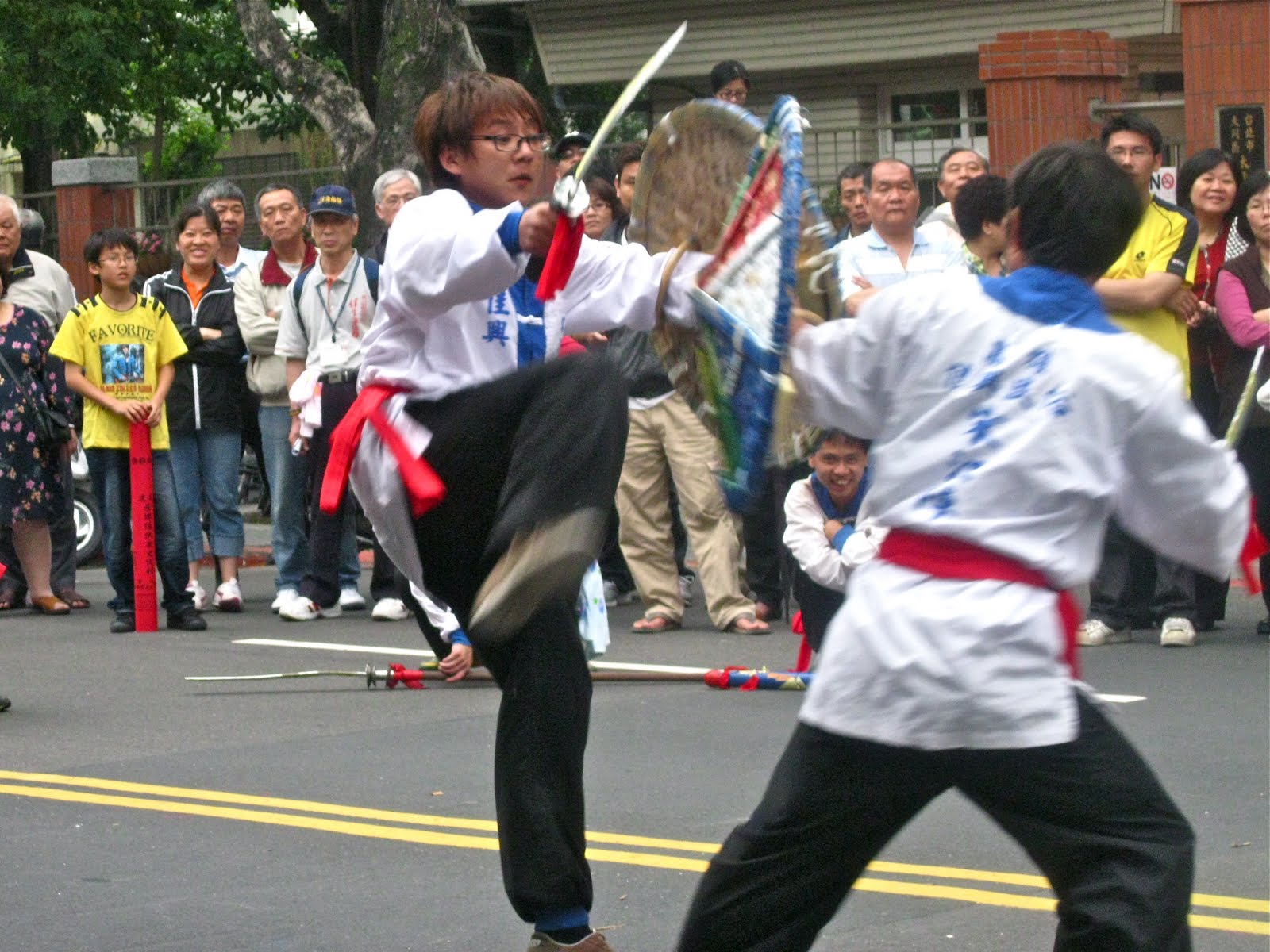
The martial arts troupe was really spectacular. They were so fast that I didn't get a lot of non-blurry pictures.
Note: contains some strong language (aka, Sorry, Moms)
OK, I’m writing this even though I don’t actually have any dating experience in Taiwan.
That’s not entirely true – I had a date in Taiwan before my then-soon-to-be-boyfriend-and-now-husband moved here. It was unequivocally the worst date of my life. Because I am a terrible and tawdry gossip (I know. I KNOW) I’ll tell you about it if you know me personally and ask.
I just feel that while the Intertubes are filled with floofy articles on expat women and dating – like this one and this one (and one blog post so offensive that despite it coming up fairly high in search results, I won’t link to it) - this one is pretty good though. Few have anything constructive to say.
Basically, they’re fine in that they do a good job of describing the situation, but, like Captain Hindsight, they don’t really confront the problem and give real, first person, been-there advice or ideas for single women living in Asia.
That may well be because they don’t want to say.
A lot of what I would say is universally applicable, at home or abroad, and yes, a lot of it is a bit hackneyed and even more of it is “prepare for a desert, a dearth of options”. In the end though, it all boils down to “be you – Super Awesome You – enjoy your adventures and let the rest take care of itself, luck willing”.
But I always know what to say – or at least what I want to say – so I’ll give you my own advice:
1.) For all that is good in the world, do not approach the dating scene with bitterness…
…even if you are single and looking to date, and you want to feel bitterness. It’s not that it’s wrong to feel that way. There’s definitely something to it. It’s just that letting it flow out of every pore or making it the topic of heated conversations, eye-rolls, complaints and smirks is the least conducive action you can take towards making things work for you.
I do NOT mean this as “be upbeat, ladies, because men like women who are happy! So if you’re sad, turn that frown upside down and pretend to be happy!”
Because a.) that’s a big pile of stinking dumb right there, and as Queen Cynic I am the last person to preach what I don’t practice and b.) it applies to men as much as women. Do you want to date a man who is bitter, angry and willing to start uncomfortable debates over it, and rolls his eyes at anyone who seems happier than he is? No, you don’t. And come on, not every male expat in Asia is like that. You’ve surely met That Guy and surely thought “not if the Apocalypse happened and it was between him and a mutant cockroach. I’ll take Roachie.” – but don’t judge all foreign men because of That Guy.
It’s not a gender thing, it’s a “nobody wants to date a whiner” thing. For both men and women.
Seriously – talk about your last solo driving trip across Chile, or the time you crapped on a pig because the toilet in the village was on stilts above a pigsty (the most awesome guys will love this). Talk about your language classes or how you went camping in the jungle, or how you were detained at a border but got out of it by smooth-talking the immigration officers. Don’t go on about how dating sucks for female expats in Asia (because everyone knows that it does – that’s nothing new and doesn’t make you sound interesting).
This is admittedly hard to conquer, because it’s so easy to feel bitter about a culture – expat and local – so clearly stacked against you. It really is unfair, and yes, it really is stacked against you. Yes, it sucks and yes, it would be great if there were a way to change it. But…
2.) …instead, jump into life abroad with an “I chose to be here, I know the downsides but I’m having a great time, there’s a lot to see and learn, and you can go stuff it if you assume I must be bitter” attitude.
Really. If you know the scene before you arrive and you come with an “I don’t care, I want to have this experience anyway” outlook, it will all turn out better for you. You may decide that you really like independent life and decide to stick around, or that being single is an acceptable likelihood of the exciting life around you.
And approaching it with calmness and confidence will simply make you more awesome.
3.) Don’t assume you definitely won’t date. You might.
As I said, I can name gaggles of women for whom the stereotype isn’t true. When worked in China with my friend Jenny – single, Western female – right around the time I left she snagged a musical Brit, the only other expat in town. They’re now married. I had a brief fling with Brendan in Beijing when we clearly like each other but before we got together (hey, it’s all good, we’re married now). When I lived in a shared apartment during my first months in Taiwan, the other roommates were all male and at least one of them partnered up, albeit briefly, with a South African woman. Out on a group outing, I met a couple who had met while they were both teaching in Korea. One does come across Western woman-Taiwanese man couples – plenty of Asian men are eminently dateworthy. Don’t dismiss them out of hand.
4.) Don’t dismiss all the male expats (or all local men), either. Or anyone, for that matter.
My now-husband was a single Western male expat in Korea, and he’s the sweetest, most non-judgmental, most openminded person I know. He’d be a catch for any woman, Asian or Western. There are good guys in the expat community. Don’t judge them all as a monolithic gaggle of dicks. They’re not. Contrary to popular belief, there are expat men who do in fact date expat women.
Similarly, not every local guy is going to conform to whatever stereotype there is of local guys out there. There are mold-breakers worldwide, and if you're confident and cool with yourself, you are more likely to find them.
Heck, don't judge Asian woman-Western man couples, either, unless they are clearly icky. I know they say that you never know, but honestly you can usually tell which couples are genuinely happy together and which are total ew-fests fairly quickly.
And while you're at it, don't judge Asian women. It's too easy to fall into the trap of "ugh, those Asian women all starve themselves, act coy, flirt, go all submissive! And the men love it! I hate that!" - but you know? No, they don't. At least not all of them, and maybe not even most of them. Don't assume. Don't hate on other women generally - you never know who is a stereotype-destroyer and the best way not to find out is to barter in stereotypes.
5.) Make friends. Join clubs.
Seriously. Most countries in Asia have various expat venues in which you can at least make friends. It’s not guaranteed but friends may lead to invitations and introductions that may lead you to a great guy (or gal, if you swing that way. I know almost nothing about the lesbian and bi communities abroad, so I’ll let a blogger savvier in those areas cover that). Even if they don’t, friends are great regardless. Who cares if you don’t have a date (dates can be excruciating anyway) on Saturday night if you have a bar date with your girlfriends or a pub crawl with a local group? If you’re religious, joining a church or other faith group is a good way to meet people, just as it is in the USA.
OK, sometimes this backfires – I heard a story not long ago about a Western woman who joined a photography club somewhere in Asia and while she wasn’t rebuffed, she was basically ignored during meetings and outings – the men there, who often brought their Asian girlfriends, didn’t want her there. This isn’t the sort of club you want to join, but I promise, most are legit.
So hey, is the place where you’re working having an outing or happy hour? Go! Is there a club, pickup team or whatever group meeting regularly? If it interests you, go! At least you’ll have social opportunities, you’ll probably make at least one or two friends, and it’ll put you in touch with the wider expat community.
I have to admit that I haven’t been proactive with this in recent years. I used to go out with my teacher recruiting company on their regular nights out, but I cultivated my own set of friends, got a boyfriend-now-husband and don’t feel the need to go out on late-night club crawls. If I want to go out, I invite some friends to Shake House or somewhere similar and drink good beer while talking.
Taiwan has plenty of these groups – as I said, my teacher recruiting company (years ago when I was a buxiban teacher and not in corporate training) has regular nights out, I know of at least one soccer pickup club, a Community Services Center book club and other groups you can join.
There are definitely opportunities to socialize, and if you make the effort, it’ll not only lead to meeting more potential dating partners, but even if that doesn’t happen (and it often doesn’t), if you have a full social life, you’ll be more inclined to be content with being single.
Finally, don’t be afraid to venture out to lively nightspots on your own (at least in Taiwan, Japan and Hong Kong where it’s fairly safe – I can’t speak for the rest of Asia). Stay away from known seedy hangouts of men looking to ogle Asian women simply by virtue of them being Asian and go somewhere more young and studenty. Chances are you’ll have at least a few decent conversations.
6.) This is going to sound clichéd, but be yourself.
No, really! I mean it! I know it sounds downright ridiculous and is probably something a stupid self-help book also said, but really. You’re here because you love the food, the language, the whatever-whatever, and you regularly show up to Chinese Club or Hiking Club or pub crawl activities. You knew what you were getting into before you came, and you’re fine with it because you wanted to explore the world – and your desire to travel trumps any desire to settle down and attach yourself to a man.
Let that show, and while dating is not something all that common for Western women here, you’ll be far more likely to get…err…lucky. In the totally not-dirty sense, but maybe the dirty sense as well.
Because, seriously, what’s more attractive: a woman who is all “Oh my god, all the men here date skinny Asian chicks, that’s so gross and disgusting, and I can’t believe it!” or a woman who is all “yeah, I’m here, I’m learning Chinese, I’m taking a kung fu class and if you think I’m bitter because I’m single than you can shove it up your butt, in fact I’ll help kung-fu kick it up there”?
(Same goes for men: what’s more attractive – a guy who whines “Western women are so demanding/fat/nagging/opinionated/difficult! Why would I ever date one again!” or a guy who is all “yeah, I love confident, awesome women regardless of where they come from”?)
7.) Know when to fold ‘em.
I know – you go out with a group and there’s always That Guy who goes off on why he always dates Asian girls – it doesn’t even matter what his reason is (you can fill in the blanks for all the usual ones). You want to shout at him that he’s a sexist, pseudo-racist jerk.
Here’s the thing – that never works. It just makes you look bad, and it doesn’t change anyone’s mind.
Think of it this way: you don’t want to date That Guy, do you? (No, you don’t). That guy’s kind of a douche. My previous incarnation was the sort of woman who would give That Guy the what-for, and it never accomplished anything.
What you do instead is let him talk – he sounds like an idiot, everyone else knows it (and if they don’t, they’re just as bad) and he’s hanging himself with his own words. I’d say “don’t roll your eyes” because I like to think that I wouldn’t do so, but I totally would, so I’ll toast you for that. Another option is getting up and walking away, because nobody should have to listen to that drivel.
You’re entitled to your opinion, but if you don’t want to date That Guy anyway, and you don’t want to be friends with him either (who wants friends like that?), what’s the use of coming out with it right then and there?
Yes, it’s unfair, and yes there are plenty of guys like that across the expat communities of Asia. Yes, I’d love to change it to. The only way you can even come close to making a dent in it is to be Ms. Super Awesome. Rise above it, don’t give it the dignity of a response it doesn’t deserve, and keep on being awesomely you. Just by being that awesome, you’ll show everyone else that That Guy is a douche, and that female expats are worth their attention, friendship and romantic overtures. This is something that reacting with the predictable bile will never accomplish.
That said, a witty retort, if you have one, is always appreciated. If That Guy is being douchey and your rejoinder is funny, a bit ascerbic but not downright bitter, that’ll earn respect. If it doesn’t, hang out with different people.
And yes, while everyone is entitled to date only people they like and are attracted to, “I only date Asian women because of X” does have a ring of sexism and racism. You’re not wrong. The best way to show that for what it is is to be spectacular – even if that means walking away without a word – and the worst way is to start an argument in a bar on a night out.
Seriously – the best way to throw stereotypes in others’ faces is to be Super Awesome and anyone who doesn’t like it can shove it. If That Guy starts spewing a bunch of idiocy about Asian women and Western women, simply by showing that you don’t stack up to that idiocy, you’re making him look bad.
(Rules are different for Internet forums. I’m not sure that’s worthy of a separate post, though).
8.) Don’t lower your standards and don’t try to compete with local women.
This is the one piece of advice I found while perusing online – “lower your standards” because you’re not going to get the same guys here that you could back home.
That’s a big ol’ deposit in the bullshit latrine right there. Don’t listen to it. There’s no point in saying “don’t have unrealistic expectations” because that’d be true wherever you are. Same deal for “be openminded and let yourself be surprised by guys you might not ordinarily consider”.
Otherwise, if you wouldn’t like the guy back home, you won’t like him here, and that won’t lead to anything good. You have not lost any rights to set standards for yourself just by living in Asia. Stick with them – the guy you want to date will meet them (there’s no guarantee you’ll meet that guy, but if you do, he will meet them).
Basically, if you are who you are and know what you want - just like back home -
Likewise, you probably have a different complexion, life outlook, set of mannerisms, body type and bone structure that is fundamentally different from women in most of Asia. Don’t think that you have to try to force those things into a mold of what you think men – both local and expat - want. If you meet a guy worth dating in Asia (or girl, if that’s how you roll), he’ll like you as you are. If he doesn’t, he’s not the right guy to date. It doesn’t necessarily mean he’s a bad guy, just not right for you. And for all that is holy – be healthy by all means but don’t try to force yourself to look or act like something you’re not.
9.) Figure out what your goals are for dating.
If you’re just looking to have fun or something to do on weekend nights, recalibrate that to include group outings, and at that point by all means date guys you aren’t serious about (within the realm of safety and sensibility of course) if the chance arises. Organize events and invite people to bring friends – you might meet someone or not, but regardless you’ll be getting your fun nights out.
If you are genuinely looking for a partner, then apply all of your regular criteria for finding someone you want to spend time with. Accept that it may not happen – heck, it may not even happen back home – and do your best to attract that person by simply being your amazing self and getting out there to socialize as much as you can, including making friends you’d never date.
10.) Make a diverse group of friends and be socially proactive.
One of the best things about life in Taiwan is that I have a group of friends made up of expat men and women and local…well, mostly women but there’d be men too if the men hadn’t gone abroad for work or school. Having this kind of group can ease loneliness and lead to social opportunities that might – no promises! – bring dating opportunities.
It’s not as hard as it seems to make these friends – especially other female friends. Other female expats are probably just as desiring of female friendship as you are – so seek them out by joining clubs or posting on online expat forums for your country. Local women looking to befriend foreigners, but not looking for a foreign boyfriend, will also be on these forums.
Sometimes it takes a little adjustment – I love my local female friends but there are cultural differences: “I know I said I’d come out but my aunt decided to visit so I can’t”, “it’s almost 11pm, I should get home or Grandma will worry!”, “Oh, no beer for me thanks” – and you might find your social events ending earlier than you’re used to (at least in Taiwan), but that’s more cultural adjustment than anything. Get a group of expats together for late night shenanigans.
I guarantee that by branching out into local as well as expat friends – something surprisingly few expats do despite talking about how they’d like to – you’ll feel more connected and more grounded overall, and if you don’t date as often, you also might not notice as much.
11.) So you don’t want to date That Guy. Who do you want to go out with?
You want to go out with a guy who, while he may be happy to date local women, is just as happy to date foreign women – he likes women that he likes. He doesn’t like women based on arbitrary criteria of racial background, but rather, he likes them for who they are, end of (which includes physical attractiveness). You do not want a guy who will ignore you just because you’re female and not local.
You want to go out with a guy who hears your stories of life abroad and thinks they're fantastic. You want to go out with a guy who likes it when you get a bit cynical or debate-y, and who, while he may not like it, at least accepts that everyone - even women - gets crabby now and again.
Those guys do exist in the expat (and local) community. I married one. They are out there and while I can’t promise you’ll meet one, if you just come here with the intent of having a good time, having a few adventures and stories to tell, and being Your Awesome Self while engaging socially in a variety of activities, he is far more likely to appear.
And the other guys who are turned off by this? Well, you’re awesome, they’re missing out and that’s just too damn bad for them.
I know. Cliched and hackneyed - but how often do you get advice that can be summarized basically as "be awesome, have adventures"?
Not nearly often enough, I'd say!
12.) If you’re female and planning a stint abroad, don’t assume you’ll have as many opportunities to date. To be honest, you likely won’t.
I know that sounds depressing – I don’t mean it to be, but there’s a tragic knell of truth to it. If you’re planning to spend a year or more in Asia, and you’re female, there is a pretty good chance you won’t be doing much dating.
I’m not saying you definitely won’t date – I can tick off so many fingerfuls of expat women who defy the statistics and tell likelihood where to shove it.
That said, you know how “forewarned is forearmed” and all that? Like how if you know you’ll probably poop out half your body weight in India before you go, that it’s not nearly as traumatic when you do, in fact, poop out half your body weight, and it’s a nice bonus if it never happens – but if nobody tells you before you go, when you start with the unstoppable bathroom antics you feel all stressed out and infuriated?
It’s true. If you prepare yourself for the reality of life as a single expat female in Asia, and acknowledge the datescape for what it is, if you do date (and you may) then that’s great, but if you don’t date as much (or sadly, as happens sometimes, at all), at least you came prepared to face this reality, and so it’s not as hard to deal with once here. Having a prepared-and-forewarned attitude about it makes it both far more bearable and makes you far more engaging and likeable, because you’ll be fine with where you are and confident that you’re doing what’s right for you.
I personally came to Taiwan on the heels of a breakup – a fairly clean break, not a long relationship, already clearly better for all involved that we not be together, and we made a valiant effort to remain friends (in theory, we still are, but we haven’t talked in years). Despite this cauterized ending-and-beginning, I still wasn’t entirely “over it” and wasn’t immediately into dating or looking to date – I was happy to spend some time as single me enjoying life abroad. It was pure luck that Brendan showed up when he did – I don’t believe the whole “it will happen for you when you are happy with yourself” because plenty of women who are happy for themselves don’t see romance immediately bloom – just as I felt fine giving up my single lifestyle and yet was happy with where I was. It was a good time to come – not really into dating, ready to spend some time on my own having adventures. If you can find that “you” place where you can make peace with a stint as a single loose cannon, well, that’s just about the right time to come live abroad for awhile.
This also means not centering your life around men and dating, but that would be my advice regardless of where you live. Live for yourself, not some hypothetical (or real) boyfriend.
I'd like to throw a big shout-out to all the Old Ladies of Taiwan (and Taxi Drivers of Taiwan) for daring to ask the tough questions - questions that they really need to know the answers to, and if they don't get them, clearly the Earth will stop spinning and the sky will fall in. Questions that generally seem to fall on foreign women - although men get them too - and require either contortions of information and explanation or just reddening silence and a mumbled "我也不知道噁".
They're really quite adept at getting, ahem, all up in yo' bidness:
"Are you married?" ("Why not?") "Do you have kids yet?" ("Why not? You should have a boy and a girl. But not more than two.")
Variation: "How many kids do you have?" ("None? Why not?") "When will you have kids?" ("Why not?") "Why are you fat? Are all Americans fat?"
"Have you gained/lost weight?"
"How old are you?"
"How much is your rent?" "What do you make per hour?" ("Oh, my granddaughter makes more/less than that.")
"Did you vote for Obama? Did you know that he's black?"
"What do you think of Ma Ying-jiu?"
"Did you have a boyfriend before you got married?"
"Why are Americans so rich?"
"Do you still work after marriage?" ("Why?")
"Why are your boobs so big?"
"Why do you have hair on your arm?"
"Why do Americans let their parents die in institutions instead of taking care of them?" "Why did Americans elect someone stupid like Xiao Buxi?" (George W. Bush)
"Why doesn't America like Taiwan?"
"It's cold/warm out you shouldn't wear that." (for all values of "that")
"Where did you buy that? How much did it cost?" ("That's too expensive.")
"How much money do you save?"
"Why don't Americans save money?"
"Why do you have an iPhone" (note: I don't have an iPhone, I have an iPod Touch) "you should save your money."
"Why do you travel so much? You should save your money." "You should cook at home, not eat here" (while the beef noodle joint owner glares) "...you can save more money and beef noodles will make you fatter."
"Why are you eating that?" ("It's not good for you.")
"Do you believe in Christianity? How about Buddhism?"
And both "Why didn't you stay in the good American economy" and "Why is the American economy so bad?"
"Did you live with your [now-] husband before marriage?"
"Did your father allow you to move abroad/live with a man before marriage?"
I mean, come on ladies, the world needs to know. How will we ever carry on without knowing how old you are, why you don't have babies yet, why you weigh what you do and who you voted for!
And yes, I did say "ladies", because we female expats do get more of this than the men, although they get it too. It's like being female opens you up to being asked so many more probing questions, or maybe it's that the Old Ladies and Taxi Drivers of Taiwan don't think it matters what the men weigh, how old they are, whether or not they're married (and why - they have to know why or it simply does not count), what their rent is and how much they save. Maybe it's a woman-to-woman thing that transcends culture and generation, like when I showed my wedding pictures to my friend's Grandma and we bonded despite age, culture and language barriers. (Note: the same Grandma who talked at length about how she'd run her son's house differently from how her daughter-in-law does it, and who admonished me to have two kids, not three, because she "had three and you can't carry them if you have so many, so don't make my mistake").
You also open yourself up to it more if you clearly speak Chinese; more so if you speak enough Taiwanese to get attention, despite not being nearly fluent (not that I'd know anything about that, ahem).
So. Let's take stock of me.
Young? Check.
Female? Check.
Married? Check.
Speaks Chinese? Check.
No kids yet? Check.
Living in a neighborhood with few foreigners? Check.
I'm like the poster girl for the kind of foreigner Old Taiwanese Ladies and Taxi Drivers like to hurl questions at like streams of betel nut juice at a sewer grate.
Fortunately for them, I'm fairly open. I won't tell them what I weigh and I won't dignify the "No kids? Is that because you're fat?" questions with a response, but I'm happy to talk to them about why I don't want kids right now - I leave the "do you want them someday" debates firmly off the table - what I think of Ma Ying-jiu, how much my rent is, how old I am etc.. I'm not sure if I'm just naturally a sharer or I've been in Taiwan so long that I've become desensitized and I just don't care if they know what I make and the fact that I lean green.
That said, at my non-answer I got the best rejoinder ever from an Old Taiwanese Lady: "if you want to lose weight, you should eat less and exercise more". Thanks, Old Wu. Because I totally didn't know that.
And really, you just have to laugh. The questions are clearly not going away - Taiwan will always have taxi drivers who ask you all sorts of crazy stuff, and those Old Taiwanese Ladies are already pushing 150 and will probably outlive you.
Which reminds me - best conversation ever:
Old lady in night market, grabbing my butt: 妳為甚這麼胖呵?
Me: 妳為甚麼這麼老呵?
Old lady in night market: 因為我小的時候我不是那麼胖啊!
(Old Lady: 1 - Jenna: 0).
Anyway, I figure, they're just trying to be friendly. They don't mean it to be rude, and don't even realize that there are people out there who think it is rude - or they realize it's a bit rude but when it's 2011 and one is old enough to tell stories about one's childhood friend the Dowager Empress Cixi, one simply stops caring.
I can see how this might bother some foreign women enough that they'll choose not to stay, and I've certainly heard my share of Western women mentioning this phenomenon. I do think that most of us take it with a grain of salt ("Don't eat that salt! It's not good for you! How will you have babies?") and adjust to it enough that we can laugh about it rather than be offended.
I have found that if you actually answer their questions, they tend to like you more and sort of adopt you as a surrogate granddaughter. One woman in my neighborhood, who's 75 if she's a day, has taken to calling me 妹妹 ("Little Sister"). Another told me her life story, which was a fascinating insight into life 60+ years ago for a Taiwanese woman, from the perspective of that woman and not a museum exhibit or history book written by a bunch of men, and was totally worth divulging my age and rental fees.
In the end, this isn't a post complaining about the personal questions or asking "What's up with that?" because deep down, I think we all know what's up with that.
It's more of a chuckling recognition, and maybe a bit of a warning for any potential expat women who find this blog before coming, or who are just settling in and dealing with culture shock. Be prepared.
Note the 7-11 down the road from the main 7-11. There is probably a Hi Life next to the photographer and a Family Mart behind him/her.
Convenience Stores. Everywhere. So convenient that they're actually a little too convenient, too the point where a big facet of culture shock here might well be that there are just too damn many 7-11s in Taiwan, and do they really need to put a 7-11 around the corner from another 7-11, across the street from a third 7-11 and next to a Family Mart?
As you know, 7-11 not-so-recently started offering espresso drinks - lattes, cappuccinos (which are basically lattes), Americanos etc.. The coffee is about as good as Starbucks but no better - perfectly acceptable, inoffensive, but with a one-note flavor ("espresso roast coffee") that has nothing close to a bouquet.
That's fine with me, because if I buy a 7-11 latte - and I do, because I'm both a coffee snob and a coffee slob - I'm not looking for a flavor profile or a complex bean with a fruity nose, woody bouquet and chocolatey finish. I'm looking for a basic latte because I need to be caffeinated at hours of the morning when I don't feel like brewing coffee at home.
Well, the coffee machine at the 7-11 near me - correction, at one of the 7-11s near me - broke a few weeks ago and is still not fixed. I have a tendency to leave home with just barely enough time to get to class, so for the first few days I just bought a Red Bull instead ('cause I'm healthy like that).
Now I walk a few steps in the other direction to get coffee at the Hi Life before my 8am class, which is maybe a half-minute walk from 7-11, and pick up a sandwich at the breakfast shop on the way.
This is both wonderful and terrible.
Wonderful because if the coffee machine at the place nearest me breaks, I can walk less than a minute to another convenience store for coffee.
Terrible, because that extra twenty meters (at most) is just so inconvenient!
Never mind that I come from a country where, if you don't live in an urban area you have to drive a mile or more to get anything (from my parents' home, you literally cannot walk to anything at all - you have to drive. It's that rural). If you live in a city, you still may have to walk ten minutes or more to get what you need. It's not considered a big deal that you have to plan shopping trips and remember everything - "must get pens! Don't forget or you'll have to drive back!" - and not a big deal that even something simple may require navigating an entire Wal-Mart five miles from home.
Here, I take it for granted. Forgot paper clips? Who cares! I can just get them the next time I leave home and take ten steps. In the middle of cooking dinner and out of soy sauce? So what! Send Brendan out and he'll be back before I've even got the contents of the pot heated up. Back home you'd have to turn the oven off, cover the pot, get in the car and drive to the nearest store, wasting at least a half hour if not more.
Back home, there were two options for coffee before work (if I didn't make it at home, which I never did because I always wake up at the last possible moment) - office break room or overpriced Starbucks in the hotel next door. If there was a line at Starbucks and the coffeemaker at work was broken, it was really, truly irritating. I might not get coffee for an hour or more - I had the sort of job where I had to at least put in my face by 9am: five minutes late and there'd be a "discussion" with the manager. Fer serious. I hated that job.
Now, a few steps out of my way and maybe one extra minute of my time is an inconvenience and my old work situation would be unbearable.
Back home, for lunch I could either bring my own or buy something in the office park food court, or eat in the hotel restaurant. That was it. In Taiwan, I can eat here or here or there or that Tainan noodle place or dumplings or a sandwich or a crepe place or lu wei or I could just grab a 7-11 sushi roll or Sushi Express or that shwarma stand or won ton soup or fried rice or pasta or...
That, my friends, is what I call perspective.
Which makes me wonder: like the two aisles of cereal and twenty-six kinds of soft drinks that nobody really needs in American supermarkets, is all this convenience good for us? Is it turning us into spoiled brats who can't be bothered to walk a few meters out of our way?
It also makes me wonder - do I mind? Nah. It's made me spoiled but I kind of love it.
I'd say that the amount of time Taiwanese office staff are expected to stay at work is a human rights violation (OK, I'm using hyperbole, but come on), but otherwise...great.
Except.
As usual, women and children are the ones still suffering. Domestic abuse (including child abuse), rape and spousal rape, including discrimination against women, are all still significant problems in Taiwan. This I also believe: random acts of violence against women are not common - women can walk outside, alone and safely, at literally any time of day or night and not have to fear being attacked. I am sure it does happen, but it's so rare that I feel quite safe in Taipei, even in the darkest hours of the early morning.
It's violence against women by people they know and are possibly married to that remains a problem - for several reasons. It's still a social anathema to report spousal rape, there are still people who believe - even if they wouldn't admit it openly - that spousal abuse is acceptable/explainable (ie "she deserved it, if she kept him happier..."), that rape within marriage is not really rape, and that it's OK to hit your child. In many cases, saving the face and protecting the family status of the relative is considered more important than getting help for the wife or child, and so cases go unreported. Many foreign brides have nowhere to turn when they suffer abuse, and that goes unreported too.
And, as usual, despite a generally clean human rights record (human trafficking is still an issue, but at nowhere near the levels of other Asian countries), those still suffering are women and children. We can clean up most of the problems in a place, and yet there will still be people who think it's OK to treat those two groups as subhuman.
One is half the population, adult females who are still grouped in with people who are not yet adults - in many ways, around the world, women are treated more or less as children, workhorses or both - and the other is most defenseless segment of the population.
So the US government won't be shut down after all - which is a good thing, I guess, when it comes to museums, parks, federal workers, federally-backed mortgage approvals and government services for the poor and elderly. Allowing it to be shut down would have also had some upsides, and I'm not entirely sure it wasn't a good idea to just let it happen (for once, I agree with Eliot Spitzer!) and what we've got is a country where liberal social principles are triumphing, but Republican (I can't say conservative - it's not, really) financial ideas are sharing that winner's circle.
This brings about an interesting little eddy in the writhing tides of comparative politics.
Before we found out that there would be no shutdown, I mentioned it to a student. She was taken aback - positively horrified - by the idea that a government would go so far as to not reauthorize spending to maintain itself.
"I thought that American politics was more mature than Taiwanese politics, and these things don't happen in America," she said.
"Yeah, well, that's not true. We're just as immature politically as the DPP and KMT. The arguments and divisions are different but the rhetoric is the same. The only thing that separates the Legislative Yuan from the Senate is that American Senators don't beat each other up..." (Which, actually, I'm not sure is historically true). "...although sometimes I think they should."
And it is absolutely true. For all the complaining that you hear about politics in Taiwan and how it's too rough, immature, pointless, boastful and full of empty rhetoric and political game-playing over serious investments in improving the country - honestly, you'd think that that was only a problem in Taiwan. It's not. We're just as bad, if not worse. I mean, is there a Taiwanese Sarah Palin? Although, for all his wishy-washiness, Obama is a better and more centrist leader than Ma.
Both countries are deeply divided over social and economic issues, and both of those divides follow cultural lines (in the USA it's generally regional and is in some way related to religion; in Taiwan it's mostly about who immigrated when). The words are different and the issues are different, but the BS is the same.
So.
A lot of people like to boast that they are "socially liberal and fiscally conservative". This is apparently something that many people are proud of, and they think it makes them somehow more sensible than either party. I am not fiscally conservative - while I'm not in favor of debt, cutting government programs that many needy people rely on is not the way to go about reducing it. Lowering tax rates for the wealthy and corporations is definitely not OK - I'm sorry but supply side, Libertarian and trickle-down economics do not work. We've been through this. We talked about this in the late '80s and '90s. We agreed. Doesn't work. Money spent on social programs for the poor, elderly and unemployed put more money back into the economy than money spent giving breaks to wealthy people. So, America, WTF?).
I do believe that a time of recession and high unemployment is not the time to slash spending. I do believe that the spending the government has agreed to cut isn't the spending that really matters, and isn't the right thing to be cutting. I do believe that Obama should have called the Republicans' bluff.
I am happy that liberal values are winning out in the USA (because they're right, natch) and that for the first time in awhile, the Democrats actually stood up for women's rights and refused to allow the de-funding of Planned Parenthood.
I am not happy, though, that conservative fiscal values, at this time, are winning - and that they're cutting the wrong things and lowering taxes for the wrong people.
So yes, we might be basically just like Taiwan except we don't slap each other, but really, someone should just take Boehner and rough him up a bit, Taiwanese-legislature style.
That third character looks like 下 with a little roof like the one on 仝, and I can't find it even with the awesome handwriting feature on my iPod's Chinese dictionary.
But anyway - tucked in a lane off Xinsheng S. Road near Tai-da, this store sells everything to meet your pro-Taiwan, anti-China needs. Want a Taiwan passport cover to cover up your ROC passport (or any passport)? They've got that (above). Want the complete songs of the imprisoned A-bian on CD? They've got that too (below).
They've also got those old-school postcards that I love so much, decorated with old prints of Taiwanese cartoons, vintage product labels and ads, antique maps and posters.
Not from the store - this postcard is from my own collection from many sources, but this store sells similar ones.
You can also get your fill of pro-Taiwan and/or anti-China t-shirts:
You have to read the top ones in Taiwanese for them to make sense
It's also a great source of maps, toys and books - there's a very small English book section with titles such as Lee Tung-hui and the Democratization of Taiwan, A Chronology of 19th Century Writings on Formosa, Taiwan Is Not Chinese!, Taiwan's International Status, Travelers in Taiwan and Taiwan Agenda in the 21st Century. If you can read Chinese you can also pick up some great titles, such as Fault Lines on the Face of China: 50 Reasons Why China May Never Be Great and Edible Wild Plants of Taiwan.
There are also aboriginal-style glass bead knickknacks, posters, a selection of Taiwanese movies (including Monga) on DVD and plush green pillows shaped like Taiwan that feature cartoon depictions of well-known DPP politicians.
Basically, it's your one-stop shop for all things obscure and patriotic!
So, right on the heels of this post (yeah, I know, I'm linking it but it's right below, whatevs) I started to feel a vague ache in my jaw. I figured, as usual, it was a wisdom tooth coming in and so it'd hurt a bit for a few days and then go away, just like with the other ones, which came in normally.
By the end of Brendan's birthday party it was a bit more serious, but I'd had three cocktails and could still eat, though it was hard to open my mouth fully, so I figured I'd sleep on it (not that I had much choice; by that time there were no realistic medical options beyond an emergency room run for prescription pain medication). Deep down I knew that this was more serious, but didn't really want to admit it. I'm the author of this old Lonely Planet classic from 2003 and as a result of that experience I'm a bit wary of dentistry generally, at least when it involves more than a filling.
This morning it was worse, and by 2pm I was seeking out a dentist, with a growing fear in my heart that this would not end well. And it didn't: I did have an impacted tooth, I did need it removed, and the pain wouldn't go away until it was removed. So I had it taken out. Once again, I didn't have much choice: it was so bad I could barely eat, and if I wanted the full general anesthetic I'd have to make an appointment and go to the hospital, which would have to wait until Monday at the earliest.
This brought me in touch with yet another aspect of Taiwan's health care, so I figured I'd write about it here.
The bad parts were (mostly) not the fault of the Taiwanese system or the dentist:
- I had it done with just Novocaine (or whatever they use now), not general anesthesia. Apparently that's normal for fully erupted wisdom teeth. I'd assumed that one got put under because, hey, it's a pretty medieval procedure when you think about it. It's basically the same thing as Ye Olde Tooth-Puller, except more sterile and with local anesthetic instead of local moonshine. This surprises me - if I ever have to get this done again, goshdarnit, I'm going under! Waking up from general anesthesia is not as horrible as being fully conscious when they do...that...that...twisting forcep thing to you.
- My tooth was more firmly embedded than most, so it took longer and was more painful than it normally would be.
- The ginormous forceps. The pressure. The blood. That crunching sound as they widened the socket and maneuvered the tooth out - I admit that I started sobbing. I'm not even embarrassed about that. It was thoroughly horrifying. (I have kind of a fear of crunching bone and have never had to face it, as I've never had a broken bone, so there's that too). Why don't people go under for this?
- I had to do it all in Chinese. My regular English-speaking dentist closes at noon on Saturdays so I went to the first dentist I could find, and he didn't really speak English. Considering the circumstances I think I did pretty well. With a wad of bloody gauze in my mouth, I managed to say "給我你們最強的藥。鴉片,大媽 - 都可以!"
- The horror of the procedure was kind of low-balled, in my opinion. I was told "It's OK to get it without general anesthesia. It's a little uncomfortable but I promise it doesn't hurt". Yeah, uh, it's true that it's not "painful" but they clearly have a different threshhold of what constitutes acceptable discomfort! I thought "OK, maybe that means the tooth just comes out" but no, it means "we get to squish your skull and move the tooth around in the socket, which causes bone trauma, before extracting it with the biggest forceps you've ever seen, and you'll feel it in your EYEBALLS".
- I do feel that partly because of the language barrier, I wasn't given enough prep on what to do afterwards. For example, they didn't tell me not to drink from a straw, so I started out doing that (then found out I wasn't supposed to, and stopped). They told me not to spit, but they didn't tell me how to properly brush my teeth and rinse. They didn't tell me about the importance of not dislodging the blood clot. They didn't tell me to avoid solid foods for two days (although I kind of assumed that). They did say "only eat food you feel you can comfortably eat. If you feel wary, don't eat it", but that's it.
- The painkillers they gave me? Yeah, so not strong enough. I've been supplementing with Panadol.
...but there were some good parts, too - somewhat attributable to the Taiwanese healthcare system.
- The entire thing cost three US dollars. Yes, $3. US. No missing zeroes. Fo' shizzle, to steal an outdated '90s slang term. A friend of mine broke her ankle in January and it's not healing, and has to have surgery. She is currently waiting for insurance approval to have the procedure and is living a very limited existence while that approval goes through. She'll still be in the bag for several hundred, if not thousand, after it's approved (which it had better be). I walk into the dentist, no appointment, pay THREE DOLLARS, and get a wisdom tooth out. It really throws the two systems into stark relief, when you put it that way, and it's clear which system comes out on top.
- General anesthesia is a covered option: I'd have to go and stay in a hospital and it would be delayed and take longer generally, as well as cost me a bit more, but it is a possibility. I'm hoping there's no next time, but if there is, I'll take this option. No way will I be conscious if those terrifying tongs of terror come near me ever again. Not every American insurance plan offers that for an erupted tooth.
- I was able to make a follow-up appointment for Monday. Not all American dentists do that - if you think you're healing fine they don't worry about checking on you a few days later. You only go back if there's a problem. In Taiwan, I'll go back on Monday, pay another $3 and get checked to make sure it's healing smoothly, which is a good way to help prevent possible dry socket, something I'm at elevated risk for.
- No appointment necessary! Try THAT in the USA without a severe emergency (mine was an emergency in that I couldn't eat, but not so severe that an American dentist wouldn't have minded if I'd shown up without calling first).
- My sweet and wonderful husband, who came immediately out to the dentist's when I texted him with the news, was there when I started sobbing (which I did - that crunching bone sound really freaks me out and I think I'm going to have nightmares about those massive glinting forceps), went out to buy me more gauze, soft food and Panadol, made me a smoothie and has generally taken great care of me.
- Millions of people suffer from far worse pain than this and have chronic conditions, or can't afford treatment (ahem USA....ahem), or have no access to treatment (much of the Third World). I have led a relatively pain-free life with the one exception of my severe slipped disc, and really, I'm quite lucky. So please don't take this post as pure complaining.
Anyway, my advice: no matter whether the tooth has erupted or not, go ahead and get general anesthesia. This is one heck of a traumatic procedure when you're conscious.
As most Taiwanese and expats in Taiwan are aware, our fair country boasts one of the best healthcare and health insurance systems in the world. We have care that is comparable to that in a Western country - I've never felt as though the care I received in Taiwan was substandard or not as good as what I'd get back home. We also have a government-sponsored insurance program that, while expensive for the government, is not nearly as expensive as for the Canadian and British governments, who control care as well as payment - or for the USA, where we bear the cost of a broken insurance system and astronomically priced care later on, in the wasted money of inefficient and unproductive workers who can't perform better because they can't afford treatment for what ails them. It may cost Taiwan a lot of money to run its program, but it's still a step ahead of the USA where even greater costs are invisible (or at least we'd like to pretend they are).
It was wise for Taiwan to have a public insurance plan but allow for private care clinics that do accept insurance, alternative plans and non-insured clinics to exist. It takes the burden of paying to build the infrastructure off the government and allows basic supply and demand to determine the availability of care. As such it's less expensive and there are more care options without long waiting periods.
I'd like to see the USA adopt a system similar to Taiwan's, which does mean that everyone would be obligated to have insurance, just as everyone pays taxes to fund education and then has access to that educational system. Generally, we have a great system in Taiwan that deserves accolades, study and emulation globally.
There is definitely room for improvement, though. There are a few aspects of the system that I would like to see changed...now. Here are my thoughts:
- Women's health: cover more reproductive health options and preventive osteoporosis testing.
In terms of women's health in Taiwan, there is a striking dichotomy. On one hand, pelvic exams for women over 30 are covered at a rate of one per year. OB/GYN services are covered, birth in a hospital costs a bit more but does receive coverage, prenatal care (I believe) is covered, mammograms and other women's health issues are covered and there is excellent coverage for treatment of illnesses that affect women.
On the other, birth control is not covered. This is ridiculous, seeing as it's a $450-$600/month proposition, or more - that's more than you'd pay for a weeklong hospital stay if you have a shared room! Granted it's still only US$20 a month, but it should still be covered. I've heard two reasons as to why it's not: the first is that contraception is "elective" (excuse me?!) - you don't "need" birth control, apparently (yeah, you don't "need" it according to people who are deeply out of touch with modern society). The second is more sadly pragmatic: the government wants to increase the birth rate - something I personally don't think they should be encouraging, in fact, I think it's short-sighted and idiotic - so they are happy to push women to become mothers in any way they can.
This second reason is downright sexist: if a woman is sexually active, as most adult women are, she has to bear the full price of contraception. For me, NT$600 is not a lot of money but for a college student who doesn't feel she can talk to her parents about the issue? A new graduate in her first job earning NT $25,000/month? A working-class woman, whether foreign (such as a domestic care worker) or Taiwanese who may earn far less? A foreign bride who can't or doesn't want to communicate with her husband on the issue? NT$600 is a bigger burden for them, and yet the government doesn't seem to care. Considering the general attitude towards condoms in Taiwan, that's hardly a solution.
It also pushes women who can't afford the pills to risk pregnancy when they are not necessarily in a position to become mothers.
Abortions are only covered in certain circumstances (in the case of rape, incest, a health threat or "seduction" - whatever that means - I believe it does receive coverage, but if you claim "psychological duress" it's not, as far as my research showed). They should receive coverage regardless.
Osteoporosis preventive testing is only covered after a fracture, and you are only covered at a rate of 2 or 3 for life. It's not an expensive exam, and should be covered for women over a certain age.
Also, cover iron supplements (NT$800 per bottle, generally) for menstruating women and calcium supplements for women at risk of osteoporosis. This is an important component of good female health. Many women suffer from anemia during certain points of their cycle and this is a simple way to boost overall health and as a result, productivity (a woman who is not anemic is going to be more attentive, alert and efficient at work than a woman who can't think straight and feels dizzy, as I used to before I realized that it was caused by cyclic anemia).
- Have a payment plan offering so that those who need an emergency procedure but don't have the money can pay it off gradually.
Right now, if you need a procedure you're expected to pay for it more or less immediately. If you can't pay, in theory you can't get the procedure. For those who need immediate care and have no money, there are charities that can help pay or defray the cost. Generally if you have family they will also step in to help if you don't have the money. This is insufficient, however, and not always available to foreigners. A system in which, if you require expensive treatment (or inexpensive treatment but you happen to be below the poverty line), you can get it and pay it off in regular monthly installments would be a great improvement in terms of health care availability for the poor, working class and struggling.
- Pay for the most effective procedure or medication, not the cheapest
Also not necessarily the newest, most expensive or most advanced: do more objective research into the most effective procedures and cover those, even if they are not the cheapest option. This will save money down the road, as people who receive more effective care generally need less care later. This includes procedures or medications with the least side effects or recovery time.
Here's a real life example: when I first came to Taiwan, I ended up with a severe herniated disc in my lower back - so severe that it required surgery. There are two surgical options: a multi-hour ordeal with a full opening of the back and two-month recovery period, and microsurgery, which takes an hour, has a one-week recovery and is easier on everyone from doctor to patient to employer. NHI only covers the first option, which seems downright medieval when better technology exists. The second option is out-of-pocket and costs NT$80,000. Still cheap by American standards (that's what it would cost in the USA with many insurance plans) but still a few thousand US dollars.
I had the microsurgery. Rather than keep someone out of work for over a month and have the doctor do an operation that takes up half a day when he or she could be seeing other patients, I truly do not understand why they don't just cover microsurgery. In terms of economic productivity, someone who can be back to work in a week and a doctor who can see more patients is better in the long run, even if microsurgery is more immediately expensive.
The same is true for medication: for septic shock, the most effective medication costs NT$300,000 a dose (I believe it works in one to three doses) - NHI doesn't cover it unless the patient has suffered two organ failures. If they covered it before the organ failure(s) though still as a second-string option, sure it'd cost a lot up-front but in the long run, you'd have two less organ failure treatments to deal with - and those can get expensive.
Along these lines, cover procedures that greatly increase patient comfort, even if they cost more. Obviously some are more effective than others, but occasionally a slightly more expensive procedure can drastically improve patient comfort, especially for the elderly. A more comfortable citizen is a more productive citizen.
- Cover preventive care.
A popular new benefit offered by Taiwanese companies is an annual check-up. As a foreigner, I have to get a check-up on my own dime every year to renew my work permit. I don't mind this, as physical exams are good to have regardless, and by American standards it's not that expensive (NT$800-$1600 depending on the hospital). Preventive care for Taiwanese should be covered - one inexpensive check-up per year could save thousands, if not millions, of NT dollars per patient down the road. I'm happy that many people have this option through work, but many don't, and most don't want to pay out of pocket so they simply forgo preventive care. This really ought to be addressed.
- Cover better dental care.
Cleanings and fillings are covered, but root canals and crowns are not. Why? How is that "elective" in any way? If your tooth is abscessed or infected and you need a root canal and crown, how can you not get it? As someone with three crowns (I blame the water in China), I can say that you really can't eat or do much of anything without one, if you've undergone a root canal.
Why on earth is this not covered?
At least vision care receives pretty good coverage.
- Consider not covering certain elective Chinese medical practices.
I don't mean "stop covering Chinese medicine" because, while I do believe it's a good holistic method of preventive care and yet not good for acute treatment, it is a part of local culture and as such deserves respect and coverage for people more comfortable with that option. Chinese herbal medicine should definitely be covered (especially for preventive care). Things like suction, acupuncture etc. have not been proven to work, however, and don't deserve coverage while other important things, such as more effective procedures, women's reproductive health and preventive care are neglected.
Sometime last year, in the middle of that big yellow dust storm that blew in from China, I met a friendly acquaintance for coffee. He was handing over a short-term gig as he and his partner were soon leaving Taipei, bound for the hard glitter of Hong Kong.
“What caused you to choose to leave, if I may ask?” I said while trying to manage my grossly oversized latte.
“People here are just…rude” – the word hit the table with a clang. “They have no sense of manners.”
I thought about that for a minute.
“Well…from the perspective of American etiquette – yeah, you’re right. But…they’re friendly! You’ve gotta give ‘em that much! They may push on the bus, never RSVP and stop in the middle of the sidewalk to answer their cell phones, but nobody can say they’re not nice people, under all that.”
“Yeah, I guess so,” he remarked, unenthused and unconvinced.
I did mention, but didn’t linger on, the fact that Hong Kong people can be just as rude if not worse, and that where they have a stronger sense of Western-style etiquette, I don't find Hong Kong as friendly or kind as Taiwan. I figured, maybe Hong Kong will be more to his liking - and that’s great. Everyone deserves to like where they live. I also figured, if he prized good ‘manners’ over friendly openness, well, that’s fine too. Not my business. Diff’rent strokes and all that, to use an old cliché.
I’ve mulled the conversation over since then and come to this conclusion: Taiwan is a friendly place – Thailand may be famed for its smiling locals (many are genuinely nice, some are smiling because they’re thinking of ways to take your money) but, honestly, in all my travels in Asia I haven’t met a general population as welcoming as the Taiwanese (although I also found Bangladesh to be especially welcoming - perhaps because it doesn't have a tourist industry per se). A genuine sense of welcoming pervades Taiwan, not the kind where you have to watch your back for that kid who seems nice but really just wants you to buy something from his cousin’s carpet shop.
I have noticed that a lot of the foreigners who leave Taiwan feeling as though it’s a lonely, uncaring, monolithic and monolingual place – or worse yet, leave thinking that the Taiwanese are mannerless boors (which is only true insofar as you believe American etiquette to be the pinnacle of good taste), do so because they are wrapped up in specific ideas of how social etiquette works, and aren’t necessarily open to it working a different way. That’s not to say that the person I met for coffee was close-minded or unwilling to try – I didn’t know him well but he didn’t seem to be.
Just that there is a big difference between “being friendly” and “having good manners”. Friendliness is, to some extent, universal. Having good manners is not, or at least is not measured on a universal standard.
I have come across many foreigners who confuse the two and, as a result, dismiss the Taiwanese as “unfriendly” simply because they have a different approach to etiquette – not because they are actually unfriendly.
From my perspective, the Taiwanese are (generally) eager to welcome and befriend foreigners, and not in a “Speak, English Monkey, speak!” way, at least not nearly as often as you’d think (yes, it does happen, but it’s not as common as some expats allege it is). If you look remotely confused while outside, someone will drag out their best English, come up to you and ask if you need help. Forget your purse in a taxi (I’ve done it)? A staff member at Ikari Coffee, of all places, helped me call the police, who put out a taxi radio-wide notice and I got my purse back- with all the money in my wallet still there (frankly I was more concerned as my passport and all other ID cards were in that purse). Show that you speak Chinese and taxi drivers are the chattiest people you’ll meet – and if you don’t speak Chinese, they’re not silent because they want to be: they just may not speak English. While hiking in the Pingxi area, thirsty and a bit overheated, we walked down to what we thought was a café (old house with lots of chairs and tables around). It was a private home, but the owners – who were hosting friends and family – ushered us in and fed us and gave us water anyway, even as we protested. Everywhere I go people strike up conversations – even when I had first arrived and had few (or no) friends, I was never lonely. Someone would always talk to me, even if it was superficial chat between strangers.
Anyway. I have a million stories like this from my time in Taiwan. The flip-side stories about people being mean, distant, apathetic or cold are few and far between (I could tell you about this one horrid taxi driver who insulted me for making one mistake with a tone while giving him an address…but he’s in the minority.)
And yet…there’s a huge etiquette gap between the USA and Taiwan. Here, it’s fairly normal to leave cell phones on through class (I allow this only because the people I teach have demanding jobs and really do need to pick up if the boss is calling), temples and museums…and to answer them too. People will wander down the street looking at something on their smartphone or just chatting, not paying attention to any other pedestrians. Bike riders don’t pay attention to pedestrians and scooter drivers, while they are more attentive, hog sidewalk space that they really shouldn’t.Pedestrians stroll at impossibly slow speeds with their friends or on the phone, often blocking the entire thoroughfare in both directions…and pay little attention to anyone who wants to get past. Scooters park in the most irritating places. Yes, people push to get on buses and more than once I’ve had someone cut in line to board the MRT.
No, they don’t write thank you notes (or e-mails) and no, they often don’t RSVP on time if at all. Yes, they do cancel plans even after saying they’ll be there – if Grandma wants to go out to dinner or Auntie Chen stays in town a few extra days, long-held plans with friends are canceled, often with less than an hour to go.
All of these things are true – not true of everyone, and not true all the time, but true enough to be observed frequently and remarked upon.
None of them mean, however, that the Taiwanese are “unfriendly” or “rude”. I define “friendly” by how receptive people are to being friends – real friends, not “gossip behind your back” friends, not by cultural standards of when it’s OK to cancel your plans with someone, or realizing that you’re supposed to RSVP. I define “rude” by somewhat subjective cultural standards and while a lot of the above behavior can be irritating, it’s not a marker of friendliness or unfriendliness.
So while I wish all the best to that person in Hong Kong – he probably will like it more than Taipei given his preferences regarding social behavior, and I have no problem with that – I’ll take friendliness over etiquette any day. As such, I’ll take Taipei over Hong Kong any day.