Just recently, an opportunity more or less fell in my lap.
Well, I say that as though it appeared out of nowhere with no work on my part, but that's not entirely true. As a result of completing a Cambridge Delta, I made useful connections in the professional teaching world in Taiwan: a network I wouldn't have been able to build if I hadn't put in that work and, I suppose, stood out while doing it. One of those people helped ensure we had access to the reading and sources we needed and has been a supportive person in the field since. He hasn't been the only supportive person, but he's certainly been the most supportive one. Hence, a chance to level up. Climb one ring higher on the professional ladder.
In other ways, I've had peers, trainers and other TEFL professionals - yes, it is a profession if you do it properly - who have been helpful or supportive. What I've learned on all of these qualification and degree courses, including in my current MEd program, have been useful and interesting and have helped me develop as a teacher, but arguably the biggest benefit has been connecting to this international network of professional teachers more as I progress professionally. This is true in any field - TEFL is no less different once you get out of the "fancy daycare" sewer end.
I have tried to pass that on as much as I am able, referring people I felt were talented, doing classroom observations and giving feedback, being a part of a group that meets to discuss TEFL-related issues and loaning out books from my now-considerable professional library. I hope to do more of it in the future.
But, I've been lucky. I was in a position where I was able to do the Delta and move on to the MEd (again, with support not just professionally but financially), and having the foothold to even do that can be an obstacle for many in Taiwan. Even so, despite my good luck, local support is minimal: a handful of dedicated people at best.
Yes, there are associations - well, there's one - and very few of the long-term professionals I know attend their events. I've been given several reasons for this which I won't repeat here.
In any case, associations aren't really the answer - what the TEFL world in Taiwan seems to lack is mentoring.
Some could benefit from group or individual support when studying for Delta, as it can seem like an impossible feat. Some need the security of knowing there are people who can be their Delta tutors - but in Taiwan, the pool of qualified people is tiny, and most don't have the time (myself included - I'm not there yet but I will be soon, and I can only hope that at that point, I will have the time).
Some have trouble even accessing the readings they need for Delta and Master's programs - someone in Taiwan likely has the books they need, but it's hard to know who.
Some quite rightly want to find work that will help sponsor them for professional development, which is not impossible but certainly rare.
Some burn out as university teachers in an academic setting with little support, because the language department is so poorly run - low pay, purposeless meetings, large class sizes, with no incentive to publish nor many opportunities to collaborate with others on development, research or publication. There don't seem to be too many mentors there, either, nor much advice they can offer for dealing with such poor working conditions.
Some are talented but can't get their foot in the door at institutions that would value them because of bad timing and a lack of opportunities to demonstrate that talent.
The support I'm talking about doesn't have to be very high-level: it needn't be advanced degree holders working together or reaching out to bring others up. It could be peer-to-peer, with teachers working together within schools - yes, even buxibans - and finding, creating or referring opportunities to receive or provide training, observe each other for learning/feedback, design or improve a curriculum or syllabus or research or write. Yet not even that is always readily available. Not even the "fancy daycares" need to be the "sewer end" of the industry, and arguably would be far more pleasant places to work if there were more incentives to work together. It doesn't have to be as horrible as it is, and it should be easier to climb out and do better than $600/hour in an insecure job where educating the learners is not the chief priority.
All in all, people just don't seem to talk. The official learning and classwork inherent in professional development is important, but so is talking, and it's not happening. I know quite a few professionals in the field, and none so far has described to me a real mentoring experience they've had in Taiwan. Having that former Delta tutor who has passed opportunities my way - essentially a form of the mentorship I'm talking about - feels like a stroke of luck few others get in Taiwan.
I'm describing what I see in the foreign teaching community here, but I'm not sure it's much better in local circles. Certainly, local and foreign teaching circles don't overlap much, which is another problem. They can and should. Why they don't is beyond me, although I can't help but think we are actively disincentivized from creating such an environment.
Across the sea, I see a friend teaching at a university in Japan who goes to conferences across the country, has a strong professional network, is able to publish and attend conferences abroad, and is not only able to climb the ladder, but there is a ladder to climb. She has people to talk shop with, people to meet, avenues of collaboration.
I want that for Taiwan. While I know that anything that happens here will necessarily be smaller-scale, it's sad that it doesn't seem to exist much at all.
One problem is the difficulty in accessing the professional development training where one builds such networks. While arguably fair for a fresh college graduate to be earning NT$600 a month - this works out to about US$20/hour in a country that's cheaper to live in - it's not enough to save to go abroad to do training. There is little professional development available in Taiwan itself (yet).
Another is that the vast majority of English teachers in Taiwan are unqualified. A strong professional support network of mentors and mentees requires a mix of leaders and learners, and there are so few leaders in education in Taiwan. I can name maybe 20 whom I know personally in the foreign community outside of the international schools, and I'd imagine some out there whom I don't know - but the number is likely quite small. Many schools have teacher trainers, most of whom were given the job because they've been teaching a few years longer, nothing more. While there is value in this, teaching for a longer period of time doesn't necessarily make one a better teacher (though it helps) or necessarily qualified to train. Many of the truly qualified ones I know in Taiwan are either too busy to take on that kind of role, and some have either left or are planning to leave. Of those, I've heard more than one story of someone who doesn't want to leave, but feels pushed out by how education works in Taiwan.
Of those who stay, as far as I know not one of them stays because they think the situation here is great. They stay, as I do, because they want to be here. It actively costs them career-wise, as it will probably cost me.
It doesn't help, either, that most institutions are run by businesspeople with no background in education. Although the atmosphere is collegial at my various workplaces now, I've seen plenty where building professional relationships for development purposes wasn't even considered, because it didn't occur to the businessperson at the top that teachers were professionals who could benefit from it. Other times, it's simply not encouraged, or seen as an active threat (in one memorable case I think they worried about us organizing, and organized labor is more difficult to exploit). Certainly as all such work is currently unpaid at most institutions, leading to a further lack of incentives.
I'm not sure what to do about all this except to do my best to be a mentor myself to the extent that I am able. When I reached out my arms, a few people pulled me up; I want to do the same for others. But if we create a stronger professional support network in Taiwan, it will make professional development easier and more accessible. We might not have a ladder in terms of training programs (yet) but we really ought to have one in terms of networking and support.

Friday, November 24, 2017


Thursday, November 23, 2017
My latest for Ketagalan Media: we need to raise awareness about immigration reform
I know I've beaten this topic to death, but I don't feel bad about that - as my latest piece for Ketagalan Media makes clear, a huge part of the problem is either a lack of awareness about or a misunderstanding of immigration laws in Taiwan. It's a common misconception that Taiwanese don't support dual nationality. Some don't, but generally speaking the issue is that they're not aware it's not already possible.
If there is one thing I want to drive home, it's this: my beef is with the double standard surrounding immigration laws.
When it comes to dual nationality alone, some countries allow it, and many don't. The key here is that those who do allow it for all, and those who don't allow it for none. Take China and Japan, for example. Those countries don't allow dual nationality either - few in Asia do. However, the same rule applies to those born as citizens of those countries just as it applies to those wishing to naturalize.
Some countries, such as Austria, only allow dual nationality under special circumstances. However, the law still applies to both born and naturalized citizens equally. Although it is unlikely that a naturalized Austrian may be granted leave to retain his or her original nationality, it is still theoretically possible, just as it is for a born Austrian.
The only other exception I can find is South Korea, and as I don't live there and the laws changed recently, rendering a lot of the information online outdated, I'm not even fully clear on that.
While I would not support Taiwan abolishing dual nationality for everyone, if they did so, at least I'd have no basis to complain about a double standard. The law would stink, but it would at least apply fairly to all people.
That, right there, is the crux of the problem, and that is what so few people understand.
If there is one thing I want to drive home, it's this: my beef is with the double standard surrounding immigration laws.
When it comes to dual nationality alone, some countries allow it, and many don't. The key here is that those who do allow it for all, and those who don't allow it for none. Take China and Japan, for example. Those countries don't allow dual nationality either - few in Asia do. However, the same rule applies to those born as citizens of those countries just as it applies to those wishing to naturalize.
Some countries, such as Austria, only allow dual nationality under special circumstances. However, the law still applies to both born and naturalized citizens equally. Although it is unlikely that a naturalized Austrian may be granted leave to retain his or her original nationality, it is still theoretically possible, just as it is for a born Austrian.
The only other exception I can find is South Korea, and as I don't live there and the laws changed recently, rendering a lot of the information online outdated, I'm not even fully clear on that.
While I would not support Taiwan abolishing dual nationality for everyone, if they did so, at least I'd have no basis to complain about a double standard. The law would stink, but it would at least apply fairly to all people.
That, right there, is the crux of the problem, and that is what so few people understand.
Wednesday, November 22, 2017
Let's talk about sex education in Taiwan
It's a popular expat pastime to point out ways that Taiwan is different from one's home country - you know, the typical "back home we have churches but here we have temples" type of narrative. I do it myself sometimes. There's nothing wrong with that type of story - vive la difference and all - but it's interesting sometimes to look at ways in which countries on two different ends of the world are more alike than they are different - for better or worse. And sometimes both.
This is one of those "both" times - an interesting article appeared on NPR pointing out Taiwan's forward thinking sex education curriculum (although implementation is far from perfect, as teachers incorporate it into other subjects as they see fit) as well as opposition to it. Both good (the modern, pragmatic curriculum content) and bad (anti-gay groups saying the same-sex relationship education is 'improper') are quite similar to the debate over this issue that goes on in my own country.
I've long been critical of sex education in the USA - as the article points out, what is taught (if anything) is state rather than federally mandated, so American children in different states might graduate with wildly different knowledge about sex and reproduction. More age-appropriate knowledge is always better in this regard (with "age appropriate" meaning "a strong knowledge base before a young person becomes sexually active, and whatever knowledge they are curious about regardless of age"), so it is never a good thing for a student in one state to have less knowledge than a student in another. When sex ed is taught, as it was in my school, I wonder about the content. I learned about sexually transmitted diseases and reproduction, but did not learn much about female anatomy - I had to inquire on my own to learn that one can pee with a tampon in, for example, and that's just unfortunate as it should have been taught - and nothing at all about physically and emotionally healthy sexual relationships (with the emotional part especially ignored). I learned that from a combination of talking with my mother, reading a book she'd given me, and honestly, learning on my own.
Imagine if I hadn't had a good upbringing or open-minded mother. Imagine what I might not have known about healthy sexuality simply because I was born into a more conservative family or state. Imagine how much of a problem that might have been for me as an adult - even with a pretty good education in these matters from home, I still made (relatively minor) mistakes. What sorts of bigger mistakes might I have made without this healthy upbringing?
And, frankly, I think it's just stupid to pretend sex - and how to enjoy it in a healthy way - is somehow a shameful topic that we must avoid talking about to children or even in (some) polite company. Everyone is either doin' it, will do it, or wants to do it. It makes about as much sense to pretend it doesn't exist as not building public bathrooms (we all excrete, too) or not eating in public or even talking about eating or admitting we eat. I also think it's stupid to consider basic health education, including how to have healthy relationships in general, as inappropriate for children. If you're old enough to notice that you have sex organs, you are old enough to know what they're for. If you're old enough to know how and why you poop, you are old enough to know how babies are made. If you're old enough to know that your parents (hopefully) have sex, you're old enough to know the good things and dangers of doing it yourself.
And if you're old enough to ask, you're old enough to deserve an answer.
So, yeah, not too happy with my own country on this front. If we could stop being so terrified of a basic (and fun!) biological function, maybe we could have a happier and healthier population as a whole. If we could do that, maybe we could understand this biology in a more evidence-based way, which would lead to less misogyny and gender discrimination and less homophobia and anti-gay fearmongering.
As for Taiwan, frankly, I'm not sure what to make of sex ed here. I know a curriculum exists, and I have seen with my own eyes attempts at public service campaigns on the topic: I once had a culture shock moment in the MRT as I watched a safe sex commercial play on the televisions that announce the time of the next train. And yet, I'm surprised by how often I come across straight-up head-scratcher beliefs. For example:
- That you cannot or should not use a tampon if you are a virgin
- That if you merely sleep in the same bed as a person of the opposite sex, you might get pregnant
- That if you drink cold drinks on your period, the menstrual lining will "harden" and stop flowing out (I know this one comes from older Chinese beliefs, but to me, hearing it is akin to hearing a Westerner talk about the healing properties of leeches)
- That homosexuality leads to AIDS epidemics
- That the percentage of LGBT people would decrease if we'd only raise children a certain way
- That it is "not normal" to be gay (often backed up with painfully flawed historical or demographic arguments)
- That criminalizing sex work will stop it
- That teaching abstinence or withholding education will stop young people from having sex
- That men "always" want to have sex but women "usually don't"
- That sex is a female "duty" to her husband
...so, basically, aside from the whole no-cold-drinks-on-yer-period thing it's more or less just like the US. As I don't think the US's sex education programs are particularly praiseworthy, I also have to wonder if Taiwan's national program is effective as so many of the same myths and misconceptions persist. It's even the same people - those anti-gay, usually religious types who are a few conspiracy theories shy of thinking the Earth is flat, who want to impose their ridiculous and frankly made-up morality on the rest of us - causing trouble and spreading lies.
A little slice of America in the Far East. In the worst possible way.
It's a shame, because unlike the US where a Puritanical past coupled with (pun intended) waves of immigrants who, while they bring diversity to the US, might not exactly bring a cutting-edge understanding of sexuality, this never had to be the outcome in Taiwan. Taiwanese culture is often dismissed as "conservative" and "repressed" by foreigners who don't know better, but the reality is a lot more complicated than that, and is not necessarily always conservative by Western standards. There is room in Taiwanese culture to be open about these things.
And then there's hilarity like this:
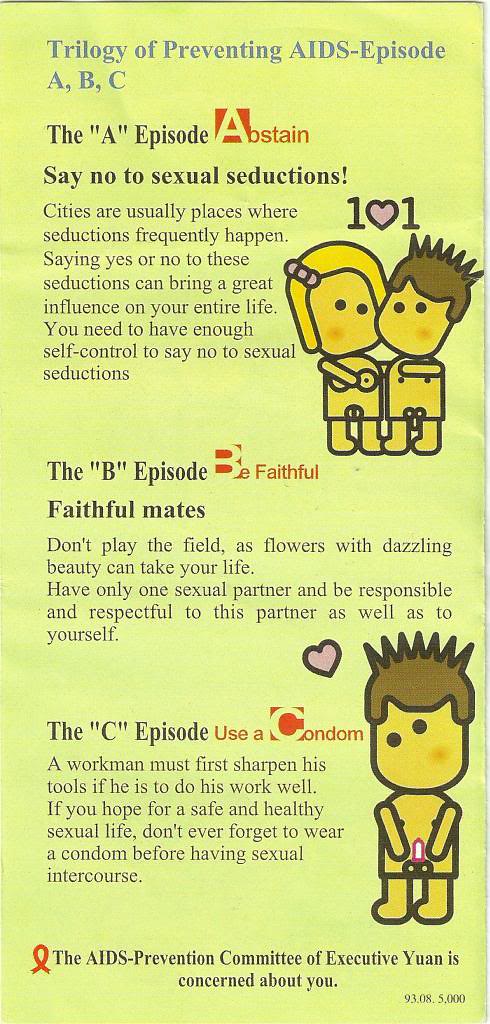
This brochure is outdated now, but I still think it proves a point. I had originally thought of it as a good thing: an attempt to educate, albeit a flawed one. Now, I'm not so sure. Why is it in English? I don't remember seeing a similar on in Chinese (although one might exist). Do they think foreigners need to be educated to avoid "seductions in cities"? Are we seen as the problem? That's a problem in itself, but the childish presentation and straight-up hilarious English - why on Earth did they think that "工欲善其事,必先利其器" was a good idiom to use? This alone renders it useless and ineffective for even this misguided goal.
What's more, instead of all the useful information they could have put on the back, they chose "avoid seductions", "flowers with dazzling beauty can take your life" and...sharpening tools?
Despite all that talk of a progressive national sex education curriculum, is this really what it boils down to?
I don't know, as I don't work in a public school, I don't research this issue and although I've had friends tell me they had very little or no sex education in school, they are all old enough that their observations would not necessarily reflect today's reality.
So I'm not sure what to think, but I do know that Taiwan can, and should, improve in this area. It is entirely in keeping with local culture that it do so.
Subscribe to:
Posts (Atom)