Tuesday, February 27, 2018

Taiwan is the canary in the coal mine, and it's getting hard to breathe

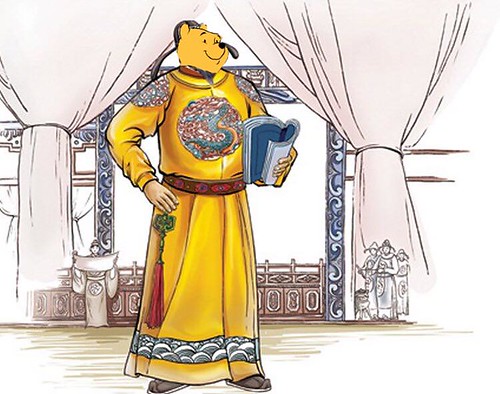
28276990_10156194460261202_3245045011505545453_n
Emperor Xi Jinping of the Pooh Dynasty


Lots going on in the news this past week or two on China, its strategy abroad, the West's reaction to it, the rise of Emperor Xi, and what this could all mean for Taiwan.

I noticed, as international media outlets began reporting on Xi Jinping crowning himself Emperor Winnie of the Pooh Dynasty, that a number of them - most, in fact - curiously left out Taiwan, like the BBC, The Guardian, the Washington Post, the Wall Street Journal and the NPR News broadcast I listened to while making dinner yesterday. Only a brief mention of how he has "toughened China's stance" on Taiwan in this other Washington Post article (I can't read the New York Times coverage as I've used all my articles for the month and it's not one of the two papers I subscribe to). Even though that last one is about how Xi might use his throne - despite there being at least a fair chance, if not a likely one, that he will eventually use it to make a move on Taiwan - it doesn't factor in at all.

This is unsettling for anyone who cares about Taiwan - not just that this changes the game vis-a-vis a potential Chinese threat, but that the West doesn't seem terribly concerned about it. If you don't believe me about that threat, by the way, Donovan pointed out clearly why Taiwan is right to be terrified of Emperor Xi in The News Lens:


Most analysts (including myself) have thought the only way China would risk an invasion of Taiwan in the short to medium term would be if the China faced enough of an internal crisis that the power of the Chinese Communist Party was threatened, who would then use an invasion as a distraction and nationalist rallying cry....

This is where the terrifying part lies. Xi may consider actions purely for glory that his more institutional predecessors wouldn’t or couldn’t have.

This should make China’s neighbors very nervous. An absolute ruler of a massively powerful nation with ambitions to enter history is potentially very dangerous and unpredictable. China wants the Senkaku Islands from Japan, several border areas from India and to consolidate power over the South China Sea. But the obvious big prize to achieve glorious “reunification” of China and finally end the “century of humiliation” would be to take Taiwan.

That would be hugely risky and destructive course to take, potentially igniting a massive war involving many countries. But we can no longer assume that only a Chinese Communist Party facing an existential internal crisis is the only likely scenario whereby China would consider an attack.

Xi might just consider it for himself.

He is absolutely correct and I could not say it better myself.

I have no idea what Xi might do - there's a lot to consider. He wouldn't have made this power play if he hadn't been quite sure it could be accomplished fairly easily, meaning that there would be no need to 'distract' angry Chinese citizens by manufacturing a pretext to attack Taiwan. That said, China has underestimated resistance before (I genuinely believe they didn't see the Umbrella Movement coming, for example, and note how they only worked to send its leaders to jail once it became apparent they could actually get elected to LegCo in Hong Kong. I don't think they'd planned for that at all), and might be doing so now. I don't know. Within the CCP, there might still be a number of people who had thought, until this past Sunday, that they might be potential heirs to the Chinese presidency, and might be less than happy about this change in plan, but not necessarily saying so outright, given what Xi does to his rivals. That does mean, however, that it is not guaranteed that he is as surrounded by syncophants and True Believers as he might think he is, and there might be a crisis they truly don't see coming, for which they need to manufacture a distraction in the Taiwan Strait.

Yes, the CCP claims to value stability above all else - but what they claim and what they actually believe are not necessarily the same. They value what suits them, and nothing more (they're very Trumpian in this way, although perhaps less venal). They value "peace and stability" when it suits them, and are also quite willing to manufacture instability and crisis when that suits them instead (and keep that door open by continually rattling their saber at Taiwan). So I would not base a belief that Taiwan is basically safe on any CCP talk about "stability".

And yes, I do believe the CCP as a whole - as Donovan wrote so well - is as keen on actually taking Taiwan as they say they are. They want to keep up the claim, sure, but they know perfectly well we're more trouble than we're worth. Xi, though? I think he wants this just for him - for his historical legacy He's not doing this for the power. He could step down in 2023 and still have that. He's doing this because he wants to be a big name in the history books. Whether or not he actually believes his blah-blah-blah about the Chinese Dream, the Rejuvenation of the Great Chinese Nation, Reunification of the Motherland and Xi Jinping Thought (barf, barf, barf and barf, by the way) - that I don't know. But that's the kind of stuff that makes it into textbooks, not the more tepid reigns of people like Hu Jintao.

Sure, this takes off the pressure of him accomplishing "Reunification of the Motherland" (BARF) by the original end of his term, but it also means we have a president-for-life who is an ideological hardliner, especially on Taiwan. 


So, we have every reason to believe he plans to make a move on Taiwan in his lifetime. 

And this is terrifying. For Taiwan, and also for the world.

All of this "Rejuvenation of the Chinese Nation" (which includes annexing Taiwan) talk stems from China's "century of humiliation" victimhood mentality - they talk about it as though it's an internal confidence-building and great-nation-building exercise, but it's really about vengeance for being the one-time top dog who was laid low by the (admittedly crappy and colonialist) ascendant Western powers. They don't just want to be "a confident nation at ease with itself", they want to be on top again. They want global hegemony. They want to take the US's place.

Taiwan? We'll just be the first domino to fall. We've seen this coming for awhile - because China already claims us, they'll go for us first. In this scenario, Taiwan's beautiful, imperfect but vibrant and fierce democracy will fall. Assuming the country is not completely pulverized, for awhile, a sham democracy will take its place in which we are able to choose among "candidates" pre-selected by China in "elections". Eventually that might be scrapped too. Not immediately - the attrition must be slow, similar to their strategy in Hong Kong. This not only wears down resistance but also makes it easier for Western nations to pretend they don't see it happening. After all, they grow tired of most stories in the news after awhile. They might be mad at first, but nobody will want to upset the new global economic order - that could mean instability (oh no!) - so they won't actually do anything. And after awhile they'll forget that they were mad at all.

The world will have 23.5 million fewer free people, 23.5 million fewer people who lack basic human rights...and the rest of the world will hardly notice.

The US - well, our superpower status has kind of sucked. We're not great. A lot of Westerners angry at the abuse of our position as we supported the toppling of governments we didn't like and propped up regimes friendly to us, regardless of what was best for the countries involved, at our failed attempts at "spreading democracy" one bombing at a time, and our take on the global economy that reeks of modern mercantilism would be happy to see us fall and to see a non-Western (and non-white, because they're sick of white people taking the whole pie, as they have every right to be) power take our place. Triumph of the people of color, that sort of thing. The rise of the oppressed, toppling the oppressors.

It all sounds really wonderful if you blur your eyes. But, if you think about it, China is just an Asian version of Killmonger in Black Panther - his idea to funnel resources to the oppressed to they can overthrow the oppressors sounds great on its face ("it's a good idea!", some people said), but in the end he just wanted to institute another kind of oppression, a different sort of hegemonic rule.

But, it's easy to get people on board when the new bully in town isn't white. It looks a lot like liberation. It's not.

So why isn't the rest of the world worried yet? When (almost) every piece of news from Taiwan includes a reference to China no matter how unrelated, how is it that when something China does really is a threat to Taiwan, nobody seems to even realize it?

Brian over at New Bloom says this is because Westerners lack a conceptual framework in which to consider Chinese neo-colonialism (phrasing from Michael Turton) and he has a point - Westerners don't seem to have the necessary lexicon to really talk about China's global ambitions. They sure get tongue-tied if they try!

But, I don't think that's because they "lack the vocabulary" or even a "conceptual framework". The framework and vocabulary exist - neo-colonialism. Expansionism. Neo-imperialism (or, in the case of Taiwan, just 'imperialism'). Hegemony. Global domination. Economic subjugation. Checkbook diplomacy. Economic imperialism. The spread of authoritarianism. We have all of these words and frameworks.

It's just that Westerners are afraid of using them to describe China (or really any non-Western/non-white nation) for fear of seeming - or being labeled - racist. They're afraid someone will say they don't understand how the historic injustice of white privilege means that anything non-white people do can't be considered the same, or as bad, as anything white people do. (A worldview which has its uses, and which I am often sympathetic to, but which doesn't apply here.)

That's really all it is - it's a race thing. All they need to do is take their old frameworks, dust 'em off and apply 'em to a regime that happens to be Asian. There's nothing new or uncharted about it. Just stop being afraid of criticizing China because someone might think you're racist if you criticize shitty things non-Western powers do, and call China's actions what they are using words you already have.

What I'm saying is, the thing Westerners lack isn't vocabulary or conceptualization, it's balls.

Feeding into my idea that this is actually a race thing: the Western world seems content to ignore China's increasing reach - including its attempts at controlling or even abducting foreign citizens - when its levers of control are used to oppress other Asians (not just Chinese - this affects Taiwanese too, and the majority of Taiwanese identify as Taiwanese, not Chinese). Their increasing control over Australian citizens is ignored by the rest of the world - though kudos to the Sydney Morning Herald for continuing to report on the story - because most Australians affected have Chinese ancestry (but, remember, are not Chinese citizens). The world ignores Lee Ming-che - a Taiwanese citizen - because he looks Chinese. They ignore Gui Minhai - a Swedish citizen - because he looks Chinese. They ignore Hong Kong because they are Chinese, regardless of what Hong Kongers want or feel they were promised.

Yes, reports are filed, articles occasionally appear, but most of the West just doesn't care much. I suppose it's too bad that these problems are happening, they might think, but deep down, they don't think too much about it, because the victims don't look Western, and it's easy to ignore a bunch of Asians. Just an internal matter. It sucks, but, well, that's in China. No matter how much the people being threatened, persecuted and prosecuted might align themselves ideologically more with Western thought than "Xi Jinping Thought", and no matter how much it is not just in China - it's happening in their own countries - and not just Chinese citizens. That they look Chinese seems to be enough to get the West to turn the other way.

So what does this have to do with Emperor Xi, Taiwan and the coal mine?

Well, we are the bellwether. The new Emperor has his eyes on Taiwan. Don't think Taiwan is in that much trouble? I do. I don't see a good outcome here - either there's a massive crisis in China, in which case we're invaded as a distraction as the CCP tries to hold onto power. Or there's no crisis in China, and the slow march of their invasion plans continues forward without much resistance from the rest of the world (although I am heartened to see a little pushback). Or, there's a massive world war because Trumpo was bored with porn stars and Big Macs and couldn't keep his finger off the trigger, and China takes advantage of the chaos. No matter how this shakes out, good potential outcomes for Taiwan are few, and the possibilities leading to catastrophe are massive.

And what happens in Taiwan - perhaps an invasion, perhaps the slow erosion of our democracy under Chinese pressure, perhaps we get pulverized by missiles and then pushed into a sham 'democracy' where 'candidates' selected by China run for 'election', perhaps we spiral into economic ruin - is a sign of things to come under Chinese global hegemony over the rest of the world. Not in terms of outright invasion (of countries other than Taiwan), but in terms of the ways in which China will seek to influence what happens within those countries - who gets elected and what they do in office. Putting pressure on foreign governments to bring their own citizens in line regarding what they can and can't say vis-a-vis China (and perhaps anything else the Chinese government doesn't want us discussing, as well), through diplomatic and economic influence. If that doesn't work, threatening them directly.

In other words, to dust off some old vocabulary that we absolutely have, we'll all be tributary states.

Don't think China would care to reach that far into the affairs of other countries? They're already doing it, to citizens of those countries. Australia (and to some extent New Zealand) seem almost like test cases for how they'd do this - want to know what they'd like to do in the US and Europe? Watch Australia.

You just haven't noticed, because your fellow citizens being threatened by China don't look like you. Taiwan is getting the brunt of China's wrath, but they're already branching out, and there's a point at which they'll no longer care if criticism comes from someone who looks Chinese or someone who doesn't.

By then, you might care, but it will be too late. The canary is suffocating, and the time to pay attention is now.

Sunday, February 25, 2018

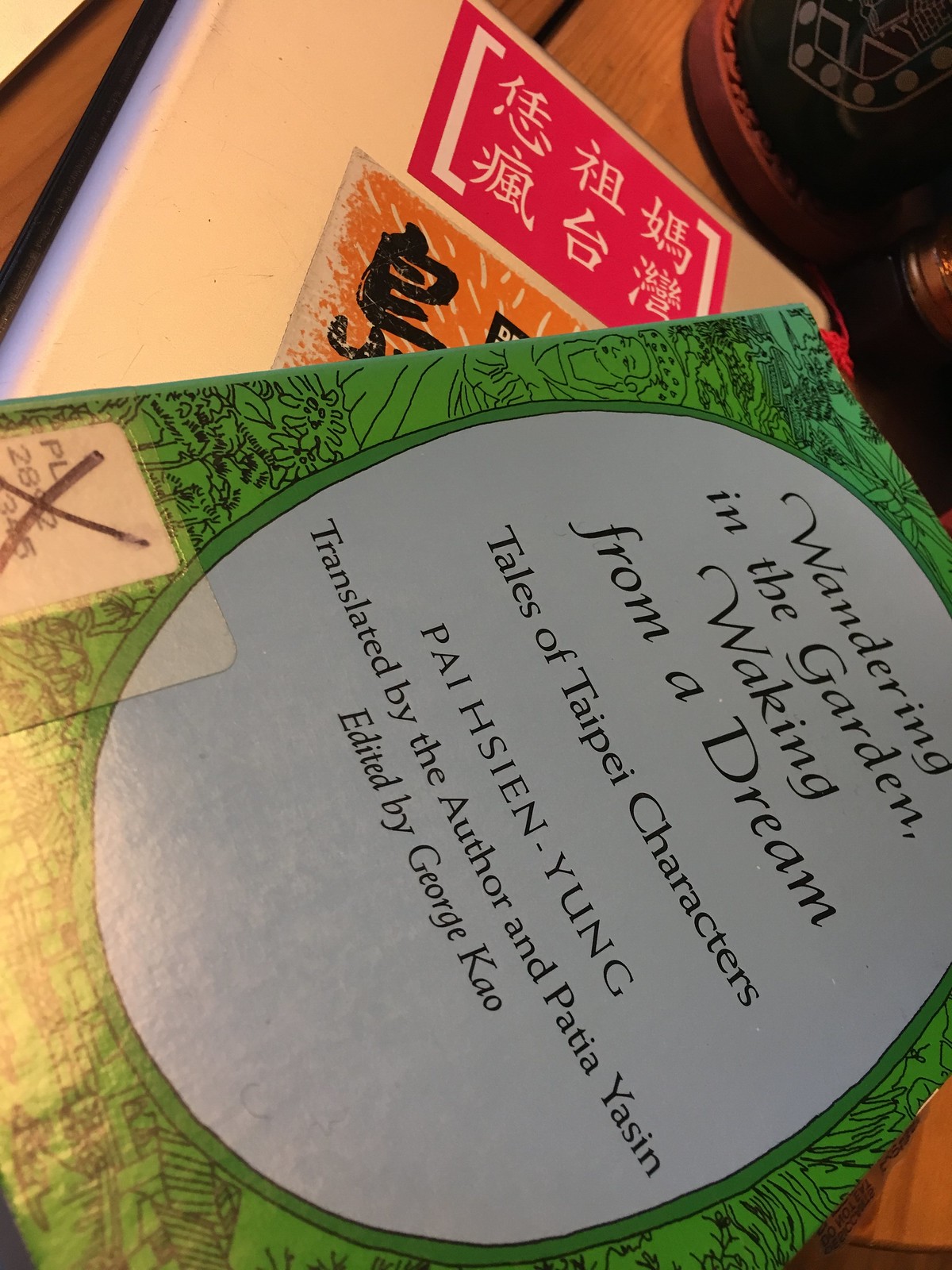
A review of Wandering in a Garden, Waking from a Dream: Tales of Taipei Characters

IMG_0299


Every Saturday I tutor the younger daughter in a family I've known for many years. We get along well and I mostly facilitate extensive reading and writing, so not a lot of traditional grammar exercises (though in her own time she works through a huge grammar book and I'll check her work - her idea, not mine.) But, I noticed one day that she was struggling with use of various passive and past perfect forms, so I said I was going to check her knowledge of Taiwanese history using passive-heavy questions.

I wrote down a few questions along these lines, for her to render correctly before answering. Things like this:

Who __________ (live) in Taiwan when it ____________ (colonize) by the Dutch?
Who had been living in Taiwan when it was colonized by the Dutch?

She looked at them and back and me and said, "Can we change the topic to the history of China?"

"Why?" I asked. "Is that what you're learning in school?"

"Yes! So I know that! I don't know Taiwan's history so well!"

"Well...no. No we can't. That's another country - "

"Mm!" she agreed.

" - and while it's useful to know about the history of other countries, especially ones with some relationship to your country, it's also important to know your own history. So we're doing Taiwan."

Despite her protests, she basically got the questions right. Even the one about how 鄭成功 managed to sneak past the Dutch patrols and fortifications.

* * *

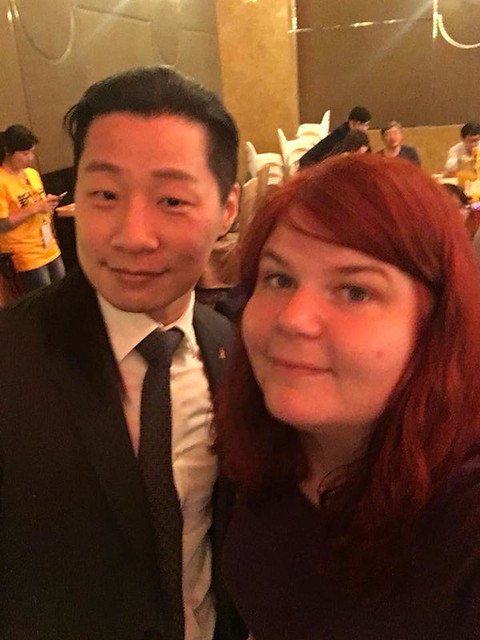
I took the bus home - it takes longer but it's direct. I realized I'd never listened to Timeless Sentence, Chthonic's acoustic album in its entirety, and it has occurred to me after meeting Chthonic frontman and super-cute legislator Freddy Lim recently that I should, so I thought that'd be a good way to pass the time riding through the streets of Xinbei and Taipei.

 
26991691_10156084754236202_2906672105890632268_n
Super Cute Legislator Freddy Lim and *me*

Every song on that album - culled from their black metal work and arranged acoustically - explores some aspect of Taiwanese history. Freddy, and the band as a whole, are unapologetic Taiwan independence advocates. Some of the historical issues they sing (well, scream) about are obvious ("Republic born of PAIN!") and some are less so ("Who now stands before me like a ghost within a dream? When did come the day when things became not what they seem?")

As these songs played, the bus crossed Fuhe bridge into Taipei. The sun was out; I leaned against the window and watched as the green median spokes were overtaken - some half-eclipsed, some fully - by the shadow of the bus. I was sitting at the back, so just as the darkened green pillars reached me, sunlight broke out again and drove out the dark.

As I watched this, I thought to myself that when I got home, before I started work on a paper that was coming due, I should read one more story in Wandering in a Garden, Waking from a Dream. I'd been reading one a day as a break from academic work, and figured I could finish the whole collection fairly quickly.

I wasn't sure how I felt about it, though.

My main issue with Timeless Sentence is that Freddy is at heart a black metal singer. He is clearly going to some effort to re-modulate his 'voice' and 'style', and the layouts of the songs themselves, to fit an acoustic format. Sometimes it translates beautifully, sometimes less so.

I too felt I was having to reconfigure my mentality to read Wandering in a Garden, Waking from a Dream. I am used to reading about Taiwanese history from a Taiwanese perspective. I had to reformulate and remodulate in order to read without judgement stories of fictional members of the Nationalist diaspora in the 1940s.

* * *

The foreword makes it clear: although the original title of this anthology of character studies was Taipei People (台北人), the people in it are not from Taipei. They live there, but every last one was a refugee from China in the Nationalist diaspora of the 1940s. Most of them didn't seem to really consider Taipei home and every last one identified with China, not Taiwan. The newer translation, then, is perhaps more accurate: Taipei Characters. 

Each of them confronts - or refuses to confront - memories of their life in China and squares them with their new lives in Taiwan. Some do better (Verdancy Chu in "A Touch of Green"), some worse (Yu Chin-lei in "Winter Night"). Some describe the pleasant, idyllic, even luxurious lives these characters led in China (Yin Hsue-yen in "The Eternal Snow Beauty"), others discuss the horrors they encountered in the Chinese Civil War (Lai Ming-sheng in New Year's Eve ). Each one is searching for their own version of peace. Although it is not directly stated, few find it.

The foreword also makes clear that these character studies are meant to do just that: study characters. Think of it as the ROC version of Dubliners (which I haven't read - I struggle a bit with Joyce). Not draw conclusions about the good or evil of the Republic of China or its effect on Taiwan. It makes these refugees human and shows them trying to rebuild some semblance of a normal life in their new home.

The arrangement of the stories is important: it starts with young (or young-seeming) beauties, one of whom seems hardly to age, who is associated with the color white (a white sun on a blue field perhaps?). As the tales continue, the characters grow older, grayer. They get weaker. They grasp at what they've lost, making the same noodles except "not as good", coloring their hair or losing everything trying to bring back loved ones (the proprietress and Mr. Lu in "Glory's by Blossom Bridge"). They start dying, some sooner than others. The first three and last three stories drive it home: starting with imagery of fresh bright snow and then spring green, followed by tales of great battles fought by people who are now older and weaker, and ending with autumnal scenes of faded glory propped up by wealth, the onset of a cold, cruel winter and finally, a funeral, they echo both the rise and fall of the Republic of China and the creeping realization that the Nationalists' current, dilapidated state is permanent and will only further decay. This also echoes Dubliners, or so I am told.

I have a deep well of empathy for such situations: my own family was driven out of Turkey and then Greece - refugees twice over. For most of my life, these experiences were recounted by ancestors who held them living memory. Everyone has the right to leave dangerous, even life-threatening conditions and seek a safe existence elsewhere, to prosper and, if they wish, come to identify with their new home, as my grandfather came to identify as American. Similarly, although these characters are not real, their pain very much is.

And yet, I note that almost every time these characters interact with someone Taiwanese, they are snobbish and dismissive. Everything about Taiwan is inferior - the silks are coarser, the people more provincial, the weather worse, the food never quite as good. They treat Taiwan like a pigsty that they, high and low-class both, are forced to live in. They don't seem to realize that the people who are already here are people too, no less worthy of respect, and this island (this country) is their home, and it is beautiful if you'll just look. They don't see it, and they don't seem to be aware of exactly how their beloved Nationalist government treats the locals (as well as some of their own, although this is not mentioned in the book).

For every shadow cast on their lives, some of these "Taipei characters" cast shadows on the lives of others, and they don't even realize it. They keep to their own communities, denigrating Taiwan and yet acting as if they own the place - I can't help but wonder, if you hate this beautiful island so much, why do you insist it's a part of your country? - and as someone who loves Taiwan, it is hard to read.

This snotty condescension, this dismissiveness of Taiwan - I have trouble with this. My empathy shrivels a little, although not entirely. If the Nationalist diaspora wonders why it is not always fully welcomed in Taiwan, perhaps this attitude - which I have no doubt was very much real - is a part of why.

There are exceptions: the narrator in "Love's Lone Flower", who spends much of her time with two Taiwanese characters, Peach Blossom (with whom it is implied she has a relationship) and Third-son Lin, and does not appear to judge them in this way. In fact, the most empathetic of the Taipei characters are the lower-class ones: the taxi dancers (although Taipan Chin in "The Last Night of Taipan Chin" is dismissive of Taiwanese taxi dancer Phoenix, in the end she helps her as best she can), the winehouse girls. They seem to make local connections that the former high-and-mighty do not. I can't expect they would have necessarily known about the white terror their white sun government was inflicting on Taiwan. They're just doing the best they can, and they too have scars. My empathy grows.

The army veterans, the generals, though, perhaps the wives of those generals - they must have known. Some of them, if they were real people, would have been a part of it. My empathy shrivels. Let them break down and die. They consider themselves Chinese, so why should we let them have governance of Taiwan? Why should the Taiwanese have to live under a foreign government they never consented to? Don't we call that "colonialism"?

That said, every last one came to Taiwan's shores and built a life here, some more successfully than others. Although my circumstances were different - I'm no refugee - I did this as well. How can I - someone who would like to be the newest of the New Taiwanese - make any sort of judgements about who is and is not Taiwanese? This beautiful country has made it possible for me to call it home, and Taiwan is a settler state - who am I to say which settlers get to call themselves local? As far as I'm concerned, if you live here and identify with Taiwan, you are Taiwanese. These Taipei characters did not consider themselves Taiwanese, but many if not most of their descendants would. Maybe their grandparents weren't really "Taipei People", but they are.

That said, how many of the real-life people these characters are inspired by turned away when they knew what was happening? How many reported a neighbor or disavowed a friend? How many to this day remain pro-authoritarian, stalling Taiwan's reckoning with its history?

But then, how many might themselves have been victims of that same regime's purges of "Communists" in their own ranks? How many would have grandchildren who grew up supporting movements like the Wild Strawberries and the Sunflowers?

The key difference between my ancestors and the "Taipei characters" is that the latter dream about their lives in China lost, and are often disdainful of the island they now call home. My ancestors missed the home they lost, but never used that as an excuse to denigrate their new country.

* * *
I say all this, but I haven't even gotten into the historical and literary allusions strewn liberally throughout these stories. I have avoided writing about this, because I don't understand every reference. I write this review as a layperson.

In order to give this book the best review I could, I read as much about the book as I could find (unfortunately, the best source is incomplete - and the complete book is obscenely expensive). There is a lot to say about the title story, Wandering in a Garden, Waking from a Dream, in which the narrator, after literally wandering in a garden, watches her old acquaintances enjoy a party in a mansion decorated with luxuries old and new, some having aged and faded and some seeming young and growing more vivacious, but still clinging, like a dream, to their lives in China. The narrator, a widowed general's wife whose stage name as an opera singer had been Bluefield Jade, is as faded as her dark jade-green qipao. The host's little sister, who helps trigger a drunken memory to her own younger sister, is more vigorous than ever. There are young lovers torn asunder by beautiful younger sisters, a snow-cave like dining room trimmed with vermilion table decorations (the ice-box where the KMT's dreams lie frozen in time, splashed with blood?) and allusions to three separate operas: The Nymph of the River Luo, The Drunken Concubine and Peony Pavilion (especially Wandering in a Garden, Waking from a Dream from that story).

I don't know if I can even begin to break all of this down, and am not sure I should in what is meant to be a book review, so here are three quick takes:

The Nymph of the River Luo alludes to a young man's tryst not just with a goddess, but, by extension, the wife of the Emperor of China. There is also a strong implication that Madame Qian, the narrator and general's wife, either had an affair with one of her husband's subordinates, or wanted to (personally, I think they did), until her younger sister stole him away. Something similar also happens at the party taking place in the story's present.

The Drunken Concubine is about how favored concubine Yang Guifei prepared a feast for the emperor, only to find he'd visited another concubine instead. In jealousy she drinks herself into a stupor. Madame Qian, jealous, is also drunk - but feels it is her younger sister in the past (and her party friends in the present) who are responsible.

Wandering in a Garden, Waking from a Dream involves a young woman falling asleep in a beautiful garden and dreaming of a sexual romantic encounter with a young imperial examination candidate. Waking up suddenly, she is so overcome with sadness that it was a dream that she dies (but is later resurrected...well, there's a lot going on here regarding old traditions and new thinking and the sadness of realizing the evanescence of life that I won't get into). Madame Qian literally wanders in a garden before being put in a dreamlike drunken state that invokes her own dream lover, and then "waking" to the reality of life wasted and happiness lost. The dream in the original opera takes place in spring - and Madame Qian's affair took place when she was young - but the party where she remembers it is in autumn, when she is much older. Her awakening echoes the awakening of the old Republic of China guard to their new, and rapidly declining, situation.

All of this is quite fascinating, and I read this particular story several times.

But what really struck me was what Andrew Stuckley, in the link above, said about a story earlier in the collection, The Dirge of Liang Fu. 

The two couplets in the study of General Pu seem innocuous enough, but call to mind an ancient story in which a leader needed to dispose of three great warriors who posed a threat to him. To do that, he offered two peaches, to be taken by the two best of them (there is an allusion there to the peaches of immortality). Of course, to take a peace was to show impertinence, but to not take a peach was also a great shame. All three killed themselves and the scheme worked.

In The Dirge of Liang Fu, the "peaches" are - according to Stuckley - communism (in China) and Westernization (from America). Each promises immortality, but each ends up killing you. To not take a peach is to fade into irrelevance, as General Pu has done.

"Hm," I thought as I read this. "I hadn't known that and I hadn't paid that much attention to the story the first time around. I definitely need to deepen my knowledge of Chinese history and literature."
But...

I live in Taiwan, not China. I spend my free time learning about Taiwan - Taiwanese history, Taiwanese literature. China is a different country. And yet, Taipei Characters is a work of Taiwanese literature.

I considered the Taiwanese students who regularly protest the "Sinicization" of history classes in Taiwan, prioritizing Chinese history - and implying that Taiwanese and Chinese history are the same - and demanding that more of Taiwan's own local history be included...

...oh.

In that moment, I realized how difficult everything really is.

How many of these Taipei characters - if they were real and you could ask them - would think Taiwanese history is Chinese history and would insist that the dichotomy my student and I perceive is false? How many would listen to Chthonic's Takao or Broken Jade, songs about the Takasago Volunteers (one small aspect of Taiwan's Japanese history which is not at all Chinese), and insist that it was the same history as that of a Republic that fought Japan as a mortal enemy? A Republic that still insists that it fought with the Allies to defeat Japan while governing an island that, right or wrong, fought on the other side? Who among them would insist that everything Chthonic sings about is both Chinese history and not as important as Chinese history, all in one ignorant breath?

* * *

Then, I thought back to one of the lyrics crooned in English on Timeless Sentence:

Let me stand up like a Taiwanese, only justice will bring you peace.

The Taipei characters were not at peace in part because there was no justice, in the end, for the wrongs done to them. But they seem blind to the injustices, like shadows, that their own government inflicted on the Taiwanese, as well.

I then recalled a minor sub-plot in Green Island, where the protagonist's father, after ten years' of brutal incarceration at the hands of the KMT for something that wasn't a crime in even the pettiest sense, can't help but suspect that his older daughter's husband - an ROC veteran from China - was reporting on him to the government. He wasn't - the spy in his home was his own son, and Dr. Tsai's son-in-law from China has suffered his own injustices and was just trying to do the best he could.

I know this story in my history too: the person who reported on my great grandfather to the Turkish government was another Armenian. The leader of the group sent to apprehend him saw who he was ordered to take into custody, recognized my great grandfather as his old schoolmate and they embraced as friends. He was never arrested - the captain was Turkish. Things are not always so cut-and-dried, the good or evil of a group is not so easily transferred to individuals.

Of course, Pai Hsien-yung understood all of this - and he was not uncritical of the "dreaming backwards" of his Taipei characters, their ignorance of Taiwan and their slow decay under a veneer of wealth. I mean, the collection ends with a winter night passed by two threadbare academics, and then a funeral. He took his own stabs at the white sun on a blue field. He knew that they not only were dreaming, but that it was time to wake up. I can't believe he wasn't also aware of the way their isolated, dream-like state affected the island they had fled to.

I didn't feel entirely comfortable reading Wandering in a Garden, Waking from a Dream, but I will say this: it is excellent, a masterpiece, and I am happy I read it.

Wednesday, February 14, 2018

Love and Cheap Sushi - my Valentine's Day meditation on dating for MyTaiwanTour

My second piece, just in time for Valentine's Day (not a holiday we actually celebrate, by the way, even when we were young and dating) for MyTaiwanTour.

It's the story of my date at Sushi Express - a restaurant I picked because I was new in Taiwan and didn't know better - with a friend who could have been something more, but wasn't. Eric Lin was not his real name, of course, but a dozen years on it hardly matters.

Plus, some thoughts on observing the dating scene from afar in Taiwan, as a boring old married lady!