Today was disgusting. So was yesterday. I don't mean I had a bad day. I mean the air was literally disgusting - it made my throat scratchy, my nose inflamed, my eyes sting and my stomach a little upset.
I felt annoyed, ill - literally sick, disgusted and nauseated - but something else too. I felt a deep-seated, wide-ranging anger.
Years ago, I was hanging out with my (adult) students and nuclear power came up. I said that while I agreed nuclear power was a bad idea in Taiwan for a number of reasons, I didn't actually support phasing it out immediately, while Taiwan's energy policies in other areas were so short-sighted. Of course I was aware of the problems with nuclear power: nowhere to store spent fuel rods, "dirty plants" where safety standards were alleged to not be met, especially around cooling/recirculation tanks (despite assurances that they conformed to a high standard of safety), and of course the fears that Taiwan's vulnerability to natural disasters. These include earthquakes, typhoons and tsunamis - could result in a Fukushima-style disaster in Taiwan, where such an event would be even more disastrous given the country's size.
But, what was the alternative? Fossil fuels? That would not only be bad for the environment as a whole, but for Taiwan's air quality in particular. Alternative energy would be best, and we probably have the technology to make that a reality for most of our energy needs, but nobody seemed interested in actually developing it. There has been some investment into wind power, but not enough. Besides, even though I don't think wind is the answer, the same activists who campaigned to shut down the nuclear plants also campaigned against wind farms (sometimes for good reasons, I should add.)
Solar comes with its own set of government cock-ups that are only now being rectified: the government is only now tackling harmful and outdated regulations regarding energy generated through home solar panels (in the past, you had to sell the power you generated to Taipower first at a crummy rate, and have it sold back to you. Hence, nobody bothered to explore solar power for their homes.)
The push to explore solar and geothermal generally was limited and insufficient (given how geothermically active Taiwan is, geothermal is probably our best bet - but not a lot of money being poured into it). Taiwan's buildings would need to be restructured in a huge way, or at least, any new buildings would have to take the country's climate into account, building in cross-breezes, overhangs and using the right materials to reduce how much air conditioning was necessary in the summer. No more stifling concrete boxes.
And I just could not support gunking up Taiwan's air by going back to fossil fuels.
Even when trying to clean up fossil fuel-powered plants, it's a hash. As my friend and Central Taiwan news guru Donovan Smith noted:
In fact, Taipower recently announced they are adding two new gas-fired units to the Taichung Power Plant, bringing the total units up to 12. Many or most people had thought they were going to use those two to replace two of the coal-fired units, but nope. A general rule of thumb is gas-fired units are about half as polluting as coal. That means cumulatively that is effectively adding one more coal-fired unit.
Fast-forward to today. And yesterday. And so many days before.
The left won: the nuclear plants are shutting down. The chances that the fourth plant at Gongliao will be finished and activated are essentially zero - and frankly, bringing it online is a bad idea anyway.
And now the air is filthy. In much of Taiwan it has been for awhile - Taipei folks just didn't notice it because it rarely impacted us. All of those power plants and other industrial waste-producing hellscapes were far enough from us that our air was still relatively clean. Now we're getting a taste of what the rest of the country has been saying for awhile.
The Taiwanese left was unforgivably myopic: they yelled and screamed to shut down nuclear power, but didn't present any sort of push for consistent renewable energy policy. "I guess pushing for renewables isn't as sexy as pushing against nuclear," people who understood my point said. "They're just not going to win the zeitgeist talking about that."
Okay, but if you don't, and you only shout about what is "sexy" enough to get attention, then your push to change society can have unintended consequences. You're nothing but gadflies, not serious policymakers searching for real solutions.
If all you do is push to shut one thing down without thinking ahead to how things will be handled in the future, frankly, that's no more visionary than the KMT building a bunch of crap-ass buildings in the 20th century that are all now falling apart and are so energy-inefficient it's a joke because they couldn't be bothered to spend real money creating sustainable architecture for a subtropical climate, and building most cities in Taiwan without viable public transit which creates vehicular pollution. All you're doing is creating another problem.
Real change means tackling the unsexy things. It means actually writing and pushing policy proposals that solve issues and take future consequences into account. It means thinking through your own freakin' beliefs to see what the outcomes might be, and addressing them. I don't see that that has been done by anti-nuclear activists or the people they've put in power.
Yet, even now, I see few from the anti-nuclear activist camp going to bat over renewable energy. Some of them are protesting air pollution: great - but ultimately ineffective. I'm sick of protests that don't offer solutions.
So what we will have is a ghost island: not just in terms of talent leaving, but also the ghostly pallor of the grey air. The ghosts of good intentions, the ghost of what Taiwan could have been if the right people just thought through what really needs to change and pushed for it in the right ways.
So we have the activists/Third Force/Taiwanese left putting on a great show of wanting to change Taiwan - and I do believe they are sincere. But they're just not thinking their ideas through and it's infuriating.
Then there is the KMT. In the words of New Bloom:
In truth, if there is any one to blame for issues regarding nuclear energy or air pollution in Taiwan, it is the KMT, which ruled over Taiwan’s developmentalist state unchallenged for decades during the authoritarian period and built up both the coal-fired power plants that contribute to Taiwanese air pollution and the nuclear power plants which many see as dangerous to Taiwan in the event of environmental catastrophes. There is no political party in Taiwan more beholden to the nuclear lobby than the KMT. Yet the KMT leverages on these issues anyway against the DPP, illustrating not only hypocrisy, but how the KMT truly stands for little else besides rote opposition to the DPP at this point.
However, I disagree with the overly-tidy (and easy) conclusion that we can brush our hands, blame the KMT and move on. As the party who has historically held power, they do deserve most of the blame. However, the left's lack of initiative in finding real energy solutions to make their anti-nuclear rhetoric sustainable also deserves criticism.
Then there's the DPP, who are mostly concerned with staying in power and don't seem to be interested in addressing any of the real issues. Caving to the anti-nuclear activists, leaning more heavily on fossil fuels, and just not doing what needs to be done to make renewable energy a reality.
Amidst this circus, the electorate acknowledges it's a problem but only ever blame the party in charge, or the party they don't like. I'm sure many do look more deeply at the bigger problem of nobody in charge having the faintest idea what they are doing or when they do, using it for their own gain, but I don't see it. I have to hope their are better people working behind the scenes, but I don't see that, either.
I don't know what else to say. I'm mad and disappointed, and I can't breathe. Those in power don't seem interested or able to really fix the problem. The opposition is, if anything, worse. The Third Force activists don't think through what they fight for nearly as often as they should. Taiwan has smarter people than this. We can do better.
Don't get me wrong, I'm still a leftie liberal bleeding heart bastard. But, I support doing the difficult, unsexy work that I feel the Taiwanese left is not doing - the stuff that's not always so wonderfully idealistic. I'm still pro-independence and pro-Taiwan. I still think this country is worth fighting for. I just can't support half-baked activism anymore. We can't trust the KMT or DPP to get us out of this mess, which means we have to look to the left, but the left needs to be smarter. It needs to start tackling unsexy issues.

Monday, April 30, 2018


Friday, April 27, 2018
In China, tech companies are blatantly sexist. In Taiwan, not even Hooters posts gender-specific job ads
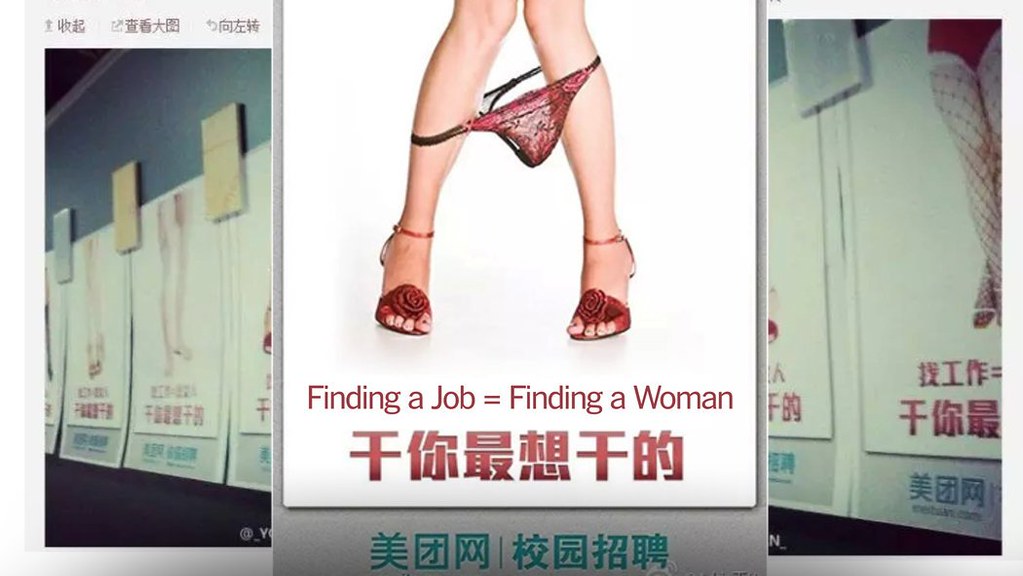 |
| I have no desire to translate the rest of this for you. It's just as sexist as it looks. |
For years, I have initiated or participated in discussions of the relative level of women's rights and equality across various countries in Asia. For years, I have posited that while Taiwan isn't exactly great when it comes to women's equality (I struggle to find a society that is), it is the best country by far in Asia for women. The problem is that "in Asia" is a low bar, even when you adjust your expectations of how feminism might look in Asian societies.
Along these lines, a spate of news and opinion pieces appeared recently on how badly women are treated - just how much they are objectified and male needs are prioritized - in the tech industry in China (and, according to Zhang Lijia, whose video op-ed is linked to below, in Chinese civil service recruitment as well, with a number of jobs listed as requesting male candidates).
Chinese Tech Companies' Dirty Secret (watch this one first, and be horrified)
Alibaba, Baidu and other Chinese tech companies post men-only job ads
Wanted at Chinese start-ups: attractive women to ease coders' stress
In all of these pieces, the biggest horror in my view is the ad that says "Finding a Job = Finding a Woman: Fuck What You Want to Fuck". I truly have no words.
Through those years, the biggest point of contention I've come across is a belief that Chinese women actually have it better - have more equality, get more respect from their society - than Taiwanese women. Talk about how in Shanghai, women rule and men do as their wives and mothers say (I haven't really found anything to corroborate this beyond what people say; I suspect it's an urban legend to some degree). Talk about how Communism sucks but at least one of its ideals is gender equality (maybe true under Mao, not so much anymore). Talk about how there are more female engineers and women in traditionally male fields in China - I saw 39-40% cited on a number of websites, but none I'd trust as a source especially given the links above).
But, you know what? I just don't believe that. I never have. I lived in China, I saw how women - in several unrelated examples where I knew the people involved personally - were treated as a matter of course. I saw, with my own eyes and through personal stories told to me, how many men in China really thought they had the right to "fuck what they want to fuck" - in some cases, literally.
In short, what I saw and heard didn't add up to this belief that "China is a gender equality leader in Asia" or that it somehow outpaces Taiwan in gender equality.
Now, I can say with confidence that I was right.
I set out to see if such job ads were common (or even rare but extant) in Taiwan, and while I would not call my look into the issue a feat of investigative journalism (it really wasn't), I did ask a wide range of people both online and off, including a number of female professionals that I know, to see if they'd even come across such an ad. I included questions not just about sexist ads targeting men (showing Zhang's examples in the vomit-inducing video above), but also ads stating explicit gender preferences or appearance requirements. I specifically did not include ads for foreign teachers, which are their own cesspit of sexism and general unprofessionalism (I'll discuss that topic below). I trawled 591 for a bit, but it's huge and I admit I barely made a dent.
Nobody - no-one on Facebook, no-one in real life, none of the professional Taiwanese women I asked - had seen anything like this in Taiwan, nor could I find any evidence of it. Every last one was positive that any company that even attempted these sorts of recruitment tactics in Taiwan would get sued so fast that the Apple Daily issues would still be literally hot off the press when the subpoena arrived.
The best I could find was one woman - a female programmer - who said there were rumors of the sorts of "engineer comfort women" (she did not mean the term in the way it is typically used in Asia, the point was to be more of an at-work hostess, not to actually provide sexual services) discussed in the third link above also exist in Taiwan. However, I could not find a Taiwanese ad for such a job.
On the contrary, I was alerted to several instances where gender discrimination in hiring in situations that might actually be open for debate were met with lawsuits: in one case, a "maid cafe" (where female servers dress up like maids - it's a subculture thing that I think is a bit tacky but is not worth my time to complain about - whatever) that would not accept a male applicant, citing its uniform of short skirts as awkward for men to wear, and was fined NT$150,000. (Link in Chinese). While I think it's relatively likely that the male applicant purposely called up the maid cafe to hear that he wasn't welcome to apply based on his gender so that he could complain, it doesn't matter: in Taiwan, it doesn't matter if you are explicitly a maid cafe. If it can be proven that you are discriminating based on gender, you are likely to lose any lawsuit that is filed. In another well-publicized case, China Airlines listed height requirements for flight attendants, saying they needed to be able to help passengers put luggage in overhead compartments. They also lost.
One of the women I asked pointed out that, as a C-level executive with hiring powers, she has to attend a workplace gender equality training regularly, and that it confirmed what the maid cafe link mentions above: the court ruled that very few jobs could restrict hiring based on gender, citing underwear modeling as one such exception (I dunno, I think an ad for boxers where the boxers are worn by women, implying that she's your girlfriend wearing your boxers the next morning, would actually do well).
This brought to mind a Hooters job ad that I saw once, which stipulated no gender. It is quite obvious that they would hire women to be "Hooters Girls" - I mean their Facebook page, predictably, is a parade of cute young women. If Hooters (Hooters!) knows it can't post a gender-specific job ad, then damn - you really can't post a gender-specific job ad in Taiwan, let alone a blatantly sexist ad touting your "beautiful women" to potential male recruits.
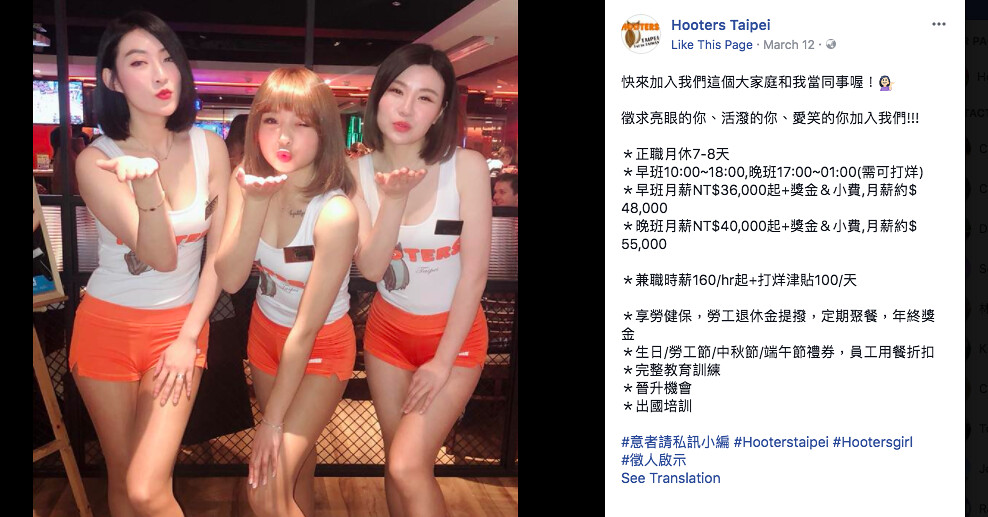 |
| The hashtags include "#hootersgirl", but note that there is no gender specification in the ad itself. |
That is not to say that Taiwan is doing fine. I'm sure anyone reading this far is screaming "but there's still discrimination in hiring! They just don't tell you they're doing it!" And that's true. There absolutely is - I can't find anything proving it, and yet, I haven't talked to anyone who isn't fully aware it happens (part of the point is getting away with it by making it impossible to prove). I doubt a man applying to be a Hooters Girl, for example, would actually get the job. I personally know of a few instances when, without giving out too much information, people in charge of hiring debated female applicants based on their looks. I know of a few instances where a man got specific contracts because he was male, and at least two where women got them specifically because they were women (in at least one case, it was a situation where she'd be working mostly with men, who seemed to want some eye candy to go along with their work obligations - yuck). I don't think it's a coincidence that in Taiwan, flight attendants tend to be young, attractive women whereas in America they seem to be more average-looking women and men of a variety of ages. It can't be that only young, attractive women apply for those jobs in Taiwan (and if that is the case, something must be actively discouraging other potential applicants).
This is not right, but a lot of people come to the (wrong) conclusion that this means the law doesn't work, or there shouldn't be a law. "Isn't it better to know up-front whether they want you or not then to waste your time applying to a job that won't actually consider you?" "Why would you want to work somewhere you're not wanted anyway?" - yeah, yeah, yeah. A tempting line of reasoning, but ultimately wrong. If there is no law specifically forbidding gender (and other) discrimination in hiring, then it becomes socially acceptable to do so. If there is a law, that's step one to eradicating it. What people who think it's better that companies be open about it are missing is that these things take time to become social norms. Passing a law doesn't mean immediate amelioration of a social problem: it's just step one. But without it, we have no power when we do see blatant discrimination, and we will never make it to step two, which is reducing actual discrimination. Anecdotally, I do see this happening: the openness with which people accepted the existence of discriminatory hiring seemed far higher a decade or even 5 years ago. Now, people acknowledge it exists but are openly disgusted with it. Without the law, we never would have gotten that far. And if you break down the numbers intelligently as Brookings has, you'll see that this could well be affecting female participation in the workforce, especially in managerial positions.
In cases where discrimination can be proven, the law seems to be actually enforced, too. That's really something - China has a gender non-discrimination law too, but it's vaguely-worded, rarely invoked and almost never enforced (Zhang Lijia covers this in her video above). Zhang is wrong about only one thing: the issue isn't that companies can get away with this because the job market is competitive. They can get away with it because society lets them, and they know the law is ineffective. In Taiwan, society doesn't really let them - not anymore - and if they face the law, which they well might, they are likely to lose.
And of course, once hired, women in Taiwan may still face discrimination or sexist treatment in the workplace, a problem faced by women around the world. Taiwan still has a wage gap - it's narrowing, but still entirely too big. I don't know any Taiwanese woman who has not faced sexism in the workplace. I have as well - it happened at a job I quit in 2014. That too is difficult to fight, but enforcing gender non-discrimination and slowly eradicating sexist beliefs in society is one tool we have in winning that battle.
Every screamer who's left is probably now shouting "but job ads for foreign teachers in Taiwan specify gender all the time!" That's right, they do. I wanted to focus on local job ads, because it does feel like different factors are at play, including that:
a.) Most of those jobs for foreign teachers are posted by dodgy recruiters and third-rate buxibans, hardly professional work environments. I do expect the average Taiwanese office at anything larger than a family-run company to be at least somewhat more professional. I have very low expectations for these sorts of schools and recruiters, who are - and I am not sorry to say this - the gutter scrapings of the English teaching job market. That doesn't make it right, but it does clarify why they think they can do this.
b.) They probably think they can get away with it, assuming foreigners don't know the law. I do not at all believe that these gutter-scrap jobs and the people who shill for them don't know the law - they do. When it's pointed out to them - and I once got kicked out of a Facebook group for doing so - they get angry and defensive and show what kind of work environment they'd really provide. They're not stupid, they're just crappy people. There's a difference. (OK, sometimes they're stupid too.)
So, no, Taiwan is not perfect, but it's still the best in Asia. We have a lot of problems to face, but hiring managers (and men) here know they can't just 'fuck what they want to fuck'.
Saturday, April 21, 2018
Cooking With Cathy
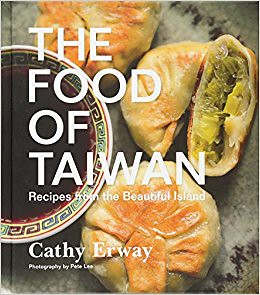
Awhile back, I went out and bought Cathy Erway's The Food of Taiwan (despite the annoying Tom Sietsema review on the back that condescendingly called Taiwanese food a regional Chinese cuisine - ugh, no, because Taiwan is not a region of China - but he didn't write the book so whatever.) I didn't make anything from it for the longest time, though, because despite being a damn good cook, I had always figured that I should spend my precious cooking time on food I can't get outside, or no restaurant I've found can make as well as I can (just try to find a brown rice pumpkin risotto with saffron and sundried tomatoes - you can't, unless you come over for dinner). Why make myself what I can get better and more cheaply outside?
Recently, though, I've reconsidered that position. It was starting to feel embarrassing that I'd been here for a dozen years yet hadn't learned Taiwanese cooking, despite being great in the kitchen. Other cuisines I've learned because I've lived in those places - e.g. Sichuan/Guizhou food, Indian food - I learned after I left, to my detriment. It was time to fix that, and learn how to make Taiwanese food in Taiwan. If anything, simply to better understand the culture I live in and try to be a part of in whatever limited way I can and am welcome to do so.
So, I cracked open The Food of Taiwan and set myself the task of making a selection of dishes from it. Essentially starting from a place where I knew what the food ought to look and taste like, but learning what makes it that way.
I approached the book knowing that her recipes would not be the final authority on how to make any one dish, but as a good English-language resource, as the only recipes I could find online that were any good were in Chinese. I can roll with that, but it's just easier to follow something in my native language.
I also planned to try any failures at least twice: I may know what they are meant to look and taste like, but that didn't mean I wouldn't get them wrong the first time around (and I did get a few wrong).
My overall impression? No one recipe is dead on, although some are very good. Often, the ingredient proportions or cooking directions weren't quite right (or didn't work with my kitchen equipment), in other cases, the ingredients called for didn't quite make sense. Some were acceptable variations, but at least one was completely off. (There's "normal variation" and then there's "every person I asked about this recipe shook their head in disbelief or wondered if Erway had ever actually had the real dish").
This cookbook is clearly meant more for cooks in Western kitchens going to the Asian supermarket for ingredients - which makes sense, as the market for a cookbook of Taiwanese food in English for foreigners in Taiwan is perhaps...uh, not that large. This was evident in some of the names of dishes ("Taiwanese burrito" for 潤餅 - huh?) But, for the cook who can just go to the traditional market or dry goods shop and get what she needs, there are unnecessary shortcuts and a few instances of confusing labeling.
So, here's what I made, and how it turned out:
Spicy marinated cucumbers / Cold pickled cucumbers (酸辣小黃瓜)
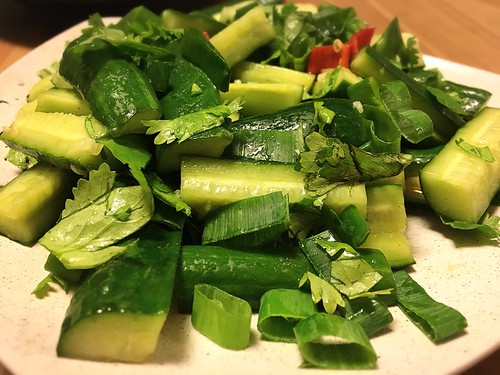 |
| I like scallions on mine, too. |
This was one of the most successful dishes, although I have to admit I've been making it for ages - one of the few Taiwanese dishes I consistently put together. I happen to prefer to mix the salt, vinegar, sugar and other ingredients all at once, and refrigerate for a few hours. However, both Erway's version (which calls for salting the cucumbers first) and mine work just fine. I don't de-seed my cucumbers as I usually eat them same day, but if you're going to save them for a few days, it's a good idea. I also prefer more vinegar - I practically submerge mine rather than just using two measly tablespoons. That, however, is a matter of taste.
What I found odd was the addition of chili bean sauce (a condiment I feel Erway invokes far too often where it is not needed). These cucumbers are much better with chopped, de-seeded long red chilis. I was also confused by the leaving out of garlic - a burst of fresh garlic paste (or coarsely chopped garlic) added to the marinade makes the dish. Also missing is a topping of fresh cilantro, but that too is a matter of taste.
Because these cucumbers are (almost) as common a side dish as kimchi in Korea, the last time I made them I was reminded of something David Chang said not long ago: that he used to think white people shouldn't make kimchi. Later on late night television he walked that back, noting that if a white person makes Korean food really well, they might become a major advocate for the cuisine and that can only be positive - and in any case, I suspect he was talking about chefs making kimchi, not regular home cooks.
That comment got me thinking about being a white lady who often cooks Asian food - I may be new to Taiwanese cooking but I frequently cook dishes from other parts of the continent, most notably Indian. I understand the criticism of white chefs cooking traditional foods of people of color while the people of color themselves continue to be discriminated against for their non-white cultures and appearances - that is, making a profit off of something that when the originators of that thing are still otherized for having created it. However, I don't see a problem with my making Taiwanese dishes for myself - after all, I live here. Should I bar myself from learning how to cook locally because I'm not a local? Would any local think that a decision to remain ignorant of local culinary techniques because of my race was anything other than utterly ridiculous? I doubt it.
I've yet to meet real-life people who think otherwise, although I'm sure they exist.
In any case, I think as long as you aren't profiting off of someone else's culture while otherizing people from that culture (seriously don't do that), if you make the food well, you're fine. The proof is in the Hakka stir-fry.
Basil clams (塔香蛤蜊)
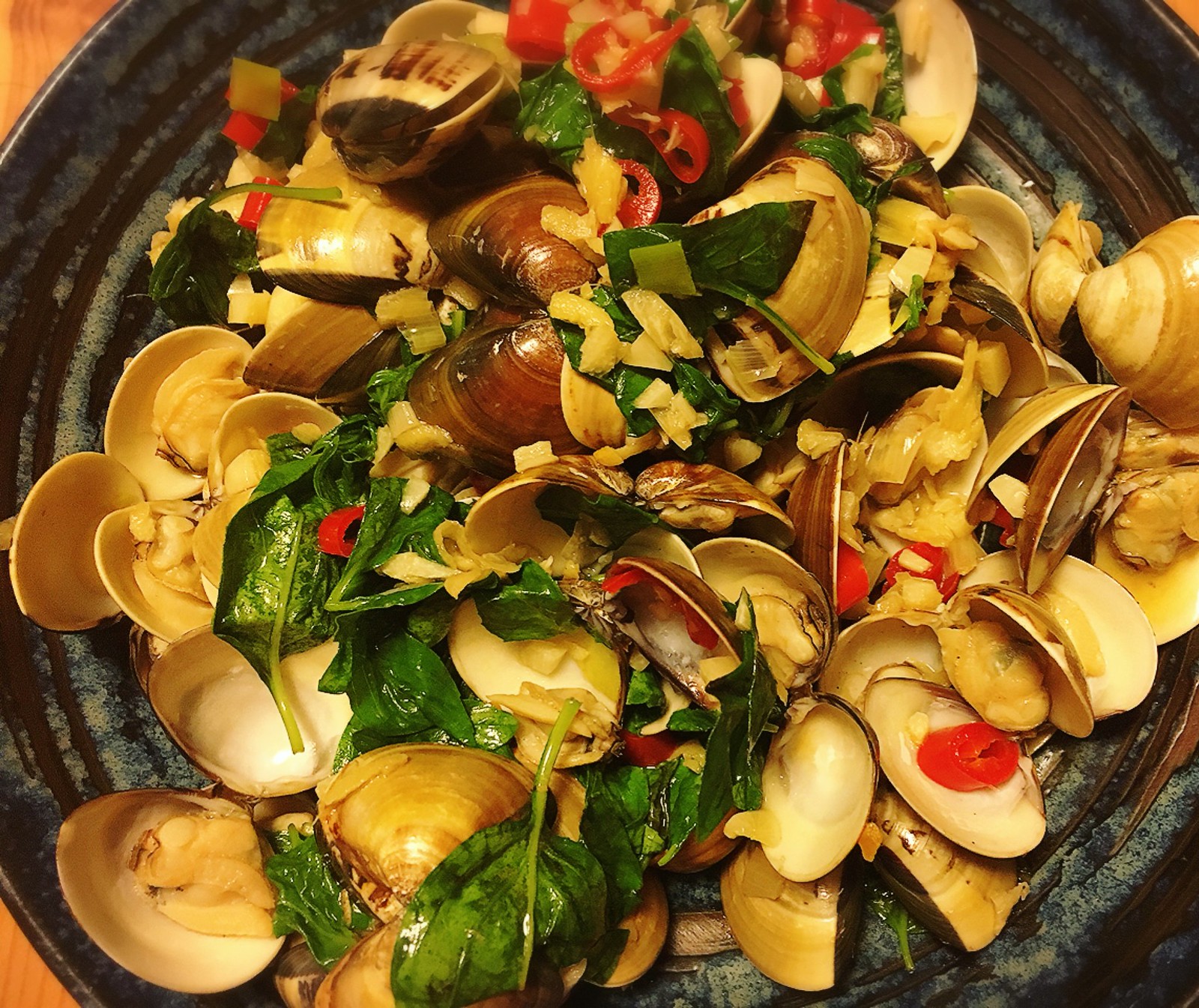 |
| Needs more basil and soy sauce, less alcohol |
This recipe was one of the closest to dead-on in terms of the flavor I've come to expect from eating this dish locally. There were no unexpected additions to the ingredient list, nor anything I felt was missing. However, the proportions seemed a bit off: the final flavor was far more alcoholic and not salty enough. The dish was successful enough that I didn't feel I needed a re-do, although I do intend to make it again simply because I like it. When I do, I'll reduce the rice wine from 2 cups (!) to 1, increase the soy sauce from 1 tablespoon to closer to a quarter cup - or use regular rather than light soy, or both - and make up for any lack of liquid with water. I also felt the dish needed more basil - about twice what is given on the recipe.
Be careful when making this one, as the clams are essentially cooked in rice wine, and...well I wouldn't know anything about any small kitchen fires that may have happened when a little bit of the alcoholic steam condensed and ran down the side of the pan and ignited...no sir.
Other recipes add one ingredient Erway leaves out: sliced ginger. Trying to hew as closely to the recipes given as possible, I too left it out, but will add it next time.
After all, one of the things I've learned while living in Taiwan is that there is just as much individual, family and regional variation in cooking as there is in the US. It does seem sometimes as though Westerners who think themselves worldly 'flatten' the part of the world they don't live in: where they are from, they recognize that one dish can have a thousand variations. Everyone and their grandmother has a slightly different recipe. But get that same Westerner abroad and they think the food of the place they are visiting has only one "traditional" way of being made, with all others being "wrong" somehow. Like each one must either be the Platonic Form of itself, or it's a bastardization by someone who doesn't know better. So they rank different restaurants in, say, Vietnam by how 'traditional' their Vietnamese food is, when as far as I see it, if it's a restaurant in Vietnam serving Vietnamese food, it is authentic Vietnamese food. What else could it be?
So ginger, no ginger, whatever. Do what you like (but I seriously suggest a little ginger.)
Braised meat rice (滷肉飯)
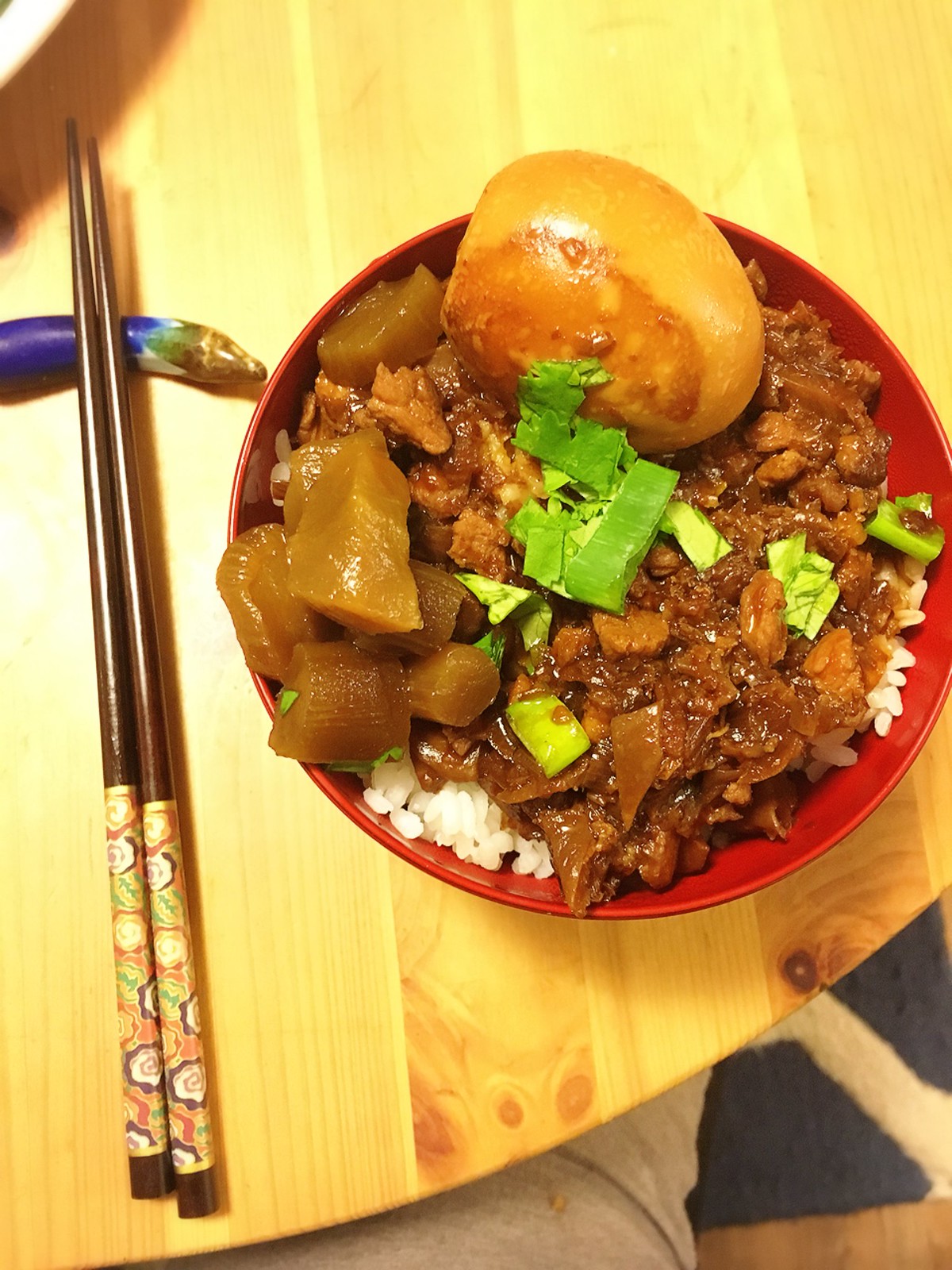 |
| This tastes so Taiwanese - braised egg was my idea, and it was a good idea |
This is one of the dishes where there seems to be the most individual variation. One of my Taiwanese friends adds preserved tofu (豆腐乳) to give the dish depth. Another uses lean meat for health, and yet another adds chopped mushrooms. A Taiwanese friend who is an actual chef adds licorice root (甘草) and dried mushroom. There is a very good restaurant on Yanji Street whose 'signature' dish is braised meat rice, but including half a hard-boiled egg and shredded chicken. Some people serve it with a Taiwanese-style pickle (which I like - and you can buy them cheaply at any supermarket). Others add cilantro (I'm also a fan.) Many online recipes call for cooking the meat first, and using the pork fat to cook the garlic - and many call for adding the white part of a green scallion at this stage (I did this the second time around and it worked well).
I tried this dish twice, as the first one came out far too thick and salty - the second time using lean meat and chopped mushroom to 'imitate' the fat I was leaving out, and it tasted both wonderful and authentic. It was a reminder that I might know what a dish is supposed to look and taste like, and I've been here for awhile, but that doesn't mean I'll get it right the first time around.
My only quibble is that the first time, I simmered it for between 1-2 hours as Erway suggests. It thickened far too much and I found I kept having to add water to it - and it wasn't necessary as the cut of meat I'd bought was pretty good - I generally don't have meat scraps lying about as we often eat vegetarian at home. However, she was absolutely right in her suggestion of the proportions of low-sodium soy sauce to regular soy sauce.
Thick soup with meat (肉羹 - though I ended up actually making cuttlefish thick soup or 摸魚羹)
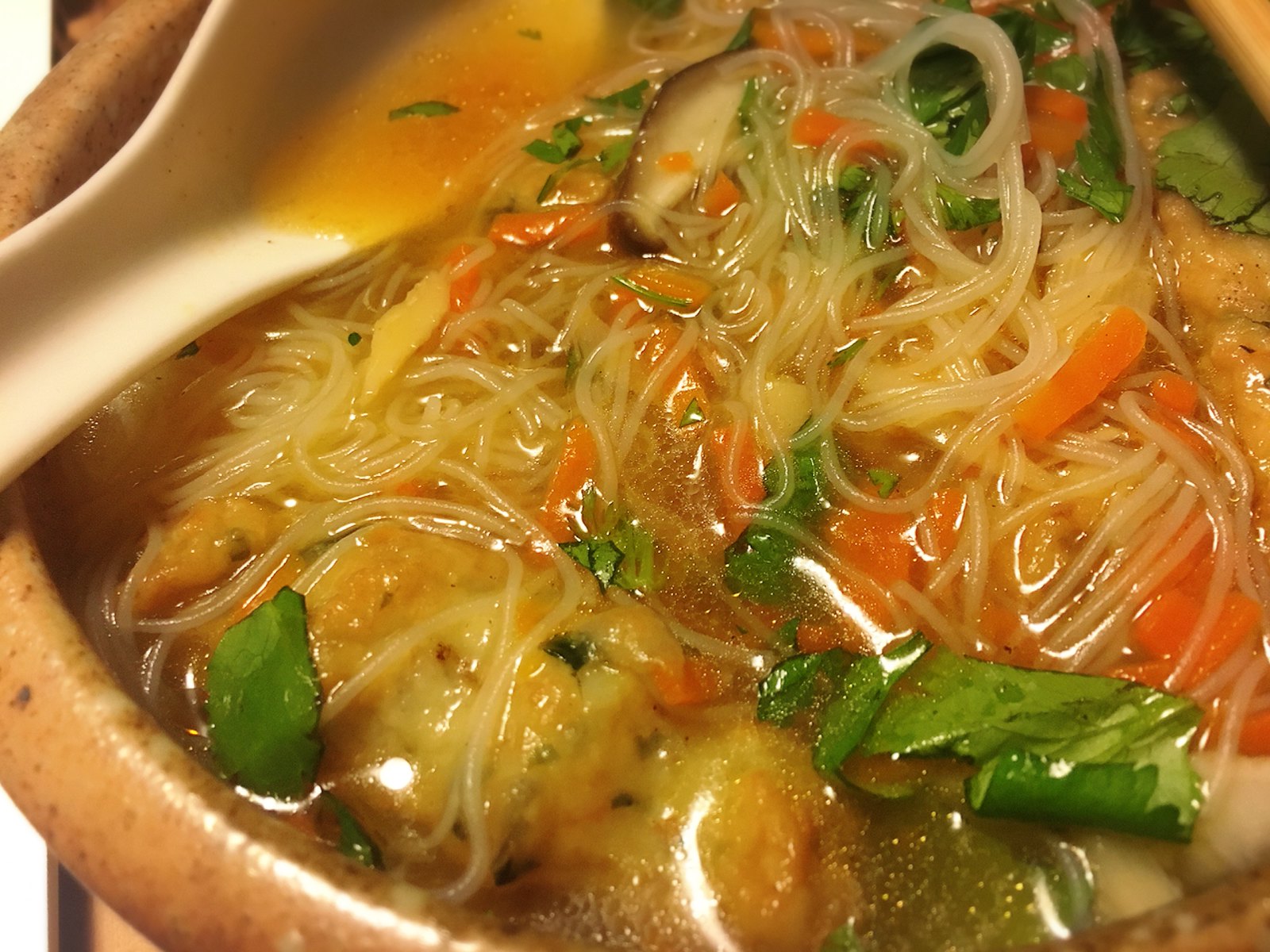 |
| The carrot was not necessary, and I like more vinegar and white pepper than Erway does |
I didn't make the fishcake-coated pork shoulder because I was short on time, so I bought pre-made cuttlefish cakes to add instead and they were fine. Otherwise, this recipe worked well, although I found the amount of cornstarch listed did not turn the soup sufficiently "thick", and I ended up adding more. I also added the noodles directly to the soup as the sizes they came in didn't work well for portioning into bowls.
This is one which created a bit of a labeling kerfuffle - Erway calls for "black rice vinegar", but just try finding something labeled that at a Taiwanese supermarket. They have it, but it's labeled 烏醋, not 黑米醋 (as one might find on Hong Kong brands if one Googles). Complicating this, some brands of black rice vinegar in Taiwan label it "Worcestershire Sauce", which I don't think it is, exactly. I knew this, but someone who isn't aware might spend quite a bit of time looking for something that is simply labeled differently.
There is at least one other thick soup recipe in the book, for squid - and I appreciate that the two are different rather than just "make thick soup, add thing you want".
The recipe calls for 1 tablespoon of the vinegar and one of sesame oil for the whole large pot - I like a bigger dose and actually add a lashing of vinegar to thick soup when I eat it out, so I added quite a bit more to my bowl, along with a sprinkle of white pepper.
The carrot could be left out, but the bamboo and shiitake mushroom are, to my mind, essential. I left out the cabbage because cabbage makes me fart. I mean like to a concerning degree, to the point that my husband replies to my farts as though I am talking to him (like this:
Me: *frrrap*
Brendan: "That's not true!")
I once saw a doctor about it but he said nothing was wrong with me, I'm just, like, fartier than average.
So...no cabbage.
Sweet potato leaves (地瓜葉)
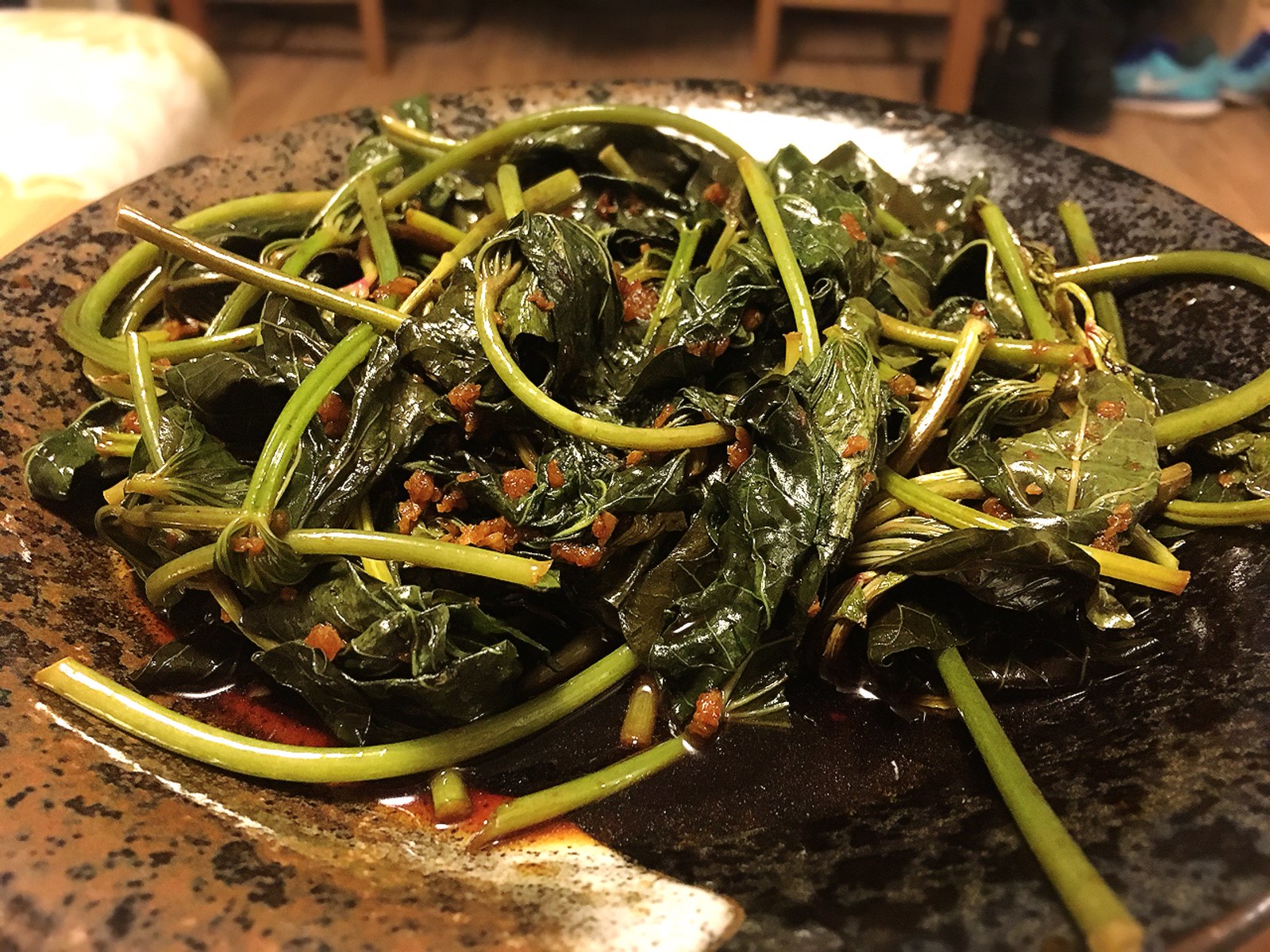 |
| The garlic is a weird brown color because this was my second attempt, and I found I preferred it with soy sauce instead of salt |
You'll be surprised to hear that this - the easiest Taiwanese vegetable there is - was one of the recipes I struggled with. The leaf wilts very quickly and grows bitter if you overcook it. The stems, however, never quite seem to be fully cooked (and, to be frank, I only like the leaves and often de-stem them now that I make the dish more often). I had to struggle my way around getting both parts of the plant to cook correctly given their very different textures. There's a metaphor in there somewhere, but I'm too tired right now to find it.
In any case, sweet potato leaves aren't even available in much of the US as far as I'm aware, and I wasn't aware they were a vegetable that could be eaten until I moved here.
Partly, I just don't think Erway calls for adding enough oil. 2 tablespoons simply wasn't enough. Partly, though, it's that I know what well-made sweet potato leaves look and taste like, but I just did not grow up in a kitchen where they were frequently made. It's one of those ways in which, no matter how long I stay, I can't fully assimilate into the culture because I just didn't have that cultural upbringing. If I'd grown up around parents cooking this dish frequently, making it might be second nature, the way making hummus is for me.
I also prefer them with a dash of soy sauce instead of salt, although I don't think that's how they are typically made. Damn it, white lady, screwing up our traditional foods with your weird changes!
But seeing as other recipes call for adding ginger or MSG, and this one doesn't, I don't feel too bad about that.
Oyster omelet (蚵仔煎)
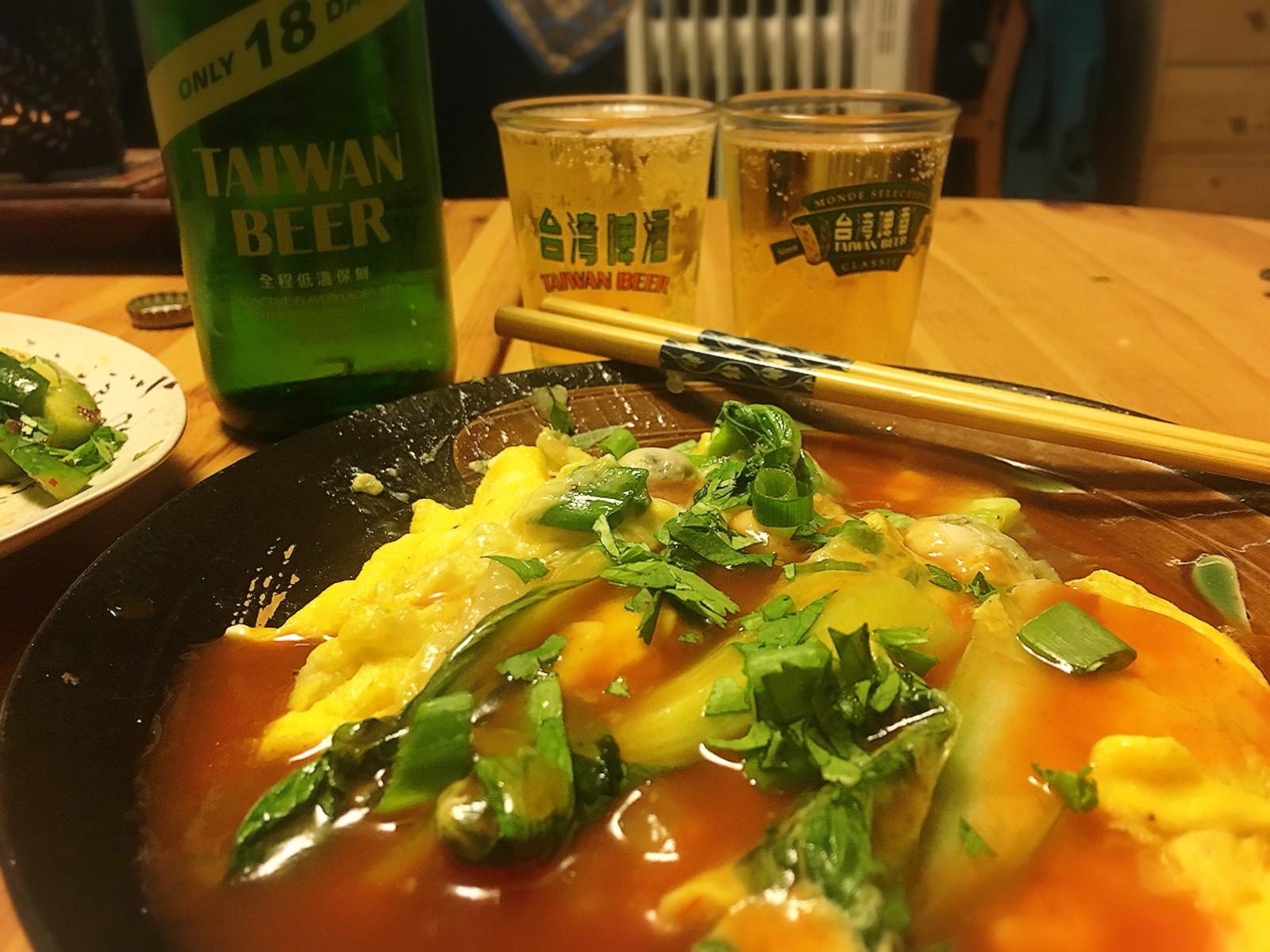 |
| This was the best-looking oyster omelet I made. They all tasted good, though. |
This was probably the most interesting of the dishes I made - not just for the act of making it, but in my friends' reactions when I told them what I was attempting. In my experience, it just isn't one of those foods that's made at home very often (which is also interesting - as it's not any harder than any other omelet). I've asked and asked, and not found a Taiwanese friend who has actually made this themselves. It's always something you get as a snack when you eat out.
But here I am, making it in my kitchen even though nobody else I know does that. I feel like it almost makes me more foreign. I'm not even sure what the equivalent would be - a Taiwanese person who goes to the US and tries to make a Big Mac in her home kitchen? ("For a truly authentic Big Mac, you have to start with a patty that is just the right shade of grey.")
The first thing you do when you make this is prepare the sauce. In fact, I wonder how 'traditional' the sauce even is, seeing as the base is ketchup. But it works - it is a bit tangier than the typical sauce you get in the night market but very good.
The only real issues I had were that the bok choy didn't cook as well as I would have liked - I found that putting it in the oil just as the oysters are shrinking a bit, just before adding the sweet potato starch mixture, works well.
My oyster omelets all tasted good but looked like garbage. That's fine - my Western-style omelets are the same.
Chicken rice (雞肉飯)
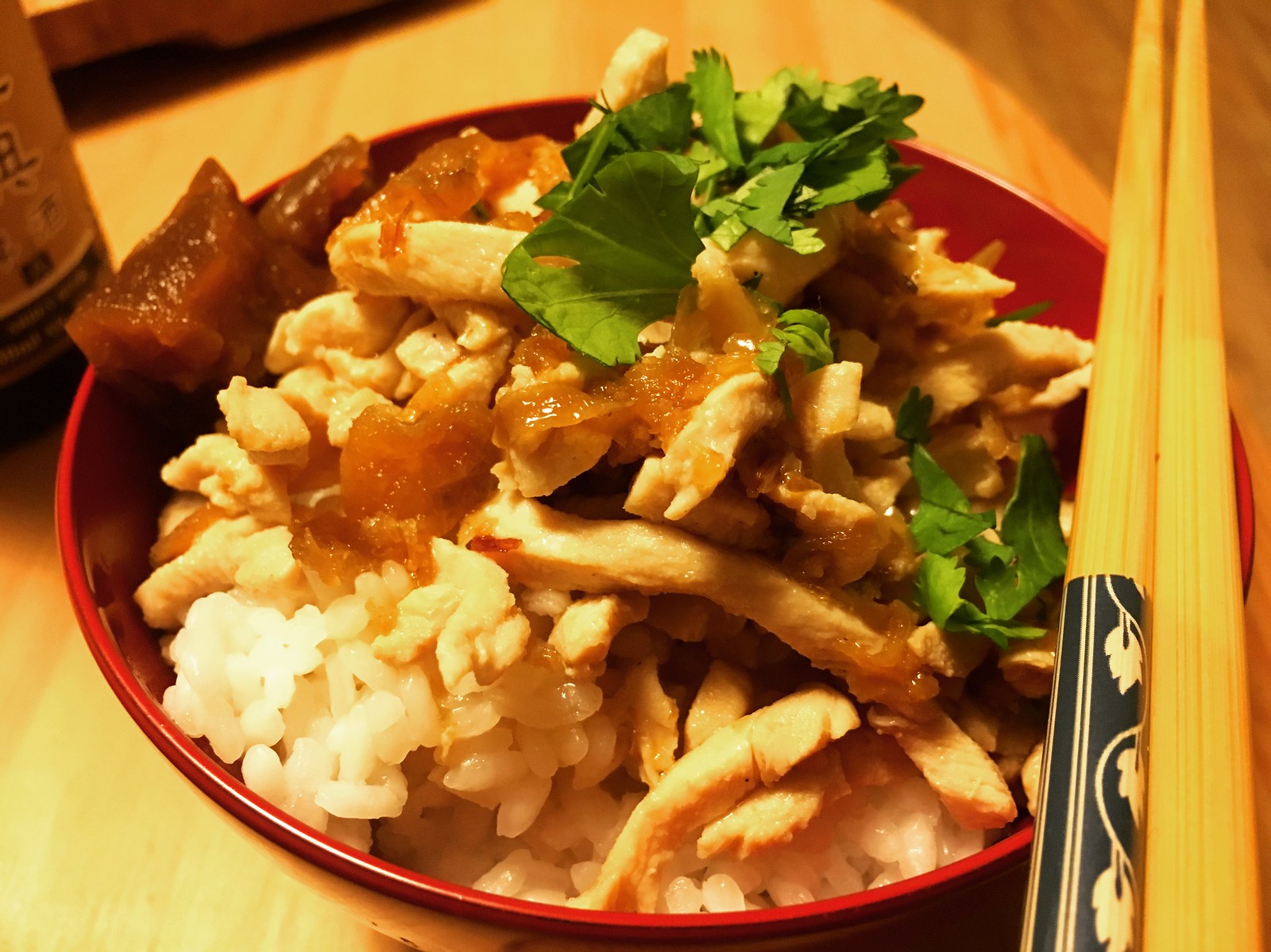 |
| I used pre-slivered chicken - probably better to shred it post-cooking instead. It was a bit dry, easy to overcook |
This was one of those recipes with a head-scratcher of an extra ingredient - Sichuan peppercorn powder? Huh?
I decided that I was going to break my rule of following the recipes faithfully at least the first time, and omit this. I accept it is a possibly acceptable "variation", but I have never, ever eaten chicken rice that tasted like it had anything like Sichuan flower pepper in it, and a Taiwanese friend I mentioned it to just raised his eyebrows and had...no words. But go ahead, try it, why not. I thought it tasted pretty authentic without it.
What I also found odd was that Erways' recipe calls for putting the fried shallots on top of the chicken, but it seems clear to me that they're meant to go in the sauce, where they turn into soft goober things that stick to the rice and chicken and make it tasty. I've never had chicken rice with crispy fried shallots, only soft goobered fried shallots.
Reader, I goobered my shallots.
Erway calls for steaming the chicken, other recipes call for boiling it. I think either is fine.
Hakka stir-fry (客家小炒)
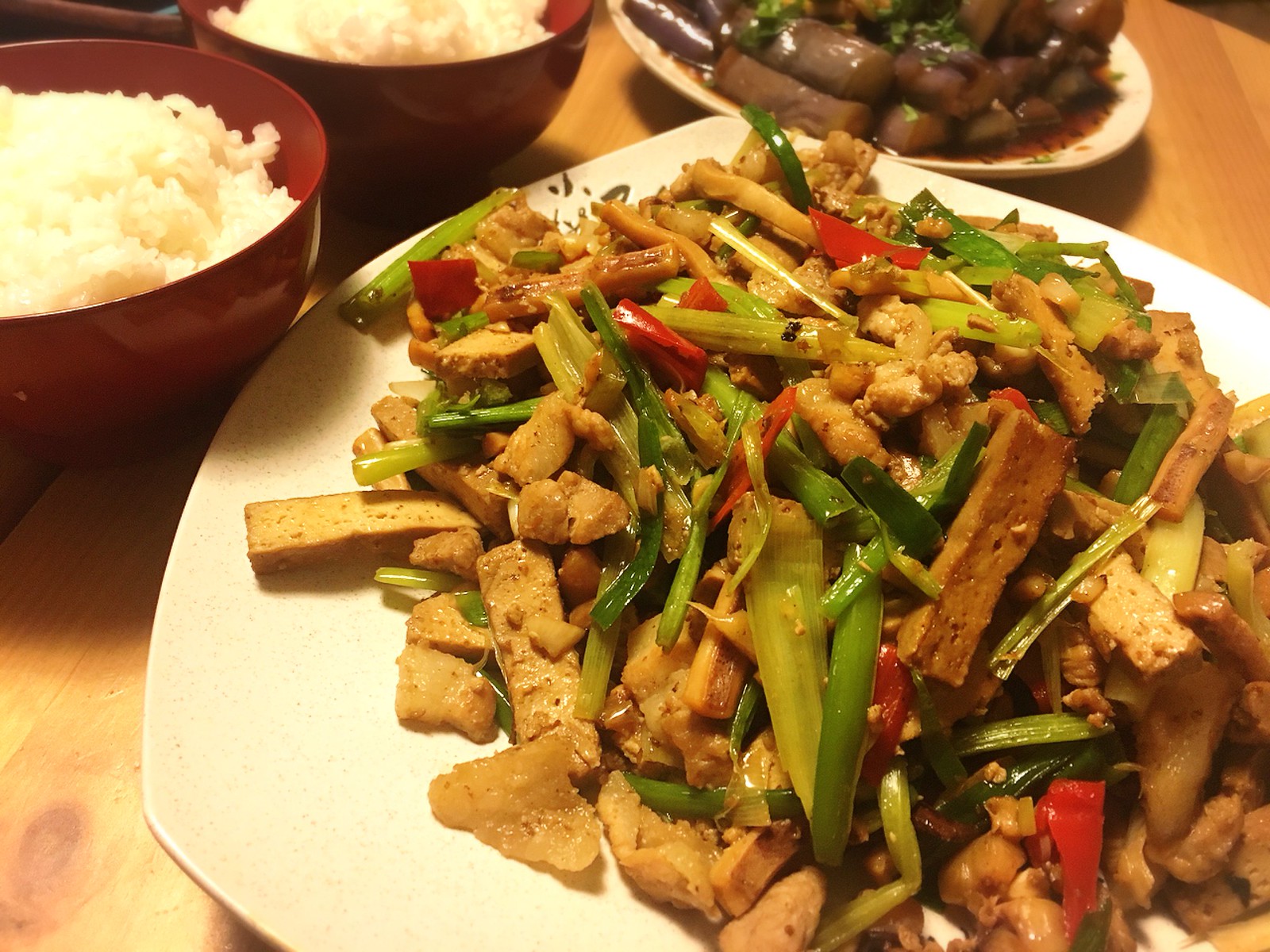 |
| Could use more color |
This was the recipe that I had to throw out. It forever has a black mark - it's not so much that it doesn't work as that the result does not look or taste anything like Hakka stir-fry.
Granted, "Hakka stir fry" has a lot of individual variation: even the name is fairly generic. It's like saying "New York Pizza". A very definite thing, but Giulio's, Mario's, Matteo's, Tony's and everyone else's are going to all have their own way of doing it. A Grimaldi's slice isn't quite the same as a typical Staten Island slice. So it goes with Hakka stir fry. Some varieties being fairly healthy-looking (they're not - they're full of sugar and oil) and others being...not that. Some involve dried tofu, others do not. Some include scallions, others do not. But all Hakka stir fries have a few things in common:
- They use strips/slivers of pork, not sliced
- They all include soaked dried squid, not fresh
- They all include garlic bolt/garlic green and Chinese celery
- They all involve some combination of garlic, rice wine or other alcohol and soy sauce, and some form of chili
- NONE OF THEM HAVE CARROT IN THEM
Erway's recipe called for fresh squid (!), larger sliced pieces of pork, according to the picture (!!), no garlic bolt (!!!), no dried tofu (okay - I know Hakka people who don't include it), and...carrot (!!!!).
I wanted this to be just another acceptable "variation" on a classic, or to find out that I'm just a dumb whitey who has no business telling Cathy Erway - who is of Taiwanese heritage - how a Taiwanese dish is made. But it isn't and I think maybe I'm not. I posted about it on Facebook, and got, from a variety of Hakka people, people who asked Hakka people and people married to Hakka people, some variant of:
"No!"
"HELL NO"
"Absolutely not"
"THERE IS NO CARROT IN HAKKA STIR-FRY!!!"
"As a Hakka man who is over 30 years old, I have never had carrot in a Hakka stir fry"
"I asked my (Hakka, with parents who run a Hakka restaurant in Miaoli) wife and she says there is absolutely no carrot in Hakka stir fry and the meat should never be sliced like that."
"I asked my Hakka coworker and he just stared at me before saying "...no."
"Where is the dried tofu?"
So, "acceptable variation aside", I can only conclude that Erway just - didn't include an accurate recipe for Hakka stir-fry. There are limits to what constitutes acceptable variation, and the Hakka People Of Taiwan Whom I Know have spoken: this recipe crosses a line.
I have to wonder if Erway just doesn't know Hakka food - her recipe for "citrus sauce" sounds like Hakka kumquat sauce, but...uses orange juice? That's odd. Either make it with kumquats or don't make it at all.
I chucked the whole thing, cobbled together a few recipes online, soaked my dried squid (easier to do than you'd think but start well ahead of time, and be aware that it stinks up your kitchen - and use rice wine or shaoxing wine, maybe with water to create enough liquid to soak a whole dried squid) and came up with a pretty tasty, though perhaps slightly pallid-looking, stir-fry.
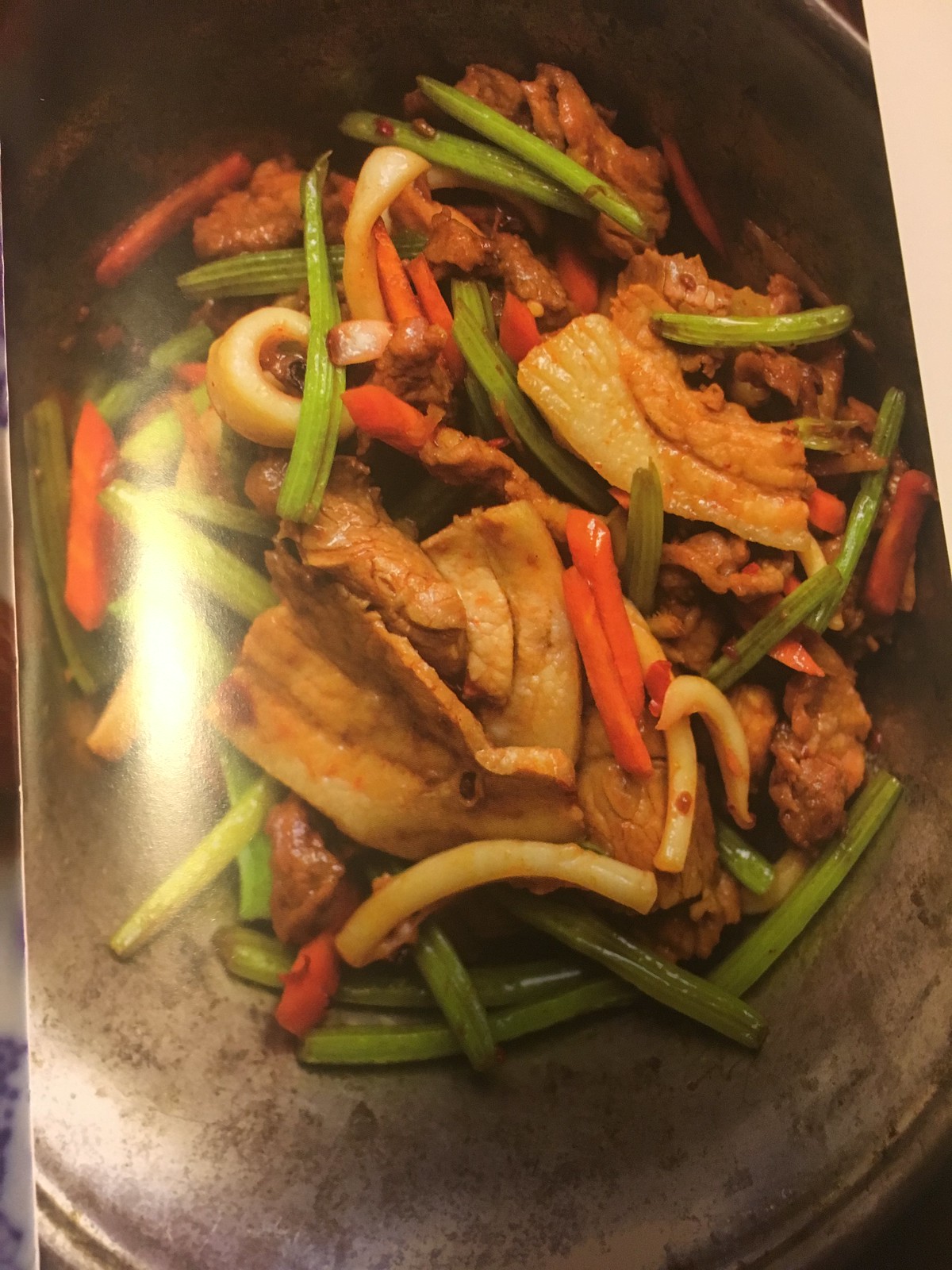 |
| But this just...doesn''t look like Hakka stir-fry. I'm sorry. (Photo from The Food of Taiwan) |
Erway suggests chili bean sauce (again with the chili bean sauce) rather than the sliced red chilis others call for, but she may be on to something here. Hakka stir fry I've had outside is redder/more colorful than what I came out with, and chili bean sauce might help with that.
* * *
So there you have it. The good, the slightly odd, and the unacceptable of The Food of Taiwan. I'll leave you with this thought: it seemed odd that it included a bunch of dishes I'm not really that familiar with - though maybe that's just because I don't order them often - but left out two of my favorites, which I would have thought would have made the final cut of any Taiwanese cookbook: scallion pancake (蔥油餅) and cold eggplant (涼拌茄子). I haven't made scallion pancake, but I did make cold eggplant, and it turned out great:
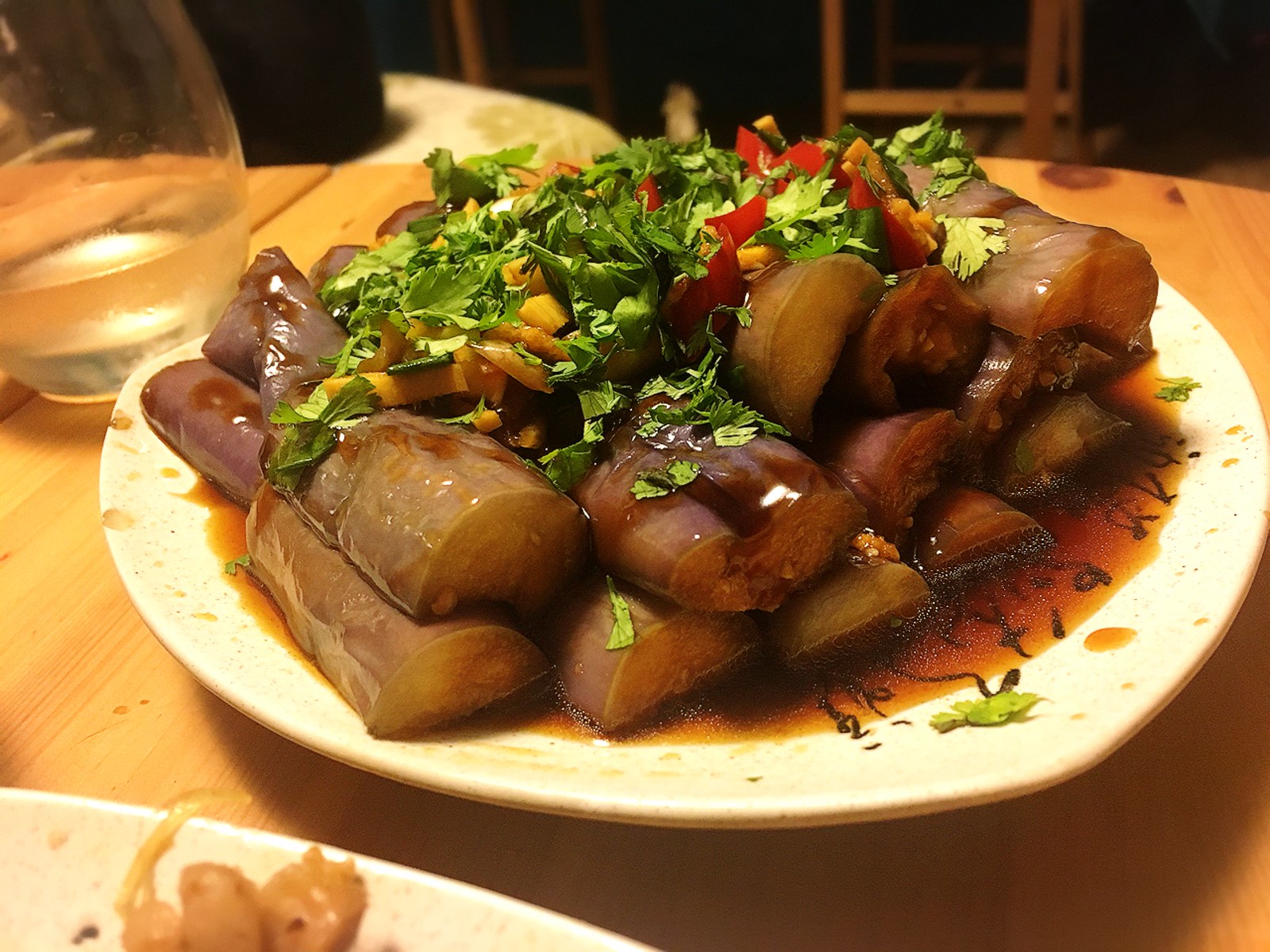 |
| Why wasn't this in the cookbook? Two other eggplant dishes were. |
I used this recipe, but added a little cilantro at the end, put some thick soy sauce in the mix to make it stick to the eggplants better, drizzled some thick soy on them after setting them on the plate, and actually steamed rather than boiled them. They smell so good when they are steaming.
Happy cooking!
And please feel free to leave your own cooking experiences with Taiwanese food - or any tips, hints or suggestions you have - in the comments. I'm always looking to improve my craft.
Subscribe to:
Posts (Atom)