 Like any good Snowflake SJW Avocado Toast Millenial*, I'm excited that Beto O'Rourke - a liberal described as "the next Obama" - is actually a realistic challenger to Ted Cruz in Texas. Texas! Where "no democrat has held state-wide office since 1994"! In a midterm election year that is not only seen as a referendum on Trump's two years of terrorizing from his perch in the White House, but also the only realistic chance we as a nation have of curbing him, to see this kind of progressive stand a chance in Texas of all places is huge.
This is especially exciting as he stands to unseat Ted Cruz, who ran for Human President in 2016 and who hates women and the LGBT community which is odd as I'm not sure his species has 'genders' or 'biological sex' in the way we understand them. In any case, pretty much nobody likes him.
So he could be gone! Yay!
...right?
Oh, wait, you support Taiwan and want to vote for representatives in the US government who are friends of Taiwan.
Then, not yay.
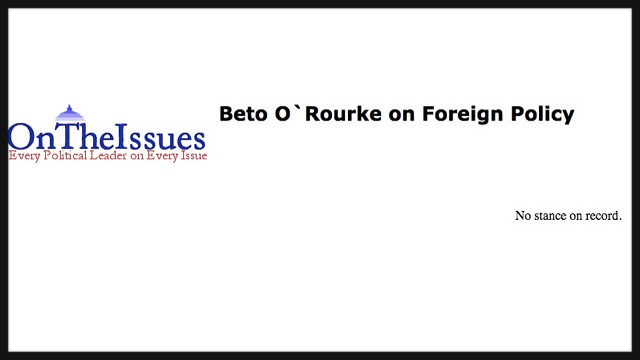
I have no idea what Beto O'Rourke thinks about Taiwan, or about foreign policy in general, and it seems neither does anyone else. His own website has no guidance whatsoever as to what, as a senator, his foreign policy would be.
But, as 'the next Obama' I can make some educated guesses. Obama was not a great friend to Taiwan. See here on arms sales (Taiwan advocates didn't seem terribly impressed and neither was I), "reducing tensions on both sides of the strait" (as though the source of the tensions weren't entirely one-sided), his advisors totally missing the point of Taiwan independence, ceding the high ground (and insistence on standing up for what's right) to McCain, and seeming to care more for Beijing's tender baby feelings than actually doing the right thing. Then there's support for the milquetoast, only-because-of-politics status quo ("a high degree of self-determination?" Screw you, buddy. Total self-determination like any other democratic nation or GTFO). Perhaps necessary, but harmful to Taiwan.
Long and short of it? Lots of talk about doing what's right on the American left, but then they turn around and play politics just like everyone else. I don't imagine an Obama-style liberal like O'Rourke will be a great ally of Taiwan.
Who knows? He might surprise me. But I doubt it.
Ted Cruz? He met with Tsai Ing-wen. Ted Cruz (Ted Cruz!) said this:
Another champion of Taiwan and supporter of the travel bill, is Sen. Ted Cruz (R-Tex.), who met with Tsai in Houston on Jan. 8, 2017 despite Beijing’s strong objections.
In an interview, Cruz slammed as “absurd” a December threat by Chinese diplomat Li Kexin during an event at Beijing’s embassy in Washington. Li told colleagues that he had warned U.S. officials against docking American warships in Taiwan.
“The day that a U.S. Navy vessel arrives in Kaohsiung is the day that our People’s Liberation Army unifies Taiwan with military force,” Li said, according to Chinese media reports cited by Reuters.
“The threat from a low-level Chinese diplomat of a military invasion of Taiwan was absurd, unduly provocative and should be met with laughter and derision,” Cruz said.
Cruz also denounced China for “vigorously” lobbying to kill strong ports-of-call language for Taiwan that he wanted included in the 2018 defense authorization bill, Cruz said.
I'd cream my damn pants if Obama said something like that.
I know, I know, a senator can say things a president can't, but remember, Cruz wanted to be
president.
But wait, there's more!
"Texas stands with Taiwan," Ted Cruz also said.
While I'm not sure why Cruz is such a strong Taiwan supporter - general wisdom has it that most pro-Taiwan Republicans support this country because they oppose "Communist China", that is, they're still stuck in Cold War thinking - I'm definitely of the school of Taiwan advocate that feels Taiwan should take the help it can get. I'm not inclined to say we don't want his support because he's awful in just about every other respect.
But, as a liberal pro-Taiwan voter, I'm damn glad I'm not a Texan.
Sure, we have bipartisan support and I am glad of that. I won't pretend this is a war of Dems against Reps for the future of Taiwan or anything like that.
But, what's a girl who supports Taiwan, enjoys bodily autonomy and wants her gay friends to have equal rights to do, when the guy she would vote for is very likely not going to be the Taiwan ally she wants to see in office, and the champion of Taiwan he stands to defeat pretty much hates her on account of her having a vagina?
If the only issue she cared about were Taiwan, the choice would be obvious (and very self-harming, if not masochistic.) But when every other platform of the friend of Taiwan she wants to see in office is so odious that she feels she must vote against him, only to worry that that strong bipartisan support for Taiwan in congress might well waver - maybe just a ripple - by voting out a Taiwan ally and voting in someone who doesn't appear to have a foreign policy at all, let alone any sense of the importance of Taiwan.
All I can say is, if this issue were to ever face me as a voter in the northeast, I would honestly spin myself in circles with anxiety. It quite literally feels like it comes down to "Taiwan, which is what is right", and "everything else that's right".
I want a tried-and-true friend of Taiwan in office, but I also want O'Rourke to win for literally every other reason.
So yeah, bipartisan support or not, it's really difficult to use our votes as Americans to support Taiwan.
*not really a Millenial but let's pretend
A friend sent me this the other day: it's a document translated in Chinese, Japanese, English and several Southeast Asian languages asking foreign spouses at the registration office filling out divorce paperwork if they agree to get a divorce.
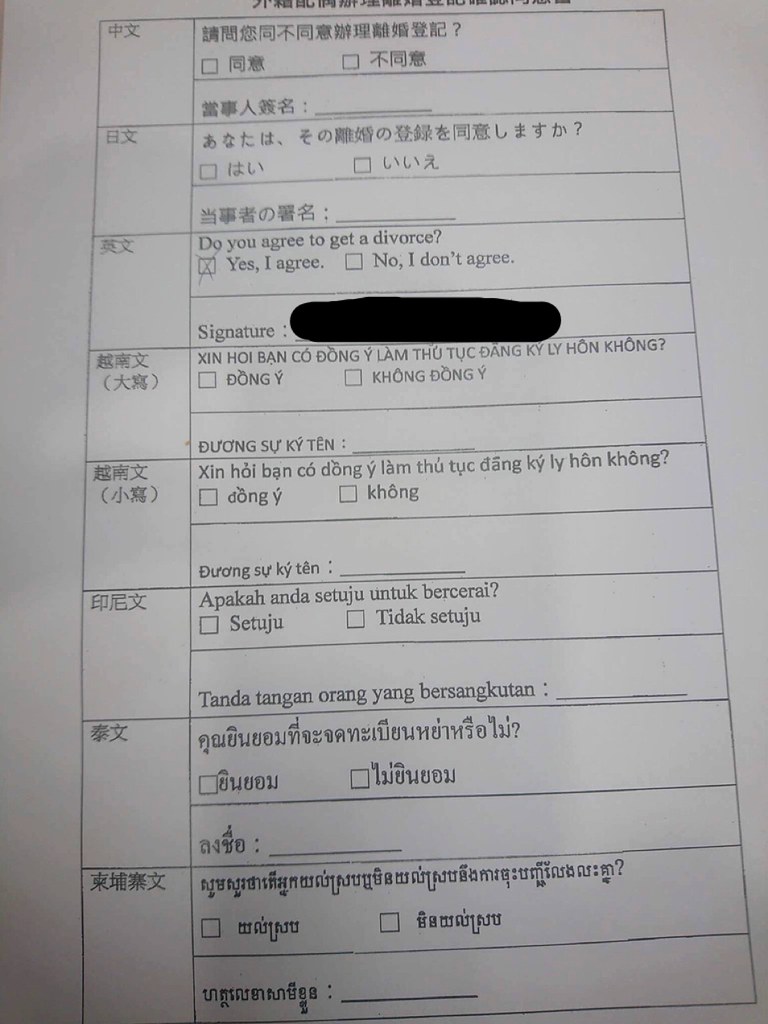 Apparently, the police require this for all foreign divorces in Taiwan now, as it is too common for a Taiwanese spouse (usually male) who wants to divorce (usually a Southeast Asian woman who can't read Chinese) to take her to the local housing registration office saying they have to "fill out some paperwork", perhaps saying it's about some unrelated thing, and then divorcing her without her knowledge.
While it's not so easy in Taiwan for someone to divorce their spouse if that spouse doesn't agree, these 'trick' divorces made it look like the wife agreed - after all, she signed the paperwork without complaint. If both spouses agree, the process of legal divorce takes less than half an hour (in terms of splitting assets, I have no idea).
Once the divorce is final, the foreign spouse - again, usually a woman who doesn't speak or read Chinese - has 48 hours to leave the country. No time to demand access to assets or other support. Possibly no time to even go to the bank, if she has a bank account in her own name, which she likely doesn't. No realistic way to take any children with her. She's out, she gets nothing, quite possibly returning to a life of miserable poverty, and he gets a clean break and to keep everything. It is extremely difficult if not impossible to fight for a fair division of assets once out of the country, and as far as I know there is no legal way to apply to stay on such short notice (though I'm not sure about that, and if there were, it's not clear that someone who can't read Chinese and might not even have her own transport would be able to access it.)
This is absolutely evil, that goes without saying. It is wrong. It cannot be tolerated.
The good news is that the Taiwanese government got its act together (that happens sometimes!) and put together this form, which is now standard with foreign divorces. Unless the spouse is illiterate - in which case I suppose an interpreter would be necessary and locating one on short notice would pose other problems - it clarifies for the soon-to-be-erstwhile foreign spouse what is happening.
If in fact she is being tricked, she can then refuse to sign the divorce papers, which buys her time and therefore better access to legal services to fight for assets and custody. She's not left penniless on a plane back to her country of birth without so much as the chance to give family there (if she has any) advance notification to expect her.
This doesn't solve every problem with the rules surrounding foreign spouses: if you knowingly divorce or your spouse dies and you were unable to obtain an APRC (or just had not done so) - keeping in mind that the men who marry Southeast Asian women may not meet the required income threshold for her to get an APRC, if she even knows that's an option - you also have few options for staying in Taiwan, and that's not right. However, it deals with a massive issue many of us had no idea existed. It materially improves an issue facing foreigners - especially foreign women - in Taiwan.
One thing that helps with this is that the document itself is very simple - one easy-to-understand question and very simple choices of answer (so if there is some ability to read but overall literacy level is not high, it should still be comprehensible), which shows sensitivity to the situation of these women. It might seem to us that any foreigner who comes to Taiwan would be literate in their own language, but when it comes to women brokered through the marriage industry (and it is very much an industry) here, that's not guaranteed to be true.
I don't often say this, but good job, Taiwanese government. You did the right thing.
A piece by former Sunflower leader Lin Fei-fan came out today, warning of Ko's embrace of Xi Jinping's and China's oft-repeated phrase, "the two sides of the Strait are one family", essentially calling Ko's seeming doublespeak on China a strategy out of the Ma Ying-jeou playbook: insisting he's not pro-unification and then acting the opposite.
I'm already anticipating the criticism that'll flow in over such a prominent figure in Taiwanese Third Force politics essentially taking a shot at Ko as the Taipei mayoral election nears and no better pro-Taiwan candidates are running (or arguably, none who could actually win Taipei exist).
One thing in particular I expect to hear, which I'd like to dismantle right now, is the idea that Ko's and Xi's exact wording don't match: that Xi uses "兩岸一家人" (a translation of "one family" that implies a single household or very immediate relatives) and Ko uses "兩岸一家親" which implies a more distant familial relation, like cousins: the idea being that you can share ancestors or be related, but not be under the same household.
However, CRNTT/China Review News/台灣中評, essentially Chinese state-sponsored media in Taiwan and Hong Kong, published a lengthy article on the 19th Party Congress in 2017, in which the latter phrase - the one used by Ko - is explicitly quoted as being used by Xi:
“兩岸一家親”是習近平總書記積極宣導的兩岸關係和平發展新理念,這一新理念的內涵極為豐富。“兩岸一家親”的基礎是兩岸同屬一個民族和國家。“兩岸一家親”的對台政策意涵是用“一家人”的思維和邏輯,“將心比心”更加彈性地處理台灣問題、兩岸分歧和對台讓利。“兩岸一家親”理念要求兩岸同胞彼此信賴,彼此扶持,不斷擴大和密切兩岸交流交往,在融合發展中撫平歷史的傷痕,共同推進中華民族偉大復興的歷史進程。
My rough translation: "The two sides of the strait are one family" is a new concept for the peaceful development of cross-strait relations actively promoted by General Secretary Xi Jinping. This new concept is extremely rich in content. The basis of the phrase "two sides of the strait are one family" is that both sides of the strait belong to one nation. This policy towards Taiwan is to use "family" rhetoric and logic to "reconcile hearts" and deal more flexibly with the Taiwan issue, cross-strait differences, and benefit Taiwan. The "cross-strait family" concept requires compatriots on both sides of the strait to trust each other, support each other, continuously expand cross-strait exchanges, smooth the scars of history in the development of integration, and jointly advance the historic process of the great rejuvenation of the Chinese nation.
Barf.
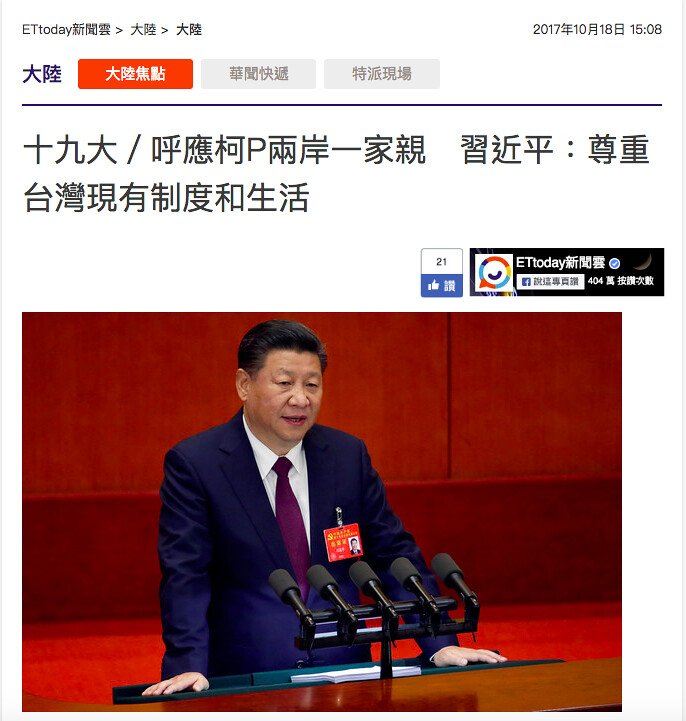
Anyway, that's what Chinese media in Taiwan is saying. It's useful to get a sense of what the Chinese government thinks, and they are explicitly using the exact same phrase as Ko: not 一家人, but 一家親. Here's another source from ETToday and another from China Times (pan-blue/pro-China media in Taiwan) which contains extensive quotes from Xi. Here's an English translation of Xi's words in 2017. You have to dig, as this wasn't one of the top points of his address, but it's there.
Basically, it seems as though Xi used the old phrasing (一家人) up through about 2013, then switched to the newer one echoed by Ko after that (一家親), while occasionally switching back to the more 'immediate family' (一家人) translation. However, both retain the same translation in English.
I am sure that China does this sort of thing intentionally - taking words that have subtle, hard to parse translations in other languages and twisting them to suit their own ends. Because it's hard to explain these things in English, those who don't know Mandarin buy too easily into CCP-approved ways of thinking about these concepts. Another key example is the way they allow confusion to blossom over the concept of 華人 (Chinese, as in, something from Chinese culture) and 中國人 (from the nation called 'China'): essentially trying to control the debate about what it means to be 'Chinese' by equating it linguistically with anything 'Chinese' being 'a part of China'. Both words, however, translate as 'Chinese' and it's difficult to explain the difference unless you learn the language. It's also difficult for people who don't want to be lumped in under the CCP's idea of what it means to be 'Chinese' to use these words.
"一家親" in its "extended family (not necessarily of one household)" context might have been embraced by many Taiwanese, just as having Chinese cultural heritage (華人) might have been. Now, you can't say those things - you can't express an opinion that you are proud of your Chinese ancestry but don't want to be a part of China - without sounding like a unificationist. That suits some people very well indeed.
Note, in fact, that these points on the Chinese renderings of the phrase "two sides of the strait are one family" are not included in Lin's article: there's just too much you'd have to say to make it clear, and you'd lose readers' interest. It takes up valuable digital real estate - but the fact that it is so hard to discuss in other languages is exactly the point.
Some might ask whether Ko really means to echo Xi and China in his choice of words. I don't know - he's the kind of person who would stumble into this sort of thing unintentionally, having a tendency to...um, not think too much about how he comes across when he talks. He tends to stumble around answers to questions he really should see coming and have rehearsed, polished answers to, but apparently doesn't - not that I generally find Taiwanese politics very polished, mind you.
There's also the terrifying fact that Ko's milquetoast KMT opponent Ting Shou-chung uses the old, even more pro-unification "兩岸一家人" - a sign that Ting, not Ko, is the one in China's pocket? That both are useful idiots, blathering pro-China rhetoric that may sound different to Taiwanese voters but is seen in exactly the same way as China - and that this is intentional on China's part? That Ting is using the phrase in a bid to get the KMT back into the CCP's good graces - they miss their Daddy it seems - but the CCP has decided Ko is a better bet? I don't know.
But Lin puts forward a convincing case that we should at least keep our eye on Ko, and hold him accountable for his words: that CCTV seems to endorse him, and that China certainly is looking to co-opt Third Force and third-party politicians in Taiwan as it sees its inability to push its agenda forward through the KMT, and that his city-level exchanges with Shanghai are problematic. While he doesn't say so explicitly, the CCP's use of specific terminology is very deliberate. These exact phrases - like 兩岸一家人/一家親, or 中華民族偉大復興的歷史進程 ("the great rejuvenation of the Chinese nation") - are significant to them and are generally deployed using exactly the same language each time. They are signals, to some extent dog whistles to those they've co-opted. If Xi has changed his wording, Ko is using it too (and defending that use), the phrase seems to have been given prominence above the language of the so-called "1992 Consensus, and CCTV is happy about all of this, it could very well mean something.
This isn't to say that I think Ko is a unificationist. He strikes me as more of a too-smart-for-his-own-good catspaw or useful idiot. It wouldn't be the first time a seeming pan-green loyalist was manipulated into doing the CCP's bidding, but I don't know what motivates Ko. All I can do is point out that, when it comes down to the very specific terminology put out by the CCP, Ko's words do in fact match up.
I certainly don't think Taiwanese voters will embrace this "one family" doctrine either: when it comes to actual sentiments of most Taiwanese people, Ko's words are not as divisive as some may believe. Just because he's selling potentially problematic ideas doesn't mean the electorate is buying them.
Some will probably say Lin is trying to tank Ko's re-election. If you read between the lines of what Lin is saying, however, it's not that we should not elect Ko. I would bet CA$H money that he fully expects Ko to win, and that he's fully aware that Yao's a joke who doesn't stand a chance and Ting is far worse a choice than Ko. Ting's clearly anti-independence stance is a huge problem, and Yao's off partying like it's 1999, naming Chen Shui-bian (yes, that Chen Shui-bian) his "supreme advisor". LOL.
I'd bet a full case of wine that Lin's goal is to get the world to look more closely at Ko and hold him to account for his words, but not necessarily to refuse to vote for him. He's someone who pokes holes in establishment narratives and criticizes where criticism is due, regardless of the consequences. That's often (though perhaps not always) a good thing.
I am sure he doesn't believe that Taiwanese voters will suddenly go pro-China either: several times in the piece it points out that the KMT is not likely to regain its lost popularity, and that Ko's words on China do not echo the sentiments of the Taiwanese people. His concern is that the Taiwanese people are deliberately ignoring his words out of convenience, for lack of a better candidate, and that's a dangerous path to follow (see: Ma Ying-jeou).
I'm not sure this is the best way to make the case for Taiwan in English in international media, as it's really something for Taiwanese voters to think about and Taiwan gets limited screen time on any media outlet. The rest of the world is confused enough by China's consistently winning the rhetoric war on the China-Taiwan debate (though less so these days), and needs to hear a clear, clarion-bright call bringing the case for Taiwan: not muddy, difficult, unclear domestic political situations that Taiwan is trying to hash out itself. I'd like to see more 'clear cases for Taiwan' and less 'domestic Taiwanese politics' for global readers.
But that doesn't mean Lin is wrong.
And every time the 1992 Consensus is called out for the pro-China garbage it is in English-language media, the better. I am only sad that the word "fabrication" was not used, because that's what it is. More of that, please.