Here are some things I am not an expert in:
Military/defense
Tech
Arms sales
Intelligence
A lot of other things
Most things, actually
But an interesting theme - to me, the non-expert, at least - seems to run through several Taiwan-related news items that touch on these topics these days.
We have the always-great Tanner Greer, writing about how Taiwan can win a war with China. Sure, China's got a bigger army, a bigger budget, a bigger country, and is all around just bigger. But in order to actually win a war with Taiwan without getting trapped in a protracted battle (or before help for Taiwan can arrive), Greer argues that it would need to take Taiwan and strong-arm the population into docility within two short weeks.
That's a very small window of time, and it is not at all clear that China could accomplish it.
What stands in China's way?
The places where the PLA could land in Taiwan amount to a few beaches on the west coast. None of them are friendly to incoming assault.
There are only 13 beaches on Taiwan’s western coast that the PLA could possibly land at. Each of these has already been prepared for a potential conflict. Long underground tunnels—complete with hardened, subterranean supply depots—crisscross the landing sites. The berm of each beach has been covered with razor-leaf plants. Chemical treatment plants are common in many beach towns—meaning that invaders must prepare for the clouds of toxic gas any indiscriminate saturation bombing on their part will release. This is how things stand in times of peace.
As war approaches, each beach will be turned into a workshop of horrors. The path from these beaches to the capital has been painstakingly mapped; once a state of emergency has been declared, each step of the journey will be complicated or booby-trapped. PLA war manuals warn soldiers that skyscrapers and rock outcrops will have steel cords strung between them to entangle helicopters; tunnels, bridges, and overpasses will be rigged with munitions (to be destroyed only at the last possible moment); and building after building in Taiwan’s dense urban core will be transformed into small redoubts meant to drag Chinese units into drawn-out fights over each city street.
Each of these hurdles is a very small thing, but strung together, each one buys Taiwan a little more time, getting it a little bit closer to that two-week window in which the war stops being a certain victory for China and becomes a massive quagmire. It is to Taiwan's advantage, not China's for this to happen. If China overwhelms Taiwan and pushes on it a tense, authoritarian 'peace', the bombings will stop. But Taiwan will be finished. There will be no fighting back - only dying. If you thought the White Terror was bad, wait until you see what China is capable of. Oh wait, we already know.
Taiwan's weapons for fighting back are comparatively small, but they could have a huge effect on how such an invasion would go.
Here's another thing that's small - the latest arms package to Taiwan. But Michal Thim proves that it's not the size that counts, it's how you use it:
On the face of it, the content of the latest arms sale does not look particularly concerning to Beijing. The total size of the sale is much less than the US$1.4 billion approved last June....
However, the content of the sale is not the most crucial aspect, although its utility to Taiwan’s air force cannot be overstated. The fact that the sale is just about supply and logistics suggest a change in attitude on the US side.
First, the items were approved on a continuing basis and as needed and available. Second, the Trump administration has not only moved from large bundles every few years to sales on an annual basis, but it may also indicate a move away from bundling orders altogether.
In the past, and especially during Barack Obama’s two terms, the US government came across as too accommodating in trying to navigate relations with Taiwan in a way that would not upset Beijing, and Chinese leaders seized on every opportunity to capitalise.
The result was that arms sales to Taiwan were bundled into large packages and separated by long periods of no activity, though the ever-growing military capability of the PLA warranted a response via robust arms sales, as presumed by the Taiwan Relations Act of 1979. Something as routine as a supply of spare parts under the logistics agreement became subject to political considerations. Now, Washington may be returning to normal.
Small sales with big impacts. Arms sales on a continuing basis and not bundled into large packages, offered fairly rarely, which China throws a fit about each and every time, are in fact not as good a deal for Taiwan as sales on an as-needed, always-available basis. Nobody - not even China - can keep up the screamy outrage for that long. The more the US sells to Taiwan regularly, the less often China can "raise tensions" (then pretend those tensions rose by themselves, like magic) over it.
Well, actually China probably can do that. But nobody can keep the media's attention with its screamy outrage for that long, and that's really what matters here. If China cries alone in a forest and nobody is there to hear it, did it ever really cry at all?
Also, BOO to South China Morning Post for completely mangling a perfectly good shot at a dirty joke in their overly prolix subheader, and read the whole article to hear about how Europe is entering the Taiwan arms game. Also a small thing with a big impact: the more people we have ensuring that Taiwan can defend itself, the better. The sale may be small but the precedent it sets is huge.
Here's an even smaller thing: Chinese companies have been hiding chips that enable them to hack into systems around the world into tech they manufacture:
Nested on the servers’ motherboards, the testers found a tiny microchip, not much bigger than a grain of rice, that wasn’t part of the boards’ original design. Amazon reported the discovery to U.S. authorities, sending a shudder through the intelligence community. Elemental’s servers could be found in Department of Defense data centers, the CIA’s drone operations, and the onboard networks of Navy warships. And Elemental was just one of hundreds of Supermicro customers.
During the ensuing top-secret probe, which remains open more than three years later, investigators determined that the chips allowed the attackers to create a stealth doorway into any network that included the altered machines. Multiple people familiar with the matter say investigators found that the chips had been inserted at factories run by manufacturing subcontractors in China.
It doesn't take a tech expert to see that this is terrifying, and Jordan Robertson and Michael Riley lay out why:
In the three years since the briefing in McLean, no commercially viable way to detect attacks like the one on Supermicro’s motherboards has emerged—or has looked likely to emerge. Few companies have the resources of Apple and Amazon, and it took some luck even for them to spot the problem. “This stuff is at the cutting edge of the cutting edge, and there is no easy technological solution,” one of the people present in McLean says. “You have to invest in things that the world wants. You cannot invest in things that the world is not ready to accept yet.”
Tiny chips, massive problems. If this is what is being found in the US, imagine how much of Taiwanese telecommunications and other digital activities and information China has access to.
There are also small things like port terminals to consider. It seems odd that after a Chinese takeover, the Taiwanese government would allow terminals in Kaohsiung port previously controlled by a small shipping company (Orient Overseas) to be transferred to Chinese-owned Cosco.
When Chinese state-owned shipping line Cosco Shipping Holdings unveiled a $6.3 billion deal to buy smaller competitor Orient Overseas (International) last year, Orient's ownership of port terminals in the U.S. and Taiwan appeared to pose a potential regulatory obstacle.
Port ownership by Chinese state companies has become an increasingly sensitive topic globally as Beijing's Belt and Road Initiative spurs concerns about whether their control could be leveraged for security purposes.
Given deepening confrontations between Beijing and both Washington and Taipei over a range of issues, it looked doubtful that Cosco would be allowed to take over the assets of Hong Kong-based Orient Overseas at Kaohsiung, Taiwan, and Long Beach, California, near Los Angeles.
On July 7, Cosco and Orient Overseas, better known under its operating brand OOCL, said that U.S. regulatory approval had been secured, with the condition that the Long Beach terminal be put into a trust and then sold. Cosco then announced the completion of its takeover on July 27, with no mention made of Kaohsiung.
While there have been no public statements, it is evident that OOCL retains control of its terminal at Kaohsiung, Taiwan's busiest port. OOCL's name remains on signage there and staff in Kaohsiung say nothing has changed.
What happens to those terminals when China grows more hostile toward Taiwan (as it likely will), or otherwise throws a conniption over Taiwan's simply trying to exist? How does it affect Taiwan's economy?
I don't know, but that people who know these things say it matters means we ought to be paying attention. These terminals may barely register as small pearls in China's massive BRI pearl necklace encircling the world, but they could, in the coming years, matter quote a lot for Taiwan.
People think big: they think about big bombs, big invasions, big armies.
But the war for Taiwan - and for liberal democratic values in the face of an increasingly expansionist China - isn't going to be won by earth-shaking missiles or massive regiments invading by sea.
It will be won by things as small as a gauntlet of booby traps starting in the Taiwan Strait and ending in Taiwanese cities, as small as whether Taiwan is able to maintain its defensive capabilities with rolling arms sales from the West, or whether we're all laid bare by hidden microchips as small as a number carved on a penny.
When it comes to ensuring a future for Taiwan, in some ways, think small.
Little end note: I just quoted a bunch of really smart men. Everything they say is worth listening to, but really, all men. You probably didn't notice, but I did. Where the ladies at?

Friday, October 5, 2018


Wednesday, October 3, 2018
The left finally notices Taiwan - super late to the game
 |
| Come on, give Taiwan a chance. |
A truly excellent piece of writing and overall backgrounder on Taiwan and why the Western left should care about it appeared in Dissent Magazine recently.
I'm elated. I have nothing bad to say about the piece. My only disappointment is that not enough mainstream Western lefties read Dissent, and its online access is blocked by a paywall (frankly, the reason for the former is certainly, in part, the latter). So a lot of people who should read this piece, won't.
Because you probably don't have access to read the full article, and I do (don't ask how, but I have my sorceress ways), I'm basically going to quote relevant bits here without going full-on copyright infringement, and hope that this will make the ideas therein a bit more accessible to those who so desperately need to hear them.
Here's how it starts:
Imagine a small, peaceful, progressive island in Asia about the size of Mary- land. Ruled until the Cold War’s very end by a military dictatorship, it is now a robust democracy, although it endures incessant hostility from its giant neighbor. Its people treasure their hard-fought equality, free press, and vibrant civil society.
The rest of the introduction is free to read, so I'll be taking the rest from the parts that are not accessible to non-subscribers. In any case, this is the country I call home. And, with some exceptions, it basically lives up to this promise as well as any democratic nation can.
Boasting the world’s largest standing army and an expansionist outlook, the People’s Republic of China deems Taiwan a “renegade province” that must be “reunified” in due course. And because the Chinese claim the island as part of their territory, they go out of their way to block its international participation. Essentially, they have made befriending Taiwan a zero-sum game for anyone who dares to do so, and the rules are simple: Engage with us and we will reward you; engage with them and we will punish you. It is fierce dollar diplomacy Beijing insists on waging, and Taipei can’t win.
Exactly, and thank you to this writer for putting "renegade province" and "reunified" in the scare quotes they always needed. Why can't mainstream media outlets do that? It's simple, easy and more accurate than what they do print (which is similar copy without the quotation marks, implying the claims have merit.) That the West doesn't see the game China is playing here, or doesn't care and is willing to sacrifice 23.5 million people who currently live free is terrifying to me. If you say you have values, live up to them, damn it.
In a recent poll that asked whether unification is an option if China democratizes (itself a long shot), just 24 percent of respondents aged thirty-nine or below said yes, while 73 percent said no. Since 2009, according to another survey, a majority of the island’s population has consistently self-identified as taiwanese— not as Chinese, nor as both—a sign that they have long assumed their de facto independence.
Yup. This idea that "both sides of the Strait" think of themselves or identify as "Chinese" is basically complete trash-in-the-dumpster bollocks. It's not true and hasn't been true for some time. Why the rest of the world is willing to force an identity on Taiwan - "but they're officially the Republic of China so they think they are Chinese too!", which is an oversimplification that leads to a dead-wrong conclusion - is beyond me. Everyone else gets to identify as they wish with liberal support - why not Taiwanese?
Keep in mind that Taiwan cannot change its official name from the Republic of China because doing so would precipitate a war that nobody wants, especially not the Taiwanese who, above all else, want peace. It wasn't a country name chosen by the Taiwanese - it was decided by the Nationalist government in China, without ever asking any Taiwanese what they thought about it. In essence, it is colonial. So it's a bit of a jerk's game of Catch-22 to then say this attempt to maintain peace means they "are Chinese".
As a diverse, tolerant country with a leader who has shattered the ultimate glass ceiling for Asian women, there is every reason to expect that tai- wan’s most faithful allies in the U.S. are on the left. Except that is not the case at all: American progressives tend to view it as either a reactionary state or one of no importance.
I think I need to change my pants.
This is so true it hurts, and what is worse, it's so painfully wrong. It calls to mind, forcefully, a "conversation" (more like an ignorant rant-fest on his part that I very much wanted to end) between a friend-of-a-friend on social media, in which he went on and on (and on and on), basically Dunning-Krugering himself into a tizzy about how it would be "better" and we should "hope" that Taiwan takes over China, because apparently this worked in Hong Kong (I don't think he's ever asked any Hong Kongers what they think about that, or read about how that's actually gone down, because that's not the answer I think many would give) and anyway, they're the same people with the same culture and history, so why not?
That 23.5 million people don't think they are the same people with the same culture and history, and who have already built the sort of democracy with a healthy respect for civil society that Western liberals can only wet dream about (just try occupying Congress in the United States - you'd be dead), didn't seem to factor in.
John Bolton, who would later become Trump’s national security advisor, electrified conservatives when he declared on Fox & Friends: “Nobody in Beijing gets to dictate who we talk to.”
But then came the partisan backlash. It just so perfectly fit the anti- trump narrative: a buffoon elected president who was already, before taking office, eroding well-established “norms” because he was either too reckless or too ignorant. “that’s how wars start,” tweeted Senator Chris Murphy. trump’s “flippant calls” were “threatening to create diplomatic crises,” Vanity Fair asserted in the same article that compared tsai with other controversial world leaders with whom trump had also spoken, like Rodrigo Duterte of the Philippines and Nursultan Nazarbayev of Kazakhstan, as if she, too, was a notorious human rights abuser.
Somebody please get me a towel, because it's getting hot in here.
Anyway, yeah, all this. Tsai is a moderate - if anything, too careful and too conservative - democratically-elected leader. Like all elected leaders, she is imperfect, but damn, she ain't Duterte. Likewise, Taiwan's democracy is imperfect. Some people who ought to be protected, aren't. But it ain't Turkey.
This echoes what the rest of the world writes about Taiwan and China - as though Tsai were somehow the one "causing tensions", or her fairly mild "we won't take any crap from China but we won't make waves either" stance (exactly the right attitude to take when facing a bully) was some sort of "hardliner" rant.
But since Horrible Death Walrus John Bolton said it - despite the fact that this one (and only) time, he was right - the left flipped the hell out.
And I thought our side was better at evaluating the merit of the idea rather than dismissing it based on its source. Hmm. Maybe we're not as smart as I thought.
Absent from the mainstream media discourse were the views of ordinary taiwanese, most of whom do not remotely share trump’s politics but were delighted to learn of their country’s long overdue acceptance and validation on the international stage. One commentator called it “the happiest thing” for Taiwan since the Jimmy Carter years.
HOO BOY HOSE ME DOWN.
Seriously, we have been trying to tell the West this for years. Why is it that the views of China and the CCP are always given center stage in the media and general pundit commentariat, and nobody ever seems to ask what the Taiwanese think about all this?
The article goes on to reflect on some of the ideas of this piece, which you should also read.
So, as late as the waning days of 1986, this was the scenario Washington faced: neither side could accept coexistence as they each claimed to be the sole, rightful owner of China and Taiwan combined. to keep gambling on Beijing—which first began with Richard Nixon’s famous visit in 1972 and formalized when Carter severed diplomatic ties in 1979 with Taipei—seemed sensible enough.
It was not at all imaginable that Taiwan would be the one to emerge as Asia’s beacon of freedom so soon while China would backslide.
Exactly. In 1979 the Western reaction to Taiwan made more sense - Taiwan was still a dictatorship, ruled by people not from Taiwan, who never asked the Taiwan if they wanted to be ruled. You know, like a colony.
And yeah, that dictatorship (which, again, was not Taiwanese) claimed to be the sole legitimate government of China. That sucks, but it's not Taiwan's fault and certainly doesn't reflect the views of the Taiwanese today. These guys did not even come from Taiwan and their dictatorship is over (though the party still, unfortunately, exists).
The idea that the legitimate government of China is currently in Taiwan is ludicrous, and almost all Taiwanese would agree with this. Those that don't tend to be in their 90s and were not born in Taiwan. And sure, maybe it's too bad that Grandpa lost the war, but things have changed.
So why doesn't the West get this too? Because, like, hey libs. It's not 1979 anymore. The king is dead! Long live the democratically elected leader of one of the freest countries in Asia!
There's a bit more history there, but I'm getting a little quote-happy. Just be aware that it was the 90s, and the first George Bush's actions after Tiananmen Square, that led to neo-conservatives taking up the cause of Taiwan (called the "Blue Team" - though Taiwan isn't exactly 'blue' anymore, it was then). Of course, what neo-cons champion, those liberals - well, the ones who don't think or don't know better - reflexively hate. Cue Clinton's tepid views on Taiwan, which set the stage for a general liberal ignoring of a quickly democratizing and liberalizing nation.
Some more recent history for you:
Simultaneously in Washington, the Blue team became ever more influential with Congress, think tanks, and even the incoming president’s inner circle. But while George W. Bush and his neoconservative allies were keen to confront Beijing early in his first term, they soon found themselves need- ing crucial Chinese cooperation in North Korea and especially the Middle East after 9/11; this compelled Bush to speak out against taiwanese independence in December 2003. the “One China” policy hence survived as a cornerstone of American foreign policy. Obama’s “pivot to Asia” did not alter that either, as he kept Taiwan out of the Trans-Pacific Partnership negotiations, although the free-trade pact was itself designed to counterbalance China’s regional clout.
You may hate the TPP, but if its more noble goals were ever achievable, it was just stupid to leave Taiwan out. A sign of liberal shortsightedness.
Today in Ttrump’s America, the staunchest supporters of Taiwan have been the same band of Republican hawks, from heavyweights such as Bob Dole and the late John McCain to Senators Marco Rubio and Ted Cruz, who are descendants of the Blue team. Because of this interconnection, the issue continues to be perceived as a right-wing cause with which progressives are reluctant to be associated.
Weeeeeelllll...here's where I begin to disagree. Pro-Taiwan lobbying groups and associations talk to Republicans and Lizard People like Ted Cruz because they have power now, and they'll take whatever help they can get (you may not like that, but it is a pragmatic approach. Yeah, it makes my skin crawl too. I know.)
But pro-Taiwan bills have recently had unanimous support, and Taiwan generally does have bipartisan support. As for why the left doesn't speak out for Taiwan as much as the right, I have no idea. I suspect it's because they're not as smart as they think they are, and as smart as I always wanted them to be that they don't see a natural ally in Asia staring them right in the face. A shame. Taiwan is super hawt and needn't be the nerdy virgin in this story, hoping to get the guy.
The rejection of Chiang’s memory reflects an undeniable reality: the old assumption that both Taiwan and China long to unite as one nation-state but disagree on which regime has legitimacy is simply not accurate any- more. Beijing’s failure to uphold the promise of autonomy in Hong Kong and Macau only makes unification with Taiwan even more far-fetched. For Americans in this day and age to still defend Kissinger’s “One China” policy—a shameful, self-serving lie to please the Chinese—is to pretend otherwise; the passive strategy aims to do the bare minimum to maintain the status quo, a status quo that is inherently unjust.
If you take one thing away from my quote-fest here, liberals, let it be that. And this:
It is high time for the political left to rethink taiwan. Progressives’ silence—whether because they are oblivious to the island’s changing politi- cal landscape or disinclined to anger Beijing—does a grave disservice to the taiwanese people who have come such a long way.
I SCREAM THIS AT PEOPLE IN MY DREAMS.
But where the island struggles most has always been on the world stage. When the SARS epidemic was killing hundreds of victims in neigh- boring Hong Kong and China back in 2003, Taiwanese epidemiologists had to combat the disease alone after the WHO denied them access to samples and information. Few things have changed over the years. the International Olympic Committee returned a verdict this May that forced Team Taiwan to keep playing under the awkward “Chinese Taipei” designation in the forth- coming Tokyo 2020 Games. Even with the deck stacked against it, however, Taiwan has not stopped fighting for respect and recognition.
The island merits them; it has never exploited its diplomatic alienation to act out. Rather, it has proven time and again to be a responsible, if minor, power. At a time when many Western countries are turning inward, Tsai has called immigrants “an infusion of new strength and a force for cultural diversity.”
Well, I'd like to see all those nice words on immigration translate into a shot at dual nationality without having to fit into some Special Magic Foreigner box, but cool. Some laws have been relaxed, and I appreciate that. I think she means what she says, and I think the generally pan-green or anti-KMT/pro-Taiwan side finally believes this while fighting conservatives in their ranks.
In any case, when it comes to Taiwan, this is dead on. Taiwan has done nothing to make waves - if anything, it accepts more humiliation than it ought to (it shouldn't have to accept any) to keep the peace. It has been nothing but stable and calm in the face of an increasingly screamy, angry, irrational China.
And yet, Taiwan is painted as the bad guy - raising "tensions", full of "hardliners", who need to make "concessions" because what China thinks about Taiwan is apparently more important than what Taiwan thinks about itself.
Let's bring it home with a hit right to the liberal sweet spot:
If the American left is serious about opposing a reactionary foreign pol- icy that preserves unequal power relations, it should speak up for Taiwan. Its enlightened views on gender, ethnicity, and class have translated into a social structure that’s reminiscent, in certain ways, of Northern Europe’s. Its capability and readiness to tackle the greatest challenges of our time, from terrorism to climate change, make it a well-deserved member of the international community. Its unlikely historical trajectory shows that bringing genuine progress to a part of the world where individual liberties are more often threatened than cherished is possible.
OH YEAH.
HOO BOY HOSE ME DOWN.
Seriously, we have been trying to tell the West this for years. Why is it that the views of China and the CCP are always given center stage in the media and general pundit commentariat, and nobody ever seems to ask what the Taiwanese think about all this?
The article goes on to reflect on some of the ideas of this piece, which you should also read.
So, as late as the waning days of 1986, this was the scenario Washington faced: neither side could accept coexistence as they each claimed to be the sole, rightful owner of China and Taiwan combined. to keep gambling on Beijing—which first began with Richard Nixon’s famous visit in 1972 and formalized when Carter severed diplomatic ties in 1979 with Taipei—seemed sensible enough.
It was not at all imaginable that Taiwan would be the one to emerge as Asia’s beacon of freedom so soon while China would backslide.
Exactly. In 1979 the Western reaction to Taiwan made more sense - Taiwan was still a dictatorship, ruled by people not from Taiwan, who never asked the Taiwan if they wanted to be ruled. You know, like a colony.
And yeah, that dictatorship (which, again, was not Taiwanese) claimed to be the sole legitimate government of China. That sucks, but it's not Taiwan's fault and certainly doesn't reflect the views of the Taiwanese today. These guys did not even come from Taiwan and their dictatorship is over (though the party still, unfortunately, exists).
The idea that the legitimate government of China is currently in Taiwan is ludicrous, and almost all Taiwanese would agree with this. Those that don't tend to be in their 90s and were not born in Taiwan. And sure, maybe it's too bad that Grandpa lost the war, but things have changed.
So why doesn't the West get this too? Because, like, hey libs. It's not 1979 anymore. The king is dead! Long live the democratically elected leader of one of the freest countries in Asia!
There's a bit more history there, but I'm getting a little quote-happy. Just be aware that it was the 90s, and the first George Bush's actions after Tiananmen Square, that led to neo-conservatives taking up the cause of Taiwan (called the "Blue Team" - though Taiwan isn't exactly 'blue' anymore, it was then). Of course, what neo-cons champion, those liberals - well, the ones who don't think or don't know better - reflexively hate. Cue Clinton's tepid views on Taiwan, which set the stage for a general liberal ignoring of a quickly democratizing and liberalizing nation.
Some more recent history for you:
Simultaneously in Washington, the Blue team became ever more influential with Congress, think tanks, and even the incoming president’s inner circle. But while George W. Bush and his neoconservative allies were keen to confront Beijing early in his first term, they soon found themselves need- ing crucial Chinese cooperation in North Korea and especially the Middle East after 9/11; this compelled Bush to speak out against taiwanese independence in December 2003. the “One China” policy hence survived as a cornerstone of American foreign policy. Obama’s “pivot to Asia” did not alter that either, as he kept Taiwan out of the Trans-Pacific Partnership negotiations, although the free-trade pact was itself designed to counterbalance China’s regional clout.
You may hate the TPP, but if its more noble goals were ever achievable, it was just stupid to leave Taiwan out. A sign of liberal shortsightedness.
Today in Ttrump’s America, the staunchest supporters of Taiwan have been the same band of Republican hawks, from heavyweights such as Bob Dole and the late John McCain to Senators Marco Rubio and Ted Cruz, who are descendants of the Blue team. Because of this interconnection, the issue continues to be perceived as a right-wing cause with which progressives are reluctant to be associated.
Weeeeeelllll...here's where I begin to disagree. Pro-Taiwan lobbying groups and associations talk to Republicans and Lizard People like Ted Cruz because they have power now, and they'll take whatever help they can get (you may not like that, but it is a pragmatic approach. Yeah, it makes my skin crawl too. I know.)
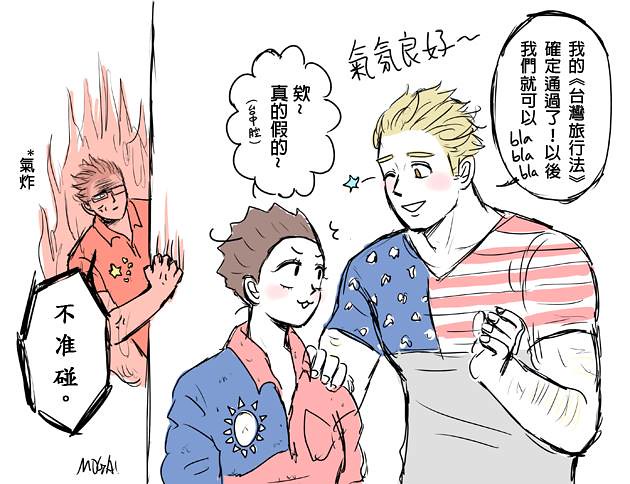
But pro-Taiwan bills have recently had unanimous support, and Taiwan generally does have bipartisan support. As for why the left doesn't speak out for Taiwan as much as the right, I have no idea. I suspect it's because they're not as smart as they think they are, and as smart as I always wanted them to be that they don't see a natural ally in Asia staring them right in the face. A shame. Taiwan is super hawt and needn't be the nerdy virgin in this story, hoping to get the guy.
 |
| The Guy (from here - I've talked to them about permission to post their work generally - they are great and you should check them out) |
The rejection of Chiang’s memory reflects an undeniable reality: the old assumption that both Taiwan and China long to unite as one nation-state but disagree on which regime has legitimacy is simply not accurate any- more. Beijing’s failure to uphold the promise of autonomy in Hong Kong and Macau only makes unification with Taiwan even more far-fetched. For Americans in this day and age to still defend Kissinger’s “One China” policy—a shameful, self-serving lie to please the Chinese—is to pretend otherwise; the passive strategy aims to do the bare minimum to maintain the status quo, a status quo that is inherently unjust.
If you take one thing away from my quote-fest here, liberals, let it be that. And this:
It is high time for the political left to rethink taiwan. Progressives’ silence—whether because they are oblivious to the island’s changing politi- cal landscape or disinclined to anger Beijing—does a grave disservice to the taiwanese people who have come such a long way.
I SCREAM THIS AT PEOPLE IN MY DREAMS.
But where the island struggles most has always been on the world stage. When the SARS epidemic was killing hundreds of victims in neigh- boring Hong Kong and China back in 2003, Taiwanese epidemiologists had to combat the disease alone after the WHO denied them access to samples and information. Few things have changed over the years. the International Olympic Committee returned a verdict this May that forced Team Taiwan to keep playing under the awkward “Chinese Taipei” designation in the forth- coming Tokyo 2020 Games. Even with the deck stacked against it, however, Taiwan has not stopped fighting for respect and recognition.
The island merits them; it has never exploited its diplomatic alienation to act out. Rather, it has proven time and again to be a responsible, if minor, power. At a time when many Western countries are turning inward, Tsai has called immigrants “an infusion of new strength and a force for cultural diversity.”
Well, I'd like to see all those nice words on immigration translate into a shot at dual nationality without having to fit into some Special Magic Foreigner box, but cool. Some laws have been relaxed, and I appreciate that. I think she means what she says, and I think the generally pan-green or anti-KMT/pro-Taiwan side finally believes this while fighting conservatives in their ranks.
In any case, when it comes to Taiwan, this is dead on. Taiwan has done nothing to make waves - if anything, it accepts more humiliation than it ought to (it shouldn't have to accept any) to keep the peace. It has been nothing but stable and calm in the face of an increasingly screamy, angry, irrational China.
And yet, Taiwan is painted as the bad guy - raising "tensions", full of "hardliners", who need to make "concessions" because what China thinks about Taiwan is apparently more important than what Taiwan thinks about itself.
Let's bring it home with a hit right to the liberal sweet spot:
If the American left is serious about opposing a reactionary foreign pol- icy that preserves unequal power relations, it should speak up for Taiwan. Its enlightened views on gender, ethnicity, and class have translated into a social structure that’s reminiscent, in certain ways, of Northern Europe’s. Its capability and readiness to tackle the greatest challenges of our time, from terrorism to climate change, make it a well-deserved member of the international community. Its unlikely historical trajectory shows that bringing genuine progress to a part of the world where individual liberties are more often threatened than cherished is possible.
OH YEAH.
An internationally-recognized English teaching certification course is now available in Taiwan!
Trinity CertTESOL is coming to Taiwan!
As a teacher trainer myself, I'm very excited about this. One of the biggest flaws in the industry of English-teaching workhouses and abbatoirs here is that, once here, if you don't already have a basic pre-service teaching certification, it's difficult to get one as there were no offerings in Taiwan. No Trinity CertTESOL, no CELTA: two of the only - if not the only two - internationally-recognized programs that include practicum hours. And, as a teacher trainer, the only two that I can personally wholeheartedly recommend.
In addition to tuition fees, that meant leaving the country for a month (and losing a month's worth of income, if you could get the time off at all) and paying all associated costs with living in another country for that month - possibly as well as rent back in Taiwan. I know it was a huge financial burden when we went to do CELTA in Turkey.
Now, that's no longer necessary: on November 5th, a part-time (Monday-Friday, 9:30-13:30) certification course is finally available locally! If you can be free in the mornings, you don't have to leave Taiwan or stop working.
Trinity is equivalent to CELTA, which means that it will be useful to you even if you leave Taiwan. Having not only been through CELTA but also Delta and in the middle of a Master's program in the same field, I can say that it's worth it. The curriculum is sound - and I'm a teacher trainer who has completed an equivalent course herself, I would know - and the practicum hours set it apart from weekend or online courses. You will certainly become a better teacher because of it, if you take what you learn from it and incorporate it intelligently and thoughtfully to the classroom while developing your own style.
It's also important to remember that these certifications aren't meant to create insta-teachers or classroom superheroes. Nothing can do that except experience, reflective practice and consistent, high quality professional development. They are pre-service programs, which means they are open to people who have never taught. They aren't even meant to give you all the skills a professional needs: entire multi-year teaching programs exist for that, and not even they can accomplish it. They're meant to give you the fundamentals you need to be competent in the classroom as a novice teacher, or to improve your practice as a current teacher, with the assumption that you will receive further development and institutional support from your employer (how much institutional support you are considered to need post-certification will vary). They are stepping-stones to higher-level in-service teaching degrees. They get you on the track - they're not the end of the road.
You may be wondering how such a certification can help you in Taiwan. I admit that's a real problem here: the complete lack of any sort of qualifications needed to be a "teacher" in Taiwan, and how certifications are generally not rewarded well, which feeds the cycle of mediocrity and poor teaching practice.
But, better jobs in Taiwan do exist. There are fewer of them, but they are generally only open to teachers who have these certifications, or at least, those who do get their resume pushed to the top of the pile. These jobs tend to be more professional and pay better (though I wouldn't say they are wonderful - almost no job in Taiwan is). You may be frustrated that at Happy Oxbridge Engrish Scholar's Acadamy, you won't get a raise for doing this program, and I'm sympathetic to that.
But, better places to work will actually consider you seriously if you do, and that will come with better pay and other perks, like the ability to request more time off (unpaid) or more time off in total (perhaps paid).
Oh, yeah, and you'll just be a better teacher for it.
As a teacher trainer myself, I'm very excited about this. One of the biggest flaws in the industry of English-teaching workhouses and abbatoirs here is that, once here, if you don't already have a basic pre-service teaching certification, it's difficult to get one as there were no offerings in Taiwan. No Trinity CertTESOL, no CELTA: two of the only - if not the only two - internationally-recognized programs that include practicum hours. And, as a teacher trainer, the only two that I can personally wholeheartedly recommend.
In addition to tuition fees, that meant leaving the country for a month (and losing a month's worth of income, if you could get the time off at all) and paying all associated costs with living in another country for that month - possibly as well as rent back in Taiwan. I know it was a huge financial burden when we went to do CELTA in Turkey.
Now, that's no longer necessary: on November 5th, a part-time (Monday-Friday, 9:30-13:30) certification course is finally available locally! If you can be free in the mornings, you don't have to leave Taiwan or stop working.
Trinity is equivalent to CELTA, which means that it will be useful to you even if you leave Taiwan. Having not only been through CELTA but also Delta and in the middle of a Master's program in the same field, I can say that it's worth it. The curriculum is sound - and I'm a teacher trainer who has completed an equivalent course herself, I would know - and the practicum hours set it apart from weekend or online courses. You will certainly become a better teacher because of it, if you take what you learn from it and incorporate it intelligently and thoughtfully to the classroom while developing your own style.
It's also important to remember that these certifications aren't meant to create insta-teachers or classroom superheroes. Nothing can do that except experience, reflective practice and consistent, high quality professional development. They are pre-service programs, which means they are open to people who have never taught. They aren't even meant to give you all the skills a professional needs: entire multi-year teaching programs exist for that, and not even they can accomplish it. They're meant to give you the fundamentals you need to be competent in the classroom as a novice teacher, or to improve your practice as a current teacher, with the assumption that you will receive further development and institutional support from your employer (how much institutional support you are considered to need post-certification will vary). They are stepping-stones to higher-level in-service teaching degrees. They get you on the track - they're not the end of the road.
You may be wondering how such a certification can help you in Taiwan. I admit that's a real problem here: the complete lack of any sort of qualifications needed to be a "teacher" in Taiwan, and how certifications are generally not rewarded well, which feeds the cycle of mediocrity and poor teaching practice.
But, better jobs in Taiwan do exist. There are fewer of them, but they are generally only open to teachers who have these certifications, or at least, those who do get their resume pushed to the top of the pile. These jobs tend to be more professional and pay better (though I wouldn't say they are wonderful - almost no job in Taiwan is). You may be frustrated that at Happy Oxbridge Engrish Scholar's Acadamy, you won't get a raise for doing this program, and I'm sympathetic to that.
But, better places to work will actually consider you seriously if you do, and that will come with better pay and other perks, like the ability to request more time off (unpaid) or more time off in total (perhaps paid).
Oh, yeah, and you'll just be a better teacher for it.
Subscribe to:
Posts (Atom)