Thursday, October 18, 2018

Taiwanese teens know that their English classes are terrible

IMG_5461


As an English teacher who believes in the power of authentic communication in language learning -after all, that's how I learned Mandarin - I've been following the work of Taipei Teen Tribune with interest. It's an English-language 'new media' website with articles written by Taiwanese teenagers, with a lot of really great content (and a useful site to follow if you want to know what Taiwanese youth are thinking). And as a professional, I'm interested in how it has helped Taiwanese youth to develop their English language proficiency.

Recently, 12th grader Irene Lin wrote this insightful piece about what it's like to learn English in Taiwanese schools. It goes something like this: 


Many students, who are able to get high grades on tests, are incapable of having an actual English conversation nor write an 

essay on their own. Lessons are designed for students to be able to answer grammar questions and fill vocabulary into sentences rather than practical usage.

Treating English like a math problem is the major flaw in Taiwan’s English education. Students are taught to look at a sentence by breaking them down into pieces based on parts of speech. Overemphasizing grammar and neglecting content causes students to misuse vocabulary and leads to a lack of ability to comprehend meaning.


Lin suggests a solution that pretty much every professional educator with solid training can get behind:


The amount of reading, writing, and speaking needs to increase to solve the problem. However, we not only need to increase the amount but also its difficulty. Students learn more vocabulary through a novel compared to a five paragraph text; learning to write an essay provides the opportunity to learn critical thinking, an ability that Taiwanese education has never taught.


The analysis itself could go deeper, but what is said is spot-on. I'd bend over and do backflips to have a student like this in my classes, and I don't even teach teenagers (I work with adults). Essentially, she's spot on that macroskills work needs to be increased by a massive amount, with an eye to creating users, not learners of the language. Taiwan's secondary school language curriculum currently focuses on passing the various national exams, which in turn are focused on a grammar-structure-heavy view of language.

It's a classic example of negative washback, and the effects are already well-known: while many Taiwanese English teachers are open to more communicative-competence oriented language teaching, only elementary school Taiwanese teachers of English feel they're able to actually incorporate this into their teaching. This is true even in Tainan, where "English as a second official language" has been a policy for a few years now: elementary school teachers are overall more enthusiastic than junior high school ones, almost certainly due to the pressure of preparing learners for national exams.

At the secondary level, teachers repeatedly say that the pressure to prepare learners for exams (which do not focus on communicative competence at all) keeps them from meaningfully incorporating learning approaches that are shown to produce competent users, not just test-takers.

There is just no way to incorporate anything like communicative teaching, task-based learning, a lexical approach or the Big Mama of bilingual education - CLIL, or Content Language Integrated Learning - at a national level as long as the teachers are still pinned to the wall vis-a-vis the national exams.

The exams themselves need to either be scrapped (at least the foreign language sections, though I'm of a mind to say the whole thing should go, with more proficiency-oriented assessment methods taking their place), or revamped so completely that they look nothing like what learners do now. There is just no place in modern language learning for pages and pages of grammar analysis without any nods to practical usage or even meaning in context.

There's just no other reasonable way to teach English for proficiency - you can't expect teachers to do that and to produce test-takers who can handle a grammar-heavy sit-down exam at the same time. The tests have got to go - but good luck convincing parents, some old-school teachers, and more conservative officials in the Ministry of Education that.

Certainly, meaningful skills and systems practice should be a part of any meaningful language-learning curriculum, but it's not enough to say "increase the difficulty."  As other professional educators in Taiwan have noted when reading this, another big issue is that the ways in which language classes in Taiwanese schools are already difficult are not the ways that will produce proficient users of English.

For example, as a knowledgeable friend pointed out, there's a glut of vocabulary in the current curriculum - far too much to absorb in any real way. If the target language for each class is 4-5 new words at most - but those words are truly used in terms of collocation, colligation, common usage, presence in idiomatic speech and more, and strongly contextually presented, by the end of a typical Taiwanese student's education, they will have still learned thousands of words - more than enough to be proficient, if they can use them across several collocations and phrases.  The difference is that they'll be more likely to actually remember what they learned, rather than trying to cram five times that many lexical items into their brains, vomiting it all up on tests, and then forgetting most of it soon after.

That Lin and her peers already know they're receiving a sub-standard language education is a start. That Lin is able to say clearly that her education does not teach her to think critically is, ironically, a sign of critical thinking ability. It gives me faith in the new generation, so I'll kindly thank you to stop calling them strawberries and mindless phone drones.

All of this leads right back to issues with making English a "second official language" in Taiwan


The idea itself isn't a bad one, and the stated goals of the program are actually quite reasonable. The goal isn't to make everyone a fluent speaker, or even necessarily a fully proficient one. They're to make Taiwan a more navigable, understandable destination for foreign visitors and businesspeople - essentially, to internationalize. They're to make English less 'scary' (so, for example, maybe shop assistants won't run away when they see me because they're afraid to speak English; nevermind that I speak Mandarin), and to improve the English curriculum that Taiwan already has. The timeline is reasonable as well.

That said, the fact that Taiwanese youth already go through about a decade of English classes in school, and most who don't come out speaking English in any meaningful way (those who do have almost always taken additional after-school language classes) is a massive problem. Simply having more classes won't help if the curriculum is ineffective. But if the curriculum doesn't work because it's preparing learners for exams rather than teaching them to use a language, it can't be changed unless the exams change.

Tainan is already doing a good job with this on the tourist end, with improvements such as English audioguides now available for major temples, so that any visitor can take a self-guided English-language tour of a number of Tainan temples, and by all accounts the work is quality.

When it comes to improving actual education and proficiency, however, my big worry is that there's simply no way to know if it's working. There seems to be no assessment mechanism built into Tainan's program, which is a yellow (if not a red) flag itself. Even if there were, it's so new that we'd have no idea if it were working by how anyhow; it's too early to know. That Lai has announced the initiative at a national level now is pure politics.

These issues aside, the problem that Lin dances around in her piece is exactly the thing that I fear will torpedo the program: we have no idea whether the continued existence of the national exams in Tainan is having an effect on the "English as a second language" program there, because there's not only no data, but no mechanism that I know of to collect it. Now, imagine that problem on a national level. I just don't see how this is going to work unless we kill the test-heavy way languages are taught in Taiwan now.

That itself is hard to do unless we clean house in terms of the teachers and Ministry of Education officials who will fight such changes, and not just hire "more teachers", but implement improved training for those teachers (both foreign and local - the time is here when it comes to no longer allowing uncredentialed 'native speakers' to be hired as English teachers in Taiwan, with little or no institutional support or meaningful training once employed. Although that's how I got my start, the system simply has to change.) For foreign English teachers, insisting on an internationally-recognized certification - especially now that one will soon be available in Taiwan - and setting parameters for which certification programs are accepted is just a first step.

On top of that, an entirely new curriculum will have to be written, which challenges learners in appropriate ways. What it means to assess learning will have to be entirely re-vamped. Only through consulting with experienced, trained teachers can we ever hope to do this well. 


Until that happens, we might be told that English education in Taiwan is going to change, but teachers will continue to prepare for the ludicrous national exams, and students like Irene Lin aren't going to see their language education get any better.

I'm not holding my breath. 

Tuesday, October 16, 2018

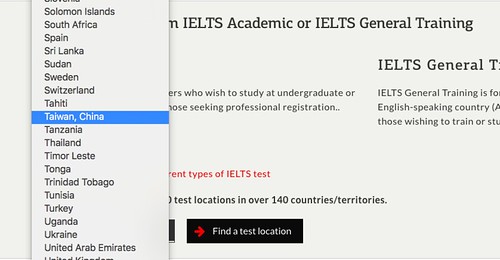
IELTS takes a political position (and my ongoing battle to fight The Man)

Screen Shot 2018-10-15 at 9.58.45 PM
Jerks.


As my husband noted in his nail-on-the-head post on the same topic, pretty much every IELTS teacher and examiner we know is horrified by the change on IELTS's website of "Taiwan" to "Taiwan, China" (Notably, Hong Kong and Macau bear no such designation. If I didn't already know this was all about politics, I'd say that's odd).

Many of us have written to IELTS to protest the change, including me. I'd include a screenshot, except that e-mail contains references to the nature of my employment which I cannot divulge, but which when blacked out render the letter incoherent. Suffice it to say, it was an angry but basically formal letter of protest and complaint.

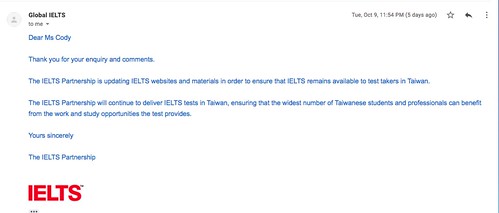
We all got the same completely irrelevant form letters in reply, which didn't actually address the issue we wrote about:


Screen Shot 2018-10-14 at 11.33.22 PM
"Thank you for your enquiry and comments. The IELTS Partnership is updating IELTS websites and materials in order to ensure that IELTS remains available to test takers in Taiwan. The IELTS Partnership will continue to deliver IELTS tests in Taiwan, ensuring that the widest number of Taiwanese students and professionals can benefit from the work and study opportunities that the test provides."


You can write to them too, by the way, their email is globalielts@ielts.org. See if you get the same bogus form letter! It'll be a fun international discourse comparison!

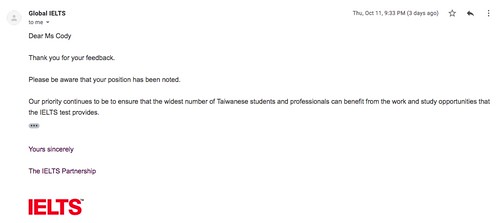
Of course, I wrote back to point out that their form letter reply was irrelevant to the protest lodged and got a snottier, though I suppose more relevant, reply:


Screen Shot 2018-10-14 at 11.34.28 PM
"Thank you for your feedback. Please be aware that your position has been noted. Our priority continues to be to ensure that the widest number of Taiwanese students and professionals can benefit from the work and study opportunities that the IELTS test provides."


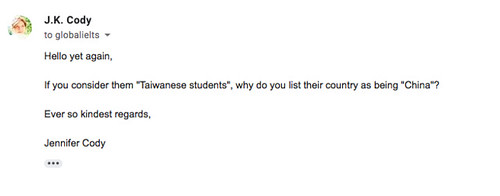
This is where I got a little testy. I'd say "I have a short temper", but several days on I decided to send this anyway. It won't make a difference, so please enjoy it as a retort created for your entertainment:


Screen Shot 2018-10-15 at 10.03.48 PM
"If you consider them 'Taiwanese students', why do you list their country as being 'China'?"


Here's the thing. I know perfectly well that we're probably not going to win this, because The Man doesn't care about our tinny complaints. It pretends to be apolitical while taking a political, pro-Beijing position. And that is what you're doing when you list Taiwan as "Taiwan, China": you are taking a political position. You are saying Taiwan is a part of China, a position most Taiwanese do not agree with.

It's hard to fight the power, which as a friend pointed out, is the entire point of having power - so it's harder for people to fight you. IELTS pretends to be a dispassionate language proficiency test, but it's also a source of power: are you a non-native speaker who wants to study in the UK (or other countries) or get certain kinds of visas? You have to take it. It's tied to the government through British Council and the UKVI service. That's power. It's not just a test.

It wants to think it's not The Man, but it absolutely is. And as The Man almost always is, IELTS is wrong.

For me, this is the point at which "Taiwan, China" stops being an abstraction: it's not just an unfair, stupid thing that terrible companies do for money. It affects me personally: I'm associated with the brand. Some of my income comes from them. If I refuse to accept this, there is a real impact on my life, moreso than boycotting airlines or slagging off TOEFL. I don't earn money from those companies. I don't know how I can take dirty money now, so for the first time in a very long time, I'm faced with a choice between a chunk of my income, and my principles.

As China expands its forcefulness, more people like me will start facing that choice. I have to hope enough of them will choose principles, as I'm headed towards doing, but I know that many won't.

This isn't a small issue relegated to Taiwan and China. It affects people like me. It affects international workers and foreign residents.

And, as Brendan pointed out in his excellent post (which you should absolutely read), IELTS is essentially helping China accomplish its political goals, which serve as precursors to its military goals:


The government of the PRC would like nothing more than to take over Taiwan and incorporate it into their territory....This is not the ranting of a conspiracy monger -- China isn’t even trying to hide its intentions. 

 Whether China takes Taiwan by force or by “peaceful” coercion, it doesn’t want the rest of the world to see it as a larger country taking over a smaller, less powerful country. That would look very bad. Instead, China wants the rest of the world to see Taiwan as a recalcitrant part of China that needs to be brought to heel. That’s why (among many things) it’s got people pushing to change “Taiwan” on those drop-down menus to things like “Taiwan, China” or “Taiwan, Province of China”. It’s all about changing the world’s perception of Taiwan so that if Invasion Day comes, the rest of the world doesn’t see Xi Jinping as another Hitler invading Poland. 

And every airline that lists Taiwan as China and every educational institution that forces students to declare their country as “Taiwan, China” is complicit in this. With Beijing -- not politically neutral.


I don't know how to fight that. I don't know how to tell you to fight that. I'm still weighing my options, although I know that not acting is not an option. I don't know what to tell my students, except not to take IELTS.

I know some Taiwan-based examiners read this blog. I know a lot of Taiwanese do, too. I don't know what to tell you.

I considered suggesting a strike, and still think that might be a possibility. I worry, however, that it will hurt local centers like IDP Taipei, who are not our enemies (I suspect a lot of the local employees of IELTS centers are on our side, in fact) without really hurting IELTS as a global organization. It might be our best shot, however, at getting this story to stay in the news and embarrass IELTS as much as possible.

I considered a petition, but TOEFL ignored the one directed at them, and IELTS will too. That's what The Man does - he ignores petitions, because he has power.

I considered saying you should change your scripts and say explicitly that Taiwan is NOT CHINA, but that could hurt candidates' performance and that's not fair. It's not their fault (even with the Chinese candidates, it's not their fault at all that their government sucks).

Of course I will continue to encourage Taiwanese students not to take the test.

Something more should be done, but the result has to hurt IELTS Global. What should that something be? I don't know yet. But I have no intention of going away and I have no intention of quietly choosing money over principles.

All I can say is that I encourage you to organize (and feel free to get in touch with me, by the way. I'm easy to find). Be creative, and don't back down. The Man usually wins, but that doesn't mean you have to sit down and obey meekly.

I wish I had better advice, though. I'm not sure what the next move will be, but I can assure you we're not done here. 


Monday, October 15, 2018

Go see "Nude" in Kaohsiung - and Taiwan, promote your events better!

0-2
Go see Nude!

Last weekend, I had the good fortune to go to Kaohsiung for a few days to take part in a tourism-related conference. That part was interesting, but not something I feel the need to blog about.

Being down there, however, gave me the chance to see one of my oldest and closest friends in Taiwan. Helping to run the family business mean she doesn't have a lot of time to come to Taipei, so we often see each other when I'm able to head down south. For those of you who think I'm a public transit snob who won't grace an old-school Taiwanese scooter with her precious princess bum, I actually had a blast riding around Kaohsiung county (technically 'city' but that was a stupid change and I won't dignify it) and downtown on the back of her scooter. I just won't drive one myself, because I value my life.


43178746_10156779845406202_5088345689415483392_o 


Anyway, we decided to check out the Kaohsiung Museum of Fine Art, which is currently hosting "Nude", an exhibit of works on loan from the Tate Modern in London.

The theme of the exhibit is nudity in modern art, and it discusses (with well-planned wall panels in English and Chinese) the evolution of nudity in art through the late 19th century to the modern era. It includes some stunning - and some head-scratching - cutting-edge modern work along side classics by Matisse, Rodin, Renoir and Picasso.

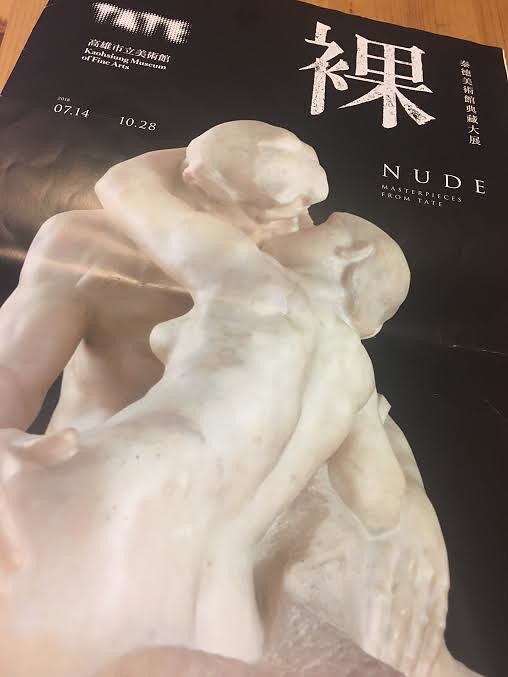
To be frank, it was just an amazing exhibit. It was fine art of a high calibre which is a real treat in Taiwan, with a smattering of well-known masters but not necessarily focusing only on the big names. It featured Rodin's Kiss, which is one of the great works of Western sculpture. The evening we went, a concert was being planned around it featuring modern works of classical music.

Photographs were not allowed, so you'll have to make do with a shot of the brochure and some postcards I purchased.


0-3
A Matisse and a Nevinson


The exhibit runs through October 28 and costs NT$280 (with concessions including a student discount), so you still have time. Go see it!

I mean, I was just in London. I went to the Tate Modern. I didn't get to see stuff this great there!

Here's what keeps nagging me: I had heard that this was taking place through the local grapevine, though it wasn't promoted in any way that made a huge impact on me. I had forgotten that it was still running, and in fact though I wouldn't get to see it as I was away for most of the summer. My local friend had to remind me that it was still an option.

When I got back to my hotel, I searched a bit to see where news of the exhibit could be found by tourists (plenty if information is available in Chinese, and the exhibit seemed to be locally popular, with the museum staying open until 8:30pm that Friday). A few articles from over the summer mentioned it, including the Focus Taiwan one linked above. After that, nothing.

A visitor searching for events in Kaohsiung in September or October (perhaps even August) would have trouble finding out that this exhibit existed, especially if they were a foreign tourist searching in English. The information is there, but it's hard to find for travelers. About to attend a conference on tourism promotion in Taiwan, this struck me as especially strange.

As a traveler in Kaohsiung - although a domestic one, as Taipei is my home - I was keen to see the exhibit, and yet would likely not have thought to go if not for my friend. And I actually had known about it! Imagine a foreign tourist here who hadn't seen any of the local news items featuring it when it opened. They'd have no idea.

Here's an example of what I mean. If you search for events in Kaohsiung, you might come across this website by the Kaohsiung City Government. It's actually a pretty good website in a variety of languages, which is already exceptional for Taiwan (where websites in English are often so terribly-designed, unclear and devoid of real information that they are essentially unusable and, I have to assume, only exist for decorative purposes or so that someone could give their nominally-English-speaking nephew a website development contract).

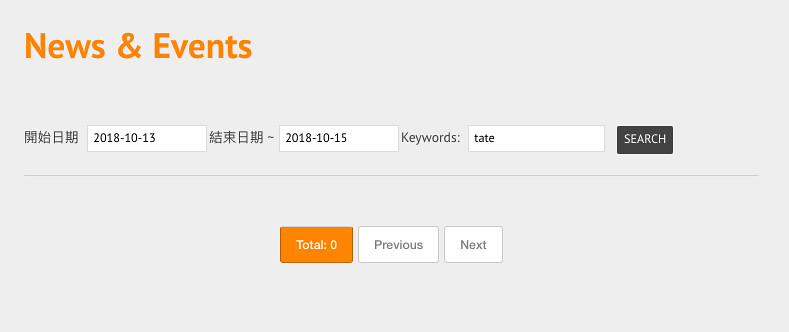
But if you actually search for events, say, this weekend, this is what you get:


Screen Shot 2018-10-13 at 2.49.06 PM
Same thing for no keyword, "art", "museum" and "nude"


Nothing.

Put in some keywords (I tried "museum", "art", "nude" and "tate") - still nothing. A tourist using this site would never have found the sublime exhibit I was lucky to see.

It really seems as though events in Taiwan are either heavily publicized but terrible, or great but not promoted well or consistently.


So, hey, Taiwan. You can do better. You have interesting events that travelers will want to know about. Make sure they do!