Wednesday, March 8, 2017

Let Her and Falsehood Grapple: Women's March Taipei (2017)

IMG_9261

Please excuse the lack of insight - this is more like personal experience and a bit of straight reporting -  I'm writing with a headache and trying to get it done tonight.

Anyway, every year I say I'm going to take Lao Ren Cha back to its roots - a blog about life as an expat woman in Taiwan, and women's issues in Taiwan and Asia. Every year I fail, instead doing what I've always done which is just to blog about whatever I want. 2017 is likely to be no different, but at least this one time I can post something in line with Lao Ren Cha's original intent.

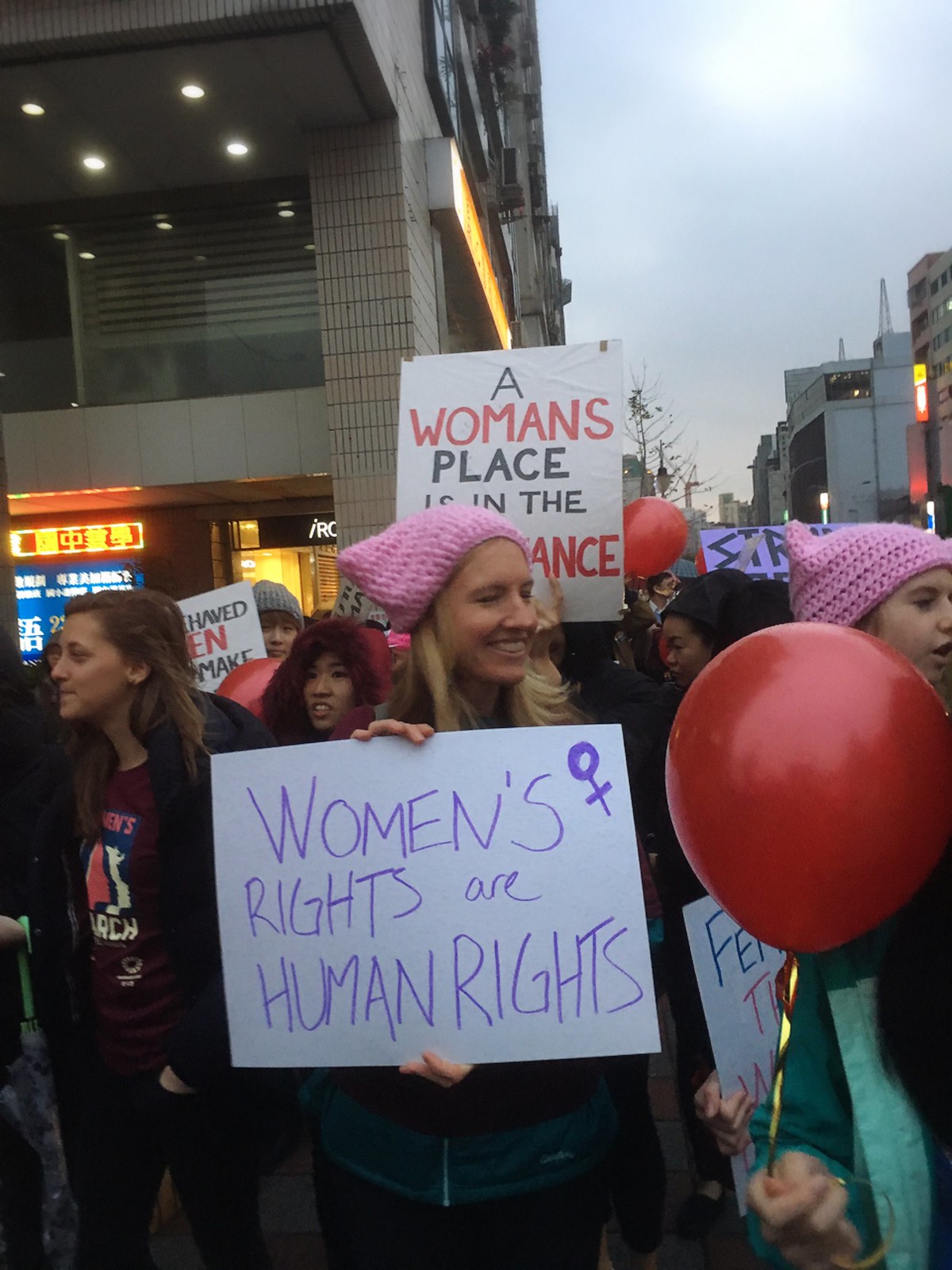
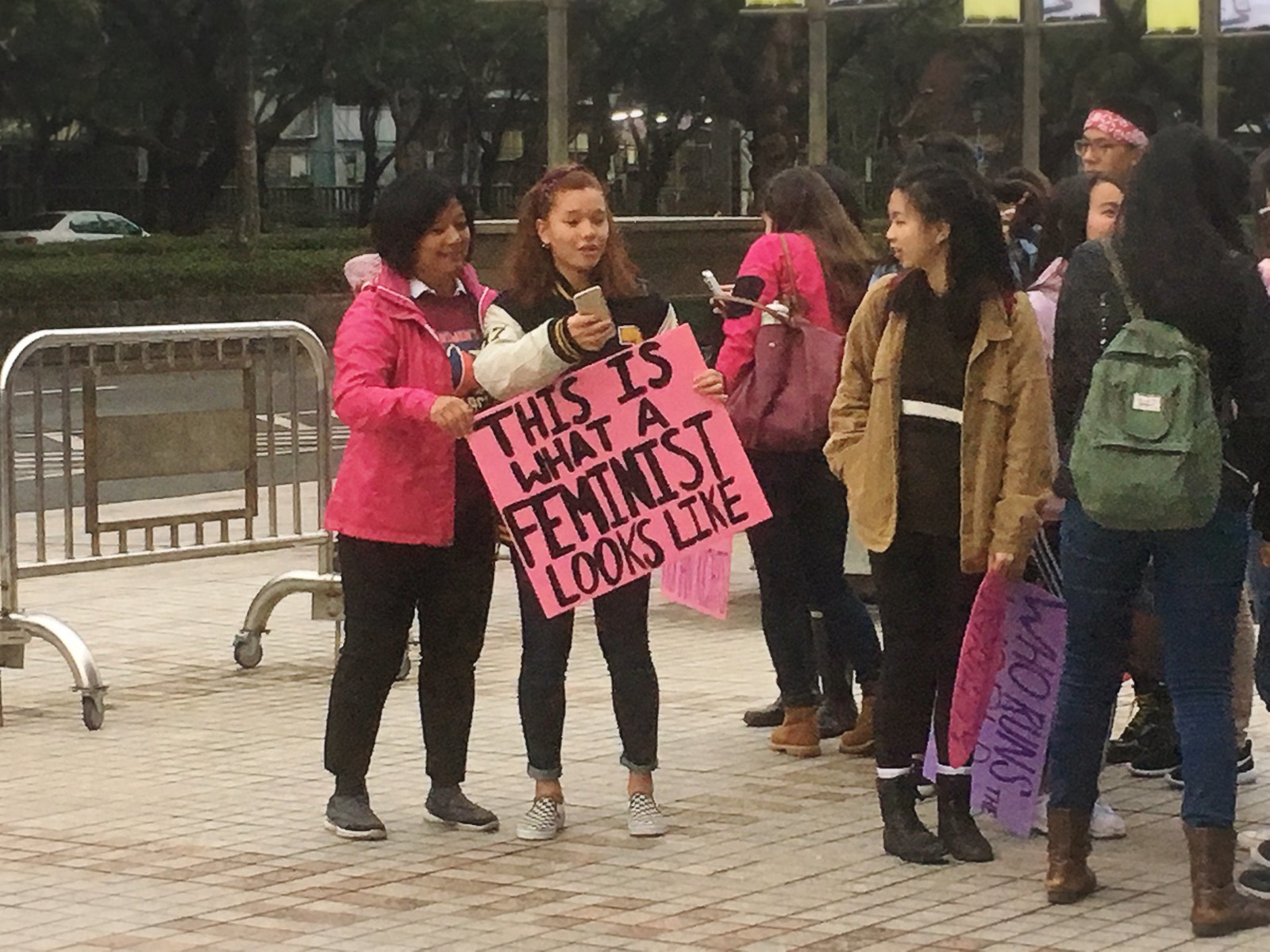
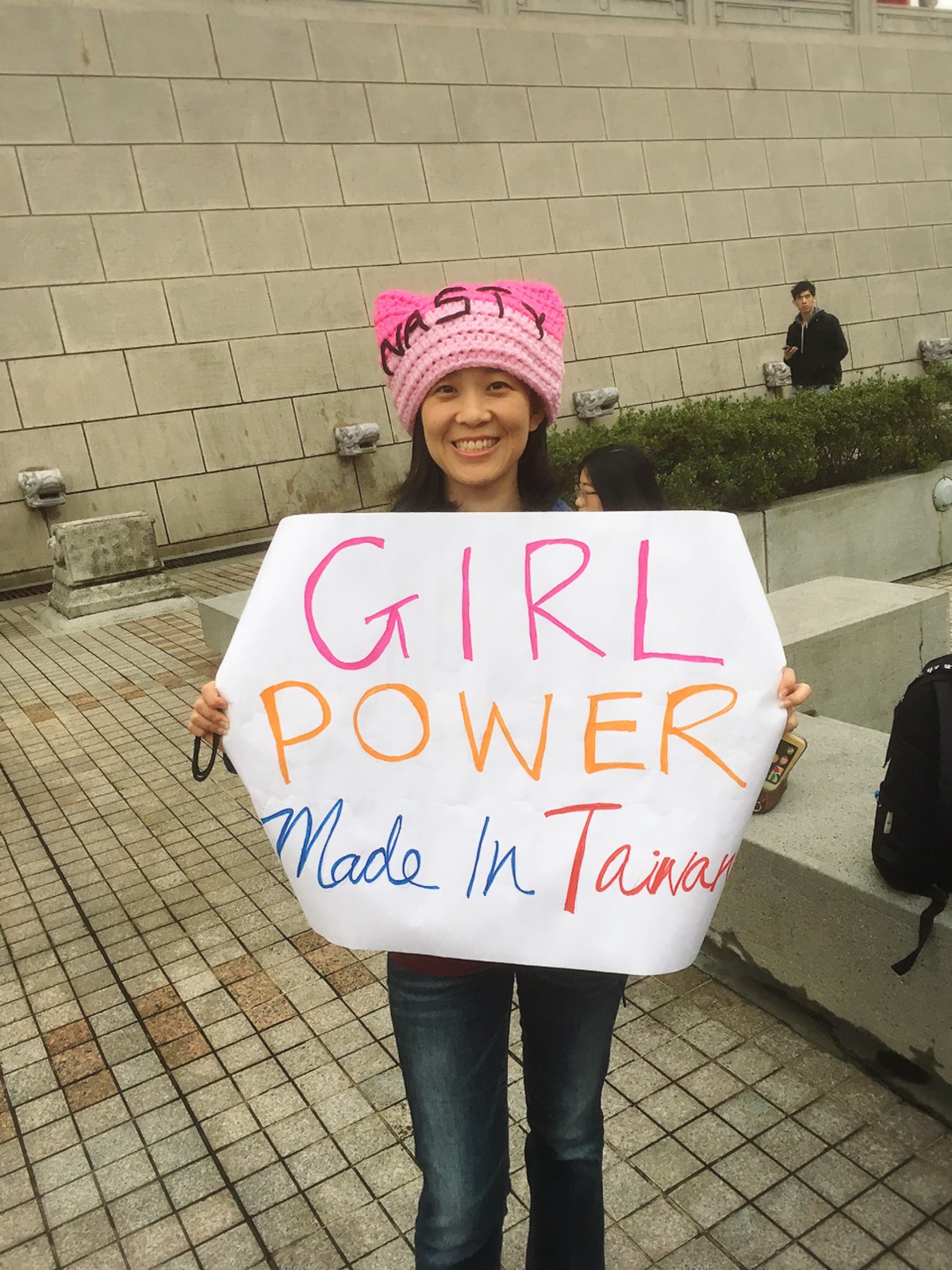
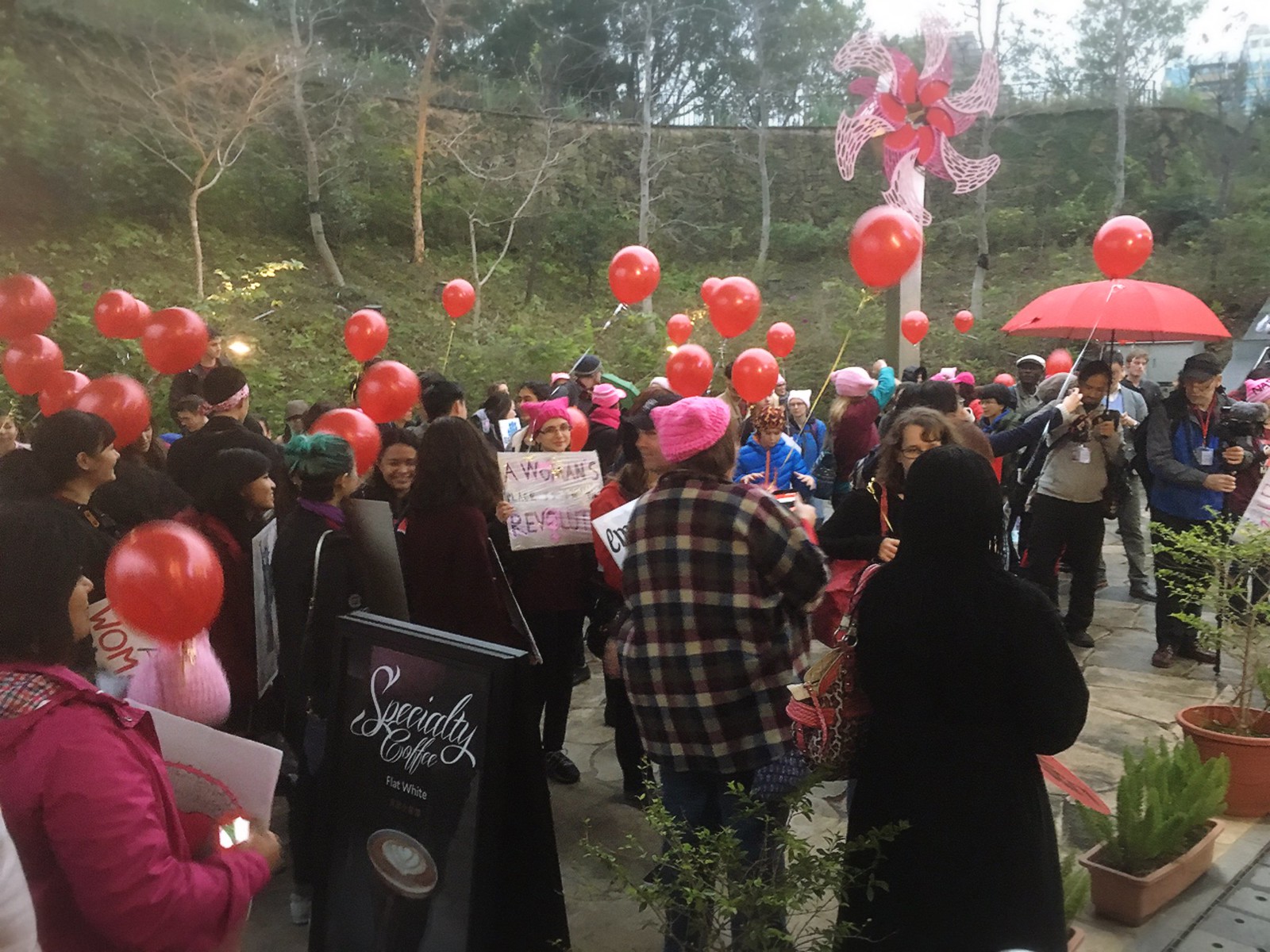
Today was International Women's Day, and the fine folks at Indivisible Taiwan put together a march from Freedom Square to Da'an Park Station to raise awareness of women's issues in Taiwan and around the world. Perhaps 80-100 people showed up - I'm neither a great journalist nor a great crowd estimator so I'll just run with that. That's pretty damn good for an expat-heavy march not aimed at a specific issue, and I was proud to be a part of it.

IMG_9258

That's big for me - I'm usually not free on weekdays, and I'm not much of a marcher (but ask me to hang out at Jingfu Gate for a good cause and I'll be there), and as the years go by my loyalties really have shifted from US issues to Taiwanese ones. This is my home, after all. I don't really do signs, balloons etc., I just like showing up. You know I care about something if I make time - on a weekday afternoon! - for an activity I am not otherwise inclined to do.

IMG_9268
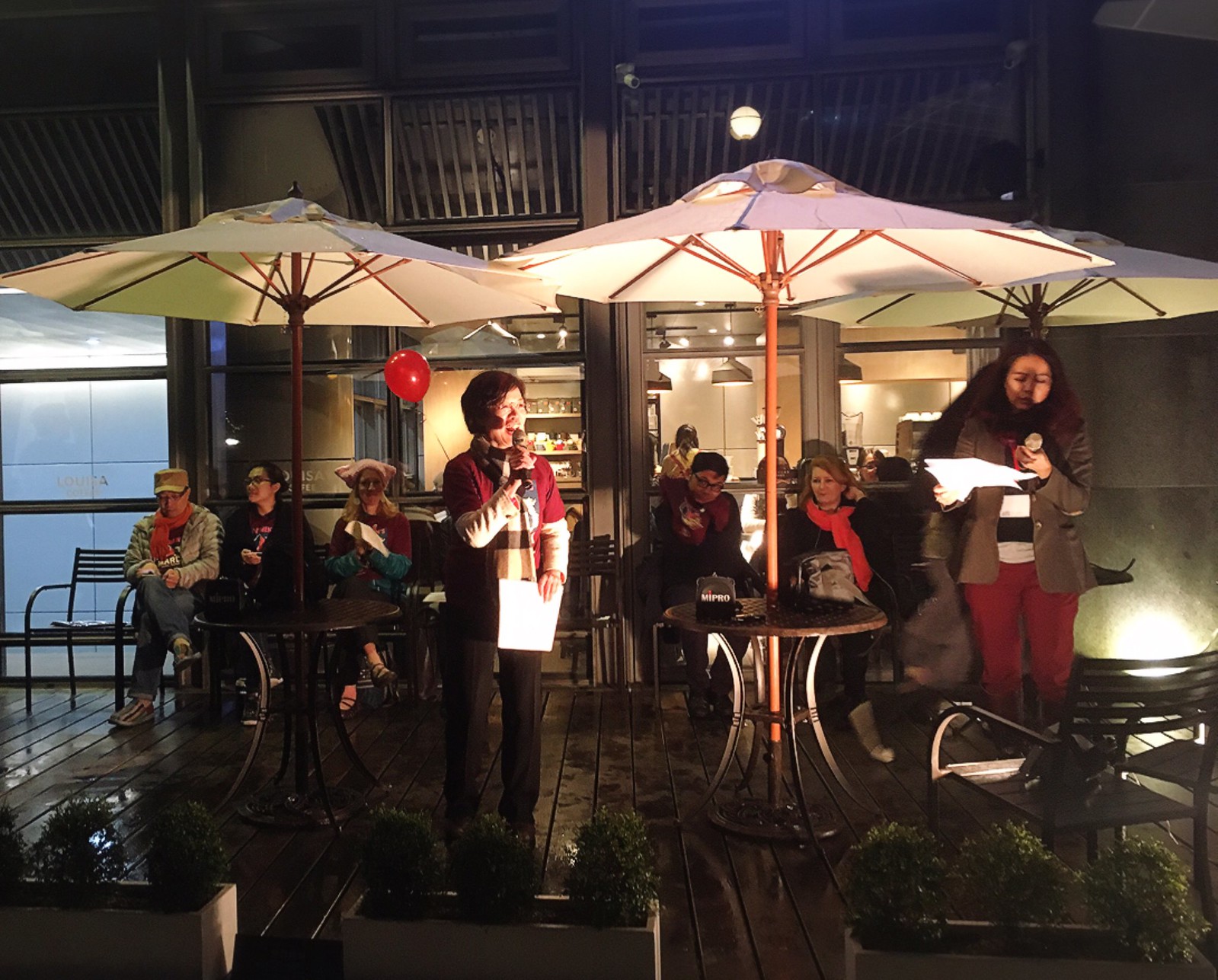
Yu Mei-nu speaks at Da'an Park
I spent much of the march toeing the line between kinda-sorta-reporting-on-it and participating, which I think is a fine liminal space for a spitballing, F-bomb dropping feminist blogger to be for something like this. I marched, and I didn't interview anyone because I am lazy, but I kinda hung around with my journalist and videographer friends. All sorts of different folks showed up - some high schoolers, many expats, many locals, a good mix of men and women of various ages. People had different reasons for marching, from supporting women's issues and causes worldwide to a targeted statement from expats in Taiwan to the Trump administration (my reason for marching - and specifically targeting the assault on reproductive rights in the US and globally) to simply wanting to see more expat-local inclusive events with greater international exchanges in the name of women's rights and progressivism generally.

Anyway here's an actual article on the march from New Bloom.

IMG_9257

Before the march, I wasn't even sure right up until I got on the MRT at 4pm if I was going to go - I had a lot to get done and I'm just not a marcher. I had felt like I did my part by helping to put together and edit a Taipei Times letter to spread the word about the march. That I went, and am now writing this despite coming down with a headache, says something!

Once we reached Da'an Park station, there were short talks by legislators Karen Yu, Yu Mei-nu and Jason Hsu (you can watch two of those three - with English, in fact Hsu spoke exclusively in English - in the links above - lazy journalist that I am, my phone was low on power so I could only capture two talks).

IMG_9262

All in all it was nice to come out, meet some people I'd only interacted with online and some expats I hadn't known in person (though it seemed like everyone knew me? If it weren't for the red hair and being super loud on Facebook that would be creepy, but okay, cool) and walk for something that matters. I don't have any deeper thoughts than that - and I have a headache - so I'll leave you with this:

Even in Taiwan our really not-that-controversial march attracted a religious nutter. As we passed she, an older foreign woman, stood to the side literally thumping a Bible (like LITERALLY thumping itm you guys, I thought that was just an expression but no!) and shouting "Jesus is the only man who can save you!"

Okay, whatevs, Jesus was cool, but who says I need any man to save me? Anyway, God is dead so that's fine.

All I have to say is that it's weird to come across that specific brand of nutbag in Taiwan. They're all over the US, we practically breed them there (literally - they tend to have a lot of kids. Again, fine, whatever). But in Taiwan? Was she a missionary? If so, she wasn't very persuasive. Was she a garden-variety expat who just happened to also be a Bible-thumper? If so, okay, but...really? It just seems like a rare type out here where the expat community I know trends very liberal.

I suppose she was out there thumpin' that Bible for the same reason we were: to come out and demonstrate for something she truly believed in. Sure. It's just, in the war of ideas, I simply don't buy that her ideas are equally valid. One side preaches equality, the other intolerance. One side preaches not judging and giving opportunity to all, the other preaches slotting people into categories based on their genitals. Like, you have a vagina, you go here. Act this way. Be like all the other vagina-havers. Or something. I don't get it. It goes against any real notion of science or ethics.

So, let her thump. We have better ideas. Or as John Milton put it:


“Let her and Falsehood grapple; who ever knew Truth put to the worse in a free and open encounter?”


Tuesday, March 7, 2017

We need more detailed and timely Taiwan news in English

I just have a few thoughts to share about some news from Taiwan this week that I wanted to share, despite my generally avoiding link lists or news summaries. Let's start with the key point - there are a few other unrelated links below because I don't know where else to shoehorn them in.

A quick note before we begin: on Wednesday March 8th (International Women's Day), Indivisible Taiwan will hold a march from Freedom Square (CKS Memorial Hall) to Da'an Park Station at 4:30pm. I have to work, but I wanted to spread the word.

Anyway. Let's start with this essay by Sunflower leader Lin Fei-fan on the reasons for his support of the indigenous Taiwanese who are fighting for full land rights (an explanation of the issue can be found in the essay). I can't make the argument any better - I recommend you all go read his essay instead. In fact I wouldn't even try to make it, when I have said in the past that we need to open up the international narrative and discussion on Taiwan to more strong Taiwanese voices, he is exactly one of the voices I mean. So listen to his words, not mine.

There has been discussion on my public Facebook page about how, as a non-indigenous person, Lin is not the best voice to speak for them, and we ought to be elevating indigenous voices specifically (and that this has been a discussion in those communities for some time). In fact, I agree completely. However, I do feel that while we absolutely ought to seek out these voices, there is room for well-written and thoughtful pieces such as Lin's, which exhort fellow Taiwanese to care about these causes. Both can be true, just as there is room in international discourse for non-Taiwanese scholars and academics to weigh in (or even bloggers like me), even as Taiwanese voices are sought out and included.

What I want to say, however, is that those of us who can read Chinese have known about this issue for well over a week. I don't mean to show off (okay, I kind of do a little, but please forgive me). My point is, plenty of strong supporters of both Taiwan and indigenous rights globally simply don't read Chinese, or not at the level they would need to to keep up in this way. Even I read sections I can't follow via Google Translate or just go very slowly, but I'm at the point now where that's only for sections - I don't have to put an entire essay like this into Translate.

I don't even mean that I want more original reporting on Taiwan in English, although that would be nice, and useful (original reporting in Chinese and Hoklo-language media is not always up to snuff). There is quite a lot of interesting discourse out there in Chinese that it would be beneficial in terms of engaging the international community in Taiwan affairs and promoting a greater understanding of Taiwan.

Discussions of English language imperialism aside, I just want to point something out. Lin makes an excellent case for Taiwan understanding itself before it can ever hope to be understood by the international community:

What kind of county will Taiwan become? This is a question every person who hopes Taiwan will become a country worthy of respect, where Taiwanese can hold their heads high among the community of nations, should always consider.
 
But if we are unable to understand the situation and oppression each group has experienced, then how can we expect the international community to understand Taiwan?

I want to make a corollary case: if Taiwan wants the international community to understand it as a country, public discourse on issues affecting it, even domestic issues, needs to be more available in other languages. Yes, English: like it or not, it's the international language we currently use and the current language of international-level public discourse. We currently have several great sources: Ketagalan Media, New Bloom, Taiwan Sentinel, Taipei Times (not perfect but let me put it this way: they get a mention whereas China Post doesn't), several blogs, The News Lens International and Focus Taiwan.

It's not enough, however. There is no good reason why I should have been aware of the issues behind, or very existence of, the indigenous people's protest on Ketagalan Boulevard, a full week before that information became available in English, and in less detail at that. Otherwise, it is very difficult indeed for those who care about Taiwan to follow discussions on Taiwanese issues, or join them, if the information is only available in Mandarin. Certainly one might expect any specialist to be fully fluent, but plenty of supporters and other interested people are not specialists. I am not a specialist but I don't think anyone would say I'm not a supporter or friend to Taiwan, and I only know Mandarin because I decided I was going to learn it and did, because I happen to be particularly good at that sort of thing.

If Taiwan wants more attention, support and understanding internationally, we are simply going to have to have more bilingual (or trilingual, or multilingual) sources available for the discussion of contemporary and historical Taiwanese issues.

Of course, that doesn't mean the readers will come. There is not a lot of interest in Taiwan internationally, although I wonder if part of that is because this sort of discourse about it is not available in English, or not in a timely manner. If the information were there, perhaps more people would take an interest? Or perhaps not - but we can't know until we make it a reality. We can't even begin to engage the international community until we take this step.

Along those lines, please check out Queerious, a new site focusing on LGBT+ issues (including marriage equality) with English content. There's not a lot there now, as it is quite new, but it is absolutely worth keeping an eye on. My rant about making discussions and news about Taiwanese issues more available in English isn't just reserved for the current indigenous people's protests and struggle, but for every issue affecting Taiwan.

Finally, just a quick note on this article. I can't say I'm a fan (sorry Taiwan Sentinel). It's okay, but it seems to follow the formula of asking a question in the headline only for the answer in the article to be "no", and I am typically not big on such rhetorical sleight-of-hand. Furthermore, while I appreciate that the article is clear in calling the "1992 Consensus" "so-called" and "highly symbolic", it is not clear enough in calling out the simple truth that the so-called "1992 Consensus" does not exist. 

And why on earth should President Tsai wait at all - for any reason - to acknowledge the truth of something that does not exist?

If you were curious about my reasons for insisting that the whole thing is a laughable fiction, here they are:

1.) Su Chi - a former KMT politician - admits he made up the term...in 2000 (not even 1993 - 2000!)
2.) The two sides don't even agree on what the consensus was (Taiwan says "One China, different interpretations". China has never agreed to that). Words mean things, and a "consensus" means you have, well, a consensus. If you don't agree, you don't have a consensus, therefore there can't have been a consensus because WORDS. MEAN. THINGS.
3.) Even if the two sides agreed to something in 1992 (nobody disputes that meetings did take place), nobody sent by either side to those meetings was a democratically-elected or otherwise publicly-agreed-upon representative of the people of either country. China doesn't care about such things, but Taiwan does. Let's say in 1992 some unelected officials from Taiwan did agree to some sort of "consensus" with their Chinese counterparts. So what? The people of Taiwan never entrusted them with the power to speak for Taiwan - Taiwan's first full elections didn't take place until 1996 (there had been some more local election activity prior to that). Whatever they might have agreed to in that alternate universe is irrelevant to Taiwan as the democracy it is today.

So no, Tsai should not "wait" before changing her stance to be more "flexible" on the 1992 Consensus (or anything else), because it is stupid to acknowledge a fiction as true - a lesson the US is currently learning the hard way.

For the record, here is a list of things that do not exist:

1.) Leprechuans
2.) Fairies
3.) THE 1992 "CONSENSUS"
4.) Unicorns
5.) Any version of "One China" that includes Taiwan
6.) God
7.) Bitter melon that tastes good
8.) Santa Claus
9.) Genies in bottles

I bid you good day!

Monday, March 6, 2017

Those "letters of agreement" Taiwanese universities signed are scarier than you think

13654226_10154341179061202_8113484870007908572_n
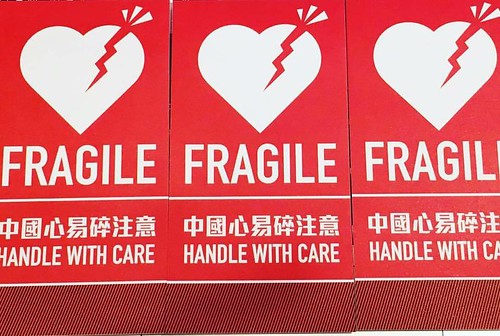
The caption reads "Chinese hearts are easily broken" - it can also be read as "Handle Fragile Chinese Hearts With Care"

Update: apparently the number of schools who signed these letters is "at least half" of the originally reported 157. Here's a link to an updated article. 

I just want to make a quick comment on the story that at least 80 or so universities in Taiwan have signed "letters of agreement" that students from China would not be exposed in class to certain areas of political discussion (namely, Taiwanese independence or sovereignty, or anything that might challenge the idea of "One China").

The agreements don't seem to have had any impact on what is actually taught in classes (from at least one account, orders are not handed down to the actual educators regarding what they may and may not cover in class and these issues are discussed), and seem at this point to be mainly intended to smooth the process for Chinese students coming to Taiwan.

I'd argue, though, that this doesn't mean they are a non-issue.

Chinese universities are hardly independent academic entities with the full range of academic freedoms one can reasonably expect in free societies. I am not an expert, and so do not know the exact extent to which individual universities are beholden to, or take orders from, the Chinese government, but I believe I can safely assume that they are all beholden to some extent, and take orders to some extent - more likely than not, to a great extent.

If, then, the letters are indeed 'pro forma', it is because nobody in China is insisting they be enforced. I don't see it as being a strategy far removed from "we'll send Chinese tourists": sure, they'll send Chinese tourists, until it is strategically convenient for them not to do so anymore. That move backfired (ha ha) but we all know it was the intended strategy. Those who relied on Chinese tourism complained as predicted, and "Taiwan's economy hit hard! Cross-strait tensions!!!!" became a bigger issue than it ever ought to have been, had the whole truth been reported rather than simply the loudest voices.

In this case, is it too hard to imagine that these letters are being asked for, and yet compliance not insisted on, for now - but that once it is strategically convenient to do so, that could easily change?

What happens when there are enough Chinese students in Taiwan, or at any given university that can be reliably expected to complain, that immediately cutting off new enrollments could serve as a threat, or be otherwise beneficial to China, the next time the people of Taiwan vote in a way China doesn't like, or the government they've elected doesn't adopt the supplicant position China demands? It seems clear to me the government could do that, and their own universities would comply.

Then it turns into headlines around the world: "Taiwanese universities suffering as China cuts off student programs", which lead to articles about how this is hurting Taiwan, which lead to piss-poor punditry about how Taiwan, by being a 'troublemaker' rather than taking the most conciliatory stance possible, is causing its own problems and creating 'tensions' across the strait. It never seems to matter that China is usually the one taking the actions and making the threats.

Indeed, bent-over, cheeks agape appears to be the only position many around the world feel Taiwan is allowed to reasonably take vis-a-vis China - often from people who in any other context talk real big about freedom, democracy and respect for sovereignty.

This would be worse than the tourism strategy, however, because Taiwan does have too many universities and, rather than allowing them to close without complaint, they actually will suffer when Chinese students are recalled or new enrollments ceased because China has found it strategically convenient to suddenly insist on the enforcement of these agreements. And they will complain, and it will make the news, and people will call Taiwan the 'troublemaker', wash, rinse, repeat.

Meanwhile every other country gets to more reasonably debate what growing Chinese influence means for academic freedom in their country. Everyone else gets to talk about how China's actions globally - most clearly revealed by the actions of Confucius Institutes worldwide - are part of a strategy to dominate the narrative about China, and truth in general.

Some universities may feel the pressure to comply, and, if this practice continues now that it's been brought into the public eye, we will have no idea which ones they will be. Academic freedom will be threatened, and students from Taiwan (as far as I am aware no class is made up entirely of students from China - even if one is, China has no right to insist that a university abroad educate them in a certain way) will also be shorted. China wins either way: the universities comply and education in Taiwan becomes influenced by Chinese censorship, or they don't and a bunch of bullshit articles are spawned that make it look as though Taiwan is the problem.

This is one reason why I get so annoyed with the "but any warming relations with China are good! It's always great for us to have good relations with China!" crowd. No, it's not, because every single thing the Chinese government does towards Taiwan that appears conciliatory is meant to advance their end goal of annexing Taiwan. No exceptions. The tourists, the students, the trade deals, the investment, all of it - is aimed directly at eating away at Taiwanese sovereignty and creating a vortex of integration that they hope will eventually push Taiwan over a critical event horizon.

In truth, this is their strategy around the world - it's not even that subtle! - but with the less critical aim of controlling the world narrative. With Taiwan they want both to control the narrative and to succeed in their goal of territorial expansion. In other countries it's a problem to be discussed, a peripheral concern to be addressed. In Taiwan it's critical to address for the very survival of the nation. Many countries do this - the US tries to promote its own narrative as well - but again, in the case of Taiwan, its own continued existence is at stake.

So, perhaps this sounds like a crazy-ass conspiracy theory - the Chinese are always out to get us. But it's quite plausible, it's in line with their actions toward Taiwan in the past, it's in line with their actual stated goal (it's not like they hide it!) of annexing Taiwan, and it makes perfect sense in the context of how universities and academic freedom operate in China.

These letters may seem like pro-forma non-issues now, but, even if you call me crazy, I truly do not believe that if they continue to be signed that they will remain a non-issue. This does not mean that I have a problem with Chinese students in Taiwan - I would like to see them here, and be exposed to Taiwan, the successes of Taiwanese freedom and democracy, and what true academic freedom means. I have no problem with them, and in at least one of my work capacities I engage with them frequently. With very few exceptions, I have never had a problem or complaint. This is not about the students.

However, I cannot stress enough that agreements like this are not an acceptable pre-condition for those exchanges to happen, and that the Chinese government will certainly attempt to use its flow of students abroad to further their political agenda.