
 |
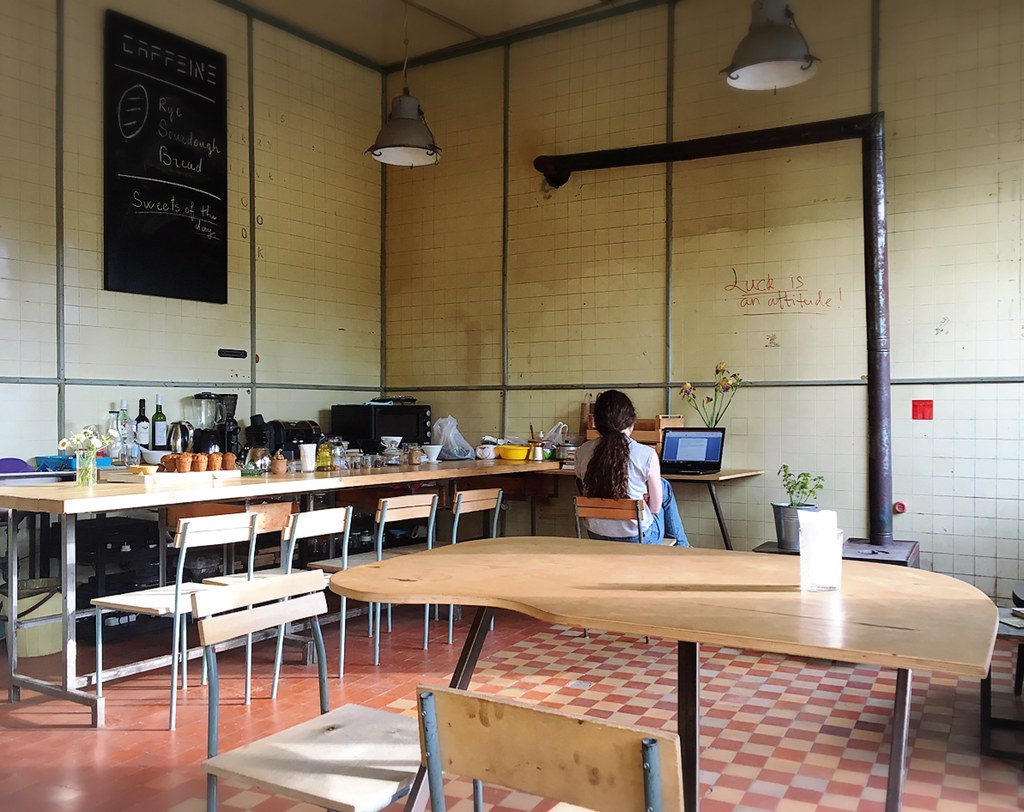
| Caffeine Cafe in Dilijan, Armenia |
We hadn't had a lot to say over breakfast to the Danish couple sharing our homestay - I am notoriously antisocial in the mornings - but the golden evenings of the Armenian summer gave way to local wine, local vodka, homecooked food and talk of global affairs.
We had come up to Debed Canyon, our last stop in Armenia before heading across the Georgian border less than an hour to the north, from Yerevan via Dilijan, where we had spent a glorious few days doing very little except reading books on a wide wooden balcony overlooking a verdant hillscape. Caffeine Cafe was near our hotel in Dilijan and provided for all of our cafe needs. I remember thinking as we hung out there, The Black Keys on the sound system and single-origin coffee in the pot, young hipsters on their laptops with hair that screamed "Yes, I drink that single origin", that as much as world travelers like to think they're going to places where everything is different, and even the people think differently, in fact Caffeine was a place that would have been just as at home in Brooklyn...or Tainan. And I bet if I'd had a political conversation with any of these young Armenians, we would have agreed on quite a bit.
In contrast, Debed was taxing physically and bracing mentally. During the day we hiked from a monastery perched on one end of the canyon all the way down to the river at the base, crossed it and crawled up the vertiginous wall on the other, over a meadow and to its sister monastery on the opposite side.
Afterwards, stuffed with home-cooked Armenian food chased with entirely too much alcohol, we climbed vertiginous walls of conversation with the Danes.
We had come up to Debed Canyon, our last stop in Armenia before heading across the Georgian border less than an hour to the north, from Yerevan via Dilijan, where we had spent a glorious few days doing very little except reading books on a wide wooden balcony overlooking a verdant hillscape. Caffeine Cafe was near our hotel in Dilijan and provided for all of our cafe needs. I remember thinking as we hung out there, The Black Keys on the sound system and single-origin coffee in the pot, young hipsters on their laptops with hair that screamed "Yes, I drink that single origin", that as much as world travelers like to think they're going to places where everything is different, and even the people think differently, in fact Caffeine was a place that would have been just as at home in Brooklyn...or Tainan. And I bet if I'd had a political conversation with any of these young Armenians, we would have agreed on quite a bit.
In contrast, Debed was taxing physically and bracing mentally. During the day we hiked from a monastery perched on one end of the canyon all the way down to the river at the base, crossed it and crawled up the vertiginous wall on the other, over a meadow and to its sister monastery on the opposite side.
Afterwards, stuffed with home-cooked Armenian food chased with entirely too much alcohol, we climbed vertiginous walls of conversation with the Danes.
"But these ideas - human rights, democratic government - they were all created by Western cultures, and they serve Western cultures," he said. "They work there, because Westerners are individualists. But to insist that these ideas must be applied globally, that's cultural imperialism!"
I liked him. He was eloquent. He was also wrong.
"The whole point is that they're not Western rights, they're human rights. They are meant to apply to all humans. Perhaps the idea of spelling out these particular rights came from the West, but there's a reason why the United Nations - not the United Western Nations, but the United Nations - has a human rights commission. And the whole idea of the right of self-determination - a democracy, I suppose - is that everyone has it. Otherwise, you are essentially saying Westerners deserve rights that others don't."
"It's Westerners who conceived of these rights, so yes, they apply to Westerners. It's Westerners who conceived of democracy, so we can assume it works best there. Asia is more collectivist, those cultures are not individualist the way we are. So these ideas just don't work the same way in those cultures, if they work at all. We can't impose our idea of how people should live on the rest of the world!"
"Well, I can agree that telling other people how to live is generally a bad idea," I replied, "but how can you say that we created human rights for us, and other people don't need the right to express their opinion, or to not be arrested or tortured without cause, or not be enslaved, or choose what kind of government they want. Maybe that government wouldn't be what we want, but there is no good argument for not caring if they get to choose at all. And I'm not saying we should go into any given country and just tell them they're going to reform into democracies at gunpoint. We tried that, and look what happened. But that doesn't mean we should just abandon people who want something better."
He had lived in Asia for years, in Indonesia. He'd spent quite a bit of time in Southeast Asia, been around the continent, certainly visited China. I asked; he had not been to Taiwan.
I liked him. He was eloquent. He was also wrong.
 |
| Debed Canyon: Vertiginous walls |
"The whole point is that they're not Western rights, they're human rights. They are meant to apply to all humans. Perhaps the idea of spelling out these particular rights came from the West, but there's a reason why the United Nations - not the United Western Nations, but the United Nations - has a human rights commission. And the whole idea of the right of self-determination - a democracy, I suppose - is that everyone has it. Otherwise, you are essentially saying Westerners deserve rights that others don't."
"It's Westerners who conceived of these rights, so yes, they apply to Westerners. It's Westerners who conceived of democracy, so we can assume it works best there. Asia is more collectivist, those cultures are not individualist the way we are. So these ideas just don't work the same way in those cultures, if they work at all. We can't impose our idea of how people should live on the rest of the world!"
"Well, I can agree that telling other people how to live is generally a bad idea," I replied, "but how can you say that we created human rights for us, and other people don't need the right to express their opinion, or to not be arrested or tortured without cause, or not be enslaved, or choose what kind of government they want. Maybe that government wouldn't be what we want, but there is no good argument for not caring if they get to choose at all. And I'm not saying we should go into any given country and just tell them they're going to reform into democracies at gunpoint. We tried that, and look what happened. But that doesn't mean we should just abandon people who want something better."
He had lived in Asia for years, in Indonesia. He'd spent quite a bit of time in Southeast Asia, been around the continent, certainly visited China. I asked; he had not been to Taiwan.
"We're not abandoning them, we're leaving them alone. They are able to come up with a system of government and way of doing things that suits them, and it's not for us to say."
"I certainly agree that people should come up with their own systems of government without being told by an outside force what to believe, but what you are essentially saying is that some cultures would be okay with arrest and torture without cause, enslavement, or being jailed or even killed simply for speaking one's mind. In a lot of countries that is the reality, but I have a hard time believing, having been to those countries, that most people prefer it that way."
"No, what I'm saying is, by insisting that everyone adopt the same norms we have, we are forcing something from individualist cultures onto collectivist ones, and it's just not going to work the way we'd hoped. In any case, given Western global hegemony and the history we have of colonization and destruction of other cultures, it's also imperialistic. It's forcing our values on the rest of the world. There is no such thing as universal values."
"So...slavery is sometimes okay?"
"What you conceive of as slavery might be considered differently in another culture, and not seen as slavery at all."
"I highly doubt that. It's a basic concept. I live in one of these 'other cultures' you speak of. They fucking know what slavery is, and their idea of it is not that different from mine, or yours. They're Asian, not stupid. They're not Exotic Orientals from the Mystical East who think up is down and circles are triangles. They're people. Normal people with a normal conception of things like slavery. You lived in one of these cultures too. Don't tell me Indonesians have a 'different conceptualization' of slavery because they come from a 'collectivist' culture. Nobody, regardless of where they come from, wants to be a slave...unless they're into that in, like, a sex way."
"Uh..."
(Hey, I actually said that. I'm just being honest. I've cleaned up the conversation in other ways, but that last bit is absolutely real.)
"But," he said, recovering, "look at what happens in non-Western countries that adopt Western models."
"I certainly agree that people should come up with their own systems of government without being told by an outside force what to believe, but what you are essentially saying is that some cultures would be okay with arrest and torture without cause, enslavement, or being jailed or even killed simply for speaking one's mind. In a lot of countries that is the reality, but I have a hard time believing, having been to those countries, that most people prefer it that way."
"No, what I'm saying is, by insisting that everyone adopt the same norms we have, we are forcing something from individualist cultures onto collectivist ones, and it's just not going to work the way we'd hoped. In any case, given Western global hegemony and the history we have of colonization and destruction of other cultures, it's also imperialistic. It's forcing our values on the rest of the world. There is no such thing as universal values."
"So...slavery is sometimes okay?"
"What you conceive of as slavery might be considered differently in another culture, and not seen as slavery at all."
"I highly doubt that. It's a basic concept. I live in one of these 'other cultures' you speak of. They fucking know what slavery is, and their idea of it is not that different from mine, or yours. They're Asian, not stupid. They're not Exotic Orientals from the Mystical East who think up is down and circles are triangles. They're people. Normal people with a normal conception of things like slavery. You lived in one of these cultures too. Don't tell me Indonesians have a 'different conceptualization' of slavery because they come from a 'collectivist' culture. Nobody, regardless of where they come from, wants to be a slave...unless they're into that in, like, a sex way."
"Uh..."
(Hey, I actually said that. I'm just being honest. I've cleaned up the conversation in other ways, but that last bit is absolutely real.)
"But," he said, recovering, "look at what happens in non-Western countries that adopt Western models."
"Well, let me give you a positive example. I live in Taiwan. One of those 'collectivist' cultures you like to talk about. You know what Taiwanese think are very important? Human rights and democracy. This is a country that is actively resisting being annexed by a dictatorship, because they want to keep their democracy. Their human rights record isn't perfect but it's a damn sight better than China's. This is a country where people care so much about their democracy that they take to the streets because they want marriage equality and the government is being too slow about making it happen, where 200,000 people march downtown because a young man doing his military service died from overly harsh punishment. 200,000! This is a country where students occupied the legislature for nearly a month because they didn't like the way a trade bill was being forced through undemocratically, and 400,000 or so people showed up to support them. In a country of 23 million! That's more than one in every sixty people! They absolutely want these things, and while they come from a different culture, they're just people who want human rights. There's nothing wrong or culturally imperialist about that.
Many if not most of them think of free nations - including Western ones - as natural allies, not enemies. They want our support. Perhaps their culture is more 'collectivist', although that seems like a very broad term and we'd have to break down what you mean by it. And yet they have a thriving, successful democracy, welcome Western allies, want more American support than they are getting, and this in no way interferes with their culture. Japan and Korea are democracies too, and they work. Hong Kong wants democracy. When they didn't get full rights, they voted in a bunch of pro-democracy legislators.
In fact, you say we're 'leaving them be', but what you're really suggesting we do to Taiwan by saying China's actions are not our business because it's 'a different culture' is abandoning an ally who wants our support.
So when you say these ideas are Western - maybe they came from the West, but in my life I meet Asians every day who believe in these things just like I do. Nobody forced it on them. America didn't come in and say 'you have to be a democracy now!' The people of Taiwan fought for it and won it themselves. So how can you say these ideas only work in the West or are inherently and inseparably Western or 'individualist' when I live my life in a non-Western, 'collectivist' culture that shares such values and they work?
In fact, if you tried to tell the average Taiwanese person that democracy and human rights are inherently Western ideas brought to them via cultural imperialism, in effect that by believing in them they are tools of Western neocolonialism, I suspect they'd be pretty offended that you think they don't deserve these values or rights that they want and hold dear, or these things are somehow not for them. As though you get to decide which values are appropriate for them - which is just another form of imperialism. Or, they'd just laugh at you."
* * *
 |
| Hiking between monasteries in Debed Canyon |
This is what it's like to argue with me. Vertiginous walls of response. At least, this is how I remember the conversation - there's always a chance that, recalled from deep memory, my mind has created a narrative in which I look way smarter and more 'victorious' than I actually was. I'm actually kind of a dope, to be honest, so take all of this with a healthy suspension of disbelief.
In any case, I've thought a lot about this conversation in the intervening months, and always circle back to two main problems with this very typical Western liberal narrative on Asia.
First is the notion that all of Asia can be lumped together in this idea of 'collectivist' culture, and that because of this (and a few other cliches, such as 'Confucianism' and 'face'), they are so different from us that there is no set of universal, fundamental values that apply to all of us. Therefore, according to this line of thinking, we can't say anything or even be upset when Asian countries turn authoritarian: it's "their culture" after all, and our concepts of "human rights" and "democracy", being inherently Western, can't be applied.
Of course, this assumes that Asia is a continent of flat, continent-wide, immutable values that are diametrically opposed to our own. It distills every difference and uniqueness across cultures, regions and even people down to "well they're Asian", which is just another form of the old reactionary rhetoric on Asia where everyone is a stingy liar in a conical hat. It's just cloaked in a thin film of being 'woke' by using words like 'collectivist' instead of, I dunno, 'sideways vagina'. If 'they're Asian', they can't be like us, and so all of those great things we want like rights and freedom clearly don't apply to them.
Take this further, and one can even justify China's expansionist rhetoric: "well, we wouldn't stand for that in the West but they're Asian and you know, they have a different concept of what it means to be Chinese, so it's not for us to say." Little or no thought given to the idea that China's annexation-happy dictatorship is just espousing yet another form of the old-timey ethnic nationalism that we already know doesn't work, and which is already in the process of being actively rejected by Taiwan in favor of civic nationalism and Taiwanese identity. Same bullshit, different continent. It's not special just because this time it's happening in Asia.
When you get to the end of that rabbit hole, what you end up doing is arguing for China's authoritarian rule and threatening rhetoric on Taiwan, or at best being a useful idiot for CCP propaganda. You end up arguing in favor of an expansionist threat taking over a friendly democracy, simply because you've applied a surface-level knowledge of the cultures of Asia to your understanding of a specific political situation. You've effectively argued that freedom, self-determination and human rights are non-negotiables for you, but not for other human beings.
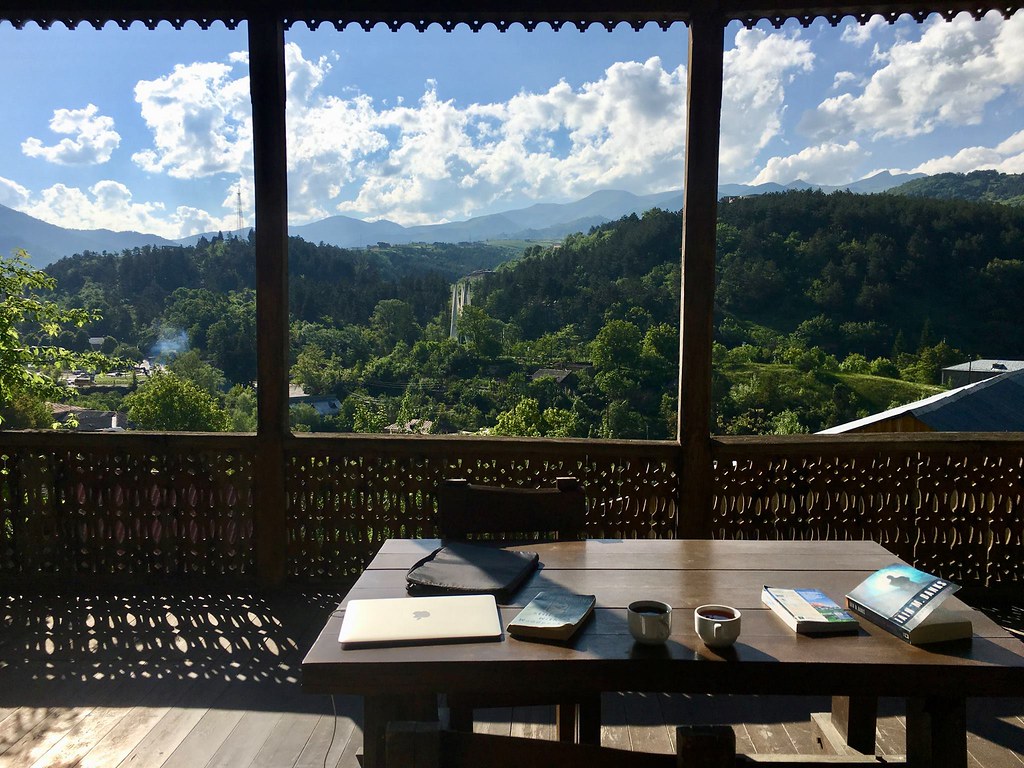 |
| Three days of reading books in Dilijan |
I understand the impulse to come at it from this direction: a lot of these ideas did originate in the West, so applying them globally feels like yet another iteration of forcing Western culture on non-Western contexts. It feels wrong to argue that something from your culture is inherently superior to the way things are done in other cultures, and there is a fear among many Western liberals of criticizing other cultures in any way - doing so might be construed as racism, as though the person arguing this has a problem with an entire culture or group of people rather than with a specific idea. It's just easier to be a relativist. But, I'd argue, it's also somewhat cowardly to not stand up for what's right, or even the concept that some values are universal, out of fear of looking like yet another whitey criticizing the way "foreigners" do things.
This sometimes morphs into an even stronger argument: that Western values simply don't belong in Asia, and any instance of them being espoused there must be the result of Western meddling because they don't suit a "collectivist" context. I don't even know where to begin refuting this - it's that nonsensical. It's about as nuts as thinking that slavery is not a fundamental concept that all people understand because of "different cultures".
However, this stems from a misconception that we are irreconcilably different from them. That our half of the world is round and varied - it has ethical topography - but theirs is flat: "Well...but...collectivism. Confucius! Face! That's all there is! It explains everything!" It was a part of what fueled the entire discredited 90s debate about "Asian-style democracy" - an invention of authoritarian governments (often ones in Asia) to justify remaining in power, not a legitimate interpretation of values. It also stems from a weird holdover of ethnic nationalism in the West: it's not so bad if China annexes Taiwan because after all they are all Chinese, aren't they?
We wouldn't make that argument about our own countries, so how can we make it with a straight face about countries in Asia? By deciding what values are and are not appropriate in Asian contexts, are we not just performing yet another form of cultural imperialism, big brothering and white man's burden? Who are we to decide what people can and cannot think in Asia?
What's more, if someone argues that we cannot criticize what certain groups and governments do because we're Western and they're Asian, how is it that they can then talk about what the Taiwanese should and should not accept vis-a-vis China, or which values - "Western" or "Eastern" - they should espouse?
Asia is not flat: it is varied and complex. Within Taiwan, there are yet more layers of complexity. Between groups and people, yet more. Many more than you would think not only buy into these "Western" values, but came to believe in them of their own accord. It was not forced on them by us (if anything, we are to blame for supporting the dictatorship that the Taiwanese people overthrew).
Taiwan's destiny ought not to be determined by biology, but by what the Taiwanese want, no different from anyone in the West who strives for a representative government and basic human rights. They don't deserve these things any less than we do simply because we've decided to view "Asian" cultures in the same flat, monochromatic way.
Not only can we criticize authoritarianism in Asia without being racist or culturally imperialist, but I would argue that we must, based on certain universal values that can work just as well in Asia as they do in the West, because people there are no less deserving. It's the only way to firmly support a friend an ally like Taiwan. We don't need to go in and force people to change - that's ridiculous - but we do need to stand up for what is right.
Yes, there is a sense of "collectivism" in Asia that sets cultures there somewhat apart from our own, and yes, Confucianism has had an influence on cultures here. But you know what other things have had an influence? Daoism (or as I call it, the "yo guys just chill and be yo'selves" philosophy), political activism, political intellectualism, international travel, protests, education in both the Asian and Western traditions, occupations, marches, coffeeshop culture (which lends itself well to political discourse) and progressivism. Don't shunt those to the side in order to make Asia seem flatter and more 'exotic' than it really is. Don't turn it into one of those Star Trek or Star Wars planets where the entire planet is just one way - the Volcano Planet, the Desert Planet, the Planet of Half-Black-Half-White-People, whatever - with no variation. Engage with it as it is, and see exactly how many people have come to embrace the universal values of freedom, self-determination and human rights - on this "far away" continent. Support them.
I thought about all of this and more as we ate our last, quiet breakfast in Armenia before taking off in a shared car across the Georgian border. I am Armenian by heritage, and there are many in Armenia who, despite wanting Armenia to be considered a Western nation, hold "Old World" views. There are many other young Armenians who want something more modern and progressive and, to my mind, better. Taiwan is no different - despite being a non-Western country, there are values they hold that can be considered not only Western, but universal. It's time Western liberal embraced that, rather than pushing it away in favor of a "Confucian" othering and flattening of Asia.

