My new queen Joanna Chiu hits the nail so perfectly on the head that the nail goes straight through the wood, through the table and right into the foot of some guy who was probably standing over her explaining how hammers work in this piece about men, journalism and Asia. She also manages to get Foreign Policy to publish the words "fuck", "swinging dick", "dick pic" and "sexpat", which is kind of wonderful.
Chiu firsts outlines some of the horrific, unprofessional, misogynist and also just downright rapey behavior she's experienced while covering Asia:
Once, a fellow journalist exited our shared taxi outside my apartment. I thought we were sharing a cab to our respective homes, but he had other expectations, and suddenly his tongue was in my face. On another evening, another journalist grabbed my wrist and dragged me out of a nightclub without a word....
The incidents aren’t limited by proximity. I have received multiple unsolicited “dick pics” from foreign correspondents — generally on the highly monitored messaging service WeChatI have received multiple unsolicited “dick pics” from foreign correspondents — generally on the highly monitored messaging service WeChat. Somewhere deep in the Chinese surveillance apparatus there is a startling collection of images of journalists’ genitalia....
Most disturbingly, a source tried to rape the correspondent while she was on assignment in China. She never told her bosses for fear that disclosure would hurt her career.
Then she reminds us that these are the exact same men covering sensitive local and regional issues in Asia which include women's issues.
I have seen correspondents I know to be serial offenders in private take the lead role in reporting on the sufferings of Asian women, or boast of their bravery in covering human rights. In too many stories, Asian men are treated as the sole meaningful actors, while Asian women are reduced to sex objects or victims. And this bad behavior — and the bad coverage that follows — is a pattern that repeats across Asia, from Tokyo to Phnom Penh.
There's a fair bit of intersectional fuck-uppery going on here too, with large numbers of underpaid local staff hired at news bureaus across Asia, the vast majority of them female, treated like errand girls and second-class employees, with little or no recourse or channels for reporting misconduct:
The problems are worsened by the unequal power dynamics in the offices of multinational media that employ “local staff” to provide translation, conduct research, and navigate complex bureaucracies, but pay them a fraction of what their foreign colleagues earn. In China, these “news assistants” are mostly young women. This pattern is mirrored in other countries, where the pool of those with the English-language skills needed for the job often skew female....
“They have no job security — if there is any conflict, they can be fired the next day,” says Yajun Zhang, a former news assistant. As a result, sexual harassment and gender- or race-based discrimination can occur with impunity. Even if they raise concerns, investigation can often prove extremely difficult over distance and cultural barriers.
Considering this, are we still surprised that international media coverage in Asia is so bad (you were aware it is mostly bad, yes, with few gems shining through the murk)?
It ties together a host of issues why the media has, in a lot of cases, failed in giving the world a somewhat accurate picture of what really goes on in media (and expat circles) in Asia. It's not only that men who treat women like garbage then report on women's issues here, but also that the people with real local knowledge who could add detail, nuance and accuracy to their reports are often at best ignored, treated as "less than" and sent on non-work-related errands, and at worst are sexually assaulted.
There are not only so few non-male voices not only in international media in Asia, but in the expat community in East Asia generally (and, frankly, local communities too - from Taiwanese student activists to the CCP and their propaganda machine to Japanese corporate leadership and politics, the voices are still overwhelmingly male). As such, those with the life experience that will help them notice and pick up certain stories are systematically discriminated against (or assaulted) - and those stories get ignored.
And it's not only that so many people who report on Asia - even for highly pretigious media - are "parachuted in" and don't know the issue on a local level at all, which shows in their lackluster coverage. Even these reporters act badly - they are mostly male, because the world runs on penises spouting their penis opinions:
Journalists parachuting in from the home office for one-off trips have also developed a reputation for treating local residents they rely on for their stories badly — especially women.
But it's also that - Imma be honest here - most of these swinging dicks are bad at their jobs. I don't know, in the craptacular coverage of Asia I've read (and there is a LOT of it), how much of it is written by dudes who are decent guys who just aren't very good reporters, and which are sexual assailants or misogynist pricks who will disparage women or troll victims of sexual assault. I just don't know. I'm sure some of the sexual assailants are men who write brilliant copy. But I can say with a fair amount of confidence that the Venn diagram of mediocre (mostly male) reporters doing a bad job in Asia and reporters who sexually harass and assault (or denigrate) women likely has far more overlap than most people care to think about.
Is it such a leap to think that a dude who is so arrogant, entitled and self-absorbed that he thinks he can grab any pussy he likes (not every man who does this is Donald Trump) would also be the sort of dude who thinks he is qualified or able to cover Asia well, when in fact he is stunningly mediocre at it?
A final thought:
This story broke about a week ago. As usual, people climbed out of the primordial Internet soup to find some way, truly any goddamn way, to blame the Asian women who go with these guys for their behavior rather than blaming the assholes themselves, at least when all the sex they're having is consensual. Because why point fingers at a guy who sends unsolicited dick pics and gropes women in taxis when there are women you can blame instead?
There was one stupid comment calling the Asian women who go for these guys (the ones who do so consensually) a "threat to Asian culture": as though it's women's choices which need to be policed and judged, not men's behavior. As though they are responsible for upholding some other person's idea of what their culture should be. As though they aren't making a personal choice. As though they shouldn't be allowed to have any choice at all (if some choices are deemed 'unacceptable', then that simply is not choice.) As though consensual sex - even a lot of it - is necessarily a bad thing.
Some will blame the men too - in true "they're rogering our women!" fashion. Instead of screaming "culture traitor!" at an Asian woman who makes a choice they don't like, they cast her instead as a stupid victim who isn't capable of making the choice. That's just as bad.
That's just for the women who go with these guys consensually. For the ones assaulted non-consensually, well, they get this instead:
As the New York Times reported, former club president Jonathan Kaiman, who had resigned in January after being accused of sexual misconduct by Laura Tucker, a former friend of his, was now accused of sexually assaulting a female journalist, Felicia Sonmez. After the second accusation, the Los Angeles Times quickly suspended him from his role as Beijing bureau chief and has begun an investigation. But as the Hong Kong Free Press noted, the original accusation had prompted many male correspondents to launch misogynistic attacks on Tucker in online conversations.
Such actions, and entitlement, reflect a sense of privilege and a penchant for sexual aggression that threatens to distort the stories told about Asia, and that too often leaves the telling in the hands of the same men preying on their colleagues.
Lovely.
These are the guys who write the stories about Asia that you read.
How do you feel about that?

Thursday, May 24, 2018


Wednesday, May 23, 2018
A review of Metal Politics Taiwan - my latest for Ketagalan Media
”He has a devil inside him,” Chthonic guitarist Jesse Black Liu says of Freddy Lim, the subject of German filmmaker Marco Wilms’ latest documentary, Metal Politics Taiwan. But he’s also a suited-up politician, elected to the national legislature.
In my review of the film, I make the case that Freddy is Taiwan and Taiwan is Freddy - that the country, too, has a devil inside it.
Metal Politics Taiwan will screen again this Saturday at the Urban Nomad Film Festival. Get tickets here.
In my review of the film, I make the case that Freddy is Taiwan and Taiwan is Freddy - that the country, too, has a devil inside it.
Metal Politics Taiwan will screen again this Saturday at the Urban Nomad Film Festival. Get tickets here.
Tuesday, May 22, 2018
The Rectification of Colonial Names
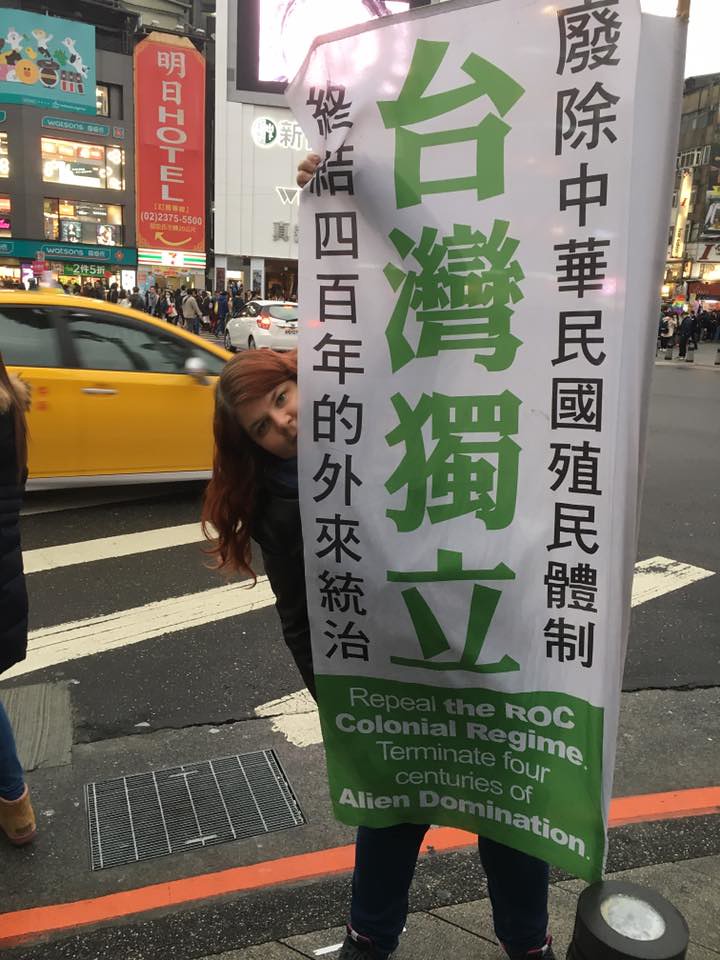 |
| This is talked about in Chinese, but not so much in English. |
Everyone agrees that the Japanese era was a colonial one and nobody disputes that the Dutch era was colonial, as well. This is true in all languages: English, Mandarin, Taiwanese, Hakka, any given indigenous language.
It's not new in political discussions in Chinese and Taiwanese to label the Qing era and the ROC era as "colonial", as well. It happens occasionally in English too: see here and here. Yet I've noticed that in English, such references still seem quite rare. The more nonfiction I read about Taiwan in English the more I notice this: the Dutch and the Japanese are "colonial", but the Qing and the ROC are rarely referred to as such. The way we talk about them lends these regimes legitimacy, a sense of being less "foreign", or a sense that if the colonizers come from China, they are somehow not just as colonial as any other invading force. They are simply "the Qing" or "the Qing era" or "the ROC on Taiwan" - as though they belong here, or it is their destiny, or Taiwan is somehow conceptually a part of China and that somehow makes it acceptable.
Calling the two Chinese regimes in Taiwan "colonial", however, is an idea I agree with. The Qing and the ROC came and extracted what they wanted from Taiwan rather than attempting to rule it as an integral part of their territory. The Qing used it as a place from which to take resources rather than a place to develop by pouring resources in - exactly what a colonial power does. At their best, they treated it as a mere defensive perimeter, a "ball of mud beyond the pale of civilization" (海外泥丸,不足為中國加廣) that they controlled simply to keep other invaders who might cause trouble for China out, not a part of China itself (only in the last decade or so of their rule over Taiwan was Taiwan upgraded to individual province).
The Qing had to be convinced it was worth taking, and the whole notion that China could rule lands beyond its natural borders (mountains, desert and sea) is actually quite modern. The Ming and everyone before them believed China's borders ended at the sea, and therefore that 'Island of Women' populated by 'savages' was simply not Chinese.
The argument put forward to the Qing by Shi Lang was not "hey this should be a part of China" but "you can use this island to cultivate sugar, rice and wood and hunt deer and it's a good defensive barrier." You know, a colonial argument. They didn't even bother taking over the whole island or to map the eastern half until some other colonial power (Japan) showed a stronger interest in it. Or, in other words, they treated it like a colony.
This treatment of Taiwan hurts us even today. When it comes to the ROC, the main argument against the idea that they too are a colonial power is a historical one: Taiwan used to be a part of China under the Qing, and therefore it can't be considered 'colonial' in the same way as the two were 'historically' united.
Otherwise, the only difference between Japan or the Dutch and the ROC is that the ROC comes from the same country as the ancestors of many Taiwanese. Even if this were definitively true (with many Taiwanese children born to a foreign parent these days - looking for a clear source on that - and Taiwan's genetic makeup being more similar to Southeast Asia than China, I doubt it is), it doesn't matter. If your only argument for being a legitimate government is "we're the same ethnicity" (whatever that means - ethnicity is a cultural construct, not a scientific grouping based on genetics), you simply do not have an argument. Ethnicity doesn't determine political destiny. We figured that out in the 20th century and it's time to apply a more modern understanding of what it means to be a nation to Taiwan.
I mean, what do we call a foreign government that takes over a piece of land and declares itself the sole legitimate government of that land without the consent of the local population? We call it colonialism.
That same power extracted resources from the land it rules - as the ROC did by gobbling up resources, putting its own in charge of large state monopolies under a command economy, expropriating land (much of which was taken for their own benefit), and using revenue from Taiwan - at one point over 90% of it - to fund the building of a military that could accomplish its real goal: "retaking the Mainland". At no point was it concerned with ruling Taiwan for its own sake. You can see that legacy in the haphazard and "who cares this is just a backwater" infrastructure development - if you could call the crumbling craphouses they built even that - that still plagues Taiwanese skylines. As Taiwan took a generation to recover from the economic double-blow of World War II and the KMT invasion, the KMT itself grew rich. As they hunted down and murdered a generation of local Taiwanese leaders and intellectuals, they themselves grew in stature and power.
What do we call such a system? Colonialism.
This is doubly true when the people are at no point allowed to vote or exercise self-determination as to whether they'd like to keep that government (even if elections are held within its framework - that's not the same as voting on the fate of the system as a whole). That it came from China makes no difference. It's still colonialism.
So why aren't we, English-speaking supporters of Taiwan, calling the ROC era, the era in which we live, the "ROC Colonial Era"? Why are we not calling it what it is?
These two ideas are intertwined: if we call the Qing era by what it really was we strike a blow against the 'historical' argument for the ROC not being 'colonial' as well. If the only other time China held Taiwan was also colonial, there is no basis for a non-colonial Chinese government in Taiwan.
In short, why aren't we more commonly telling the truth about Taiwan: that since the 1600s it has, with almost total continuity, been a colonial territory of three countries: the Netherlands, Japan and China (twice)?
I know I've got a tough hill to climb on this one: I'm still riding people's butts about not calling China "Mainland China" or the "Mainland", even among people who are pro-Taiwan. We are ceding semantic ground we really ought not to be ceding to the CCP and to annexationism in general (related: can we please stop calling it 'reunification' or even 'unification'? It's annexation. Make your names for things reflect reality). The fewer linguistic footholds we give for justification of annexation by China, the better.
But if we can't even kick that ridiculous 'Mainland' habit, I wonder how long it will be before we start using English to make reality plain.
China's designs on Taiwan are just as colonial as anyone else's. The only non-colonial government of Taiwan can come from Taiwanese self-determination, which entails voting not just within an "ROC" system Taiwan didn't choose, but voting on the fate of that system.
Until then, we live in a colonial state.
Subscribe to:
Posts (Atom)