So, Vice President Mike "the only reason not to support impeachment" Pence gave a speech about China relations that heavily referenced Taiwan.
Despite having severe reservations about our "friends" on the right, I want to be happy about this. I want to laud robust support for Taiwan coming from the White House, because support in high places matters no matter what horrific woman-hating mouth-hole is shrieking it.
I mean, this is great:
And since last year alone, the Chinese Communist Party has convinced three Latin American nations to sever ties with Taipei and recognize Beijing. These actions threaten the stability of the Taiwan Strait, and the United States of America condemns these actions.
It's wonderful, because it correctly names China as the agent of these actions, rather than implying that these issues just arose out of nowhere on their own, or are somehow Taiwan's fault. Of course, the media still jumped on this correct statement as evidence of the US "inflaming tensions" with China simply by stating what is true because their writing is bad and they should feel bad.
But, despite some small gems, I can't love this. It's clear from Pence's remarks that 'support for Taiwan' just equates to Taiwan being 'a better version of China'. He - and seemingly, a lot of people like him - don't support Taiwan because it is a unique entity forging its own path. They don't support Taiwan on its own terms as a safe, friendly, vibrant, (mostly) successful, developed democracy. They don't support it as 'Taiwan' at all.
They support it as an alternative model for 'all Chinese':
And while our administration will continue to respect our One China Policy, as reflected in the three joint communiqués and the Taiwan Relations Act, America will always believe that Taiwan’s embrace of democracy shows a better path for all the Chinese people. (Applause.)
NO! NOT (APPLAUSE)! Don't applaud that!
While I think it would be great if other authoritarian countries in the region, including China, took note of Taiwan's success and realized it presented a better path, the fundamental reason shouldn't be that they are all "Chinese" - it should be because it is simply a better path, regardless of whether you come from China or Thailand or Vietnam or the Philippines or wherever.
That word "Chinese" doesn't mean what you think it means, anyway. I don't think it means anything at all: after all, what markers does 'being Chinese' carry? Being a citizen of the People's Republic? Well, Taiwanese aren't. So they're not Chinese then? Singaporean Chinese are not Chinese? Is it ethnic? Whatever it means to be Han - and it seems to mean very little - plenty of citizens of the PRC are not it: see - Tibetans and Uighurs, to name a few. Is it linguistic? Do you have any idea how many mutually unintelligible languages are spoken across what is referred to as 'Greater China'? At least two of them (possibly more) are not even Sinitic. Is it cultural? The cultural differences within China itself vary more than cultural differences across Europe. Is it history? Taiwan and China have a very different history. Southern and Northern China vary historically as well. Dynasties expanded and contracted, rose and fell, across very different swaths of 'Chinese' territory, leaving very different histories for the people of those places. Tibetan and Uighur history are likewise unique. So what does it mean to be Chinese?
In any case, the One China Policy may simply mean that the US acknowledges that China claims Taiwan, but does not necessarily support said claim, doesn't fix this either. Despite various assurances, it is still a policy that:
a.) considers China's feelings on Taiwan to be as important as the Taiwanese people's feelings about their own country
b.) was crafted during a time when Taiwanese had no say in what their government claimed as the Republic of China, and as such is outdated; and
c.) still fundamentally assumes that Taiwan is ultimately, in some way, Chinese, even if it is not a part of China. It's a really weird thing to untangle but basically the Shanghai Communique, where the One China policy is outlined, doesn't say that the US considers Taiwan 'a part of China', but that 'Chinese' people in both Taiwan and China do.
So in theory, this means the US doesn't necessarily recognize that the ultimate future of Taiwan is as a part of China, but is also inaccurate in the 21st century - Taiwanese don't even think they are 'Chinese' let alone agree that 'Taiwan is a part of China', and they have not felt that way for some time. So, continuing to abide by it may make diplomatic sense but doesn't do justice to the world as it is today and certainly misrepresents the Taiwan side.
Even when one could say that the majority of Taiwanese identified as 'Chinese' - which has not been the case for awhile - it was in a period immediately following a long-term effort by a military dictatorship from China to convince them through education and destruction of local and historical cultural symbols that this was the case (what, you think banning the Taiwanese language from schools and actively destroying most Japanese-era shrines in Taiwan were unintentional acts? They were not).
Some may be tempted to point to the fabricated 1992 Consensus, stating that Taiwan and China "agree" that there is "one China". We have to remember, however, that not only does the '1992 Consensus' not exist (there was no consensus in any meaningful sense of the word and the term itself was made up long after the fact), but that even if it did, the representatives from Taiwan who were sent to those meetings in 1992 were sent by a government which was not yet fully democratically elected. They did not represent the people of Taiwan - so nothing discussed in those meetings could possibly reflect the actual views of Taiwan as a modern democratic nation. In fact, nobody has ever asked the people of Taiwan if they actually want to be governed by the "Republic of China", even in the democratic era.
Therefore, if you still abide by the notion that both Taiwan and China agree that there is one China and Taiwan is a part of it, and you refer to Taiwanese as just another kind of Chinese who set a good example for their brethren across the Taiwan Strait, you're not an ally in a way that's actually good for Taiwan long-term.
I can't say, then, that Mike Pence is truly on our side. More likely, his vision of the future involves a democratized China (but not a liberalized one - Pence is no liberal) that has a happy 'reunion' with Taiwan and they all sing and dance in their conical hats to gong music in their cute little Chinese country because they are all Chinese so of course they are in one country because that's how countries work.
Oh yeah, and in this conservative fantasy, they hate the gays and are super regressive on women's issues because the socially conservative Chinese majority will overwhelm more progressive-thinking Taiwan on these issues.
So no - if you think the future of Taiwan is fundamentally 'Chinese', then you may be an ally of someone, but it isn't Taiwan.
Anyway, moving on.
Chinese authorities have also threatened U.S. companies that depict Taiwan as a distinct geographic entity, or that stray from Chinese policy on Tibet. Beijing compelled Delta Airlines to publicly apologize for not calling Taiwan a “province of China” on its website. And it pressured Marriott to fire a U.S. employee who merely liked a tweet about Tibet.
I want to like this, but "distinct geographic entity" feels like a flaccid half-stab in place of what should have been a robust, thwacking "country" or "nation". Can't complain too much though - it's something.
I'm less concerned with what this means within the Trump administration. I don't agree that it's a "split" within the White House, because the White House has not been coherent enough on its Asia policy in general for there to even be a split. From Little Rocket Man to "we fell in love", from photo ops with Xi Jinping to "they're interfering in our election", from the phone call to indicating that Taiwan may be a bargaining chip to this, the only thing consistent about current US policy in Asia is that it's kind of screwed up and nothing can be taken as a rock-solid guarantee. In an environment like that, there are so many cracks and signs of strain, I don't see how a split, if it exists, would even matter.
And that's just it. I welcome warming relations, even from absolutely terrible people and weirdos who may not be murderers but just, like, seem like murderers? Y'know? But I want those warming relations to come from an administration that, regardless of how much I hate them, is at least consistent and dependable. I know, I know, a consistent, dependable administration likely wouldn't dare to make a massive change in US policy towards China and Taiwan. But a girl can dream.
As a friend pointed out, the veep can't take any public position on the sovereignty of other territories. He indicated that this speech sets the stage for the normalization of relations between Taiwan and the US in the future, and that would be huge.
But I don't feel particularly great about that, not because I don't want good things to come from a bad administration (we have so few good things these days, I'll take them from just about anywhere), but because it's not a trustworthy administration.
On top of that, it's an administration that is not just talking about the One China Policy for diplomatic effect, but proactively talking about Taiwan as a model for China, as though it were one part of a greater whole that was doing well, which other parts could learn from. In a pan-Asian context, sure. Taiwan is part of Asia. In a pan-China context, I gotta say, the twentieth century called and they want their talk about "Free China" back.
And I just can't get behind that, or even put a drop of faith in it.

Tuesday, October 9, 2018


Monday, October 8, 2018
IELTS bends over for China
Another day, another money-making entity kowtowing to China. This time the culprit is IELTS, the international English proficiency test that is the exam of standard for those hoping to study in the UK, Australia and several other countries (most of Europe if English is the required language, Canada, New Zealand - many, if not most, American universities accept it as well).
This makes no sense to me. Sure, China is a huge market for IELTS, but China needs IELTS as much as IELTS needs China. Chinese students and others hoping to move abroad need to take IELTS to make it happen, period. An innocent reading of this would be that many Chinese want to study abroad, and everyone - including the government - welcomes these international connections. A more sinister one is that China can more effectively expand its United Front operations abroad if it has a large contingent of Chinese abroad to facilitate that, including students. Most of those students would have to take IELTS.
So - unlike with airlines - this just doesn't make sense. IELTS could have told China to suck an egg and I don't see that China would have had a choice. Why didn't they? The only answer I can come up with is cowardice.
In my dreams, every IELTS examiner in Taiwan (or enough of them to make an impact) goes on 'strike'. They refuse to examine, or examine only at the bare minimum to keep their certifications, causing a severe examiner shortage that the IELTS head office will have to deal with. They don't budge until Taiwan is called 'Taiwan' again.
In reality, I know how unlikely that is to actually happen.
Here's a ray of good news, if you are an IELTS examiner who is angry about this change. If you don't want to refuse to examine - though come on, do ol' Lao Ren Cha a solid and refuse to examine! Make the consequences real! - it is possible to get in touch with the IELTS head office. Ask your employer in Taiwan (so that would be either British Council or IDP) for the correct contact information and encourage them to complain in an official capacity, as well. Don't just leave this to the Taiwanese government. Then write to them.
It's not much, but it's better than trolling Air Canada for kicks (though by all means, do that too). Someone might actually read your letter and then politely respond to you with some British blather that translates to "we don't care", but it's something.
This makes no sense to me. Sure, China is a huge market for IELTS, but China needs IELTS as much as IELTS needs China. Chinese students and others hoping to move abroad need to take IELTS to make it happen, period. An innocent reading of this would be that many Chinese want to study abroad, and everyone - including the government - welcomes these international connections. A more sinister one is that China can more effectively expand its United Front operations abroad if it has a large contingent of Chinese abroad to facilitate that, including students. Most of those students would have to take IELTS.
So - unlike with airlines - this just doesn't make sense. IELTS could have told China to suck an egg and I don't see that China would have had a choice. Why didn't they? The only answer I can come up with is cowardice.
In my dreams, every IELTS examiner in Taiwan (or enough of them to make an impact) goes on 'strike'. They refuse to examine, or examine only at the bare minimum to keep their certifications, causing a severe examiner shortage that the IELTS head office will have to deal with. They don't budge until Taiwan is called 'Taiwan' again.
In reality, I know how unlikely that is to actually happen.
Here's a ray of good news, if you are an IELTS examiner who is angry about this change. If you don't want to refuse to examine - though come on, do ol' Lao Ren Cha a solid and refuse to examine! Make the consequences real! - it is possible to get in touch with the IELTS head office. Ask your employer in Taiwan (so that would be either British Council or IDP) for the correct contact information and encourage them to complain in an official capacity, as well. Don't just leave this to the Taiwanese government. Then write to them.
It's not much, but it's better than trolling Air Canada for kicks (though by all means, do that too). Someone might actually read your letter and then politely respond to you with some British blather that translates to "we don't care", but it's something.
Sunday, October 7, 2018
How is it that "China tensions" are always everybody's fault except China's?
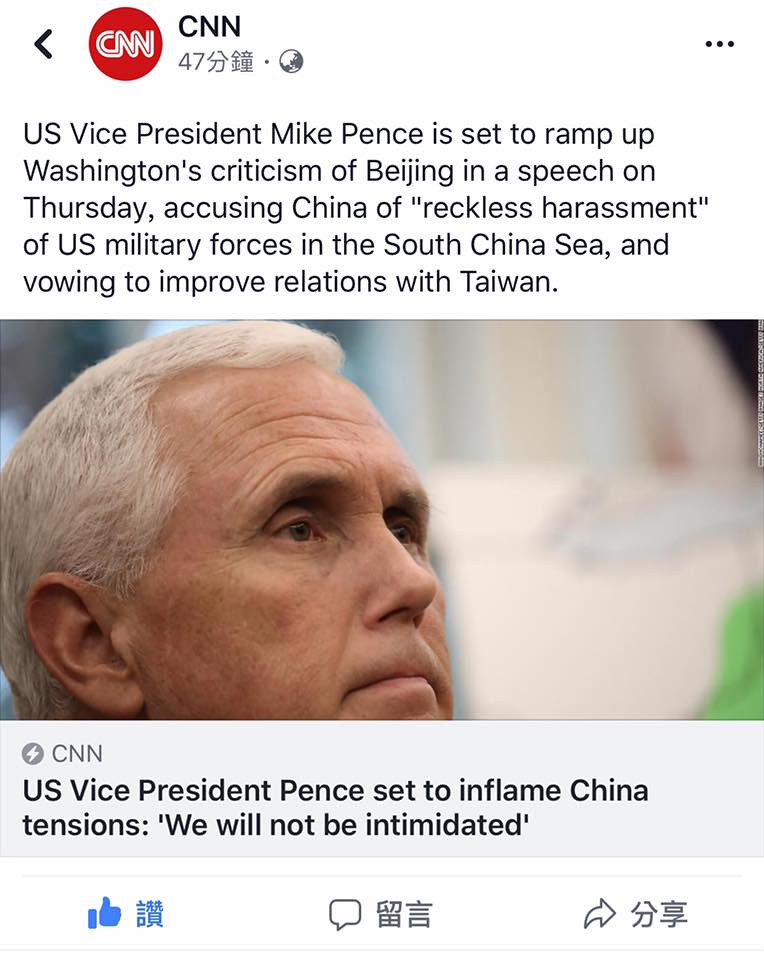
Over the past few months, I've been keeping quiet track of something that's been a problem for awhile, because it's important to always keep a fire burning under the bum of anyone who reports on Taiwan.
Perhaps, with Michael Turton no longer blogging, someone's gotta do it. Perhaps I'm just fed up. I don't know. But in any case, it's once again time to look at the English-language media on Taiwan and their completely mangled ways of referencing "tensions" (OMG!) in the Taiwan Strait.
Let's get one thing out of the way - the tensions, such as they are, are always there. China wants you to think they're going up and down, but in fact when looking at it from Taiwan, nothing has really changed. My life is the same as it was on Election Day 2016. China attempts to chip away at Taiwan in little ways, but the "tensions" don't really change much beyond that.
But if you keep writing that they are "on the rise" or that "relations" keep hitting new "lows", people will think there's a real change. There isn't.
Notice the above - China is the one being aggressively expansionist in the South China Sea. China is the one that regularly threatens Taiwan with eventual annexation, actively tries to interfere in Taiwanese affairs, and attempts to diminish Taiwan's exposure and standing on the international stage.
Yet who is "inflaming" tensions? Not China - the US! For standing up to them! China can bully its neighbors in the region all it wants - if you dare stand up to that bully, you are the one "inflaming".
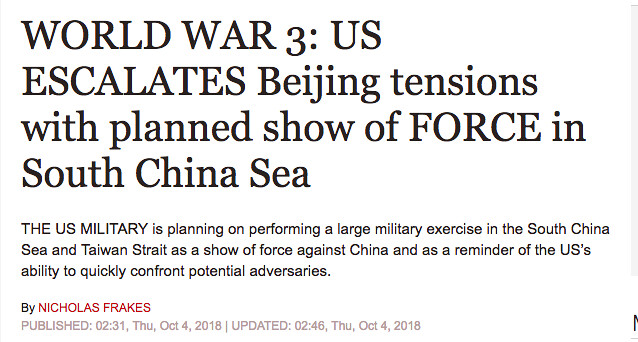
I mean, this is in Express so don't take it too seriously, but not only does the US "inflame" tensions, it "escalates" them. At least it's not Taiwan creating "tensions" anymore, it's the US. Is that an improvement? I don't think so: it plays right into a lot of anti-West liberals' beliefs that everything Western is evil and everything Asian is great, and that evil empires can only come from the West. Therefore, if the power is non-Western, it must be better or more moral.
This is absolute bollocks of course, but a lot of people believe it, and headlines like this don't help.
ALSO DON'T FORGET THE COMPLETELY GRATUITOUS AND UNPROFESSIONAL CAPITALIZATION.
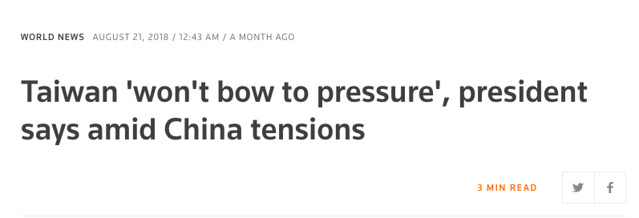
I call this the "Classic" - in this construction, tensions just appear. Nobody causes them. Nobody is the aggressor (or at least, the aggressor is definitely not China). It's left unclear, because to clarify it would be to say, clearly and accurately, that China is the one purposely causing "tensions", and encouraging those tensions to be reported in the press as either an issue that just is - and therefore could not possibly be solved by the CCP being slightly less churlish because these tensions sort of exist ambiently - or is somehow Taiwan's or someone else's fault. They do this in order to make Taiwan's every move difficult.
That's an accurate reading of China's strategy of "tensions", yet nobody seems to report it that way. Nobody assigns the proper agent.
Here are some more ambient "tensions" for you:
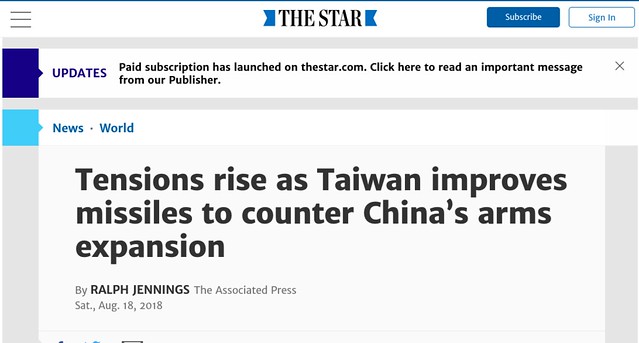
Oh great, Taiwan's biggest human boondoggle in journalism writing about tensions as though they rise independently, rather than someone (China) making them rise, and implying that the reason is Taiwan's actions of mere self-defense, rather than China's aggression (which necessitates that self-defense).
Tensions are like self-rising flour I guess. They just...rise.
If you think I'm being to harsh, read an excerpt below:
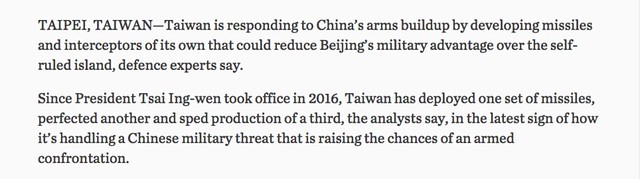
I'm not sure how to read that last sentence, but it sure comes across to me as an implication that Taiwan maintaining its ability to defend itself from a Chinese attack - because remember, Taiwan has no intention of attacking Taiwan, but China absolutely talks of its intent to attack Taiwan - is what is "raising the chances of an armed conflict".
Not, oh, say, the country that actually talks about how it plans to precipitate an armed conflict.
China can talk openly about its intent to start a war to annex Taiwan by force, and nobody will say it is "raising tensions", but when Taiwan tries to improve its ability to defend itself from that openly-admitted-to attack, it is "raising the chances of an armed conflict".
And finally, there's the one that makes me sad:
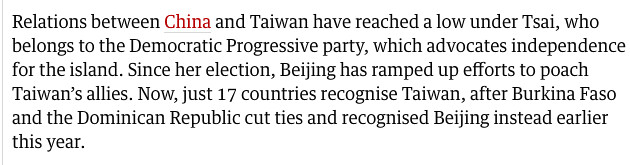
I'd really hoped for better from The Guardian. I've written about this before, so won't belabor the point, but it's worth briefly repeating that this toes a line that, on either side, is not fair. Either it can be read as "relations reaching a low" with no agent pushing them to that low (although there is an agent: China), or it can be read as Tsai and her party (which "advocates for independence") being the ones who are causing the relation to "reach a low".
The opposite is true: Tsai has done her best to be even-tempered and toe a peaceful line while not giving in to China's bullying (a wise policy maneuver that is often mischaracterized as her refusing to "make concessions" to China - as though the problem were her stance, not China's, and she should be the one to concede). Yet you won't reach that conclusion by reading this.
The headline of this one was a problem too, making it sound as though Taiwan's isolation had no agent causing it, when the truth is that China is the one working to isolate Taiwan.
That is the accurate way to report the situation - China as the principal agent, the bully, the tension-causer, the isolator - so how come nobody says so?
Anyway, let's end on a happier note:

This is from the Washington Post - good work. Finally, someone gets it right. Someone assigns the proper agent to the "feud", the "relations hitting a low", the "tensions" - someone finally points the finger right where it belongs: China.
It's a message that the West desperately needs to hear. Why couldn't CNN, The Star and The Guardian write like this? (Express gonna Express, whatever.)
The Washington Post getting it right notwithstanding, this feels like another season, another batch of "tensions" that nobody will admit China is causing.
I'll check back in around the New Year to see who is writing about these sentient, self-raising "tensions" that are always on the rise despite, in reality, their always being about the same.
Subscribe to:
Posts (Atom)