Sunday, March 24, 2019

This time, it's Bloomberg choosing its words poorly when discussing Taiwan

IMG_3008


Bloomberg just ran a profile article of Han Kuo-yu, and the language choices are...not great. I have it on good authority that the Taipei bureau chief is a good dude, so I'm not sure why, but regardless the language and framing in this piece (which has some strong parts) merit some detailed discussion. Let's have a look. 


For officials in Beijing looking for a Taiwanese presidential candidate who improves the island’s fraught ties with the mainland, Han Kuo-yu is saying all the right things. The question is whether he runs.

"A Taiwanese presidential candidate who improves the island's fraught ties with the mainland" implies that it is somehow Taiwan's fault that ties with China (not "the mainland" - that's politically charged terminology) are tense.

But it's not. I'm sure Tsai Ing-wen would love better relations with China, if China would accept that Taiwan isn't interested in unification. That's not a position held only by Tsai - she was elected in part because of it, and is the general sentiment in Taiwan.

Tsai has extended olive branches, but they come with the clear indication that Taiwan's sovereignty is not up for debate. China has not accepted them.

It's Beijing's fault, not Taiwan's, that relations are "fraught". So it's not Taiwan's job to "improve" them - it's China's.

Also, why are you starting an article with what China wants and thinks, rather than what Taiwan wants and thinks, Ms. Wang?


"Such blunt talk contrasts with Taiwan’s current president, Tsai Ing-wen, a cautious critic of China who’s bracing for a tough re-election fight after bruising policy battles and an isolation campaign by Beijing."

So, why is she facing a difficult re-election campaign? Is it really because of her stance on China? Most people seem fine with her approach to China - not budging on Taiwanese sovereignty, but not instigating any tensions, either. Her approach ensures that it is clear to all who care to observe that it is Beijing doing the bullying (something that was true, but not always clear, under former pro-Taiwan President Chen Shui-bian).

The reasons why her approval ratings are flagging have to do with the economy (although it's actually not doing as badly as people think) and some displeasure over her 'cool' technocratic governing style, as well as domestic governance at a local level. It's actually not that closely related to issues regarding China.

The sense that it's all due to her views on China is further implied by Wang omitting what these "bruising policy battles" were over. Mostly, domestic issues: marriage equality, labor laws, pension reform, that sort of thing.

Tsai was elected because of her pro-Taiwan views, not in spite of them.

So why is Bloomberg implying that Taiwanese people are angry with Tsai over this, and not domestic governance issues?

Besides, what exactly are we saying here? That in order to "reduce tensions", Taiwanese people might want to consider voting for a Beijing-approved candidate? Are we not aware that that is exactly what China wants, but might not turn out well for Taiwan?


Han’s shock defeat in November of a candidate from Tsai’s Democratic Progressive Party in the ruling bloc’s stronghold catapulted him to the top of the list of possible presidential hopefuls from the China-friendly Kuomintang.

Putting this in the same paragraph as the quote above implies that this victory was due to China policies. It wasn't. There were a number of odd convergences here, between Han's populist appeal and some very weird and questionable sources of funding and support (when people talk about possible Chinese interference in the last election, well...I don't know about Han specifically but it wouldn't surprise me). There was anger over local governance.

But your average Kaohsiunger does not agree with Han's pro-China tendencies. Unlike Tsai, he was elected despite, not because of, these views. Look at any data about the political leanings of Kaohsiung residents, and this will be clear (Wang alludes to this later but treats it as an inconvenient aside that contradicts the "China!" narrative.)


On Friday, he begins a week-long trip to Hong Kong, Macau and the mainland cities of Shenzhen and Xiamen.

How lazy does journalism have to be to point this out but not interrogate it at all? It's presented almost like a good thing - no questioning at all of how and why Han was invited to Hong Kong and Macau, and who could have set that up and authorized it...and why? And how his insistence that this trip is "all business" is at odds with what we actually know about it?

No interrogation of whether the candidate China prefers may pose potential risks to Taiwan, and that "improving fraught tensions" is not necessarily the best outcome?

Why - after a few paragraphs implying that Taiwanese want a more pro-China leader (even though that's not necessarily the case) - is none of this considered?


Chinese President Xi Jinping, who held a historic meeting with Taiwanese counterpart Ma Ying-jeou weeks before the vote, has cut off communications with Tsai’s government and led a campaign isolate her island diplomatically.

The meeting was not particularly historic and didn't have much effect at all on how Taiwanese voted in the 2016 election. It was literally a non-event, a stunt to try to convince Taiwanese to vote for the KMT, and it failed. Most Taiwanese do want a strong economy and can accept economic ties with China if they deliver one. But seeing how Ma's push for closer ties did not result in definitive economic growth, and that Beijing showed its hand in terms of quietly tethering 'economic ties' to an agenda of political integration, Wang is making way too much of China's reaction leading up to and post-2016. 


Tsai now looks vulnerable, receiving the support of less than 20 percent in recent polls, as she grapples with both voters concerned about deteriorating ties with China and those who want a cleaner break. 

Though I don't know the exact numbers, Ma didn't have great approval ratings before his re-election campaign either, and won. It's sort of a thing in Taiwan. A smarter write-up would have compared Tsai's current approval ratings to what they tend to be at this point in their administration for any given Taiwanese president.

And it again places too much emphasis on Tsai's China policy, and not enough on domestic-level grievances (some of which, like air pollution and low wages, are merited - but which are results of decades of poor governance and can't be fixed in 3.5 years).

Even if the issue were Tsai vs. China, again, no questioning of what it would mean for Taiwan to choose a Beijing-approved candidate simply because China wished it so? No delving into alleged Chinese interference in the 2018 election? Nothing?


Tsai has sought to push back against Han’s pro-China remarks, saying there can’t be an arranged marriage with China because Taiwan is sovereign and its people have the freedom to choose. Taiwan’s official Mainland Affairs Council also took a shot at him [emphasis mine], arguing the island “must resolutely refuse China’s terrorizing affection.”  

Great way to use language to cast a negative connotation on the rhetoric of one side! "Took a shot at him"? How about "spoke frankly" or "pointed out" or any other neutral choice?

Besides, Tsai is right. Unification is impossible because Taiwan is sovereign and the people have the right to choose...and aren't interested in dictatorship and loss of rights. They can see the ways in which Hong Kong has failed and know not to go down that road.

A note here that most Taiwanese do, in fact, support the status quo (not unification), that the status quo is sovereignty (because it is), do not support unification or "One Country Two Systems", and that Taiwanese identity remains strong would be apropos, but we get nothing.


Others observing from Beijing argue Han’s candidacy could lead to a breakthrough between the long-time rivals. He supports the idea both sides are part of “one-China” -- a negotiating framework Tsai has refused to endorse.

More poor language choices.

First, why is this still being framed in terms of what Beijing wants, not what Taiwan thinks?

Second, when the intentions of one "rival" is to annex the other "rival", and they will not accept any offer of negotiation that doesn't put this potential outcome on the table (which is, to them, the only acceptable outcome), when there is a "breakthrough" that's not necessarily a good thing.

Third, Taiwanese who identify as Taiwanese don't see their goals as part of a "rivalry". Rivalries are for "two Chinas" - the ROC and the PRC. But those who just want Taiwan to be Taiwan aren't a part of that. There's no rival claim to China coming from pro-independence types. It's not a rivalry - it's a bully and a target who refuses to succumb. It's just the wrong word, period.

So on one hand we have this inaccurate, undeservedly positive phrase "breakthrough between rivals", and on the other we have a subtle denigration of Tsai/pro-independence views with "refused to endorse", as though this makes her the instigator or the intransigent side who won't negotiate - as though negotiations could ever be fair in this situation.

Tsai doesn't endorse "one China" because Taiwanese by and large do not want to be a part of China. Why not say that? Why make it seem so negative? Why leave out important facts like this?


“If he wins in 2020, it is likely that he will reverse Tsai’s cross-strait policies,” said Wang Dong, an international relations professor at Peking University and secretary general of the Pangoal Institution, a Beijing-based research group. “The mainland, of course, would have much more trust in him.”

What's up with the implication that it would be a good thing for China to trust and like a Taiwanese politician? No delving at all into what that could mean for Taiwan, when China's goal is to annex Taiwan?

This is a Taiwanese candidate, not a Chinese one. China's bullying does matter, but Taiwan's views matter more.

The question isn't "will China trust him?" (seriously, quit it with "mainland"), but "should Taiwanese voters trust him?"

Why aren't you asking that question, Ms. Wang? 


Kaohsiung city spokeswoman Anne Wang said Thursday that Han was focused on promoting the local economy and “will not think about other plans for the time being.” This week’s trip was intended to promote economic and cultural exchanges and not touch on politics, she said.

You're just going to take her at her word and not actually question this? Do you honestly think China would allow this trip if there were no political motivations?


The trip will test Han’s ability to navigate sticky issues on the mainland and in the fractious former British colony of Hong Kong. His past forays into the public eye have been rocky.

Again with the "mainland". Ugh.

Anyway, again, you should be questioning whether China cooperating with a Taiwanese politician is actually a good thing for Taiwan, but that's either ignored, or you take it as a given. I'm truly not sure which.


When he was a legislator in 1993, Han punched future DPP President Chen Shui-bian, putting him in the hospital. As president of the Taipei Agricultural Products Marketing Co. in 2016, he dared a city councilor to swallow a hockey puck during a dispute. 
During his run for mayor, he told a gathering of female supporters that anyone who created 1,000 jobs in Kaohsiung would get a kiss. Earlier this month, he was forced to apologize after dismissing the idea of attracting white-collar workers from the Philippines since it was hard to believe maids could become English teachers.

Lest you think I just want to hate on this article, I am quoting this here to point out that it's pretty good coverage of his past controversies. Nice work. 


Han successfully cast himself as the “CEO mayor” during the campaign, propelled in part by a social media campaign led by his Canadian-educated daughter, Coco Han. His focus on economics on platforms such as YouTube and Facebook helped garner robust support from younger voters looking for higher wages. 
One of his slogans was: “With goods sold and talent flowing in, Kaohsiung’s people will make a fortune.”

Sure, okay. Not untrue. But it would be smart to question whether his outlandish and oversize promises had a chance of holding up. If you actually look at his focus on the economy, you'll see that he's unlikely to actually be able to deliver on his promises. Kaohsiung will never be Shanghai. It will probably never even be Taipei. We do need to improve the economy across Taiwan, including in industrial centers like Kaohsiung. But...this seems a bit vague and impossible to deliver on.

And at no point do you question this, or ask whether or not it's prudent to run a guy for president who hasn't even proven he can run Kaohsiung, whose promises seem so pie-in-the-sky that any rational person can see that they just aren't credible, and what it means that the KMT is willing to run him anyway, and China is on board.

Why not, Bloomberg? Why not, Cindy Wang?

Saturday, March 23, 2019

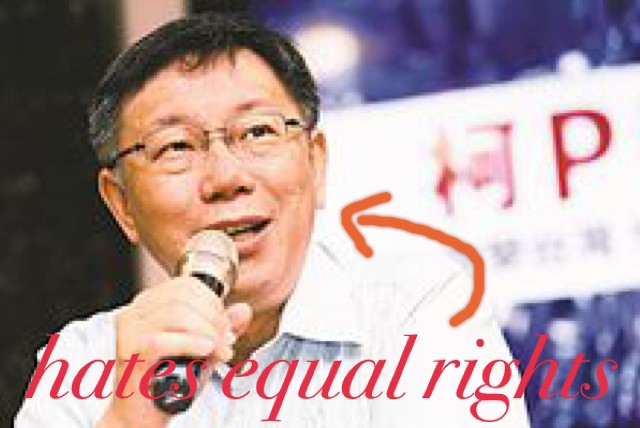
Mayor Ko is a Gay-hating, Misogynist Turd

Untitled
doctored image (test and arrow mine) from Wikiquote


So, I've tried to be a Very Good Blogger these past few months by keeping my swearing and general foul-mouthedness in check, so I think I've earned this one.

Because I think it's most appropriate to the story to do an end-run over the serious-faced analysis about what it means and what are Ko's intentions exactly and just call it like it is without any of the wannabe pundit BS, I'm just gonna say it straight: Taipei Mayor Ko Wen-je is a homophobic, sexist buttclown.

The misogyny has been amply covered, because there is a lot of it. I won't re-tread on that - links to his previous comments about women are covered in the link.

The gay-hating, though? That's new, so let's rumble.

According to Liberty Times (link in Mandarin), while in the USA - which was its own whole drama thing - Ko commented that he voted against marriage equality referendum in the last election, but that he "allowed Taipei to hold the Pride Parade" which shows that "Taipei City is very tolerant".

Don't let his talk about "tolerance" and Pride fool you. First, that's a basic human right (the freedom of assembly) in Taiwan. Oh, thank you so much, Mayor Ko, for giving LGBT people the right to freedom of speech that they already had anyway! Barf.

Second, "tolerance" is not enough. Equal rights and tolerance are both necessary: without tolerance, equal rights can ring hollow as people, even when exercising their rights, may face discrimination. But without equal rights, merely "tolerating" someone else's existence doesn't confer upon them the dignity of actual equal status.

Voting against marriage equality is an anti-gay, anti-equal rights act. Simply put, if you do not think same-sex couples do not deserve the same rights that opposite-sex ones enjoy, you do not believe in equal rights, and you specifically want to deny them to LGBT people. That is a fundamentally anti-gay viewpoint. There's no other way to put it. The two cannot be reconciled. You can talk all you want about "being tolerant" but if you want to deny a group a human right, that is not "tolerant". You are telling opposite-sex couples that they shouldn't be alowed to inherit from each other, make medical decisions for each other, have visitation or next-of-kin rights, adopt, be on each other's insurance or any of the other things opposite-sex couples can do just because they have different junk.


That's anti-equality. Period. There is no "loving" or "decent" way to interpret this.

What's more, "but I allowed Taipei to have Pride!" is a weak-kneed cop-out. Tolerating someone's existence without open comment or harassment and letting them march down the street, but wanting to keep them second-class citizens, is simply not good enough, and is not actually tolerant. Tolerance means accepting that people who aren't like you are human too and therefore have the same goddamn rights you do, period.

Anything less - oh it's so nice, we're so nice to you, you can march and walk and wear your costumes! - is not good enough. There is no excuse. There is no cover. There is no sappy, manipulative "love the sinner" or "acceptance" or "lifestyle" rhetoric.

Either you believe in equal rights or you do not, and Ko Wen-je does not believe in equal rights.


I also wonder what he hoped to accomplish with these comments - his most supportive base are the youth, who are also overwhelmingly pro-equality. Did he expect that he could say this to win older anti-equality voters, but keep the youth with his comments about Pride?

I hope not, because that would mean he thinks the youth are stupid. I certainly hope they don't let this go.

Confusingly, this comes after addressing the right-wing Heritage Foundation touting Taiwan's social values as akin to those of the West (marriage equality is common in the West now) and talking about elections as social movements toward change. To a bunch of right-winters. Huh.


Which...okay, if you think that, why did you vote against the goals of the biggest social movement since the Sunflowers, and arguably the most progressive and Western-aligned, which asked for the most evolution from Taiwanese society?

Because you're a jack-bucket who says whatever and doesn't care, that's why. You proved that with women; now you're just adding LGBT people to the roster. Screw you.

Friday, March 22, 2019

You can't force patriotism, so stop blaming Taiwanese for not caring enough about the ROC

Untitled


The National Interest has some of the best journalism on Taiwan out there (among media sources not dedicated to Taiwan, that is). So as expected, this piece on the questionable capabilities of the Taiwanese military to fend off a Chinese invasion was quite strong - mostly.

I absolutely believe Minnick's concerns are founded, even though for my own sanity I must also believe President Tsai when she says that Taiwan can fend off the first wave of attack, a belief which is widely held. I also have to believe that aid would come after this point (though of course I can't say this with confidence) - again for my own sanity. Not just for the country that is my home, but because my own life as I know it would be over. 


But this point struck me, and I can't let it go without saying something: 


Public lethargy and a lack of confidence in the military has drained the armed forces of manpower and morale. And it is this lethargy, along with the unwillingness of Taiwan’s political elites to communicate this imminent threat to the public, that must be addressed.

Taiwan’s military wants to procure big-ticket items from the United States, but at the same time it has been forced to reduce conscription and training due to funding issues and an apathetic civilian population....

Part of the problem is conscription and a decline in patriotism.

This isn't the first time I've heard that Taiwan is facing a military recruitment problem because of a lack of "patriotism." Concerns that neither training nor pay are particularly good, pensions have been cut, that it's widely seen as a difficult working environment and that military service obligations are to be borne with annoyance if they can't be outright avoided are all valid.

But kvetching about a lack of patriotism?

Dudes, you did this to yourselves. 


I don't mean the Taiwanese in general. I don't even necessarily mean the military specifically. I mean all you people who whine about how Taiwan shouldn't change its name unilaterally, and be very cautious about altering or scrapping juridicial documents like the constitution and symbols like its flag and national anthem (both of which are very China/ROC/KMT-oriented). And all of you who say these symbols are "small differences" and to harp on them is "narcissism". You may be Western or Taiwanese, based in Taiwan or abroad, but all of you and the government you have convinced to retain the name and general governmental structure of the "Republic of China" can look squarely at your own damn selves if you want to know why Taiwanese don't feel particularly patriotic.

Those names and symbols do actually matter, and it shows in how little they inspire the Taiwanese populace.

Why should the average Taiwanese person feel great love for the Republic of China? Especially if that person lived through the worst years of the horrors that uninvited colonial government inflicted on Taiwan, how could there be any great welling of pride when seeing that white sun on a blue sky, that party symbol of the KMT on the national flag? How could the eyes of most Taiwanese well up when they hear their national anthem which references their "party" (the KMT) and is therefore an explicit callback to the era of dictatorship and mass murder? And what kind of dummy do you have to be to expect otherwise?

At best, you'll get deep ambivalence - after all, if the ROC flag is the one people know abroad and it differentiates them from the PRC, that's something - and you should be grateful for even that.  It's hardly deserved. F
eeling some form of conflicted happiness to see that flag or the name "Republic of China" used by international organizations is a kindness - a generous offering. Calling it paltry or insufficient is an insult.

Telling Taiwanese that they ought to feel patriotic fervor for the government that once oppressed them, and its symbols, because they can't realistically get rid of them right now? The same symbols that were (and are) used to try to erase their own Taiwanese identity? When members of the party that introduced those symbols (and that oppression) call disagreement "separatism", threaten people who disagree with death, and seem to care more about China than Taiwan? That's messed up.

Even for those who don't hate the ROC and its symbols, it's a confusing message. We have to fight for Taiwan - or, err, the ROC - um, which claims to be China, but we have to fight against China as the ROC for the future of Taiwan...uh, here, look at this flag that has one political party's symbol on it, which is from China and seeks to supplant your sense of Taiwaneseness, which we're preparing for war against...as China...for your country, Taiwan. 

Yeah, okay. That'll win those youth over!


The ROC is a system on life support. It's around because of the threat of war if Taiwan were to dismantle it, and perhaps a small (but rich and influential) class of people who still think it is a government worth keeping around. It's around because the allies Taiwan hopes for in the event of war tell Taiwan it has to be this way so as not to "anger China".

That's a recipe for declining patriotism; who, beyond that core of diehard ROC fans, could summon up much more feeling for it than one feels for their annual gynecological exam? (Or for the guys, whatever it is you get examined every year that is important to do but uncomfortable.) Necessary for continued health, but not exactly inspirational. 


Like an ice-cold speculum, the white sun on a blue field and everything it stands for just does not engender the sort of emotional connection to a place, system governance and set of social values that underlie an urge to join the military.

So for the military to be pushing that same old "ROC! ROC! Let's fight for the ROC!" patriotic blargle...yeah, it's not going to work. They could try harder, they could make it swisher, they could give their recruitment drives higher production values. They could just plain offer better pay, benefits and working conditions. But if the population is not too keen on the ROC, all but the latter is just not going to work.

Or, worse than an ice-cold speculum, it is about as inspirational as this, um, "song" trying appeal to supporters of Wu Dun-yih.

Please don't come in at this point blaming the Taiwan independence activists for this state of affairs. Yes, it's true that in social conditions where most people think of themselves as "Taiwanese" and the country they live in as "Taiwan", to say that "Taiwan can never be 'free' with the ROC around" makes it more difficult for people who love Taiwan to feel great patriotism when Taiwan is called the ROC. 


But...

a.) They're right, even if that truth is neither convenient nor realistic (and deeply confusing to people who don't know Taiwan well, so please stop saying it to them - just stick to the digestible "Taiwan is already independent and they just want to stay that way" and let's not air our dirty laundry in front of the white people, 'kay?)

b.) The average Taiwanese person thinks the hardcore independence activists are a bit nutty, even if they fundamentally agree with the message. From my experience, your average person who doesn't follow politics too deeply does want Taiwan to maintain its autonomy but they think the folks to take to the streets all the time are...going overboard. So their message probably isn't the reason for the greater societal apathy.

c.) This outcome was inevitable. Anyone with eyes and ears can see that the ROC is waning, it's propped-up, it's nothing to feel great emotion for (and was frankly never that great, even when it was the government of China). It's just natural not to feel particularly moved by symbols that are pushed on you and disconnected with how you actually feel about your country and society. 


If the Taiwanese military wants to build a sense of patriotism that will lead to wider recruitment, Minnick is right that it first needs to communicate the true depth and nature of the threat to the public. Folks calling for better careers in the military are likewise correct.

But they also have to quit pretending that the old ROC rah-rah can work. It can't. It's dead.

I know most of the military leans blue and that the ROC's name can't be safely officially changed right now, but the youth are Taiwanese, not Republic of Chinese. Naturally independent. They'd probably fight for that, but you have to couch the message in terms of the country and society they know, not what the government is forced to say at the higher levels.

That is, appeal to the desire to fight for Taiwan, and stop leaning on symbols that, if they don't inspire bitterness and emnity over the ROC's dictatorial and murderous past, are simply dead.