Tuesday, April 9, 2019

Everything you need to know about why One Country Two Systems will never work in two easy trials!

Untitled


Just now, we've learned that leading figures in the Umbrella Movement were found guilty of "public nuisance". This comes after Umbrella Movement leaders were jailed for their role in the protest, which was the largest in Hong Kong's history. (A lot has gone on with that trial including an appeal, but while that appeal set them free, it did not stop the Beijing-endorsed trend toward harsh punishments for civil disobedience.)

Of course, "being found guilty" and "doing something wrong" are not the same thing. In this case, one certainly does not reflect the other. 


More than that has been going on in Hong Kong, as well:


Compare that to the outcome of the charges brought against the Sunflower leaders in Taiwan, who were found not guilty as their actions were found to constitute legitimate civil disobedience, which was upheld on appeal. Trials against other Sunflower activists did not result in such progressive verdicts, however. That said, it's notable that charges brought against the government have also recently been accorded a re-trial.

What stuck out to me about those Sunflower trials was this:

Taipei District Court Chief Judge Liao Chien-yu (廖建瑜) said the panel of three judges made investigative inquiries, and reviewed theories and practice surrounding the concept of civil disobedience, through literature and research findings on the topic by both Taiwanese and international academics and experts. 
The judges studied the concept so that they would be better able to weigh defendants’ and their lawyers’ arguments that their reasons for storming the legislature were legitimate and socially justifiable, because it was an attempt to block the cross-strait service trade agreement, which was being rushed through the legislature by Chinese Nationalist Party (KMT) legislators without consulting the people, Liao told a news conference.

This would never happen in Hong Kong. 

As with Hong Kong's turn toward authoritarianism, there are many other examples of Taiwan's turn toward progressive values, though the bending of the arc toward justice is indeed slow.

But I don't need to list them for you. Everything you need to know is right here.

These two trials show without artifice or obfuscation exactly why One Country Two Systems will never work. Taiwan is free; Hong Kong is not. Taiwan (for the most part) set its activists free and made a decision that looked to a liberal future. Taiwan at least took a step (though an imperfect one) towards understanding the role and necessity of civil disobedience in democracy. Hong Kong did not. 


Taiwan was able to do this because it is not subordinate to the CCP. Hong Kong took its own path - or rather, was forced down that path - because it is.

A free society can never exist under the same framework as an authoritarian regime, much less be subordinate to it, because being found guilty and doing something wrong are not the same thing. Taiwan is (mostly) able to tell the difference. China - and by extension Hong Kong - clearly is not.

How much clearer do we have to be?

Monday, April 8, 2019

When a "Taiwan separatist" goes to China...

IMG_0165
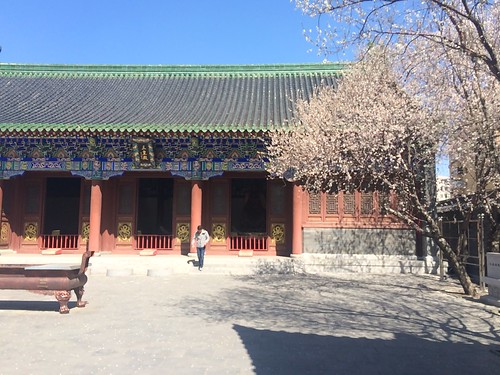
The temples here remind me of the ones in South Korea, and one of them (not this one) is a Matsu temple, of all things!  


I'm going to say something that should seem sort-of obvious but might shock a few people anyway.


I like China.

I still hate the CCP, though.

Some of you are probably thinking "why wouldn't you? The people are friendly, the food is great, the history, literature, architecture and culture are fascinating, the scenery is often stunning. There's a lot to like in China!"

And some of you are surely thinking "but they're our mortal enemies! And all the pollution! And the government! It's so oppressive!"

Both of these groups are right.

I've spent a week here running a training course, and was also in Shanghai recently. And I have to say that although I felt a little nervous beforehand for reasons I'll explain below, I would overall say that I had good experiences here. The people - the managers I've worked with, the trainees - have been so friendly and hospitable. Of course, I knew already that people in China are usually very welcoming to foreign visitors. The managers worked hard to ensure that I was comfortable, happy and well-fed while here; I ate like a king. The trainees worked their butts off, were an exceptional class and just all around great to work with, as well as being friendly and willing to learn. It was an honor to work with them, and more importantly, I genuinely like them.

Of course, the food is as spectacular as I remember it. I haven't had much time to go out and actually do anything, however, as these are purely work trips.

And I've found that if two conditions are met, this proud Taiwan "separatist" does like visiting China: the first is that it's only enjoyable on days when pollution isn't bad. The day a pollution and dust storm blew through was awful. The days the air has been breathable have been fine.

The second is that I have fast, consistent access to the open Internet. Without that, I can't even talk to my husband as neither of us uses any social media or chat apps that are allowed in China. I can't do much of anything: the majority of things I enjoy doing online consistently are banned in China, and in 2019 it's just not acceptable to me that my access be restricted.

VPNs don't work well - if you can get them to connect (which they won't always do), they can be slow and the connection can be lost. The only way to travel, I've found, is through one of those Wifi hotspots you can get at the airport in Taiwan. They bounce you right over the Great Firewall quickly and consistently, and cost a little under NT$200/day (my company paid for it).

This might seem like a dumb thing to say to some of you - white girl realizes China's not so bad after all! would be an uncharitable but possible way to characterize it - but remember I've spent the better part of the last decade devoting my time to writing about politics in Taiwan and Asia from a pro-independence standpoint. After awhile you start to think of China as 'the enemy' rather than a beautiful country full of lovely people.

The CCP is the enemy. China's just a country. How can one hate a country?

I'll only say one thing on the other side of that perspective: being here with unrestricted Internet access takes away the most obvious way that China's police state makes itself known. Everything else is normal: great bars with great music (though nothing with particularly thoughtful lyrics), great cafes, great shopping, great food. People living their lives. Fear doesn't lurk around every corner. Xinjiang and Tibet are far away. A great deal of literature is still banned, but they don't always check carefully.

Without the daily annoyance of wondering whether or not you'll be able to get online, you'd be forgiven for forgetting that you're living in a place run by authoritarians who want to annex a neighboring democracy and are perpetrating both cultural and literal genocides in their western provinces. The CCP seems to have figured out - after, uh, some trial and error - that if you force people to give up all cultural touchstones and push them into a gray Communist hellscape, they aren't going to like you very much. But if they can eat, drink, wear, listen to and buy whatever they like and you give them a home-grown social network, that's enough for huge swaths of the population. They might just leave you be.

If you're from China and are used to the Internet issue, you're used to getting state-approved news, you've never seen a banned book, you've been raised to think Taiwan is yours by right and Xinjiang and Tibet seem far away indeed, it must be easy to otherwise forget exactly who is running things. You might even support them: China's gotten a lot nicer in the past 20 years, after all.

I'm not the first to say it, but so much for the idea that economic growth inevitably brings political liberalization.


I prefer living in Taiwan for sure; it's my home. One of my requirements in a place to live is that it be free, and Taiwan is: I feel safe expressing myself openly there, and my friends enjoy democratic norms I feel are crucial. I do not, and will never, consider Taiwan to be a part of China, and I don't intend to live in China. I will still criticize the Chinese Communist Party until I draw my last breath. I'll stay in the fight against their aggressively expansionist policies. In that sense, I'm still in the trenches. You will never see me become one of those Westerners who apologizes for Beijing's brutal authoritarianism and aggressive expansionism. I stand for universal human rights, self-determination, and freedom and that will never change. The CCP will always be an enemy.

In other words, all the shiny things brought about by economic growth shouldn't be enough to tempt Taiwan toward China; Taiwan's sovereignty is about more than that. It's not enough to tempt me, either. My true freedom is worth more. 


But on a clear day, if you have a good portable hotspot, it's pretty good to visit - and I wouldn't mind coming back.

So what made me nervous? Well, being here for work, I couldn't just say what I thought about Taiwan because agreeing to come at all basically means I've agreed that I'm a representative of the company and not here in a personal capacity. That (Taiwanese) company treats me well; I want them to do well and this is good business for them. In any case, nobody asked.

To be honest, I don't know what I would have done if someone had.
IMG_0205
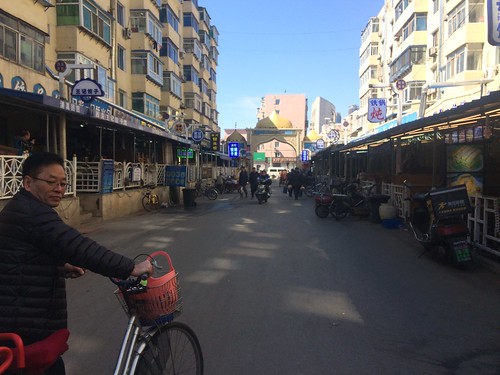
On a street of Hui (Chinese Muslim) restaurants in Shenyang


It's usually not that hard to keep my political views to myself at work, but when you know you can't say anything because it's your job to make your employer's Chinese client happy, being hyper-aware of it makes it more likely to slip out because what you can't say is always on your mind. Like how telling a kid she can't do something just makes her want to do that thing more, know what I mean? Though some managers here figured out, of course I never told any trainees, nor would I.


Because of this, I did feel a bit 'closed': advocating for Taiwan isn't the only thing in my life, but it's a big part of it. Ensuring that none of my trainees was aware of that part of my life, and that they knew me in a professional capacity rather than a personal and political one did entail pretending that part of myself didn't exist for a week, and not just during work hours. We all stayed in the same hotel; I saw them at every meal. In that sense, being only about 3/4 of who I actually am was like cutting off my left arm. I could function, but it wasn't the whole me.

That said, I never compromised. I stood for the national anthem because it's required, but I did not put my hand on my heart (I couldn't have sung it even if asked). I always referred to "Taiwan" and China": no "Mainland", "province" or anything like that passed my lips. Because it was relevant to a class discussion, I mentioned that NTU was founded "when Taiwan was Japanese". I didn't pretend or lie. I walked a thin line between holding to my principles in my language use, but also not offering that information about myself.

But I'll tell you, while the trainees never found out about my political views, the two managers who helped run the course did. One is Taiwanese so I just told him. The other is Chinese but figured it out through my language use and hearing me talk with the Taiwanese manager. She was surprisingly cool with it. If you are open, you will find people who can accept the whole you - the problem is, you won't find out who those people are until you say something, by which time it might be too late.

When she did find out and we could finally just talk openly about these things, the whole feeling just changed. We went from friendly work acquaintances who shared our meals with small talk punctuated with quiet periods to people who could actually have discussions.

And to be frank, that's what made me decide that I did, in fact, enjoy this trip to China. The air's been okay (which I'm told is unusual), the hotspot works, fine. But really, it's the ability to be not just myself, but my whole self, around at least a few other people.

So I'll end with this: pro-Beijing types love to talk about how Chinese and Taiwanese have some sort of special relationship or understanding due to cultural, ethnic and historical ties. A relationship they often claim no-one else can understand, a special affinity. I've heard it both hinted and said obliquely that this creates a special affinity between individuals as well in which they understand each other as ultimately culturally Chinese.

I'm here to tell you that it's not true.

Until that breakthrough toward the end of my trip, I found that when I was out with a mixed group of Taiwanese and Chinese, they were amicable. You might think there was some special cultural affinity or set of tacit understandings that we clunky interlopers could never comprehend which transcended politics.

And yet, I could see the ways in which my Taiwanese colleagues and acquaintances held back whenever it was a mixed group. It was very subtle, like buttoning a bit closer to the collar than one ordinarily buttons. Zipping up a jacket just a little higher than usual. You'd have to be watching for it to see it, but it was there.

The second the company changed and it was all Taiwanese, it was like a collective unconscious breath was let out. The belt loosened. The words loosened.

I know this because, although I am not Taiwanese, I was treated as one in these situations. I felt it too. I even mentioned it explicitly, and the others readily agreed. It wasn't dislike, they pointed out. They liked their Chinese counterparts - you just had to be careful what you said. Among other Taiwanese and the Honorary (that's me), you could speak more freely.

And that same feeling came back the second the Chinese manager indicated that she was fine with my beliefs. Jackets unzipped, collars loosened, guts unsucked.

It has nothing to do with ethnicity, history cultural 'affinity', or even being Taiwanese. If you understand Taiwan's situation and what it stands for, you're in.

If not, you could be as genetically similar as anything, but you're out.

While many of my trainees are likely openminded about Taiwan, it breaks my heart a little to realize that some of them might think less of me if they knew what my real views on Taiwan were - that I stand for everything they were taught to stand against. 


That's one of the great tragedies of Beijing's warmongering over Taiwan: if they'd just accept that Taiwan is already independent and wants to stay that way - if they'd just respect that Taiwan has the right to determine its own future - a lot more Taiwanese and Chinese would likely be truly open with each other on a personal level, and there would be a lot more closeness between them. More friendships would form, and the world would be a better place.

Tuesday, April 2, 2019

TENSIONS HAVE BEEN ENRISENED! (Or have they?)

At this point, we're all used to the skewed language that English-language media uses to talk about Taiwan. When the CCP does something to exacerbate tensions with Taiwan, or acts extremely offended over something going on here (including actions of individual Taiwanese citizens), the default seems to be that "tensions are rising" - no agent is named as the entity doing the raising. Or it's subtly implied the fault is Taiwan (e.g. "tensions have been rising under Taiwanese President Tsai", as though she's the one doing the escalating. She's not.)

Even when a story should be reported neutrally or with a critical eye to Chinese government's actions - as there is plenty of evidence of ill intent - the language used always exonerates Beijing and invites the reader to imagine that the other side is in the wrong. For example, here, we see language such as "soothe" and "calm" in the face of a "swipe" by a European leader (European Commission President Jean-Claude Juncker). To read that, you'd think that the Europeans were hysterical - MEOW! - as cool and collected President Xi sought peace. Criticism of China's actions comes much later and is phrased dismissively ("which some see as" is basically newspaper code for "you can ignore those people"), even when more investigation into the intent and impact of these actions are merited.

Gee, you'd almost think the international media is wary of criticizing China, even when it would be right to do so. Huh!

So what happens, then, when there is absolutely no way to avoid pointing out that the CCP is the one exacerbating tensions? When no accurate language is possible that implies that these tensions just magically rise on their own, or perhaps they are the fault of Taiwan (or some other country "taking a swipe" at China)?

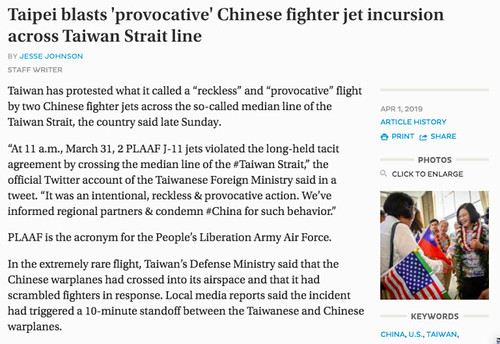
Consider this example from a few days ago:


There's just no way around it: without provocation, the PLAAF made an incursion into...well, I'm not sure if we can call it "Taiwan airspace" exactly (someone with more expert knowledge is welcome to fill me in) but violating an agreement like this - even a tacit one - is in fact intentional, provocative and reckless. MoFA is absolutely right.

And there's no way to write about that which takes the blame off of the CCP...or is there?

Local and regional news is reporting on it, but the top article (in the Japan Times) manages somehow to make Taiwan look like it's overreacting, when it absolutely isn't:


Screen Shot 2019-04-02 at 5.41.40 PM


"Provocative" in quotes can mean that they're just quoting MoFA's words, which is true, but they're called "scare quotes" for a reason: used this way they also imply that the words used don't accurately describe the situation. That's followed by "so-called" and "extremely rare" and a lot of talk about what China thinks, but none at all really about what Taiwan thinks and why it responded as it did. And while I'm happy they asked Bonnie Glaser about this, after some tired faff about the "renegade province" they go on to continue minimizing Beijing's actions as if to say "hey Taiwan, why so serious? It's not a big deal. Don't make this into a whole big thing - you wouldn't want to raise tensions, would you?"

When anybody who is aware of China's actions in the 1990s know that they were meant to scare newly democratic Taiwan into, um...not being democratic. You'll recall that there were also missile tests then, and they were intended as an oblique threat to Taiwan. It was terrifying and kind of a big deal. I remember hearing about it as a teenager in the US who had no relationship to or conception of Taiwan. It was a big deal then and it is a big deal now.


And that's not even getting into SCMP's use of language: "hardline" etc.  - to make Taiwan look like the fire-starter. Plus this steaming turd:

Analysts in Taiwan said, while it remained to be seen how Beijing would react to the order to forcefully disperse any future incursion by PLA jets, Tsai could risk setting off a cross-strait conflict which might drag Washington into the situation [emphasis mine].

Excuse me, ahem.

HOW IS TSAI "RISKING SETTING OFF A CROSS-STRAIT CONFLICT" WHEN IT IS CHINESE PLANES STARTING THE CONFLICT??

Seriously, Lawrence Chung and Liu Zhen, what the hell is wrong with you?

Then there's this, from Channel News Asia:


Taipei hit out at China on Sunday (Mar 31) for what it said was a "reckless and provocative" incursion by two fighter jets across a largely respected line dividing the two sides in the Taiwan Strait [emphasis mine].

Excuuuuse me. No. 

China hit out at Taiwan, not the other way around. Why do you lead with an implication that China's the one being provoked, rather than the provocateur? (The rest of the piece is a little bit better, giving some good reasons why Taiwan needs to procure better defensive capabilities and discussing Chinese pressure, though I wonder why they say Tsai will be "fighting" for re-election rather than merely "running").

Outside of Asia, the reporting has been spottier. The Washington Post (via AP), MSN, CNN and ABC News ran stories (mostly copies of each other) which are a bit better than the crap from SCMP and Japan Times. I'm not a fan of the use of "scrambled" (to me it connotes haphazard surprise with a whiff of incompetence) but I'm told it's the correct term. So...okay.

The New York Times ran a Reuters feed which has some of the usual Reuters junk, including this gem:


There was no immediate reaction from Beijing, which views Taiwan as part of its territory.

I...what?

Didn't Beijing do the action that Taiwan is reacting to? So why are you reporting it as though Beijing is not reacting to Taiwan? Is Beijing's reaction to Taiwan's reaction really so important that it needs its own one-line paragraph? Did I just use up one of my free NYT articles reading this garbage?

To their credit, the Washington Post and ABC News started out with strong reporting on what Taiwan thinks, rather than showing everything the issue through the CCP's preferred lens. Read those to see how it's done right (though WaPo's reporting dives into a little 1949 nonsense toward the end).


But BBC? The Guardian? Anyone else? Anyone home? Hello?

Silence.

(I Googled and checked the sites of each and found nothing; if I've missed something, let me know.)

Edit: BBC is in the game two days late with a bit more trash for the fire.


How do these growing tensions relate to the deepening differences between Washington and Beijing?

Huh - it's like they don't even care about how this might impact Taiwan or its 23.5 million people.

Taiwan - of course - is seen by Beijing as an inseparable part of China; its separation from the motherland merely a temporary phenomenon.

WHY "OF COURSE" AND WHY DID YOU ADD MORE JUNK TO THIS ALREADY JUNKY PREMISE?


This weekend's incursion by Chinese warplanes is a reminder of the dangerous Taiwan dimension as well.

There is no "dangerous Taiwan dimension", there is only the "dangerous Chinese expansionism dimension". Why are you making it sound as though this is somehow Taiwan's fault?

For everyone else, why aren't they reporting it?

Maybe they just didn't think it was big enough news, although you'd think an incursion over a tacitly-agreed border which prompted a 10-minute stand-off and a reaction from Taiwan that they will "forcefully expel" any further violations, in one of the biggest the biggest potential flashpoint in East Asia would be, uh, news.

Though I doubt it would be this purposeful, I have to wonder if they shy away from any reporting on China and Taiwan that makes China look bad. Even if the impulse to do so is subconscious, it seems that tensions must always be everyone's fault except China's.

Of course, though most media can't seem to wrap its head around the notion that Taiwan may have an opinion about this and that opinion matters, there seems to always be space to run stories about Beijing lashing out at the US as the reason why it bullies Taiwan (and then denying said bullying).

So we get headlines like "Chinese State Media Blames US For Stirring Trouble in Taiwan", because apparently Chinese propaganda is newsworthy on an international scale, but how Chinese incursions on Taiwan affect Taiwan isn't. 


It's almost certainly not a war-starter, but it is a deliberate instigation. Leading up to the 2020 election we can expect to see more of them, as the CCP attempts to terrify the Taiwanese away from voting for the party that wants to guarantee their sovereignty, and into the arms of a pro-Beijing bloviator that China can manipulate. And, of course, it puts Taiwan in a tough position: respond and risk looking like they are overreacting, or ignore it, which basically gives them the green light to keep ramping up their provocations.

So why is half the world still reporting on it bewildering and frankly disconcerting ways that somehow make it sound as though this - even this! - is either not a big deal, or somehow Taiwan's fault?