Monday, September 23, 2019

Let's keep highlighting women in Asian pro-democracy activism

Denise Ho at the US Capitol 2019
Denise Ho (Wikimedia Commons)

I'd like to start by saying that this is not a complaining post. I actually have something positive to say, so let's get the negative stuff out of the way first.

Back in 2017, the New Power Party held a forum with Hong Kong activists Joshua Wong and Nathan Law. The event itself was kind of forgettable, although I suppose it was important to demonstrate that activists from Taiwan and Hong Kong do have strong ties. You may remember that they were attacked at the airport by pro-China people of dubious affiliation when they arrived.

For something that wasn't too memorable, this event sticks in my head for an unrelated reason: the whole thing was a massive sausage fest, and no-one seemed to notice, at least not publicly.


15589708_1421190261285659_2445893661930251453_n
Source: New Power Party 


No, really: 

15894591_1459902027414482_6040510899113324047_n
Source: New Power Party Facebook page

Seriously, did you guys serve ketchup and mustard at that absolute hot dog stand of an event? Did you really (unintentionally, I'm sure) shove the one unsmiling woman off to the side?

This was just one event that I happen to remember for this reason, but it's indicative of a trend.

This, to me, looked a lot like the male-dominated social movements of 2014: in Hong Kong, the leaders who emerged from the Umbrella Movement were the aforementioned Wong and Law. From the Sunflowers, if you're not someone who closely follows this corner of Taiwanese politics, can you name any prominent figures beyond Lin Fei-fan, Chen Wei-ting and Huang Kuo-chang? Of course women were involved and some did play prominent roles, including going on to political involvement, but the media and general public seem to have mostly forgotten about them.

I've thought, over these years, that this was a two-pronged (heh) problem. The first is unintentional but deeply problematic: that long-forgotten 2017 event that nobody questioned as being exceedingly male made it quite clear that few involved in these movements was actively invested in encouraging more gender-balanced participation. Few were pointing out that sausage-festiness of it all or paying attention to disproportionate and unfair media representation (though some did - New Bloom is good at consistently drawing attention to this issue), and fewer were trying to make it right. Nobody was reaching out to women who wanted to get involved. It wasn't malicious, but it had the effect, combined with the public's tendency to listen to male voices over female ones, of making it seem like a bit of a boys' club.

The second was more malicious at an individual level. I've mentioned this before, and I'll say it again: there are multiple stories I simply cannot tell publicly about women I know who have been treated like dirt by the supposed 'good guys'. From being casually dismissed to treated like a secretary to unwelcome come-ons, and having nobody to turn to who really cared enough to stand up against such behavior alongside them, I am aware that, while some of 'the good guys' are genuinely good guys, others are not always all that great. 


But don't think that this is a grousing or whining post - things are getting better. I want to point that out and highlight this fact, to encourage you all to keep an eye on both the women involved in activism in Asia, and to be part of the push that encourages more women to get involved.

I was so happy to see Hong Kong singer and activist Denise Ho go to Washington DC earlier this week to testify before Congress along with Joshua Wong. I was even happier to see that Ho got just as much press for her remarks (which I personally thought were more powerful, but that's really a matter of opinion). In some cases, she got the spotlight. (The original article is from Reuters).

One of the bright sides - in a season of protests with very few bright sides - is that women just as much as men are now being seen in activist roles, even though the protests themselves are officially leaderless.

The #ProtestToo event called attention to allegations of sexual harassment and assault of female protesters by police - the first time I think a whole movement like this, in Asia, has taken an interest in a gender issue. I'm delighted to see not just Wong and Law, but also Agnes Chow Ting taking leading roles - and Yau Wai Ching before her.

Agnes Chow being interviewed in Jan 2018
Agnes Chow being interviewed in 2018 (Source: Wikimedia Commons)

I think Taiwan is waking up too, and starting to actively seek out female activist voices (the News Lens article on Meredith Huang linked far above is from early 2019), but we'll have to wait and see.

That doesn't mean we've completely turned things around, though. That trip to DC where Denise Ho made the news? Yeah, well:


70511860_1950212841796706_7540642028246269952_n
Source: Joshua Wong's Facebook page
Huh. Maybe not so righteously feminist after all.

I've seen regular old journalists referred to on Twitter as "female journalists" covering Hong Kong for no discernible reason and thought - shall we also refer to 'male journalists'? 
Why not?


EBuA-EIWwAIXz28
Source: right there in the image, it's all over Facebook

I've also felt in some cases, however, that images of (mostly attractive) women protesting in Hong Kong have been used to rally people or draw sympathy simply because they are female, which - to me - doesn't really honor the reasons why those women are on the streets in the first place. I can't be too upset about this, after all, one of the most iconic figures of the protests has been Grandma Wong (who has apparently not been seen since August 13). On the other hand, it does seem like female images are used when they are either young and pretty, or venerable elders.

And yet, it's a (tiny) step forward. I can only hope the trend continues, and does something to kick the dudes here into action.

Saturday, September 21, 2019

Su Beng has passed away, and the rain pours down

Untitled


Su Beng (史明), a true hero of the Taiwan independence movement, passed away late last night at the age of 103 (101 by Western age counting).

He's most famous for writing Taiwan's 400-Year History (available in English in Gongguan bookstores 台灣ㄟ店 and 南天書局 - the English version is much abridged from the massive tome in Chinese), but also for being forced into exile in Japan in 1952 due to his leading role in the Taiwan Independence Armed Corps (they really were armed, and had a plan to assassinate Chiang Kai-shek in the early years of the White Terror). Perhaps you've heard of his noodle shop in Japan, where he'd also gone to university. I believe the shop still exists - more than one of my friends and students in Taiwan have brought their children there while on vacation in Tokyo, so that the younger generation might understand something about Taiwan's history. Before 1949, he'd also 'worked undercover' in China; I don't know what he did there, but it could probably fill a whole new book of stories. He wasn't one for peaceful resistance, after all.

Enough with the bio - I met Su Beng once.

I was a young, silly Taiwan neophyte - in Taiwan for perhaps a year, perhaps two, but still just a flighty English teacher and not much more than that. I kind of knew who he was, but not really. Not really really. I didn't get a picture, and I still regret that - I can't join the friends of mine who are putting their photos with Su Beng online to mourn his passing. If I believed in anything like a conscious force behind the universe, I'd wonder why it put me in the presence of greatness before I was ready to truly appreciate that fact; as an atheist, I know it was just bad timing.

It feels odd to be so glum about the passing of such an ancient man, who lived a long and meaningful life and made a real contribution to Taiwan. Death is natural, it's part of life, and he was over a century old. But he was also a living legend, so it feels like a piece - a quarter or so of those 400 years - of Taiwan's history has also gone from present to past. If there's one thing all of us who fight for Taiwan - beyond all the infighting and personal fallouts, beyond all the attacks and power jockeying, beyond the far lefties and the ethnic chauvinists and the idealistic students - can agree on, it's that he was one of the greats. Perhaps even the greatest.

The rain poured down last night as we heard about Su Beng's passing. The land felt quieter; perhaps Taiwan was crying. This morning, it's intangible and indescribable, but the air feels...bereft


Rest in peace, Su Beng. You made Taiwan's history a little clearer and brighter for all of us, including that dumb white girl you met back in 2007.

And the fight - your fight - continues. 

Thursday, September 19, 2019

For the love of our good Lord and Savior, Jesus M.F. Christ in Heaven, please stop saying "Mainland" like it is a neutral term

Untitled
This is what I'd like to do to the hands of everyone who types the word "mainland" - I mean metaphorically...of course

So, I don't feel like writing about Terry Gou deciding not to run for president because reasons. I want to write about how the international media have taken Hong Kong off the front pages just as the Hong Kong government and their brutalizing thugs "police force" intended, but I'm waiting on that to see how it plays out. I could write about the Solomon Isl----yeah no.

Instead, I want to write about a thing someone messaged me about recently - hadn't I written something once about the use of the word "Mainland"? I thought I had, but other than a section in this piece, I can't find it. So - great. Let's do that now.

I'm going to take what I wrote there and expand it here.

Let me begin this first part by saying that I am not an expert on Cyprus. But, if one day I opened up the New York Times and saw an article about Cyprus with a sentence like "Cyprus just [did a thing that any normal sovereign nation would do], which drew a strong reaction from Mainland Turkey", my eyebrows might get stuck to the ceiling. The paper would almost certainly receive a flood of angry mail from indignant Cypriots and those who sympathize with them, and would probably be compelled to chastise the reporter or editor as well as issue a correction briefly explaining the true situation.

Or imagine if someone wrote about "Okinawa" and "Mainland China" (after all, China does claim Okinawa) - the reaction would be stunned, at best. In fact, Japan took the Ryukyus not long before it took Taiwan, there is some ancient history between the Ryukyus and China (not that it should matter), the US occupied the islands for decades after WWII and only gave them to Japan in the 1970s, and there is an independence movement there. And yet you'd never say "Okinawa and Mainland China" just because China might want you to.

So why is it so acceptable to use "Mainland" when referring to China in relation to Taiwan? Why do people think they can use that term apolitically? It is clearly not a neutral word.

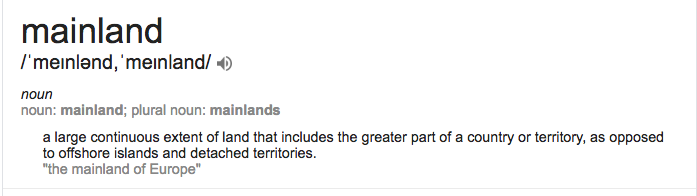
Here is what it means, specifically: 


Screen Shot 2019-03-01 at 2.45.50 AMScreen Shot 2019-03-01 at 2.46.01 AM


The clear connotation of “mainland” is that it is the main/continental part of a territory, and that outlying islands which are referred to in relation to it are also part of said territory.

By that metric, the only reason to use the phrase “Mainland China” in relation to Taiwan is if you want to imply that China and Taiwan have some sort of territorial relationship, or that Taiwan is a part of some larger concept of China. If you believe they are two sovereign or at least self-ruled entities, it makes no sense at all. In that sense, Taiwan does not have a mainland, unless you want to refer to “mainland Asia” (as Taiwan is a part of Asia, but not a part of the People's Republic of China).

Why then do people keep saying it? Partly it is force of habit. Pro-China types insist on it, and the media often follows. It is unclear how people came to believe the word was neutral or apolitical. It is not. It implies that there not only is but also should be a territorial relationship.

Even if you want to claim that, because the ROC officially calls itself 'China', it's acceptable to call the PRC "mainland China", I'd still challenge you on that. The ROC came to Taiwan from China and occupied it at the behest of the Allies in 1945 (there is no binding treaty that definitively cedes Taiwan to any government of "China"). Regardless, that government was not invited here by the Taiwanese people. They were never asked whether they wanted to be a part of the ROC, most don't identify primarily as Chinese now, and most don't support any sort of unification. If it could be done without any threat of 'retaliation' from China, the ROC would quite likely - though not definitely - be on its way out by now, if not entirely gone in favor of a Republic of Taiwan. Most Taiwanese refer to their home and country as Taiwan, not "the ROC".

If you refer to the island that people who don't identify as Chinese as something off the coast of "mainland China" (implying a territorial relationship they never agreed to), is that much different from telling people how they must identify? Are you not telling them "you think of these islands as your home country, but it's actually a piece of territory connected to a larger 'mainland', whether you like it or not"?

Some might say that omitting the word "mainland" and just using "China" and "Taiwan" is overtly nationalistic. But it isn't - it's just stating the truth as it is now. Taiwan exists, and it's not part of the country commonly referred to as "China", which as of right now is the People's Republic. It's the name of an island, and it's also what almost 24 million people call their country. It's not nationalistic to refer to a place people consider a country as a country, and a different place that they don't consider part of their country without any qualifying markers implying that it might be otherwise. 
Right now, there's a country called "China", and there's an island, which you can also call a country, called "Taiwan" with a different government than the one in "China". How is it 'nationalistic' to just say so? How is it not nationalistic to draw specific kind of connection between Taiwan and China by calling one the "mainland" of the other?

Simply using "China" and "Taiwan" is also the most open way to refer to these two places without closing off any future possibilities. "Mainland" implies that there ought to be some kind of future relationship in which the two places are connected. "China" and "Taiwan" are two existing places whose statuses may change in the future - referring to them as such doesn't cut off any potential outcomes. "Taiwan" and "Mainland China", however, does: it neuters the notion of Taiwanese independence in the present, by giving Taiwan a "mainland" that the Taiwanese never asked for. 


How political is “mainland”? It is required as a corresponding term to “Taiwan” in Xinhua’s style guide, a reflection of Chinese government policy. When you use it, you are quite literally referring to Taiwan-China relations exactly as the CCP wants you to. If you want to talk about Taiwan exactly the way the Chinese government prefers, by all means use “mainland”. But why would you?

Think of it this way: you may not necessarily default to Taiwanese independence as the only possible future for Taiwan. You may think the ROC is legitimate. I don't agree with you, but fine. These are valid (if flawed) opinions. Great news! You can still believe those things while calling China "China" and calling Taiwan "Taiwan", because a place exists called China, and another place exists called Taiwan! That terminology has room for your views while also making room for opinions which disagree with yours, whereas "Mainland China" does not. 

I know what you're thinking. But acktchuelly, you want to say, Taiwan's situation is diffrennnt than Cyprus or Okinawa! Yeah, sure, it is. Taiwan is in a unique position. But I do think they are comparable enough for this purpose: saying Turkey is the "mainland" of Cyprus makes a political statement about who you think should ultimately govern Cyprus: and unlike the PRC in Taiwan, Turkey actually already occupies part of that island. Saying "Taiwan and mainland China" similarly makes a political statement, implying that some government of China which includes the current China would be a more legitimate government than an autonomous, mainland-free Taiwan.

And sure, nobody reasonable disputes that Okinawa is, at least currently, Japanese territory. But then nobody reasonably thinks that Taiwan should be a part of the PRC, and nobody reasonably thinks that the ROC is going to "defeat the communists and take back the mainland". And the PRC has about as much right to claim Taiwan as it does to claim Okinawa - and they try to use historical arguments to justify both, even though the current government of China has never controlled either. And as far as I'm aware, just like the Taiwanese, neither the Cypriots nor the Okinawans want to be a part of Turkey or China, respectively.

So why would we all instinctively consider the use of "mainland" to be offensive in those situations or at least to be making political judgement calls we have no right to make, but not in the case of Taiwan? Is it a good idea to keep using the exact terminology that China wants us to use? Do we really want to keep being useful idiots?