|
| In both domestic and foreign labor, it's the women who are pushing the real changes |
In the span of a few short years, I've noticed something regarding labor actions in Taiwan: all of the most successful ones (as well as less successful but highly visible actions) have been organized and carried out by women.
The Taoyuan Flight Attendants' strike (which you might know of as the "China Airlines strike") of 2016, called “first successful strike held by an independent labor union in Taiwan’s history" by the union director has overall been upheld as an example of what organized labor can achieve if they persist. Of course, the flight attendants themselves - remember them, occupying the road around the China Airlines headquarters? - were predominantly female, as were the organizers and public faces of the movement (including the union director, Su Ying-jung).
The EVA Airlines strike, though less successful, garnered a high level of visibility, both domestically and internationally. Though they gained fewer concessions than the earlier flight attendants' strike, I do think it creased a sense that striking is a legitimate way to push for a better work environment rather than pushing "too far" and being taboo. Of course, most of the EVA strikers were also women.
There was also the China Airlines pilots' strike, which skewed more male (in Taiwan and globally, in the airline industry men are more likely to be pilots and women are more likely to be flight attendants. Someone's going to get mad at me for saying this, but the reason is sexism. But, it's not directly related to my point here.) The pilots' strike was also largely successful, but came on the heels of (and was perhaps spurred on or inspired by) the success of the flight attendants' strike. Other labor organizers have pointed to the China Airlines flight attendants' strike for giving their own initiatives more visibility.
 |
| China Airlines Flight Attendants' Strike, from Wikimedia Commons - you'll see both men and women engaging in the strike, but I can assure you that the organization and core of this action was predominantly female |
These strikes were historic in Taiwan, in part because there really hasn't been much in the way of labor movements or strike actions in the country since the 1990s. In the late 1980s and early 1990s, there was a strong uptick in the number of autonomous labor unions formed, in contrast to the old-style, often conservative, government-backed unions which were mostly formed to prevent organized labor from making significant ground or challenging KMT control of and profit from the island's most lucrative industries (there's a long history of state interference and personal and party benefit from industry in post-war Taiwan and of course the military dictatorship didn't want organized labor threatening their control, and most autonomous organizations of any kind were banned - labor, women's organizations, you name it). As Martial Law was lifted and Taiwan began the process of democratization, unions in general threw off the shackles of state or corporate control and protests, strikes and various labor actions did take place, but then the movement lost steam.
Around the same time, the Supreme Court upheld the ruling against RCA for exposing workers to toxic waste - especially carcinogenic solvents - causing high incidents of cancer among former employees. Though the RCA workers did not have all of their demands met, RCA was ordered to pay damages to afflicted former employees and their families. And, again, most of the workers involved and the people who organized to fight the lawsuit were women.
I have been looking into it and can't find a similar example of an organized group of male workers bringing a lawsuit against a former employer and winning in the way that the RCA workers did - if you know of one, please clue me in. There's a reason, however, that this case was considered historic.
While all this was going on, there has been exactly one large cross-industry labor protest of note, which took place in late 2017. Though many of the attendees were female, if you look at the photos, you'll see that huge blocs of industrial union participants were male (indeed, check out the photo of the Chunghwa Telecom Workers' Union from that link). The women I saw in attendance tended to be foreign domestic workers fighting to end their exclusion from many of Taiwan's labor protection laws, and young protesters showing up to represent a variety of related but not-quite-the-same causes, such as marriage equality and Taiwanese independence.
For a number of political reasons which are not quite relevant here, the usual activist groups and left-leaning political parties were largely absent in any organized form, though individuals from those movements did show up.
And that protest went exactly nowhere, and a lot of people felt tricked or misled by the organizers, myself included. To be honest, beyond the foreign labor groups and some of the individual young activists who showed up, the whole thing felt like conservative older men and some leftie labor activists who aren't exactly pro-Taiwan (some people call them 'pro-unification left') coming together to hold banners, and create a whole bunch of sound and fury, signifying nothing.
In short, it sure feels to me like the backbone of the labor movement in Taiwan is female. Not only that, but the future of labor movements in Taiwan are, as well. It's the women who fight back, the women who lead historic strikes, and the women who get results while the men hold signs and criticize President Tsai (but where were they when working conditions were degrading under President Ma? I remember no large labor protests from those eight years. Do you? Why, whatever could be the reason?) and nothing happens.
I've also noticed that the fact that women are leading the labor movement is simply ignored in media reporting of their success. New Bloom, which is usually quite good at highlighting issues of misogyny and gender/sex discrimination, called the China Airlines flight attendants' strike predominantly young, which is true (flight attendants in Asia skew young), but not predominantly female, although it was. They did point out that the EVA Airlines flight attendants were all female, in the context of EVA's frankly sexist and probably illegal hiring policy, but not in the context of women being the vanguard of contemporary labor movements. Taipei Times didn't bring up gender at all when discussing the flight attendants' strike or the RCA lawsuit.
 |
| EVA Airlines strike photo from CNA via Taiwan News |
Of course, it shouldn't matter, because labor is labor regardless of gender. But considering historic discrimination against women in labor around the world, including Taiwan, what is considered to be overall low labor participation by Taiwanese women (more on that later, though), and the overall tendency of small and medium-sized businesses to be represented by men (regardless of who is doing most of the work) and the painting of men, traditionally, as hard-working entrepreneurs but not women (see the male-oriented phrase 黑手變頭家 which lionizes male 'black-hand' laborers for becoming successful business owners)...it does matter. It has to matter. I hope for a world where someday it doesn't, but in 2019, it does.
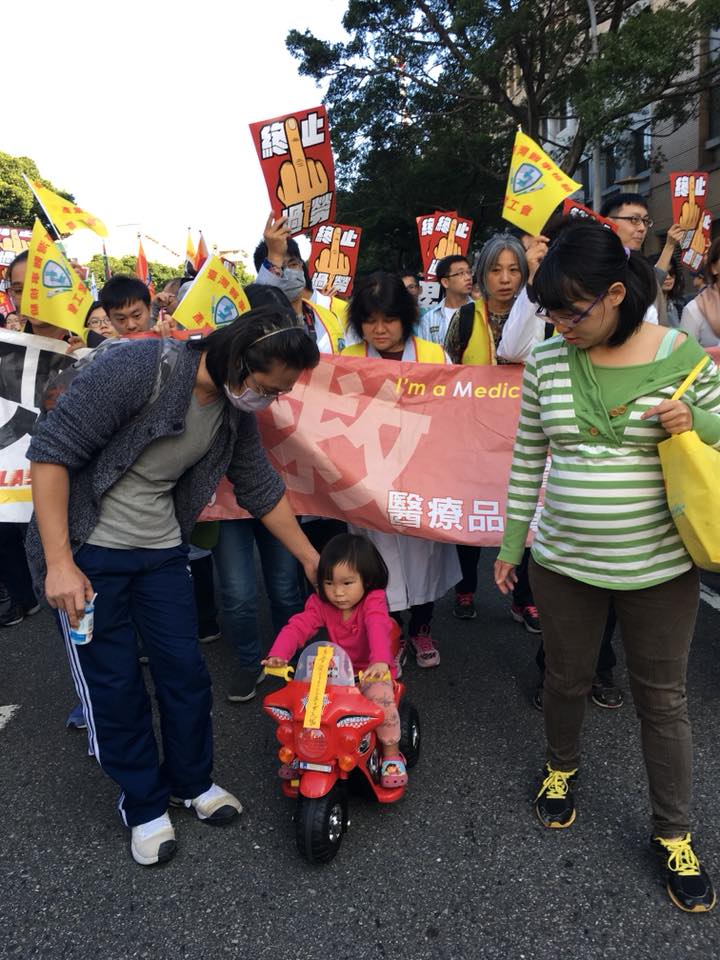 |
| One of the few examples of a group of women at the 2017 labor protest |
It truly feels like women are on the front lines and taking the initiative in a society that is still oriented to respect male labor but not female labor, and getting zero credit.
This invisibility of women as the backbone of labor in Taiwan has historical roots - at least, I think it does.
Looking at Taiwan's labor history, those post-war "home industries" and "home factories" where individuals did manufacturing piecework in their homes were often seen as a way for the women of a household - who, by the way, still had to do all the regular household labor - to help the family income. Men and young people engaged in this work as well: I remember a student who'd reached an extremely high perch in an internationally-known Taiwanese company telling me about pressing plastic leaves for fake flowers with one hand while studying with a book in his other hand, because his father's income as a bus driver wasn't sufficient to support the family. But, so often, it was "housewives" who did this work.
When factories - both large and small - drove Taiwan's industrial miracle, they often looked to women as sources of labor. This was in part because they could pay them less, and in part because they expected the women to leave their jobs as soon as they married and (probably) got pregnant, meaning they wouldn't have to worry about things like severance pay or a retirement pension as they would with long-term male workers. For the smaller factories, men were often the sales and public face of the company, but women did a huge proportion of the actual manufacturing. These factories and industries were seen as 'male' - all those 'black hand' laborers working their way up in the world - but they weren't, really.
When 'family businesses' became part of the small-and-medium sized enterprise boom that helped make the Taiwan Miracle possible, who do you think in the family did all the back-end work? The 'man' (usually a husband or father in the family) would be the public face of the company, but the person keeping the books, taking stock, perhaps doing a large proportion of the actual work, and often making important business decisions was that man's wife. Mr. Chen might be the 老闆 (boss) with his own business card, but Chen Tai-tai - the 老闆娘 - is the real boss. If you want something done, don't talk to Mr. Chen - talk to his wife. Of course, she does all that and also all of the housework and child-rearing, but probably doesn't have a business card.
I say all of this anecdotally, but I've brought up my observation to countless Taiwanese friends and students and not one has disagreed, and while none of my reading states this explicitly, it's strongly implied in several of my sources.
And yet, when one reads about society in the Taiwan Miracle (there's even a book called State and Society in the Taiwan Miracle, which mentions 'businessmen' but generally not the women who actually did a great deal of the work), rarely are women's contributions to this miracle acknowledged, and they're certainly not given credit for being the backbone of this miracle, which I absolutely believe they are.
I've seen this play out in my social circle as well. One of my best friend's parents run a small business in Taiwan, and until recent years my friend's father was the 'face' of that company (though her mother also did a huge amount of the work). Recently, my friend has taken over a lot of the operations and she does get credit as the 'public face' of her family's business, but that's a modern development. But, remember a few paragraphs ago when I touched on "low labor participation" of Taiwanese women? This friend of mine doesn't draw an official salary. As far as I'm aware her job isn't official at all. While she is absolutely employed, I'm not at all sure that the government considers her as 'part of the labor force' (I don't know how they arrive at those statistics). I get the feeling that a lot of wives and daughters do in fact participate in labor outside the home, but aren't counted because it's all informal.
Informality is quite possibly a key, in fact, to why Taiwanese women get so little credit when they deserve so much. Taiwanese labor contracts - if there's a contract at all, which there often isn't in the case of family - in these small businesses are often extremely informal, looking more like agreements between relatives, neighbors or friends than formal work contracts (that's backed up by academic research, not just an observation). I count women's labor for a family business to be labor 'outside the home', though often it takes place literally inside the home (the home often doubling as an office for the family business, or being physically connected to it, in the case of family factories). Families themselves might consider this work to not be labor in a workplace but rather just..women's work that women do for the family, at home.
How much of the labor of women is simply not counted because of this?
To drive home my point, I want to leave you with a story that goes further back in Taiwanese history. In her excellent book, Anru Lee narrates how textile production was banned under Japanese colonial rule, when economic policy was essentially mercantilist (foodstuffs such as rice and sugar would go to Japan, finished goods would come from Japan to be sold in Taiwan). But cloth was scarce, especially during the war, and there was profit to be made in weaving and selling it - so families, often women, would do so. Raw cotton had to be imported and wasn't available to these women, so they'd use cotton from old clothing and household products. Then they'd use their recycled-material cloth to swaddle and carry their babies in public, where they could then sell that cloth without being noticed (women were also considered less likely by the Japanese authorities to break the law, so they wouldn't come under as much scrutiny). In this way, women contributed economically to their households, and did so entirely under the radar.
And it seems women in Taiwanese labor are still under the radar, even when they take to the streets.
* * *
A few sources for this piece which I didn't explicitly mention (and are in print so can't be linked) but deserve credit:
In The Name of Harmony and Prosperity: Labor and Gender Politics in Taiwan's Economic Restructuring by Anru Lee
Women's Movements in Twentieth-Century Taiwan by Doris T. Chang
The Trade Union Movement in Ma's Taiwan by Yu-bin Chiu and Uneasy Alliance: State feminism and the conservative government in Taiwan by Huang Chang-ling, both in Taiwan's Social Movements Under Ma Ying-jeou, edited by Dafydd Fell.