Thursday, December 12, 2019

The KMT desperately wants to be rubber to the DPP's glue, but it's not working

IMG_2834


To be frank, I don't really want to write about the KMT. I'd rather talk about the re-election campaign of President Tsai and what she's doing on that front. Sadly, other than a new song (which isn't bad as Taiwanese campaign songs go and intentionally references the band's 2014 hit inspired by the Sunflower Movement, Island Sunrise), some bomber jackets and holding the line she's taken since 2016, there isn't much to say on that front. She hasn't come out with any exciting policy proposals or new platforms that I've seen. "Hold the line and take no risks" seems to be her entire campaign strategy. Frankly, while I'd like to hear more from her about what she'll do once re-elected, this isn't a bad tactic, even though it doesn't give me much blog fodder.

So, instead let's talk about the way the KMT is trying ever so hard to turn the Su Chii-cherng fake news/suicide case into a big scandal for the DPP, and why it probably won't work. Sigh.

For those who don't know what this is about, here's a rundown of events, mostly from this source. It's long and involved, so feel free to skip anything you already know - I'm putting the whole story here because  it's one of the advantages of blogging that I can go long-form if I want and tell a fuller story. I'll put the whole thing in a different color so you'll clearly see where I pick up with commentary.


* * * 

Last year, posts on PTT insinuated that the Taipei Economic and Cultural Office in Osaka (Taiwan's de facto embassy) wasn't providing sufficient assistance to Taiwanese nationals in Japan affected by Typhoon Jebi, in contrast to the assistance that China was giving its citizens. New Bloom reports that the Chinese consulate 'stepped in' to help Taiwanese nationals; other news sources say that the inadequate response of Taiwan was merely contrasted poorly with that of China. The News Lens reports that some Taiwanese apparently feigned Chinese nationality to gain assistance from the Chinese consulate. I'm not sure which version is more accurate.

It doesn't matter much, the truth is that the Japanese government arranged all evacuation assistance, and rejected China's request to send in buses to aid its citizens (although representatives of one Chinese airline filled at least one bus with only Chinese nationals). The Chinese consulate reported falsely that they had arranged transport and food for their citizens and were willing to include Taiwanese citizens who "identified as Chinese" (according to an interview with a Chinese traveler). Global Times, a WeChat post and other Chinese media spread this story.

It was then picked up by Taiwanese social media, where the Taiwanese consulate was criticized for not doing enough for its own citizens, to the point that some pretended to be Chinese. Criticism at first focused on Taiwanese envoy to Japan and 2008 presidential candidate Frank Hsieh (謝長廷), who tried to explain the situation but whose statement didn't get much traction on social media.

This criticism morphed into defending Hsieh and placing the blame on the head of the Osaka consulate, Su Chii-cherng (蘇啟誠). Remember, of course, that Su hadn't done anything wrong, as the entire story was fake to begin with. Su committed suicide soon after. It's difficult to say if the fake news blizzard precipitated his suicide, but an investigation was formed (despite the KMT insisting that the DPP and Ministry of Foreign Affairs were "not interested in investigating" the event), and online personality Slow Yang (楊蕙如) was indicted for not only public insult and hiring someone to post disinformation, but for those posts leading to Su's death. Su's widow says the criticism and his suicide are related, although his suicide note did not specifically mention the incident.

Despite Su's family and some media reporting that the government was going to reprimand and demote Su, MoFA says it had no plans to do so.

The person Yang was indicted for hiring was Tsai Fu-ming (蔡福明), although it's not quite clear who made what posts, and I'm not sure it matters much. Yang had previously been close to the DPP and Frank Hsieh in particular, having previously worked for his election campaign. There's also a furor over a company she owns being paid by the Taipei City government - money she was awarded thanks to her ties to DPP and specifically Frank Hsieh-tied city councilors. Suffice it to say, the DPP and Yang have had ties in the past.

Yang is well-known in Taiwan, as an online personality, mostly on PTT. Her reputation, however, is not great - I've talked to a few people about this and the general consensus is that she's always been an opportunist and purveyor of questionable content.

KMT politicians pounced on this, insisting that Yang was a paid troll-master of the DPP who was tasked with spreading fake news and that the accounts used to spread fake news can be traced back to her, as well as to a DPP legislator's office. I'm not quite clear on who is alleging what, but it seems that the Taipei District Prosecutor's Office is indicting Yang for her role in creating these posts, whether by her or by the online troll she allegedly hired, with the KMT embellishing the story by insisting that the DPP was ultimately funding the whole thing.

Last week, KMT politicians held a protest outside the Ministry of Foreign Affairs (MoFA) shouting "MoFA kills people!" and insisting that Frank Hsieh and Foreign Minister Joseph Wu both "offer an explanation" and resign. A scuffle ensued, with the KMT lawmakers insisting they were injured due to rough treatment by the police. Video later surfaced of legislator Arthur Chen of knocking off an officer's cap before pushing her. Two other politicians, Chen Yu-jen and Lin Yi-hua (Lin happens to be running for Chiang Nai-hsin's old legislative seat in my district and is something of a rising star in the KMT) got their fingers caught in a door or gate, and Chen apparently fainted. Both went to National Taiwan University Hospital (NTUH) emergency room for treatment.

Their seemingly (ok, definitely) exaggerated reactions, and those of KMT figures insisting they'd been seriously injured, garnered much online mockery - with Han Kuo-yu and other KMTers visiting Chen in the hospital, video of Chen walking slowly out of the hospital as though dazed some time later, as well as Lin Yi-hua insisting she'd been badly hurt and required hospitalization (and apparently limping pathetically and lying on a stretcher like a trauma victim long after the fact - when the worst of their injuries was getting their fingers caught in a door). 


NTUH was accused by some of giving priority in the queue to politicians (which they denied), and the politicians themselves were accused of abusing national healthcare resources.

DPP legislator Wang Ting-yu then released a video showing at least one person - seemingly Chen though I can't tell, personally - deliberately sticking their fingers in the door at MoFA. MoFA has since filed a complaint against the KMT legislators


* * *


tl;dr:

The KMT is screaming about DPP paying "online armies" to spread fake news and then being injured by police when protesting at MoFA, despite there being not much evidence that the DPP was behind the posts, and video clearly showing that the KMT politicians at MoFA were acting aggressively and more than likely exaggerating their injuries.

Got all that?

Great. 


* * *

What strikes me about this whole story is how clearly desperate it is on the part of the KMT.

While it makes sense that the Chinese consulate would spread fake news and Chinese media would pick it up - after all, that's what the Chinese government does - it doesn't make a lot of sense that the DPP would pay someone to spread that news in Taiwan, and then make posts defending Frank Hsieh and criticizing Su under the assumption that the fake news was accurate. 


It doesn't even make sense that the DPP or Hsieh would pay online 'armies' to defend them in this fashion from fake news spread by others, when Hsieh had already released a statement clarifying that the entire story was false. Neither the DPP nor Hsieh are perfect, and they do make PR mistakes, but it doesn't take a tactical genius to see that the truth of the matter would have come out soon enough and if anything, it would just make China look bad, which is always good for the DPP. It should be obvious that adding another layer of fake news to existing fake news is a bad idea.

I also have it on reasonably good authority (not firsthand, but a source I trust anyhow - make of that what you will) that if anyone paid Slow Yang for these alleged actions - which someone or some entity probably did - it wasn't the DPP or Frank Hsieh. You don't have to believe me as it's third- or fourth-hand gossip by now, but I want to put it out there anyway.


Then there's the absurdity of being so outraged by so little proof - it seems likely to me that Yang did do what she's been accused of, although that's just an opinion, but there's almost nothing there to definitively link the DPP to her actions. There's a story concocted out of disparate threads that doesn't make a lot of sense when you put it together, a few old relationships between a person of questionable morals and some DPP figures, and assumptions made based on online behavior that all political parties engage in, and it's become a full-blown conspiracy theory. 


And, of course, there's the conflating of Su's suicide ostensibly being due to facing "humiliation" and a demotion at work, and being humiliated by social media posts. Those are not the same thing at all and although the indictment indicates that the prosecutor's office believe the posts played a role, it's not at all clear from KMT accusations that that's the case. 

The KMT is implicated in a much more thoroughly substantiated allegation of fake news and disinformation linked to Chinese interference online and in the media, with the Association of Taiwan Journalists, the National Security Bureau, foreign analysts and more weighing in. Remember, pretty much every Taiwanese media source accused, with proof, of receiving money from the CCP is tied to the KMT. Every time money finds its way from China to Taiwanese political figures, it's the KMT that's implicated. Every time China spreads disinformation, it favors the KMT.

Considering that, it's a bit rich for them to accuse the DPP of doing the same thing, but with far less evidence to back up their claims.

Or rather, it makes perfect sense, if they want to deflect people's attention from their own disinformation, including blatant untruths spoken by their own presidential candidate.

The KMT's authoritarian roots and the DPP's more activist roots also come into play. It's not just DPP tactics that make them look like the party that's friendlier to activists - they actually are. As a result, they tend to be known for passionate rallies and protests. Having never held full power (both the executive and legislative branches) before 2016, they were usually the ones banging on the doors to the halls of power - halls usually occupied, until recently, by denizens of the KMT.

The KMT has repeatedly tried to harness that same social movement and activist energy, and mostly failing, because it's simply not in their party's roots or ethos. From astroturfed "social movements" and faux protests right up to this spectacle, they've never been victims and so they suck at playing the part.

Let's not forget that it was the KMT who routinely brutalized democracy activists (the people who went on to found the DPP) and who caused real injury to social movement activists just in the past few years - those water cannons, the police beating students with clubs? That was on the orders of a KMT administration. People involved in the democratization movement ended up injured, in jail or dead. The perpetrators of the White Terror? The KMT.

So when they want to claim the same 'cred', and try to turn it around and scream that now that the DPP is in power they are engaging in the same tactics, the best they can do is stage a whole long-winded spectacle around a few minor injuries - injuries that the people involved managed to help inflict on themselves, looking at the video. It's just another way that the KMT takes proven or well-founded accusations against themselves and tries to say it's the DPP who are really doing those things, à la the "Green Terror".

But, as the old rejoinder goes, if there's really a Green Terror, where are the bodies? Where are the missing people and where is the extensive network of shadowy military prisons?

The KMT may desperately wish that they were rubber and the DPP glue - and whatever you say bounces off of me and sticks to you - but they're not. They keep chucking things off of rubber and watching them boomerang right back on them. (Also I think Ma Ying-jeou might literally be made of glue - he has the right personality and just looks so melty.)

In other words, if you want to know what the KMT has been up to, looking at what they accuse the DPP of doing is a good place to start. 

Monday, December 2, 2019

It's not independence that is "hopeless", it's unification: like many, Terry Gou is answering the wrong question

Untitled
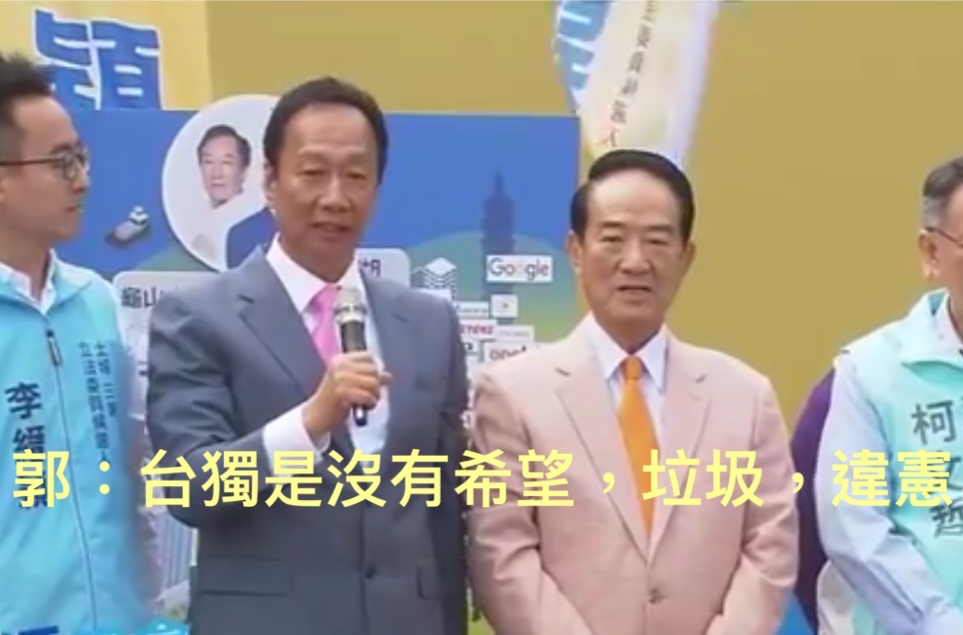
Screenshot from NowNews video with subtitles added

Let me start this by saying I don't care about Terry Gou. He's just some rich guy, he'll never be president. While he's obviously got business acumen, he's foolish to think that running a country is similar to running a business. I've never forgiven him for saying "you can't eat democracy" as a way of saying he thought money was more important than freedom (and therefore unification would be potentially acceptable), and I have a whole host of new reasons to renew my dislike.

However, please allow me, after saying "I don't care about Terry Gou", to write a lot about my opinion on Terry Gou. Or rather, his views on Taiwanese independence.

The other day, at a rally for some other guy, Gou appeared alongside that candidate, James Soong and Ko Wen-je for a whole lineup of people I don't care about. Around the 19-minute mark of this video, Gou said:

搞台獨都是垃圾...台獨沒有希望、垃圾、違憲 
Translation: "All Taiwan independence supporters are garbage...Taiwan independence is hopeless, trash and unconstitutional!" 

Notably, he tried to make it sound as though he was just repeating and agreeing with something he insists Ko Wen-je said. Ko denied this, saying that he said some independence supporters are scammers and liars, but not all of them, and he respects people who sincerely believe in it.

I'm not sure what that's supposed to mean, because people who actively but insincerely support Taiwanese independence are not a thing. I suppose he is trying to create a distinction between people who care about Taiwan independence, and those who only say so to get votes but again - not a thing. It's the other side of that which is true: people who have said they oppose unification, but actually don't, or quietly support it (see: Ma Ying-jeou).

The pan-blue/red and the pan-green media have all covered this, mostly from the "Ko said that wasn't what he meant" angle, which really isn't the story here. It doesn't matter who said it first. That it was said at all is the problem. UDN (pan-blue) notably focused on "Taiwan independence is hopeless, garbage and unconstitutional" - the sort of thing their readers might agree with even if they'd blanche at calling people they disagree with "garbage". Pan-green media focused on "Taiwan independence supporters are all garbage", because that's more of an offensive slur against actual people than merely a stupid opinion on an issue. Rest assured, dear readers, he said both. And both are awful. 


That's not all Gou said, but I'll get to his other stand-out remark later.

First, I'd like to tell you why I'm writing about Gou when I do not care about him. It's because his dumb remarks give me a good 'in' to make a point that's been clonking around in my head for months now.

And that is this: when we talk about whether Taiwanese (or Hong Kong) independence is possible or hopeless, most people are asking the wrong question.

They ask (and answer) "how could Taiwan (or Hong Kong) possibly gain independence? China would never allow it for Hong Kong, and never allow recognition of it for Taiwan! It's impossible! China's too big, too strong!


But what they really should ask themselves first is this:

"How could Taiwan and Hong Kong possibly become a part of China?"

Especially as it exists now, what would it take for such an annexation/integration to be successful?

It would require Taiwanese and Hong Kongers to willingly give up their rights and freedoms and submit to authoritarian Chinese rule. It would require this even though people from both places have seen the way that China treats its own citizens - that is, not well at all.

It would therefore entail people from these places not only agreeing that it's acceptable to be 'a part of China', but to actually think of themselves as Chinese. Hong Kongers no longer believe the former, in large part, and are slowly moving away from the latter (considering how common it is now to refer to themselves as "Hong Kongers" rather than as "Chinese"). Taiwanese haven't believed either for quite some time.

How would Taiwanese (and Hong Kongers) ever come to believe and willingly submit to these things? What would it take to accomplish that?

The answer is that there is no way to accomplish that. There is no way to peacefully and straightforwardly convince Taiwan (or Hong Kong) to unify. The only option is violent annexation following underhanded attacks on democratic norms.

Taiwanese are already soured - probably permanently - on the notion of being a part of China. The youth are soured on considering themselves Chinese in any sense. Hong Kong is quickly moving in that direction, which I would argue was an inevitable development given what China is like.

By starting with the wrong question, unificationists like Gou - and yes, he is a unificationist - delude themselves into believing that unification could possibly be peaceful, that a general pro-China consensus will ensure that it's not necessary for the PLA to come in and start shooting at Taiwanese, and therefore that this outcome is better than the threat of war under continued independence.

That's not what will happen, though, because there won't be a general pro-China consensus. Ever. Unification will not make the differences in culture, belief systems and society between Taiwan and China go away. The only option left is prolonged Hong Kong-like guerilla warfare - and that won't drive Taiwanese to change their minds, either. If anything, it'll only harden them against China even more.

And that way - the only way one can conceive of working - simply is not going to happen. Rather than "accept unification or it's war", it's time we accepted the real truth: "the only choices are independence, or war".

So when Terry Gou says "Taiwan independence is hopeless", what is that supposed to mean? What does he expect to happen instead? It's unification that is hopeless. How would it even work? Why do people - Gou included - allow the assumption that unification is possible to pass unquestioned, but not the assumption that independence is possible?

Most likely, if asked, he would point to the "status quo" - the ROC not claiming independence but resisting unification - as others have done. That's surely what he meant when he called independence "unconstitutional" (which is true, I suppose, but absent a threat from China, the constitution can be changed.) He doesn't seem to realize that the status quo is independence, as much as he'd like to pretend that's not the case.

Gou and others might want us to believe that 'Taiwan independence' is a terrifying unknown thing, whereas the status quo is safe, secure and known. But a version of Taiwan independence already exists - the mirage of danger is created and maintained by Chinese threats, not any lived reality. And the status quo, insofar as it is different from independence (which it isn't in any practical way) is not particularly safe.

Of course, the status quo is not tenable. China has made it clear that they do not intend to allow it to continue forever, and it's time we paid attention. It's just not smart to assume they are bluffing because that's the easier truth to swallow - when someone tells you who they are, believe them.

The longer it is prolonged, the longer China has the time to build up its military, poach diplomatic relations, throw out debt traps and economic dependencies to make the rest of the world beholden to its agenda. And the longer it is prolonged, the more Taiwanese (and Hong Kongers) will resist the idea, as they have done and will do.

Of course, I won't even entertain the notion that a unified China under the ROC is possible. Why not? Because hahaahhahahahahahaha.

So stop asking whether independence is, as Gou said, "hopeless" and "trash". Ask instead whether unification is hopeless. You'll find that it is.

UDN also pointed out that Gou said this:

第三勢力不容忍台獨、反對台獨。 
The Third Force doesn't tolerate Taiwan independence, it opposes Taiwan independence.

That's interesting, I guess. I mean, the Third Force has, since the term came into being, referred to the left-of-the-DPP folks who considered themselves "colorless" (but, in truth, were always broadly pan-green). Other than their generally socially liberal political views and activist roots, one of the things that binds them together is a support for Taiwan independence.

Now, it seems that people like Gou, Ko Wen-je and his new ego-machine and the PFP/James Soong people are trying to appropriate the term for themselves. That's a joke - the term already refers to a group of people and they can't be silenced. These guys aren't colorless, either. They are broadly pan-blue and always have been. Let's not forget that in the past year or so, Ko has consistently attacked the DPP and been supportive-ish of the KMT. James Soong was the guy behind a lot of censorship and colonial-mentality policies from the authoritarian era, when he ran the Government Information Office. Gou very recently tried to win the KMT nomination and is sucking sour grapes because he lost spectacularly. 


In other words, these guys absolutely have a color. The real Third Force has engaged in a very long internal debate on whether they are "little greens" or exist independently of the pan-green camp, instead holding the DPP accountable. It seems clear that most of them have decided that they are little greens for the purposes of the presidential election, for now, because Han and the KMT are a greater threat to Taiwan than the DPP having no meaningful opposition from the left. This is right, as it puts the country first. If Huang Kuo-chang wants to sulk in the corner about it, that shows how self-serving he's always been. 


Ko, Soong, Gou and their various party affiliations and hangers-on - are not even trying to engage in that debate. They are acting blue while calling themselves "colorless" and "the Third Force". It's just another iteration of the pan-blue camp calling DPP and pan-green ideas "ideological" and their lawmakers as "doing ideology", while pretending their side is neutral and ideology-free (of course, it isn't. No side is.)

It's also vaguely interesting to me, watching the NowNews video linked above, that whenever they need to drum up sentimental support, these guys pivot from "independence is trash" and "the ROC" to "Taiwan", with Ko Wen-je saying "give Taiwan a chance!" and the resulting chant focusing on Taiwan, not 'the ROC'. It's almost as if - and stop me if I sound insane here - that they know that voters have a stronger attachment to the concept of 'Taiwan' (their island) than 'the ROC' (a foreign government which claims sovereignty). It's like they're aware that when people conceptualize their country, in their minds that country is Taiwan.
So despite being anti-Taiwan/pro-China in platforms and rhetoric, they're quite willing to hypocritically call on that sentiment when it suits them.

Never fear, the actual Third Force, like most Taiwanese, prefer independence or the closest thing to it. These folks are an entirely different ideological force, and are likely to remain a sidelined one.

Why? Because they're asking and answering the wrong questions. And who will vote for you when you can't even ask the right question, let alone answer it?

Sunday, December 1, 2019

What does Han Kuo-yu's strategic baby tantrum tell us?

IMG_5001
The speech bubble says: "I'm 200 times bigger than a standard jelly baby!"

Recently presidential candidate and Kobitos peach Han Kuo-yu likened looking at poll results to 'getting hemorrhoids' and then said that his supporters should stop participating in them (or lie and say they supported Tsai Ing-wen).

I'm not even going to bother going into how childish this is - basically the equivalent of "I'm taking my ball and GOING HOME!", showing what a big fat man-baby Han is deep down - because I think there's more going on there.


Screen Shot 2019-12-01 at 12.05.39 PM


Frozen Garlic already covered this pretty well, pointing out that other KMT candidates might not be so pleased about it, which indicates it was more of him mouthing off than a KMT-planned strategy, which implies that rifts within the KMT are not only deep, but that the cracks spread rather wide. Perhaps wider than the general public is aware of.

His mouth-off might have been strategic or intentional, or not. There is a childish logic to deciding that you're going to try to remove a thing that's not working out for you, rather than dealing with it.  It almost doesn't matter; when commentators liken him to Donald Trump, this is the sort of thing they mean. "The rules aren't working for me, so I'm not just going to throw out the playbook, I'm going to crap all over it so nobody else can use it either!" is extremely Trumpian. And remember, Trump won. It's not a crazy tactic to try and basically neuter a problem plaguing one's campaign, in this case, poor polling results.

But something else struck me while chatting about it with a friend late the other night. This is a bully's move, not the move of someone hoping to attract more supporters. This is what you do when you think you've got everyone on your side that you are going to get, and all you can do from here is try not to lose any more points, and hope for an upset or technicality that gets you in (you know, like Trump).

Voters who are still on the fence between "obvious hotheaded puppet of Beijing" and "cautious person who has run the country competently for four years" aren't going to think "well, Tsai has stood up to China really well, but you know, I like that Han Kuo-yu just sort of gave his finger to the entire concept of data collection. I think I'll vote for him!" This is the sort of thing that riles up an angry base, but does not necessarily expand it.

What we can deduce, then, is that Han has decided to play a bully's game rather than use poll results to try and hone his message and grab more voters who may not love Tsai and are still open to voting for the KMT. He knows he won't be able to. We can also see how little he actually cares about carefully targeted messaging (though to be honest, I think we already knew that).

Interestingly, though, for a man who claims to speak for the people, he doesn't seem very interested in what the people are actually saying when they respond to those polls! Could it be - that he doesn't actually care and thinks swagger alone could help him win? Call me crazy.

But when those polls are conducted - and they surely will go forward - we'll be able to gauge to some rough degree whether Han's supporters are actually listening to him. By that measure, we might have a stronger idea of how many of them are strong supporters and how many are just voting for him because he's KMT and they'd vote for a paper bag if it had a white sun drawn on it, but won't necessarily voice automatic agreement with everything he says.

His tantrum was reminiscent to me of the time he said he didn't want the votes of Taiwan independence supporters, telling them to "vote for Tsai!" An odd strategy, as most Taiwanese support some form of independence, or at least they don't support unification of any kind, ever. 

It's also odd as, in the past, the KMT has at least pretended to want to court independence supporters (not trying that hard, knowing they'd never get the hardcore folks, but trying to get the so-called 'centrists' who might buy a line like 'no independence, no unification, no war', a saying of Ma Ying-jeou's during his own campaign and administration). However, that doesn't seem to have been just an outburst of Han's, as around the same time the KMT started testing out the idea of promoting a "cross-strait peace agreement" (tantamount to some form of unification), and Ma himself changed his tune to "no independence, no war, don't reject unification".

That doesn't seem to have worked, as his poll numbers have been slipping ever since. Hence his latest screamer.

I suppose I could say more about this, but you know what? It's a beautiful Sunday and I could be not doing that.