Note: I'm super busy this month working on my final pre-dissertation paper for school, and it's a big one. So, Lao Ren Cha is going to be a bit quiet in November. Thanks for understanding!
I know that a huge part of the problem for pro-marriage equality advocates in Taiwan is funding: despite having fairly broad public support, they don't have a lot of money. Anti-equality hardliners, on the other hand, are pretty flush thanks to church donation networks (and international help from anti-equality religious groups, mostly from the US).
But, I have to say, I haven't seen much aggressive fundraising let alone the issue I tackle in my latest for Ketagalan Media: the fact that the bad guys are out-organizing us. They have more people on the streets, more fliers, more Line group invasive posting, more ads, more banners.
Banners and fliers cost money, and so do vests for volunteers if you want them. Ads are expensive. I get it - but I haven't seen much crowdfunding either.
You know what's free, though? Talking to people. Volunteers. Engaging in conversations in Line groups (if only to get the haters to keep quiet). Putting up designs drawn by volunteers for people to download and print out to make their own posters, placards and stickers.
In any case, in this piece I talk about the out-organization and how it makes it look as though pro-equality advocates are not standing up and getting votes for the upcoming referendum. I also cover the constitutionality of the anti-equality referendums and what the strategy might be behind them.
There's more to be said: the outright lies from the anti-equality camp, the attempt to rig the televised debates. I'm sure there will be more to talk about as the month goes on.

Monday, November 5, 2018


Wednesday, October 31, 2018
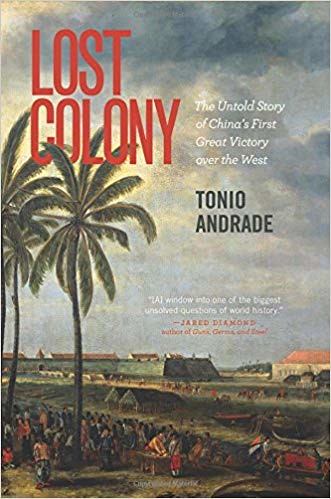
Come for the nudity, stay for the underpants: a book review of Lost Colony
 |
| Come for the nudity. Stay for the underpants. |
Drunken German traitors. Bum-waving Swiss farmers releasing streams of foul expletives. A missionary in dirty underpants. Naked swimmers, a Chinese general who (probably) had syphilis, slaps, mad rages, racist colonial caricatures getting all up in each others' grills, a two-timing translator/con-man, fire ships and booby traps (no actual boobies it seems, though). A war whose outcome may have been decided on the relative discipline and adaptability of each side's leaders, or on what technology and food supplies they had...or maybe it was just the weather.
These are the colorful details that illustrate Tonio Andrade's meticulous historical account of the defeat of the Dutch colony in Formosa by another kind of colonizer - Zheng Chenggong (Koxinga). Well, sort of - calling it "a meticulous historical account" is actually doing Lost Colony a disservice, although it could easily pass muster as an assigned text in an academic setting. It's also a rollicking good read.
Don't let that lull you into a belief that it's a light read, though. The book explores some heavy themes, ultimately challenging the old and, to be frank, kind of racist assertion that Western colonial powers won wars because they were more disciplined or had a technological or perhaps tactical edge. (Andrade doesn't call it racist; I'm calling it racist.) The central question is worth asking: if Western powers really had all of these advantages, and that's why they conquered so much of the world, how is it that they lost Taiwan?
Through the story, Andrade discusses and compares the relative merits of Dutch and Chinese warships, military technology (including artillery, weaponry and fortifications) and military strategy. He discusses the evolution of those ships, too, based on weather conditions sailing in the Atlantic and around Africa as opposed to Asia, with its monsoons. Don't think this means that Lost Colony is a boring military history though. It's got military elements - it kind of has to - but they don't slow down the story. Hell, I loved this book, and I'm just not that into military history.
This isn't because I'm a girl who doesn't like Big Manly Weapons because they're So Big and Manly, by the way. I grew up around guns and books on military history and have a healthy respect for firepower used intelligently.
Naw, it's because I'd rather we didn't need militaries at all. Too bad we don't live in that world. Anyway.
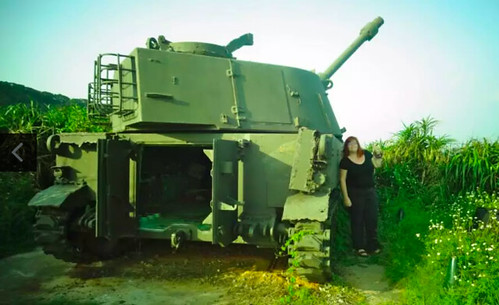 |
| I like...big...guns and I cannot lie (me & a howitzer from our trip to the Matsu islands) |
It's no wonder that writer Joyce Bergvelt chose to novelize it in Lord of Formosa (although Lost Colony was not available to her as a source when she did). I called that fictionalized account "cinematic in scope", and frankly, for a work of non-fiction, so is Lost Colony. Count me among those who say that this story should be made into a film as a way of exporting Taiwanese soft power abroad.
That's all well and good, you're saying, and I love a good story about conniving translator-businessmen and foul-mouthed bum-slappers, but how is historical account about something that happened in the 1600s relevant to my life?
Well, it's a well-worn adage among those who know Taiwan that the coming-to-Taiwan stories of Koxinga and Chiang Kai-shek share many parallels, which invites consideration of the present day seeing as the Republic of China has still unfortunately not given way to the Republic of Taiwan. I'm not going to talk about that, though, because everyone does. I'm more interested in how Andrade's telling of what happened when the military apparatus of a Western country met an Eastern one, and what that has to tell us about Taiwan's biggest foe.
The Art of War figures heavily in the narrative as well - and in fact, when hearing about the various axioms Koxinga was known to employ in practice, I could not help but think of the current tactics of the Chinese Communist Party in trying to convince the West that it is not an ideological foe - when it absolutely is - and bring Taiwan to heel.
By the time I got to the end, Andrade seemed to agree with me:
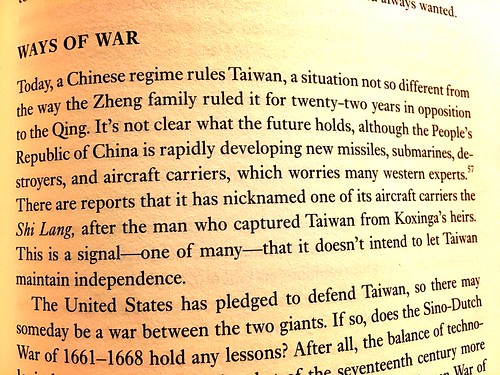 |
| "Today, a Chinese regime rules Taiwan"...I think I officially have an intellectual crush on Tonio Andrade. Freddy's still my guy in the end, though. |
After all, as Andrade notes, just because we think the West as a military advantage over China in terms of both technology and numbers - the US spends several times more on its military than China does - that doesn't necessarily mean we will win a potential future war. Frederick Coyet (the last colonial governor of Dutch Formosa who lost the war with Koxinga) had plenty of advantages - Renaissance fort architecture, big ships carrying heavy artillery that could sail at a closer tack against the wind than Chinese war junks, a potential alliance with Koxinga's enemy, the nascent Qing dynasty, and advice from Chinese defectors. For several potential reasons explored in the book, including a false belief in the superior discipline of his troops and his failure to listen and adapt, he lost anyway. We might too, and it's more than just Taiwan at stake.
Lost Colony tells its story with a remarkably clear-eyed look on the past. In much of Taiwan and parts of China, when Koxinga's conquest of Taiwan is discussed, there's an undertow of a sort of ethnic pride that one of their own (I suppose) kicked out the red-haired foreign colonizers.
The Dutch are no longer hated in Taiwan, per se - their colonial rule was so short-lived, involved such a small slice of Taiwan, and happened so long ago that it would be odd if they were - but Koxinga is seen by many as a hero. To be frank, it's a way of thinking I also find common to the Western left: of course someone like Koxinga would be the "good guy", relatively speaking. He was Chinese, Taiwan is Chinese (it's in Asia, anyway - same diff to a lot of Westerners), and Western imperialists were, and are, evil.
Western imperialism was and is evil, of course. Imperialism sucks. But this doesn't make Koxinga a comparatively "good guy" or a "hero". He was a warlord too - a colorful, brilliant warlord, to be sure - but still a conquering colonizer. The Chinese in Taiwan at the time were immigrants, not native inhabitants, and Taiwan subsequently became a settler state. Of course, your average Westerner probably has no idea who Koxinga was, but the big-picture implications of this kind of thinking are troublesome. Andrade understands this, I wish more Westerners (and Asians) did, too. He tells the story without picking sides. He made a case that we shouldn't dismiss the history of Asian military technology, training and strategy, while pointing out objectively who seemed to have advantages in what areas.
Andrade ends on an ominous note: the seventeenth century, when all of this took place, was one of the most tumultuous in human history, in part because of a spate of climate change that started wars, decimated populations and caused governments to be overthrown.
The climate change facing us in the twenty-first century, he notes, is likely to be several orders of magnitude worse than that. How will we face it?
Don't let all that doom-and-gloom scare you off, though.
There's also the aforementioned cursing Swiss bum-shakers, drunkenness, nudity, a fair number of references to testicles (one person got a cannon-ball shot straight through his) and a missionary in dirty underpants. There was a surprisingly detailed account of exactly how and when the Dutch, holed up in Fort Zeelandia, could go to the bathroom, and how often body parts got blown off by enemy fire in the process.
Read it because it's serious, but also read it because it's fun.
Thursday, October 25, 2018
Come to Pride this weekend
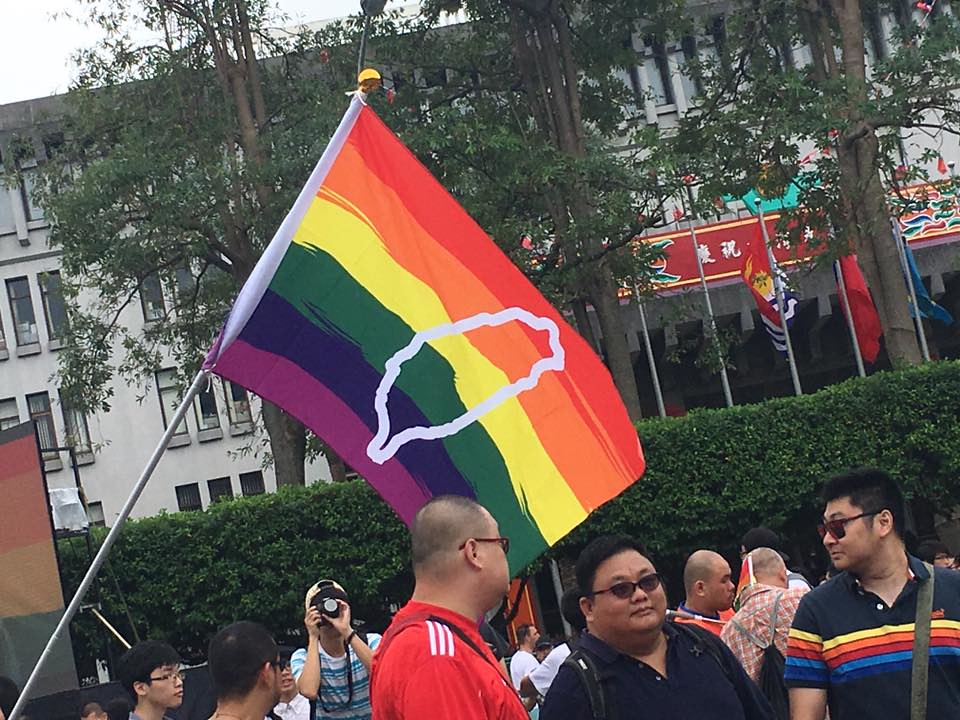 |
But, plans have changed, because Pride is this Saturday.
I'll still go to Donggang on Sunday, but it's really important that as many people as possible attend Pride this year. You should come too. And bring your friends!
In May 2017, Taiwan's highest court ruled that marriage is a right afforded all citizens with no reference to gender, and therefore marriage equality must be allowed. The court gave the government two years to work out a legislative solution: either to simply pass a law allowing marriage equality, or to change the civil code to abide by the ruling.
There have been some political ups and downs, some debate over which route is better (changing the law can likely be done quickly; changing the civil code is harder, and the ruling DPP doesn't think they have the support from the large socially-conservative-but-pro-independence segment of their base to make it happen.) There is a growing sense that the DPP hinted at support for marriage equality when campaigning, and promptly abandoned it to appease their more conservative base, and of course the KMT doesn't give a damn about anyone but the KMT. With elections coming up and the initial 2-year deadline now less than a year away, a lot of activists are upset.
This is especially important with two competing referenda coming up in about a month: one affirming Taiwan's commitment to equality, the other full of outdated, religiously-motivated and hateful garbage (yes, I'm biased). Remind people to go out and vote for love in November.
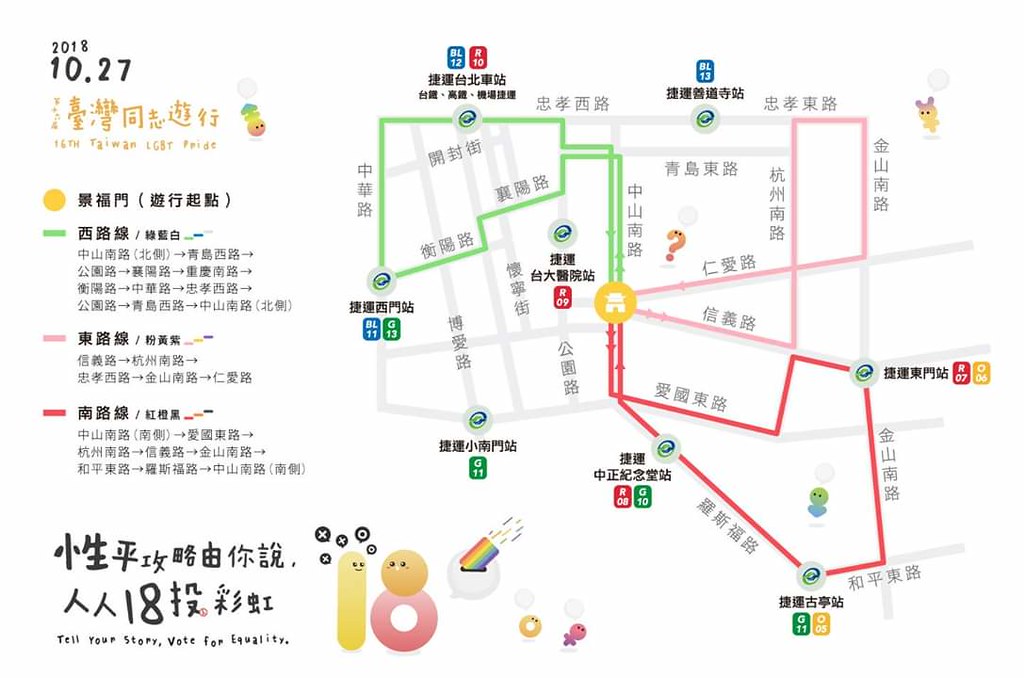 |
| Meet at 1:30 at MRT National Taiwan University Hospital station, start out at 2:30 - these are the routes. I always go the red route. |
Cue Pride. With no specific marriage equality rallies planned, and the anti-equality gay-haters being very well-organized and resourced (moreso than the pro-equality side, although I would argue the national consensus is broadly with us if you count those who are not opposed to equality), there is a sense that this year's Pride is going to be more politically charged and all about showing the government that we (LGBT people and allies/supporters) haven't forgotten.
While it's not my place to opine on what Pride should be, I can say what I think it's likely to be - and that you should be there. A friend of mine (gay with a Taiwanese partner if it matters) was also saying he was hoping this year would be super politically charged and motivated. There's a sense in the air that this is what's happening, but we need numbers.
All are welcome at Pride, which means you can be a part of it. You can add to those numbers. You can make it clear that equal rights matter, and it's time for the government to stop pandering to prejudice and outdated, discriminatory thinking.
Pride Taipei usually makes international news - at least it has in the years surrounding the 2017 ruling, as the world watches to see whether Taiwan will be the first country in Asia to give equal marriage rights to all. The numbers do matter, and you do make a difference.
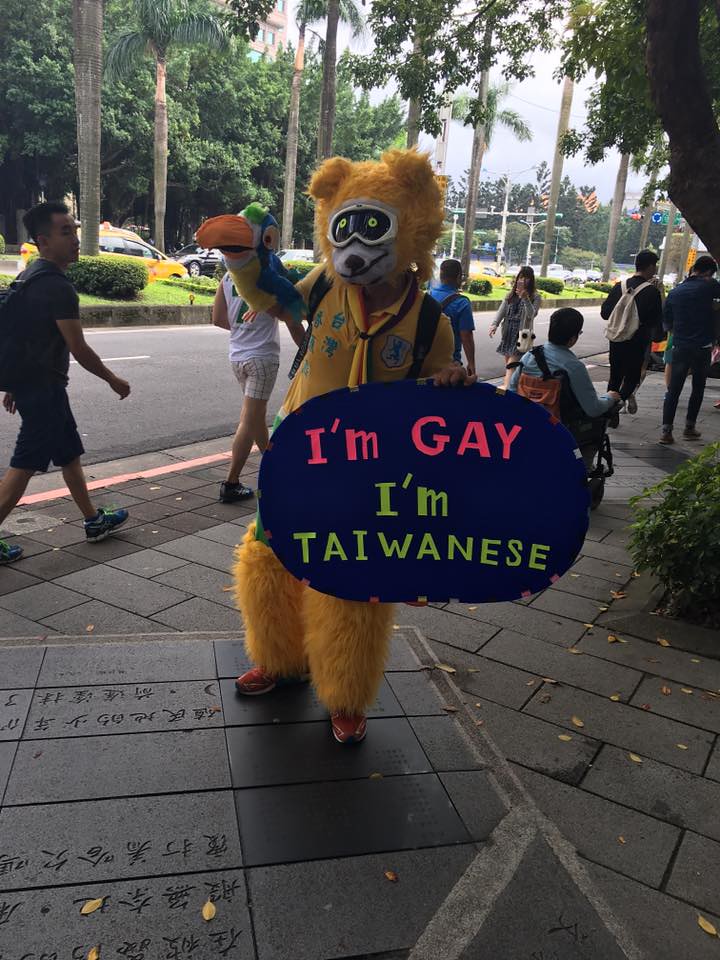
Show the LGBT community your support, and show the world that Taiwan, while imperfect, is the freest and most progressive country in Asia. Show them that we can do this, and that there is no reason why equality can't exist within Taiwanese culture.
Pride is not a rally or a protest - it's a celebration, and all are welcome. It's a great way for foreign residents, even if you are a bit reticent to attend actual protests, to show their support for this issue.
Grab your rainbow gear and come with us.
Swedish citizen Gui Minhai has been held by China for three years and Sweden has been super weird about it
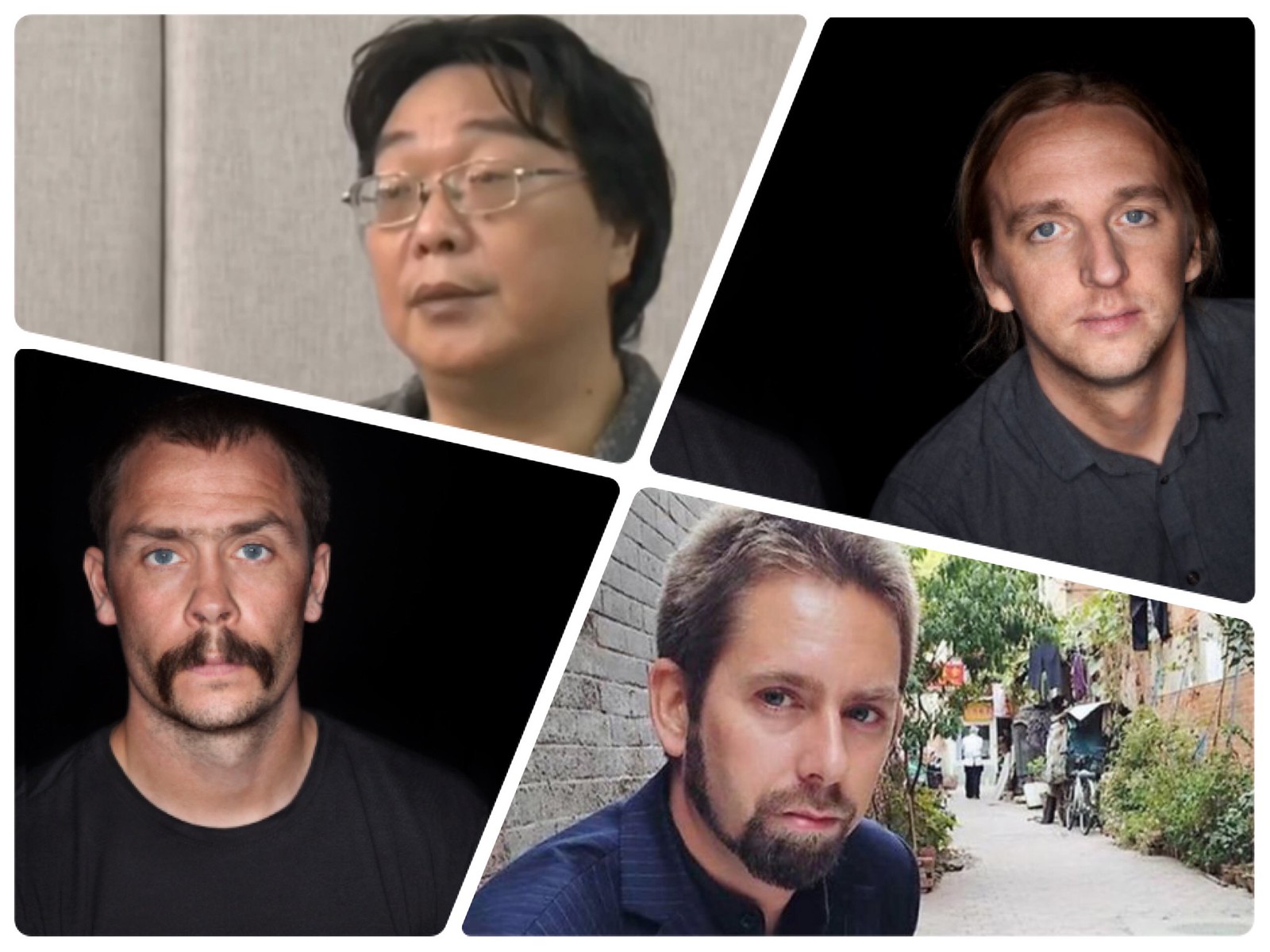 |
| Gui Minhai, Martin Schibbye, Johan Persson, Peter Dahlin |
Taipei-based Swedish journalist Jojje Olsson held a talk last week on the case of Gui Minhai. Gui is a Swedish citizen abducted from Thailand by the Chinese government who, beyond some limited contact with family and Swedish diplomats, has been held basically incommunicado. In fact, the talk itself coincided with the date when Gui had been officially held for exactly three years.
The most informative part of Olsson's talk was his description of what Sweden is doing (or not doing) to get him back. While they are highly involved in closed-door, quiet talks with Chinese officials, it seems odd that these talks are indeed so "quiet": not only has the government not been in regular contact with Gui's daughter, but the case seems to be far more low-profile than it ought to.
This weird silence can be understood in comparison to the government's reaction to two other Swedish journalists who were similarly kidnapped and held for over a year in a foreign country on trumped-up charges. Johan Persson and Martin Schibbye spent over 400 days in an Ethiopian jail for essentially doing their jobs. Similarly, Gui had broken no laws in Hong Kong, where his books (which were semi-biographical tabloid fodder about Chinese leaders) were published, and was in Bangkok when he was taken. Like Persson and Schibbye, he is a Swedish citizen.
This is even more eyebrow-raising, as other European countries (most notably Germany, according to Olsson, but including much of the continent) have not only more publicly called for Gui's release, but have tried to work together to collectively take public action. And yet, Sweden stays on the path of "quiet diplomacy", even though it doesn't appear to be working. Bad publicity scares China. A few polite Swedish diplomats? Yeah I don't think so.
But in Persson and Schibbye's case, there was an uproar in Sweden and the government much more transparently and openly feuded with Ethiopia over their detainment. What's more, Swedish officials were regularly in contact with Persson and Schibbye's family members.
Why are they raising much less of a fuss in dealing with China over Gui Minhai? Why are they not in regular contact with Angela Gui (his daughter)? When Gui was snatched a second time from a Chinese train under the noses of Swedish diplomats who were taking him to Beijing for medical care, why did the reaction seem so muted?
In the international media as well, while the case has been reported by major outlets such as the BBC and the Guardian, the average person (including the average Swedish person, I'd gather) doesn't even know that this is happening. To even your typical well-traveled educated European, the idea that China would abduct foreign nationals in foreign countries might even seem farfetched. But that's exactly what they've done.
The suggested answer is that China is a powerful country, both politically and economically. Ethiopia means little to Sweden; there are fewer risks with starting an openly critical campaign to get abducted citizens back.
I suggest an even more obvious answer. Here is a photo of Swedish citizens with Swedish names, Johan Persson and Martin Schibbye:
 |
| Wikimedia Commons |

And here is a photo of Swedish citizen with a Chinese name, Gui Minhai:
 |
| A screen grab of a screen grab - not many photos are available |
Hmmmmmmmmmmmmm. Do you think it could be...?
Yeah, I do.
The rest of Europe, as noted above, seems to understand the gravity of the situation. I have to wonder why the Swedish government doesn't.
Certainly, China wants the world to think that Gui is Chinese and this is a Chinese matter. Gui is not Chinese; he may have been born in Ningbo, but China doesn't recognize dual nationality. The day Gui became Swedish is the day he stopped being Chinese. Regardless, Chinese state thugs forced Gui to say publicly that he wanted to renounce Swedish citizenship and he "slammed the country" on television. (It is certain that this was a forced statement; there is no possibility that this is truly how Gui feels about the matter).
It is well-known that China thinks of basically every person of Chinese ancestral heritage as Chinese; their actual nationality doesn't seem to matter to the CCP. They do this by threatening Chinese students abroad, taking over Chinese-language media aimed at the diaspora and threatening loved ones who may still be in China, among other tactics.
It's also not a stretch to see that they think they can get away with holding Gui in part because he, well, looks Asian. They are betting on the rest of the world seeing this as a "Chinese" issue, not an international one, and that the world cares less about these things. Basically, China is deeply racist about such matters (thinking everyone with Chinese ancestry is Chinese and therefore subject to CCP control no matter how many generations ago their family left is racist), but they're also betting that we are racist too: that we will care less because Gui is Asian.
Why do I say this? Well, compare China's treatment of Gui to their treatment of another Swede involved in China: Peter Dahlin. Gui published books - legally - that threatened the CCP's reputation. Dahlin is an activist who threatens the CCP by working with human rights lawyers in China.
Dahlin was released after a few weeks. Gui has been held for three years. Dahlin was taken in China, over actions he undertook in China; Gui was taken in Thailand over actions he undertook in Hong Kong.
I'll repeat myself: Peter Dahlin is white and has a European name. Gui Minhai looks Chinese and has a Chinese name.
China didn't want a disappeared European on their hands, so they let Dahlin go. They are betting on you not thinking Gui is European.
Don't believe me? They abducted another foreign citizen too: Lee Ming-che. Lee is Taiwanese, not Chinese. But his name is Lee Ming-che and he looks Asian. Lee was abducted in China, over actions that he took in Taiwan where he broke no laws.
Like Gui, the Chinese government wants you to think Lee is Chinese and that this is therefore a Chinese matter and none of your business. It is no such thing. They want you to fall back on old mental blocks - for you not to care as much about people with Asian faces.
Still don't believe me? Despite Swedish officials being fairly quiet about pressing for Gui's release, China has started a massive diplomatic row over a family of play-acting Chinese tourists and China's ambassador to Sweden is something of a grandstanding jerk: all of this (even according to Olsson) seems to be related to China's attempts to pressure Sweden to just forget Gui Minhai exists, and to shift the spotlight of the Sweden-China disagreement from a Swede abducted by China to a family of shrieking stooges.
Again: China wants you to forget about Gui Minhai, and Lee Ming-che too. They want you to see these foreign prisoners of the Chinese state as "Chinese", so you won't worry your pretty little head about them. The Swedish government, for some reason, seems to be playing along just enough to keep Gui out of the news. The result is that most people seem to be forgetting about him, if they knew he existed at all.
You, however, should do no such thing.
Subscribe to:
Posts (Atom)