Saturday, February 16, 2019

Taiwan needs more strikes!

25592133_10156005421236202_1463402081024972191_n


As you've no doubt heard if you follow Taiwan news at all, Taiwan ugh China Airlines pilots were on strike until very recently. Notably, while part of the negotiations to end the strike included an annual bonus (de rigueur in most Taiwanese workplaces, so I was surprised to learn that apparently pilots did not receive one? Huh), overall the strike was not about higher pay, better 'perks' or other 'benefits' not related to health and safety.

At the core of their demands were that more pilots be assigned to longer flights, so that total working hours for pilots could be brought down to a reasonable standard that would not leave them overworked and overtired. It also prioritized hiring Taiwanese pilots (including foreign pilots residing in Taiwan) over foreign pilots.

I have no particular opinion about the latter demand, but the former is simply reasonable. Nobody wants an overworked pilot; that's how disasters happen, and let's not forget that until very recently China Airlines had a poor safety record (in recent years things seem to have improved). Although China Airlines says its safety and working hour policies are within international standards, considering said safety record and how overtired pilots can be a factor in plane crashes, I question this.

Besides, it's simply not that culturally ingrained in Taiwan to strike at a particularly busy time for your employer (the strike began over Lunar New Year, one of the busiest travel times in Asia), especially if better compensation is not the employees' core demand. To take an action like this, the pilots themselves must have known that overwork and lack of sufficient cockpit crew was a major issue. The only real rebuttals to these demands were, essentially, "but that would cost money!" (yeah, a safe work and customer environment usually does) and "but we'll lose passengers!" (yup, but you'll lose more if there's a major crash and people will die), which underscores how strong a case the pilots made.

The thing is, this kind of strike has been a fairly rare phenomenon in Taiwan, especially in earlier decades. Up through the 1980s, generally pro-business, anti-labor laws governing collective action made strikes difficult if not impossible (not surprising given the repressive Martial Law political atmosphere more generally), and even in the 1990s, despite some strikes taking place, "legitimate union strikes" were still rare, and difficult to legally carry through. Although strikes have become more politically possible since then, they're still fairly rare, with an exception being the China Airlines flight attendant strike in 2016. (That the ground zero for highly-publicized strikes seems to be China Airlines also points to an anti-labor bent to their workplace culture).

The lack of strikes in previous decades wasn't just about anti-worker labor laws - there is an overall lack of a strong labor movement in Taiwan for a number of reasons. There are surely some cultural reasons for this (think of stereotypical "East Asian" work culture which values hierarchy and collectivism; there's a kernel of truth to it, although Taiwan is certainly more chilled-out than South Korea or Japan in this way).

But, more importantly, it's the result of an intentional political attempt to keep labor from organizing so as to advocate for its own needs. This has been done in a very devious way: not by union-busting or trying to dissuade workers from organizing, but by preemptively creating worker "unions" and "trade associations" that employees in a company or industry may belong to, so as to create the veneer of organized labor, but which is ultimately controlled by the companies or government, not the workers themselves. Such organizations have typically represented the best interests not of the workers but of management (or the government) and did not necessarily take on labor advocacy at all. In fact, what "management" and "the government" might want were not always different, given the history of nationalized industries / state-owned enterprises in Taiwan and how government control of industry and labor was used as a tool for political repression.

Of course, as independent labor movements coalesced, these came into conflict with the old-style "unions", there were disagreements on whether to improve the lot of labor overall or to address specific needs of specific groups of workers and...it's all very complex but essentially, that's the reason why not every political party, group and organization which claims to represent the interests of "labor" is on the same page, or even gets along. For more on this point I recommend Yubin Chiu's chapter on trade union movements in Taiwan's Social Movements under Ma Ying-jeou (I'm sorry that it will probably cost you $50 to buy the book if you wish to do so, though that's better than the earlier price of $150 - and although Chiu obviously comes from a Marxist viewpoint on labor issues, he's good at explaining the fundamentals and historical complexities of trade unionism in Taiwan).

Under such conditions, it's not surprising that the labor movement has not been particularly robust and strikes have been fairly rare in Taiwan.

Anyway, taking all of this together, Taiwan simply needs more strikes.

First, because the typical Westerner's idea of a "strike" seems to involve the workers demanding better compensation. An anti-union libertarian friend of mine has even said that he imagines that only mediocre workers support collective bargaining, because the most talented employees have a strong position from which to negotiate better remuneration - it's only the employees who are not particularly distinguished who need to rely on collective action to improve pay and benefits.

That's wrong for a number of reasons, most notably that it assumes that all collective bargaining is aimed at better compensation for each individual rather than improved working conditions for everyone as a collective whole (it also assumes that more valuable workers don't care about whether their less-highly-performing coworkers are compensated fairly, which isn't always true.) But the flight attendants' and pilots' strikes show that this simply isn't that common a motivation in Taiwan: although compensation played a minor role in these actions, the crux of what the workers in both cases were demanding had to do with overwork and general working conditions.

Although I also support strikes for better collective compensation, there's a moral high ground to striking so that you can do your job better, not just to get more "stuff". Salaries in Taiwan are quite low and organized labor has not made any strong moves to push for better pay overall. There are a lot of hurdles for labor to jump simply in terms of social awareness of this issue: it's still taken as normal that one cannot challenge one's boss; changing jobs more often to garner wage increases rather than asking for a raise at one's current job is still seen as a good strategy; and it's still quite common for workers to defend long hours in the office because they prioritize making more money over having more personal time (even though one could argue that workers deserve both reasonable pay and reasonable hours, the rejoinder is that if management won't even give workers one of these two things, it's unrealistic to expect both).

 Of all the good reasons to strike, strikes in Taiwan seem to happen for the best possible reasons. So, more strikes please.

25660409_10156005414221202_8494411837760928893_n
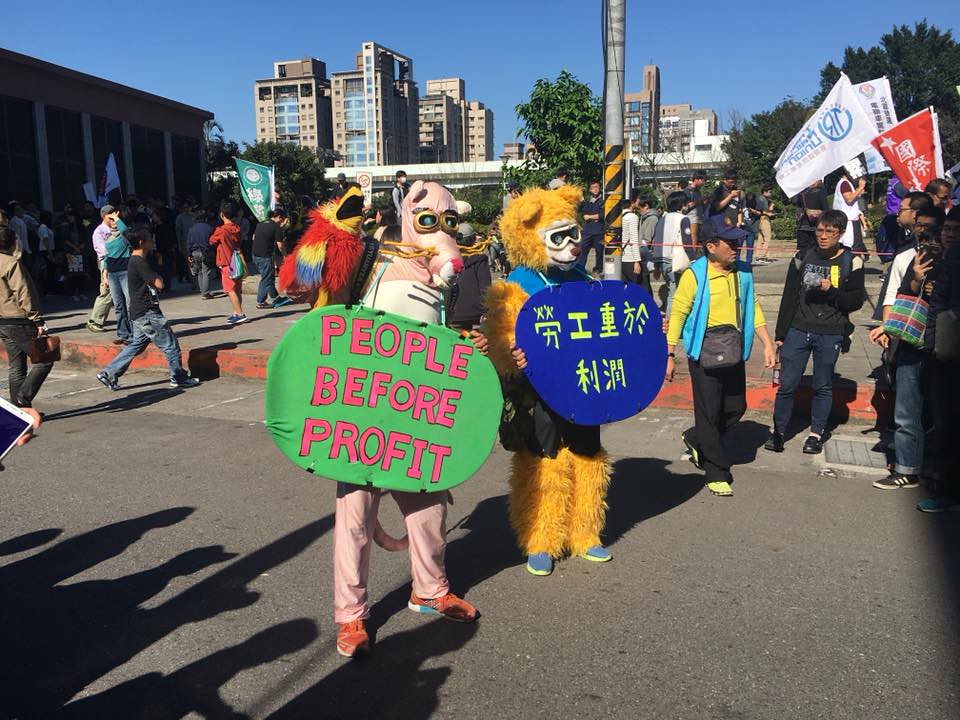
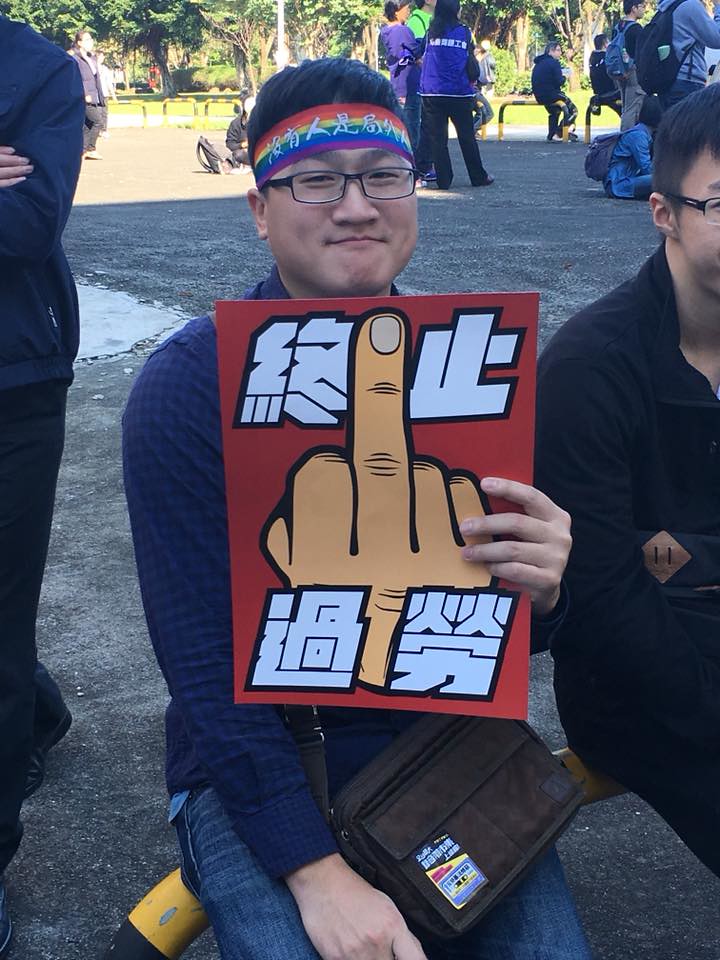
What's more, modern labor movements in Taiwan tend to be tied to other important social issues -
this labor protest attendee is marching to "end overwork", and also showing his support
for marriage equality


Second, given the cultural and historical reasons outlined above, there's no reason to believe that Taiwan's economy or infrastructure will grind to a halt (as seems to happen regularly in France) due to a large number of strikes. Despite the two prominent China Airlines strikes, they are still seen as a last-ditch strategy by labor unions that have only fairly recently coalesced outside of management control. Without a strong history of striking, it's unlikely to become a popular or even particularly common strategy. I don't foresee any sort of slippery slope here where there's a strike every few weeks over every little issue.

And if workers feel that their complaints are valid enough, and their conditions urgent enough, that this 'last ditch' strategy is necessary, there's probably a good reason for that. More strikes please!

Even if there were a slide into strikes taking place over a greater variety of issues - pay, sex discrimination in the workplace or the gender pay gap (still real problems in Taiwan), long hours - this would overall be a good thing for Taiwan. These are intractable issues that have been allowed to fester. Employers in Taiwan have taken the attitude that "I hired you and pay you, so you have to do everything I ask of you exactly when I ask for it, even if I take up all of your free time and I will take it as a personal affront and loss of face if you challenge me in any way on this or even attempt to discuss your working conditions" for too long. Labor standards are a joke. If strikes are what it takes for management to wake up to the fact that their employees are not their chattel, then more strikes please!

Working conditions, culture and compensation have been problems entrenched in Taiwanese society for far too long, and have arguably hindered Taiwan's economic development overall, as it loses its Millenial generation to better career opportunities, pay and working conditions overseas. Greater labor organization that is not under management control will become easier to attain as workers take stronger collective action, and will be the final step to eradicating the old government/management collusion which has been both historically politically repressive and anti-worker. It has the potential to bring various social movements together (see the image above).

Yet strikes are not likely to become yet another entrenched problem in Taiwanese society given how they are already typically viewed as an action that ought not to be commonly taken.


To put it simply, Taiwan needs more strikes.

Tuesday, February 12, 2019

Yes, it is hard to fight for Taiwan: Small Sexism Stories

Let me tell you a story. You can probably guess where it happened from my previous posts.

While discussing an issue important to domestic policy in Taiwan, a panel of highly distinguished speakers took turns making some opening remarks, starting with the two women on the panel - both elected representatives in the Legislative Yuan.

Then the men spoke. The first one pointed out Taiwan's low birthrate and made a comment along the lines of how we can't expect Karen [one of the legislators] to have "more babies" to raise the birthrate. Then, seemingly slightly embarrassed, he blundered into a repetition of the same comment that we can't rely on this same legislator to have more children. (I have to hope he was repeating his bad joke in a flustered attempt to sort of prove to himself that his slip wasn't that bad). Another speaker said he served with her on various committees, and so spent "more time with her than her husband".

A friend of mine pointed out that every man on the panel repeated some version of this joke about a comparatively young, attractive female legislator (which shouldn't matter but probably does) having more babies for the sake of Taiwan's dwindling birthrate. I missed these other comments as opening remarks tend to be repetitive and I'd kind of already gotten the point and was making notes about what topics I might bring up.

When the floor opened to the audience, I wondered whether I should say something about how inappropriate this was. Or rather, I knew I should but had no idea how to word it. I had no idea if these men and this legislator have this sort of jokey friendship, but didn't think it mattered if they did; that doesn't excuse the inappropriacy of such public remarks.

And, I will admit with some regret and self-chastisement, I weighed in my head the need to discuss issues of national import when it came to language education and teacher training, with how discussion of these blatantly sexist remarks would detract from that.

Towards the end, another woman affiliated with CG (Corporate Governance) Watch did say something: that Ms. Yu's competence at her job as a legislator "has nothing to do with her ability to have children".

Thank goodness she did say that; someone had to. The audience was supportive; there was a strong round of applause and a few standing ovations (I was one of them). Yu herself looked relieved that someone had said something, though I won't try to interpret beyond that what her private thoughts were. The good news is that the men on the panel also seemed appropriately chastened.

It reminded me that, going forward, I need to do more to be that person, especially if nobody else is standing up and saying something. I do try, but none of us are perfect.

(No, I am not interested in a discussion of whether or not such comments were in fact sexist. They treated Legislator Yu in a particular manner because she was female and able to have children. That means they were sexist, period.)

I've said it before, and I'll say it again - it's hard to support Taiwan as a woman who also values egalitarianism. It was easy to get swept away discussing other issues of importance, and basically find a reason not to discuss the very real instance of sexist language on display at the beginning of that meeting.

What do you do when the people who are your allies in one way show that they have very little regard for your sex/gender in another? Would my points about language education and teacher training have gone unheard if I had been the one to say something? Bringing that up and making an issue of it, however right, may make it more difficult to discuss other issues and may even cause one to lose allies (a lot of men who say sexist things turn hostile when it's pointed out, and may not be willing to work with someone who addresses their behavior for what it is). And it takes time away from discussion of other issues.

And it can hurt the cause. There is unlikely to be any great damage as a result of these comments, the reaction to which hopefully caused the men in question to reflect on their behavior and commit to doing better next time. That's all this relatively minor incident needs, and I must hope or even insist that that happens. But what happens when it's, say, one of the leaders of the progressive cause?

It hurts the whole cause when the incidents are more serious, both in terms of media representation and female involvement - and I personally know than one woman who has shied away from joining progressive causes in Taiwan because of the men they'd have to spend time with. What woman wants to get involved when she knows the men she'll be working with are going to say and do sexist things?

It creates an environment where women are tempted - encouraged or pushed even - to overlook minor or even major instances of sexism in their fight alongside people who are otherwise allies, for the bigger picture, the greater cause. But we can't. It could hurt the reputation of the cause itself, or result in fewer women getting involved. If fewer women get involved, issues pertaining to women within that cause are less likely to be considered. For example, who is going to consider sexism in language education, including pay gaps for English teachers, if not as many women join the initiative this meeting was about, because they felt unwelcome after the remarks of the male panelists?

This meeting should not have been clouded with the comments of the men on the panel. It simply should never have happened. I should not even have to be writing this post, but feel I must.

We all need to go forward remembering that the people who brought down that cloud, who distracted from the main point, were not the woman who spoke up and the others who applauded her, but the men who made the comments in the first place.

Now, let's take this lesson and apply it to Taiwan advocacy in general. If Taiwan supporters in the US government are also sexist sacks of crap, we need to acknowledge that and deal with it, however we can. If women in Taiwan advocacy point out that there is a problem, damn it, listen to them and take it seriously. If someone in the movement is saying or doing sexist things, stop that person. Speak out. Men, you too. All of us. Deal with the small incidents like this one in small ways (a simple call-out and request for reflection will do), and the big ones in big ways.

Don't keep forcing women like me and others who fight for Taiwan to always have to do those mental calculations. It's not right, and you know it.

Monday, February 11, 2019

Making a fuss is worth it: IELTS gets a well-deserved smack for calling Taiwan "China"

Screen Shot 2019-02-11 at 6.37.53 PM
I was banned from commenting on IELTS's Facebook page because they're a bunch of dictator-loving pissbabies,
but I'm glad to see others taking up the fight.


Recently, 46 members of the UK Parliament came together to castigate the International English Language Testing System (IELTS) for changing its designation of "Taiwan" to "Taiwan, China" on its website and admonish them to revert to the original wording. The charge was led by legislators from the UK's version of the Taiwan caucus, and to be frank, is a breath of fresh air in a world that seems all too happy to sell out to China.

While it's highly unlikely that any of them read my post, my other post or my husband's (better) post on this topic, I do think it's worth it to make a stink, even in the tiniest way. As a friend pointed out, all that accumulated stink can sometimes build up to something, and cause people with real power to take action.

And all I can say is that I'm annoyed that my own country's government didn't, as far as I know, do anything similar when TOEFL made the same change.

And that's just the thing - the hardest part of advocating for Taiwan is being utterly powerless. When a major testing organization, which is meant to be apolitical (as language proficiency testing shouldn't have blatant political biases) makes such a political move for obviously profit-driven motives, a lot of damage is done. The more organizations with 'prestige' give in to China's demands for how to refer to Taiwan, the likelier it is that everyday people around the world will see that wording and just automatically file 'Taiwan' under 'a part of China' - and there's very little that people like me can do about it or only a very limited sphere in which we can raise a fuss. Or worse, if the topic ever comes up, they'll point to organizations like IELTS and say "oh, look - but IELTS calls it China, so there must be something to that!" and stop listening to reason when people like me, who as individuals don't have the cachet of a generally well-respected organization, point out the clear issues with such logic.

It's also simply psychologically damaging to Taiwanese people, who have to see their country referred to as "China" all over the place, with very little recourse and no warning as to when it might happen or where it might pop up.

These things do matter - the war over what things are called, what language is used. When every major company, organization and website calls Taiwan "China", people start thinking of Taiwan as, well, China. 

It's also difficult to keep up the fight because, to be honest, we lose so goddamn often. It's brutal, it's neverending, it's a psychological beatdown (which is part of the reason why China does it). It's really a thing of beauty to see that we cut deep on this one, and perhaps (perhaps?) a group of MPs will be able to accomplish what people like me simply cannot. Do I dare hope for more? Reader, I dare: perhaps this isn't just a speck of light on a bleak horizon when it comes to IELTS, but a sign that the tide could turn.

And, of course, it's personally challenging as well. As I've written, I have some work through IELTS, the nature of which I'm not allowed to publicly reveal (of course, by telling you that, I've essentially revealed it, and since I'm furious at IELTS, I don't even care.) Fighting this has taken a toll on my income, as I now sign up to do work for them as little as possible, when I used to do it pretty regularly, for pretty decent pay. I had to proactively decide that principles were more important than cash, and I was privileged to even have the choice open to me. It stands to hurt my future plans as well - there's a fair chance I'll do a PhD in the United Kingdom, as full-time study is the only way to get funded. Doing IELTS work would theoretically be better-paid than a lot of other things I could do to bolster my funds while there, but if I'm committed to my principles, it's not really open to me. It takes a hard, personal toll.

Alongside that is how difficult it is to get other people involved. I know the local administrative staff is upset about the change as well, but their entire full-time jobs depend on working for IELTS. I have the ability to tell IELTS to take a hike, but they don't. Other foreigners who do similar work are either tepid about fighting back (thinking it's too much trouble) or not financially able to cut into their work.

It's a brutal, brutal slog. More often than not, we lose. But sometimes we don't, and we're on the right side.

Make no mistake, IELTS's decision was evil, and they deserve a smackdown for getting political about such a sensitive issue. I'm just happy to see it was delivered.

And IELTS, if you're reading this...

...screw you. 

Saturday, February 9, 2019

If a "bilingual", "globally-oriented" Taiwan is the way forward, immigration reform for educators is imperative

Just a quick thought at the end of Lunar New Year that struck me as I chatted about my life in Taiwan with a friendly British couple on the beach. Links to come later as I can't easily add them on an iPad. 

They asked me if dual nationality in Taiwan was even possible, or if I would have to give up my original nationality to get it. I told them sincerely I was happy that recent changes to the immigration laws in Taiwan created a pathway, but dismayed that the path was entirely too narrow and impossible - as an educator, I'd have to be a university professor (assistant or associate - I forget which because that's so far off for me that it doesn't matter yet.) I mentioned that I have friends at prestigious institutions like Academia Sinica who have been told that this is interpreted (incorrectly) to mean "when you have tenure", so they won't even write the necessary letters for their academics until that happens. 

"Imagine," I said, "having to get tenure at Academia Sinica before you even qualified as an educator!" 

It was the same thing I'd told Legislator Karen Yu just a few weeks ago. 

My husband joined in, "It seems like a rule that was put in place with very little thought - like some people in a room just decided that sounded good, but which has a huge effect on people's lives that the folks in that room are totally unaware of."

And I've come to realize, as those whole "bilingual country" and "English as a second official language" talk starts slowly creaking its wheels towards actual action, that if the government is serious about it, that immigration laws, especially for educators, simply need to be loosened. Now. 

The usual pushback to people upset that they don't qualify for dual nationality in Taiwan (like me!) is "this is the set of talents/skills that the government has decided it needs, that's why it's comparatively for someone in STEM to jump through the hoops, but difficult for teachers. They want STEM workers but don't need so many teachers. Deal with it!" 

This is of course nonsense, though I do acquiesce that this is what the government *thinks* are the skills it needs to attract to Taiwan. What's horseshit is the notion that Taiwan actually needs more talented foreign STEM professionals. Taiwan has reams and reams of local STEM talent, the best of whom are leaving Taiwan due to low pay and poor working conditions. (and even so, if anything there's a surplus of engineers and IT professionals. Perhaps pay would go up if they were more scarce.) Foreigners aren't going to take those jobs in any great number because the jobs aren't very good; what it needs is to provide attractive enough opportunities to get its own talent to stay, and perhaps some foreigners as well. Taiwan is not a developing country; what it would take to satisfy top Taiwanese talent is not far off from what it would take to attract foreigners. Expectations don't differ that much. 

But what Taiwan actually does need - or will need in the coming years - is talented educators. It's true that there is a surplus of not-very-well-trained "English teachers". While I support a way forward for them in the field that involves better apprenticeship and training than what is on offer now, they are not the ones I mean. We have a lot of those (too many, in fact) and not enough trained and experienced foreign educators - whether you have a teaching license, a Delta or a postgraduate degree. Among those who are here, a disproportionate amount are English teachers or non-specialized teachers of young learners; teachers who specialize in other subjects are harder to come by. We have even fewer experienced language teacher trainers - and I don't just mean among foreigners. There aren't that many options for teacher training in English among locals either. 

The government seems to have realized this - the talk at the meeting before Lunar New Year focused at times on this need. But they don't seem to have realized that if that is the talent Taiwan must attract, then one of the best ways to get those already here to stay and attract new professionals is to make it easier not just to move here, but to stay. That is, to further amend immigration laws so that teachers who want to build a career here have a hope of staying on as citizens, someday, if they wish. 

If we're going to really go ahead with a "globally oriented Taiwan" - that is, a country where English is integrated culturally to a degree that eases the road to greater internationalization, which is the actual goal - Taiwan is going to need more than a handful of professors who currently qualify. 

They are going to need teacher trainers (you know, like me). Not just to train up foreign teachers, but locals as well (which is what I focus on). No country actually achieves the level of 'bilingualism' that the government says it aspires to with foreign teachers alone: you'll notice that English medium teachers in countries like Singapore, India, Hong Kong (I'm calling it a country and don't care what you think) and the Philippines are overwhelmingly local. They're going to need advisors, translators, editors and tutors. They are going to need English proficiency test examiners (even though tests like IELTS suck for political reasons and you should not take them if you can avoid it.) 

And yes, they're going to need just regular teachers. Not just English teachers; if Tainan is any indication, this push is going to go hand-in-hand with a bilingual education model, where regular subjects are taught in English. This model isn't particularly common in Taiwan, although schools with multilingual curricula exist; educators who are familiar with it will be needed, and a number of them will be foreign. Teacher training programs and certification courses will hopefully become more readily available in Taiwan - I have high hopes for international standard pre-service certifications, including those run by Cambridge and Trinity. But those require trainers, and to get to a point where locals can do those jobs (as such training does not currently exist in Taiwan), we'll need foreign teacher trainers. 

So, it makes absolutely no sense, from this moment forward, for the government to imply through its immigration law that it does need foreign engineers but it doesn't need teachers. It makes no sense to set the bar for educators so ridiculously high that almost no-one meets it, and to predicate it on a job some valuable educators may not even want. 

Personally, while I think I'd be a fine academic, I find a lot of meaning in teacher training, especially training up non-native speaker teachers. This is a real contribution to Taiwan - but to become yet another university professor teaching the same old academic writing and speaking classes? That is also meaningful, but we have a lot of them already. Are more of those what Taiwan really needs, at a time when it will be gearing up to train a bunch of new teachers in modern methods that are not currently common here?

Many of us are already here, and have made Taiwan our home. We want to stay and contribute, and one of the best ways the government can ensure that we do is to make it feasible for educators to gain dual nationality. Taiwan is a fine place to live as well; surely some newcomers will want to stay. 

It's time for Taiwan to truly open the door to them, and amend its immigration policy to reflect the talent it says it needs.