Sunday, October 4, 2020

Wandering around Neihu (yes, Neihu!) and a political history of the Kuo family, for some reason


On the final day of the long weekend for Mid-Autumn Festival, we decided to pick a part of Taipei we rarely visit and find something interesting to do there. Usually when we do this, we end up in one of the older or more innately interesting areas: Ximen, WanhuaBeitou, Shezi (included here as an antique store listing, but I've actually explored far more of the area than that), Wanhua again, my many walks in the quieter parts of Dadaocheng and Dalongdong, more Wanhua. Sometimes, of course, we seek out the less clearly fascinating parts of the city and run with that. These include our visit to the oldest house in Xindian, which has probably been demolished by now, or our trip to the Li Family Mansion in Luzhou - though that post doesn't actually discuss the Li mansion as we couldn't enter that day, we did eventually visit. 

This time, we set our sights on a more challenging district: Neihu. While it looks like a nice place to live, and the restaurant scene there is improving, there isn't much to interest the casual visitor in this part of town. Other than restaurant trips, the occasional visit to a big box store (hey, that's where they sell American-style drip coffeemakers), plans to meet friends, one visit to Donghu Park and one hike, I don't think I've ever purposely gone to Neihu for fun. Has anyone?

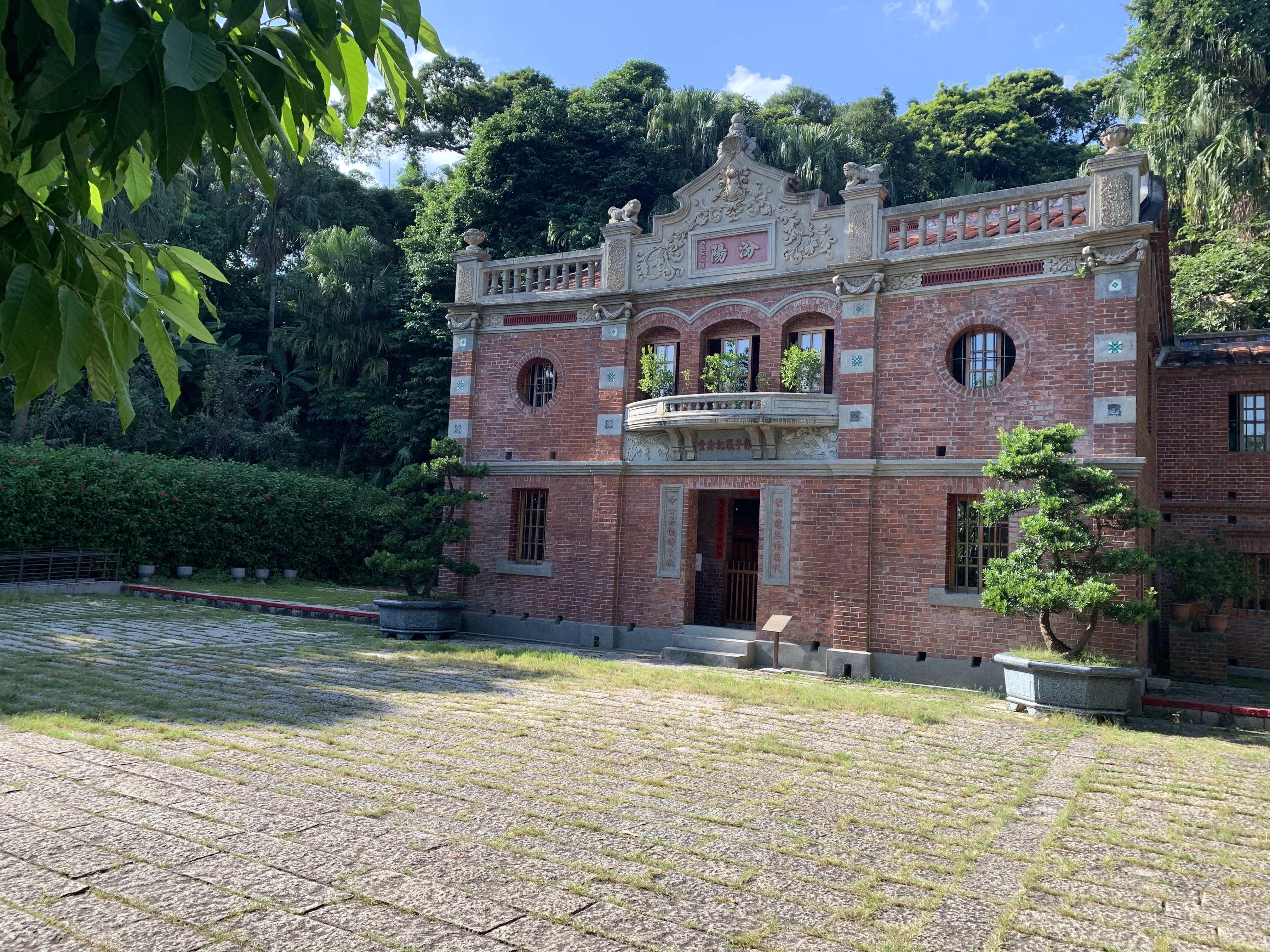
I had a vague recollection of hearing about an old family mansion in Neihu that I'd never been to. The photos from my old set of Historical Sites in Taipei books made it look decrepit and unloved, and back when I first heard about it, there was no MRT up that way, so I let it slip from my memory. But with this idea to see what one could actually do for fun in the area, I dug out the books and found the listing: the Kuo Family Estate (now the Kuo Ziyi Memorial Hall). Nearby was another Japanese-era building -- the old Neihu Village Hall.

Untitled 


And conveniently enough, both were near the MRT.

In fact, the Kuo mansion is so close to Wende Station that I'm surprised it took me this long to check it out -- it's less than 50 meters' walk, not including a long but not particularly steep set of stairs. So that's where we started. 

Kuo Ziyi Memorial Hall 郭子儀紀念堂

MRT Wende Station (Exit 1, turn left and follow the signs, you cannot miss the gate and stairs)
Untitled


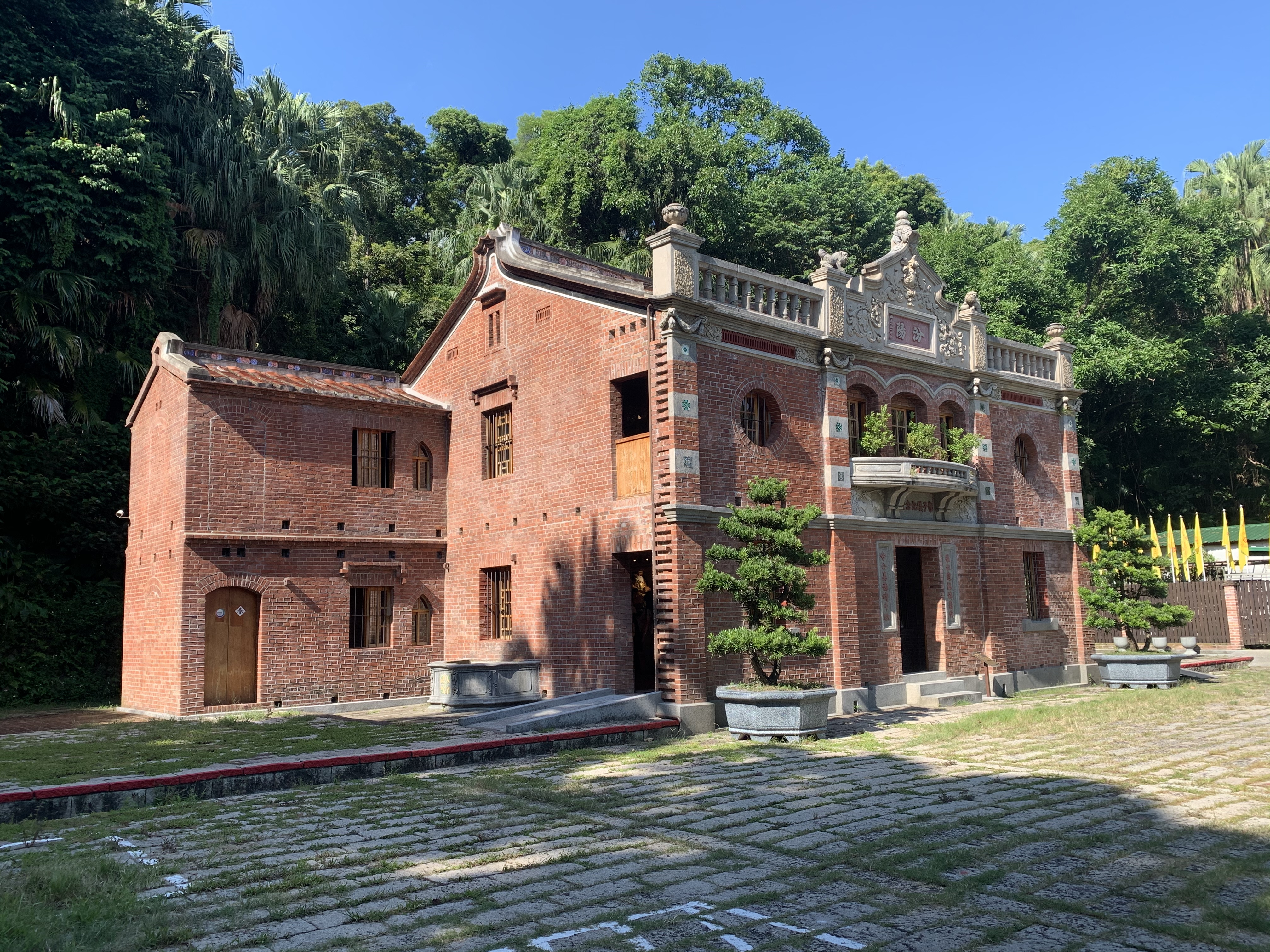
Built in 1919, the house is in the Taisho style very common to that era of Japanese colonial rule in Taiwan -- you'll know it by its red brick and cement exteriors with Baroque decorative flourishes and typically wood interiors.

This was originally the home of Ku Hua-jang (郭華讓) the first mayor/borough chief of Neihu, back when it was a village unit rather than a district of Taipei City. In fact, it was an administrative unit called a zhuang 庄 in Chinese, which isn't quite a town, and was a different type/level of administrative unit from the old Qing-era system. (I don't really understand much more about that, so that's the most I can say). It was later occupied by Kuo's relative, Kuo Hua-xi (國華溪). 


The Kuo descendants from this branch of the family also were important figures in twentieth-century Taiwan.


Historical Sites in Taipei says that there was a beam installed specifically to hold "traditional Taiwanese censers and lanterns", and at some point it was re-named 碧奉宮 (Bifeng Temple), although it was never actually used as such. Apparently in the 1980s there were plans to turn it into a Matsu temple, but the architecture of the front gate was deemed inadequate, and neighbors opposed the move, which led to the site being abandoned and falling into disrepair.

Then, the World Kuo Family Association -- which has its own website -- stepped in to direct and fund its renovation. (Their website calls Taiwan the "Taiwan Area" - a minor thing, but it'll come up later). It's also now the seat of the association. 

Anyway, even though the house was built by the clearly wealthy and connected Kuo Hua-rang and his cousin Kuo Huaxi, they had a much more famous ancestor, Guo Ziyi. Guo was a general in the Anshi Rebellion (the one where An Lushan revolted) in the 700s. That would be the Tang Dynasty, Emperor Xuanzong -- if that means nothing to you, you may have heard of Xuanzong's favorite and famously beautiful concubine, Yang Guifei (who had been friendly with An Lushan....anyway, there are lots of dramas, go watch those). He was also key in diplomatic (and war) dealings with the Tibetans and Uighurs and apparently saved poet Li Bai's life. Long story short, Guo Ziyi was an extremely important historical figure who had a real impact on the history of East Asia. 


This is why, when the World Kuo Family Association renovated the mansion, instead of honoring the builders, they turned it into a memorial hall for their much more famous ancestor, Guo Ziyi. 

Here's the culture difference: if I built a bad-ass Baroque mansion because I was the local town chief, and a few generations later my descendants decided to renovate it, I'd be pretty annoyed if they ignored my legacy and turned it into a big memorial for some ancestor of mine. But, when it comes to local culture, that doesn't seem so weird at all. I bet Kuo Hua-rang and Kuo Hua-xi would not only think that was fine, but deem it right and appropriate. 

Here's another thing I find interesting: years ago, a friend of mine surnamed Kuo told me about how there were three groups of Kuo immigrants from Fujian. One settled in Yilan, one in Hsinchu and one in Tainan. More Kuos came with the KMT refugees (including the family of tycoon and supreme jackass Terry Gou). Apparently, although most of the Kuos of Fujian were entirely Han Chinese, some were actually descended from Hui ("Chinese Muslims", though I don't know how I feel about that term). Guo Ziyi was from Shaanxi (陝西) and was later named the Prince of Fenyang (汾陽王) -- according to a plaque in the mansion, this was due to his military victories in Fenyang, Shanxi (山西 - not the same as his birthplace). The Kuos had been around for a long time before the Tang Dynasty, and therefore not every Kuo can name Guo Ziyi as a direct ancestor. However, many Kuos in Taiwan, regardless of which group of settlers they were in, claim that the Kuos from Fujian originally came from Fenyang, and can be traced directly back to Guo Ziyi. 

I have no idea if (or how many) of these Fujian Kuos, many of whom eventually settled in Taiwan, were actually descended from Guo Ziyi, and how many were not. But this is illuminating

One of the Guo family is from Hui clans around Quanzhou in Fujian.

Early in the 14th century, a Persian Al-Qudsan Al-Dhaghan Nam (伊本·庫斯·德廣貢·納姆) was sent to Quanzhou by Külüg Khan for assisting grain transportation by sea. He failed to return to Khanbaliq due to war, then got married and settled at Quanzhou. Because his Persian surname Dhaghan pronounces similar to Chinese Guo, Al-Qudsan Al-Dhaghan Nam's grandsons began to change their surname to Guo in order to assimilate with local Han Chinese. It was politically expedient to claim they were descendants of Guo Ziyi in order to be better accommodated by Local people and later Ming Dynasty government....

In Taiwan there are also descendants of Hui who came with Koxinga who no longer observe Islam, the Taiwan branch of the Guo (romanized as Kuo in Taiwan) family is not Muslim, but still does not offer pork at ancestral shrines. The Chinese Muslim Association counts these people as Muslims. The Taiwan Guo now view their Hui identity as irrelevant and don't assert that they are Hui.

Various different accounts are given as to whom the Hui Guo clan is descended from. Several of the Guo claimed descent from Han Chinese General Guo Ziyi. They were then distressed and disturbed at the fact that their claim of descent from Guo Ziyi contradicted their being Hui, which required foreign ancestry.  While the Encyclopædia Iranica claims the ancestor of the Guo clan in Baiqi was the Persian Ebn Tur (Daqqaq).


Huh. Assuming this is true, the guy being memorialized in the Kuo Family Mansion is probably not an ancestor of all of the Kuos in Taiwan (although surely he is an ancestor of some). 

Another unofficial story, relayed to me by word of mouth, is that some Kuos from Fujian were actually the descendants of captives or slaves brought back by Guo Ziyi after his dealings out west. Some moved back west and even on to Turkey, but some stayed in Fujian. In later generations, in order to assimilate, they took the surname of their captor's family. It again was considered politically wise to simply say they were descendants rather than admit they were not Han (this is also said to account for some Kuo families not including pork in religious offerings).

I don't want to presume too much, but if the ancestors of these Kuos were actually Muslim and from areas west of China, wouldn't that potentially make them more closely culturally/historically connected to Guo Ziyi's negotiating counterparts or even enemies, rather than Guo himself? Does it matter, so many centuries later?

Perhaps that's too much of a supposition, but it's worth contemplating that the official or "politically expedient" version of history is not always the correct one.

And in the case of Taiwan, this potentially looks a lot like a Sinicization -- no, a Han-washing -- of history to keep every narrative in line with Taiwan as a mere offshoot of the "Great Chinese Nation" and its "5,000 years of history", rather than a unique place that may hold some of its own unexpected historical twists and turns. I do wonder why the World Kuo Family Association, which includes people of "Kuo" ancestry across the entire spectrum of the Chinese diaspora, might be interested in pushing a Han-centric narrative, especially in *ahem* the Taiwan Area.

Maybe I'm reading too much into it, and connecting the site to an extremely famous guy from Chinese history was just a way to get government funding for the restoration. But the Kuos are huge (just check their website!) and there's a wall of donation plaques, so I am pretty sure it was funded by the association. If you're curious, I did not see a plaque from Terry Gou. 

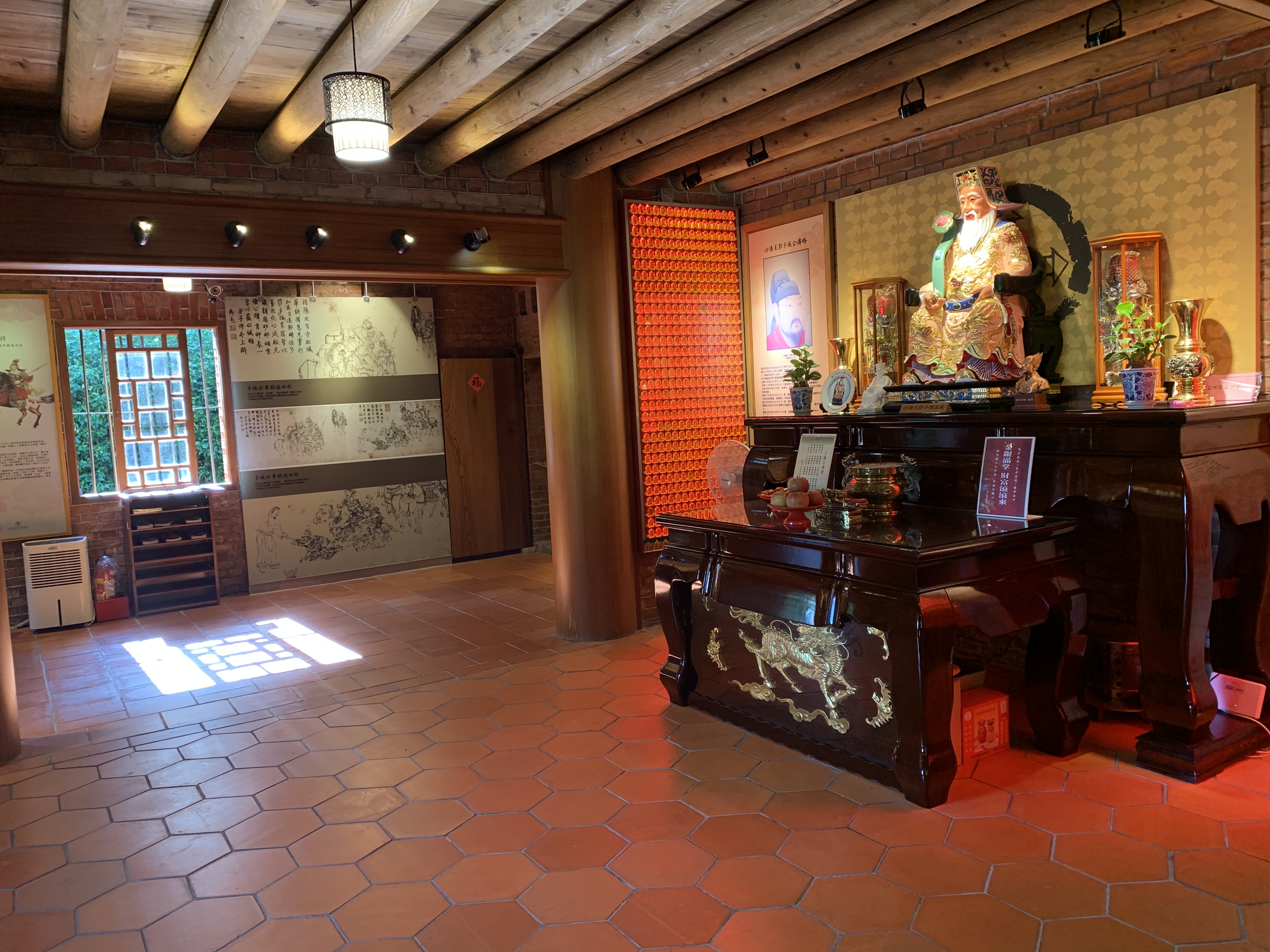
In any case, the mansion has been beautifully restored, though rooms that would have been living spaces once are now clearly meeting halls for the World Kuo Family Association. 

Untitled


There is a rubbing from a Tang Dynasty tablet extolling the virtues of Guo Ziyi, a placard that casts some pretty passive-aggressive shade on Yang Guifei, a big idol of Guo Ziyi, some lovely wood restoration especially around the windows, and lots of dorky-fun photos of the World Kuo Family Association as well as a variety of books locked in glass cases.

It's well worth a visit. 


Untitled

Neihu Village Hall 內湖庄役場會議室

#342 Neihu Road Section 2 內湖路二段342號

MRT Neihu, or a short walk from the Guo Ziyi Memorial Hall 

From the Kuo mansion, we walked to the Neihu Village Hall, which is now a community activity center. 

Built in 1930 -- so, when the Kuos were still around and probably running the area -- it faces north and looks over the "old village" of Neihu. There's nothing left of that, however: just newer residential buildings all the way to the hills. There is an old ruin called the Chen Family House a short distance north but a quick look on Google Maps made it seem unimpressive -- a ramshackle of bricks mostly hidden by a corrugated metal roof. We were hungry and it was hot, so I didn't suggest we go. 

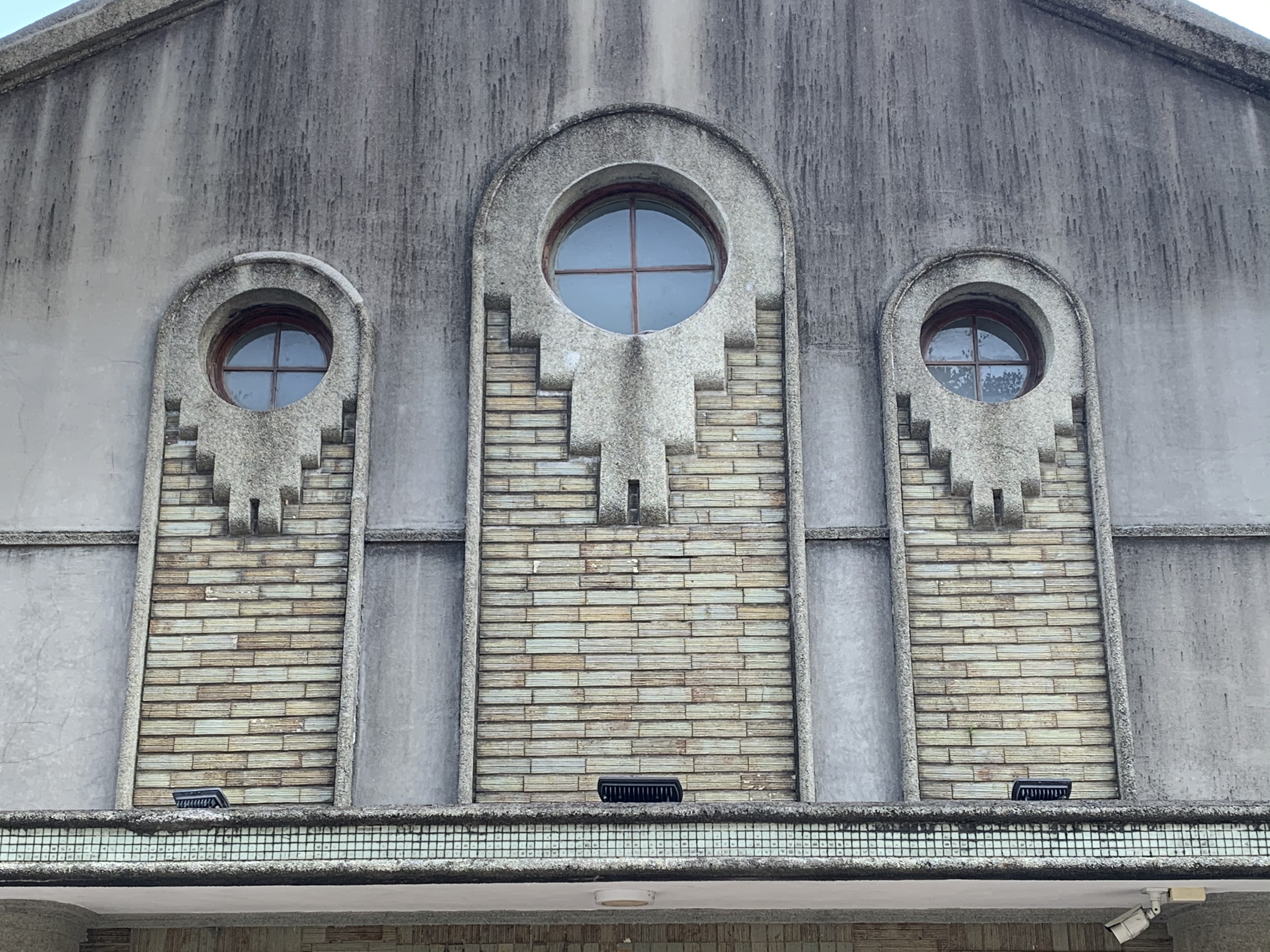
The interior of the hall was not open but no matter; the outside looks far more interesting (you can see some photos of the interior here). In a country full of Japanese Baroque, it's refreshing to come across some straight-up Art Deco

The design of this hall is more interesting than its history: the tiles are greenish-blue and reticulated (meaning they have a veined or network pattern), and are dull, meaning they don't reflect light. This is apparently the "air defense color" I wrote about before, as it made buildings more difficult to identify by the bomber pilots flying above. Of course, knowing that now, I seem to have messed up the popular bright cyan color that I wrote about with this duller blue-green; it's clear that this earthier color camouflages better than bright turquoise-y cyan, and would more naturally be used in architecture where air defense was a concern. That means the bright, cheerful cyan I looked into was probably just a cheap and popular paint color in mid-century Taiwan (it was also popular in the mid-century US, so that's no surprise) and because it's both bright and contrasts attractively with brick, wood and concrete.

Of course, the "air defense color" -- that earthy blue-green -- also became popular as an aesthetic-only choice. Look at the way it's used here: there's no actual military or defensive purpose for it. 
It's there simply because it was deemed pleasing. 

Untitled


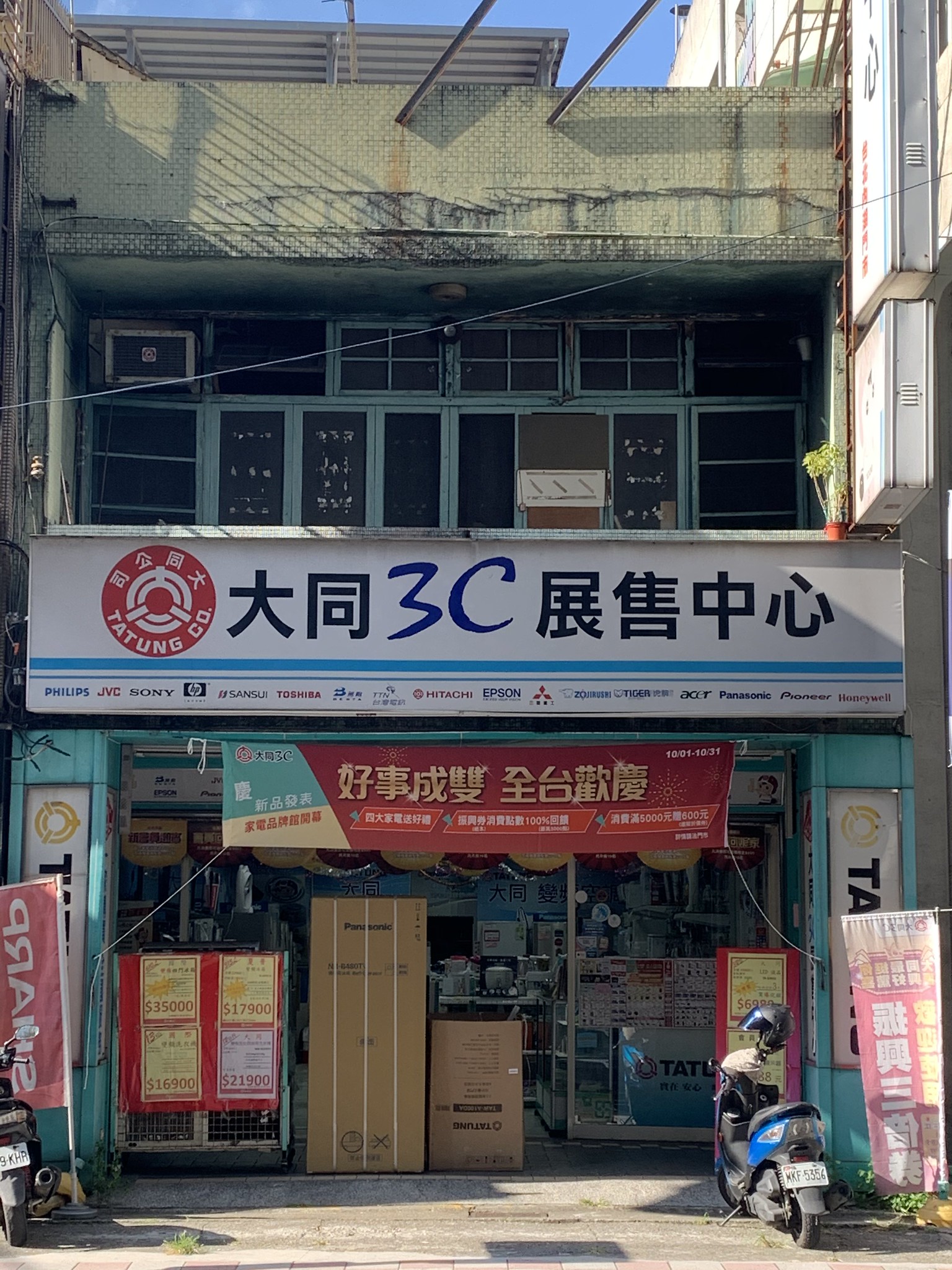
The cyan I had been talking about looks more like this: 


Other notable features include the bull's eye windows with medallion/key pattern decorative casements -- very common in Art Deco -- and the semi-circular columns that end in a waterfall pattern that reminds me of the Art Deco dressers my mom used to have (we sold them not long ago, and though I'll miss them, I have no reasonable way of getting them to Taiwan). The stepped gable is also classic Art Deco, though only a nod to the design (some stepped gables are far more dramatic). 

After the ROC occupied Taiwan, the building was briefly named Zhongshan Hall (not to be confused with the bigger, fancier Zhongshan Hall in Ximen) and then the Neihu District Public Activity Center, now that Neihu had ceased to be a village or zhuang 庄. 

We wrapped up our day in Neihu with a visit to a whiskey store near Xihu that has a particularly good selection so I could pick up some rye (洋酒城 - literally Foreign Liquor City; there are more branches than the one in Neihu), a quick stop at Oma's German Bakery, and a late lunch at The Antipodean Specialty Coffee, which I strongly recommend. 

Untitled


The walk from the Neihu Village Public Hall to The Antipodean takes about 20 minutes, and will take you past the National Taiwan College of Performing Arts, interesting for its mid-century 'Eurasian' architectural style that I find both revolting and fascinating (it looks a little bit like a budget Sun Yat-sen Memorial hall from the outside, if you squint). 


Untitled


You'll also walk past Bihu Park -- it's not dramatically impressive on its own, but it does make the walk more pleasant and offer a nice place for a break. The large, white building at the far end is a reading room -- literally just a large building full of tables with air conditioning where you can go read and study. Not very exciting, but I enjoyed the review by one visitor who complained about the old lady who hangs out there like it's her house and spits loudly and frequently. 

There are more things to see and do in Neihu, of course. If you're closer to the Costco end, check out the tomb of Lin Xiu-jun (林秀俊墓), which is very close to the bus stop with good service from all over the city. Though it's just a small tomb, it's the best-preserved, and perhaps the only, traditional Fujian-style tomb in Taipei, and dates from the 1770s. There don't seem to be any animal sculptures like the one in rural Miaoli or the few you can find on Kinmen, but there are some interesting colored tiles. It's also near Aphrodite, the funky antique market I sometimes like to peruse, though I haven't been in years. 

There's also a Qing-dynasty quarry (easily findable on Google Maps) near the trail up to Gold Face Mountain. That is also a worthwhile hike, though we came at it from the Jiantan side, which took all day. A bit to the east of that are several hiking trails that snake past temples with good views and a suspension bridge. 

Monday, September 28, 2020

The CCP is a black hole that makes me question my own values

IMG_2029

This is a piece of street art I found - the artist is Mr. Ogay


Last week, I began a blog post about Chinese apps WeChat and TikTok being banned from purchase in app stores in the US, but never finished it. Partly I just couldn’t maintain a focus as it’s not clearly related enough to Taiwan, my core writing topic, and partly I felt like everything I had to say on the issue tapped into a deeper question:

In so many areas where China is concerned, I find myself going against my political instincts and nature to support certain actions and policies that, generally speaking, I would otherwise oppose. Why is that? 


For example, I am generally against banning apps or access to communication platforms. However, in the case of WeChat and TikTok, I’m ambivalent, with a slight lean toward supporting the ban (despite despising Donald Trump’s administration with not just my bones, but my guts, skin, blood and waste matter). 


I’m not moved by arguments that it denies ‘freedom of speech’ to some communities; freedom of speech is not available on WeChat or even TikTok thanks to Chinese censorship. The only difference is that in the US you may become a person of interest with your post deleted. In China, your post being deleted is the best possible outcome; you could have your account suspended or be shoved in a truck and carted off to a gulag. I’m slightly moved by the argument that it cuts off people in China from loved ones abroad, but ultimately that’s China’s problem: they’re the ones that made it impossible to use just about any other platform (that they don’t control). So why are people mad at the US, not China, for a situation China created? It makes about as much sense as admonishing Taiwan for “provoking China” or “raising tensions” when China is the one creating the tensions and choosing to react with anger. 


I’m especially not moved by the argument that corporate surveillance of our data in other countries is just as bad as CCP surveillance on WeChat. Sure, it sucks, but it’s not equivalent. FaceCreamCo may be harvesting my data trying to sell me face cream, and I hate that, but FaceCreamCo isn’t going to cart me off to a literal gulag if I speak out against this. Even politically, whatever the US government may be doing with our data, we are able to write about that, debate it, disagree with it, insult our leaders — and generally speaking, we can expect that we won’t be threatened and we certainly won’t end up in a re-education camp or be dragged out to a field and shot. (There is a social media moderation problem which censors women and people of color but not white men, however.)


That alone shows you the two issues are simply not the same and should not be compared this way. The reason is simple: what else is the US supposed to do? Allow apps that are basically thinly-disguised hostile government surveillance and malware to operate within their borders, potentially harming people in their country, including their citizens? What’s the better option here?


Anyway, this isn’t the first time I’ve gone against the logical conclusions of my own values where China is concerned. For instance, I’m also generally anti-war and anti-military. On principle, for instance, I oppose the US maintaining the largest military force in the world, by several orders of magnitude, and spending so much on it as American citizens suffer due to insufficient social and community services, crumbling or insufficient public infrastructure and an utter joke of a social safety net, despite rather high taxes (I’m fine with higher taxes, but I want the money to be spent thoughtfully and effectively). 


In theory, I’m against the US getting over-involved in just about any conflict abroad, as we always seem to make such a mess of it while proclaiming that we’re promoting American “values” or “exceptionalism” or whatever the term du jour is, despite the fact that the values in question are universal (human rights, including the right to self-determination) and the US is not exceptional in any good way. 


And yet, I am in favor of US military assistance to Taiwan. I know that my own values as well as the brutal history of US involvement in foreign conflicts, plus the sheer horror of our bloated military, should cause me to oppose it, but I don’t. Taiwan needs friends, and can’t exactly choose its backup. If that means hoping a military industrial complex that horrifies me in every other way will have Taiwan’s back in case it needs to fight the PLA...then that’s what it means. 


In general, I’m also anti-violence. I prefer peaceful resolutions, having grown up watching revolution over bloody revolution fail to deliver a better life for the people of any given place. At the same time, I’ve watched countries that have slowly progressed and improved despite having to make some tough compromises that affect the lives of real people make real progress — Taiwan among them. 


However, I’ve come to realize that fists don’t stop tanks, period. We can talk all we want about how Taiwan should be anti-war but still resist China. But that’s not going to work if China is hell-bent on a war. Refusing US assistance is akin to telling China that this is a fight they can win, and it’s foolish to think they won’t try. They won’t particularly care that such moves would create a state of prolonged internal conflict that would make Syria blush — this is a government that is quite comfortable with literal genocide. 


Then there are the economic issues. I’m no communist, and am barely socialist. That is to say, I’m anti-corporate and anti-crony capitalist, and have never been happy working for any sort of large multinational entity, and I support strong social programs and careful regulations as companies can basically never be trusted, but I’m not anti-free market. 


So when the whole US pork controversy hit Taiwan (again, sigh), my instinct was to think “you all are saying this will be good for the Taiwanese economy, but pork prices are already low, good products are available, and it will certainly hurt Taiwanese farmers”. 


But, in a bigger picture sense, I have to admit that what Tsai is doing probably is best for Taiwan. Taiwan Report summarized the issue well: meat imports are not the only thing potentially on the table. (If that’s all it was, I would probably oppose it). It’s that Tsai has it quite right that Taiwan is too economically dependent on China, and a big reason for that is the lack of trade agreements with other countries, a situation that is mostly the fault of CCP bullying on an international scale. Say yes to pork, and that could open the door to more important agreements. Free trade isn’t always good for all involved, but in this particular case it actually is, for Taiwan: it’s an opportunity to bolster economic ties with the US and, through that, signal to other countries that working with Taiwan may be possible even in the face of Chinese fury. 


Taiwan independence advocates (so, almost everybody who cares about Taiwan, and certainly everybody worth listening to) and anti-KMTers have been saying for years that getting too close to China is bad for Taiwan, directly opposing the KMT line that the only way forward is for China and Taiwan to deepen ties. The KMT is wrong, but those who oppose them also tend to oppose every other workable option that would keep Taiwan’s economy robust because they sound scary and not protectionist enough. How do you find alternatives to economic ties with China, if you’re not willing to seriously discuss economic ties with anyone else, in any ways that matter?


I actually do believe in protecting local industry, generally — if that can be shown to be the better path in that particular instance. I don’t want Taiwan to be a hub for major international conglomerates as I’ve seen that create sickening inequality almost everywhere it’s happened, from New York to Silicon Valley to Singapore to Hong Kong. 


And I do think the US starting out with agricultural products (which is bound to create opposition in Taiwan where so much of the history — even recently — is tied to the land) rather than just offering to open up more general trade talks is kind of a dick move. And yet, when it’s all stacked on the scales, I find myself supporting any move that helps wriggle Taiwan out of Chinese co-dependency and towards other international ties. 


These are just three examples: banning apps, military assistance from horrible people, and economic issues. I could add a fourth — opposing talking to right-wing figures in the West even if they support Taiwan —  but I’ve spilled so many words examining that particular issue that I don’t particularly wish to revisit it. Generally speaking, I’ve come over to the side of supporting bipartisan endeavors, not because I think people like Ted Cruz are acceptable (they are not; I’d spit on Cruz if I came face-to-face with him) but because I’ve realized that it’s better if support for Taiwan transcended electoral politics. That goes both ways: hoping the left and center will come around, but also not tying all Western support for Taiwan to their successful elections. 


So, the final question is why. Are my principles just not strong enough? Do I claim to have certain values and then abandon them the second they become inconvenient? Or are my beliefs more tied to ends than means — means matter to an extent, but are some compromises not acceptable if the outcome is preferable? I can’t rule out the former, it would be self-serving to say it shouldn’t be a concern. But overall, hopefully the latter holds more sway: just as a person who believes in peace won’t necessarily say it’s wrong to punch a Nazi, maneuvering Taiwan into a better international position may require me to accept a few choices that I otherwise would not support. 


Anyone who says, for instance, that they support peaceful protest but won’t abandon a cause just because a protest for it grew violent should understand this. I won’t abandon paths that I think are in Taiwan’s best interest just because the means don’t always fall within my most rigid principles, because the key principle I hold dear is that Taiwan deserves recognition and de jure sovereignty. Period. 


And, to bring this all back to China, the enemy also matters (and make no mistake, the CCP is an enemy). When an enemy can be negotiated with, one should negotiate. When non-violence is possible, it should be pursued. We should stand by local business and not be taken in by big money when that can be done without remaining economically tethered to an active, vicious enemy. 

Another way to put this is fundamental values vs. beliefs. I believe in peace, diplomacy, finding solutions, civil disobedience while avoiding violence. Self-determination and human rights as universal (not just Western) concepts, however, are core values. It's best for the means to align with my beliefs (diplomacy, non-violence), but at the end of the day, when a choice must be made, I'll stick with my core values. Taiwan won't get to choose if China starts a war, and if it does, it's more important to me to defend sovereignty and human rights in Taiwan than to refuse to fight because war is bad. Forming opinions about CCP hasn't corrupted that process, it's clarified it. 


But the CCP is so truly awful, so unacceptable, so threatening and so utterly disgusting that the full horror of their actions, from the missiles pointed at Taipei to the cultural and literal genocides in Tibet and Xinjiang, creates a black hole of evil that warps everything around it. It can’t be negotiated with, it does not respect non-violence, and it absolutely will try to use economic blackmail to force Taiwan’s hand. It will exploit party politics and foreign culture wars for its own benefit. That is the stuff the CCP is made of. There is no good in it. 


Even today, your average peace-loving or anti-war person will admit that it was necessary to, say, fight the Nazis. That appeasement was wrong and brought us nothing good. This is how I feel about China. And that’s what the CCP are — Nazis. You can’t negotiate with Nazis, you can only fight them. Frankly, you might not get a choice. 

Appeasement didn’t work then, it won’t work now, and that means that I have to adjust the principles I hold when it comes to everything else, because to Taiwan, it’s a threat unlike anything else. 

Tuesday, September 22, 2020

Reflection Eternal

                      IMG_6971


I mentioned in my last post that there would be more ‘headspace’ and casual blogging on here, at least until I get my bearings. And I mean that — it’s been a couple weeks but I still feel like I’ve just stepped off a Gravitron or a Tilt-a-Whirl, and all I can do is roll with that. I’ve done a lot of sleeping, and teacher training has picked up (ask me someday about my Kaohsiung Hell Week conducting EMI/EML training for university professors just before the dissertation was due; I used my incidentals’ allowance to buy a bottle of whiskey that I drained over several evenings of editing after full days of training. At least the hotel was pretty nice). I still haven’t gotten back into my normal rhythms; the research tabs I closed when I hit ‘submit’ have not been supplanted by the news tabs I used to open every day. Mostly, I rest. 


In the meantime, I just turned 40, and we celebrated our 10th wedding anniversary. For Lao Ren Cha, this means I’ve been blogging for the full measure of my 30s. I do expect that will stretch to my 40s, but what that will look like remains to be seen. Generally I don’t put much stock in life changing much just because one celebrates a milestone birthday, but I have to admit that for me, it seems to have been the case every time. I turned 20 in India, on a semester abroad that changed the trajectory of my life. I celebrated 30 in Costa Rica, on our honeymoon. We were just passing through; in fact we did a one-month bus trip from Panama to Guatemala, and it’s a testament to how long this blog has been running that I wrote about it! I celebrated 40 right here in Taiwan, 10 years married, dissertation just submitted, living a good life with far more stability than I’d ever imagined possible. The road ahead once again looks different on the other side of that Big 0 birthday.


That brings me to the real point: what’s been going on in my headspace. A few years ago I toyed with the idea of taking my writing in a more serious direction. I even wrote about it, though I can’t find that post now. It seemed like a good idea at the time, though being in grad school, I didn’t have much time to actually pursue that, though I did take steps to raise the overall level of discourse here, though I made a few exceptions when I was especially infuriated. 


Now, I honestly must say I’m happy I never went in that direction. That work matters, but there are plenty of people already doing that, many of them are quite good. There’s not much more I can add as yet another voice. Even when it comes to blogging, I do it because I enjoy it, but I don’t pretend it has a major impact beyond the relatively small bubble of people who already care about Taiwan. That’s not to say I think I’ve had no impact; perhaps there's been a small amount.


That said, over the past few years, I’ve watched Taiwan smash more soft power wins in everything from health care to music. Attention to Taiwan’s situation has even been raised in birdwatching communities. These successes in telling Taiwan’s story to the world came from people working in their respective fields who also happen to care about Taiwan. 


And what do I do as a profession, not a hobby? Teacher training. Over the past few years, I’ve come to realize that I’ve had more impact helping my students to tell their own stories - and the story of Taiwan - and in raising the skill level of Taiwanese teachers of English so that they can do the same, if they wish than I could ever have through writing alone. In short, in most places where I feel I’ve made a positive contribution, it’s been behind the scenes, helping to elevate Taiwanese voices. While I have no issue using my own to speak out as well, I’ve come to realize that it’s not where my most meaningful work lies. 


Nothing clarified this more than writing my dissertation. I interviewed six teacher trainers, a mix of Taiwanese or foreign, and the foreign ones mostly develop local teachers. I focused specifically on intercultural communication, looking at the extent and methods that these teacher educators reported using if/when they incorporated intercultural communicative competence (ICC) in their teacher development work. Within that, I took a critical look at what ICC means, or might mean, for Taiwan in terms of Taiwan’s political situation as well as critical cultural issues and awareness. In short, what is Taiwan’s story and how do teacher educators here contribute to helping people to tell it to the world? 


Through this, I came to appreciate the extent to which both Taiwanese and long-term resident foreign teacher educators truly care about Taiwan, and contribute in their own ways to advocating for this country. Most of them had something to say about Taiwan, what it stands for, and what it has to contribute — and how the world would be better off knowing more about it. It’s something I have also been involved in, in a professional capacity, and it’s clear that’s where I can have the biggest impact in the years ahead. 


I will still blog, of course. I’ll still cover Taiwanese politics and issues from my perspective. I enjoy it, and it will continue to be a hobby -- I'm writing something about the US WeChat ban now, though it's neither as fun nor as true to what's actually in my head as this post. Perhaps I will have a few more moments of making small differences through it. Who knows? Writing is important too, but I’ve come to realize through completing a graduate program that I can contribute more in different ways. 


That’s good though - it means that I can use this space to be more creative rather than just straight politics all the time; in fact, I’ve always thought of myself as more a creative non-fiction writer than any sort of journalist or analyst. And, of course, I hope to elevate more Taiwanese voices. I enjoyed editing the two guest posts I had the opportunity to put up, and would like to do more of that.


So, if the general tenor in this space seems different, there’s a reason for that.


This is also a call to all of you, my readers (yes, all twelve of you). Look at what you already do — your life, your career, your field — and figure out how you can contribute to Taiwan that way. What soft power impact can you have, in your respective fields?


Sunday, September 20, 2020

It's very hard to stand for Taiwan and work for a corporation at the same time

IMG_6237


Let me say at the outset of this post that post-dissertation life has been a mishmash. That's where my headspace is at, so until the fog clears, I'll probably be writing more like a casual blogger. Not only did work pick up immediately after I submitted the thesis, but I've come to realize that I need to take at least one year off, and probably more than that, from academic work and not even think about the possibility of a PhD for now, just to keep myself on an even keel. (To be clear, a few people have thought I was doing a PhD but in the UK, a "dissertation" is for a Master's). I realized when I hit that 'submit' button that I've been engaged in some sort of high-level teacher training since 2013, whether for a professional or academic degree, and it's time to stop for a bit and breathe. It's time to think about how I can put all of that challenging, time-consuming and expensive training to good use contributing to Taiwan. 

Anyway, let's talk about corporations, and how much they suck. I won't give too many details now, but I'm currently embroiled in a battle with one of my (former) employers over my political speech, and Lao Ren Cha as a blog is directly related. I'll tell the whole story when it's finally over. For now, the main issue is that I criticized the political position taken by a large corporate entity that I used to have a professional association with, and was essentially fired for it. They had changed their website to say "Taiwan, China" instead of "Taiwan", and I spoke out. I complained in the office -- an act I was willing to agree not to do again -- and here, without revealing exactly what my association with them was. 

Frankly, I only continued to do minimal work for them after this change because I genuinely like my coworkers in the Taiwan office, who are generally (if not unanimously) on my side. I hoped that continuing to shine a light on the issue, along with the Taipei office itself expressing strong disapproval, would eventually cause them to see the lack of logic and moral integrity in their choice to take a political stance, and change it back. That didn't happen - instead, I was told I would have to remove any posts mentioning the organization. I refused, and continue to refuse. The reason is simple: in Taiwan, despite any contracts one may have signed promising not to criticize one's employer, it's actually protected speech to criticize them publicly for political reasons, which I did. The linked article specifically discusses unions -- I'm not a member of a union, but honestly, that protection should cover all professional relationships. 

I don't expect I'll ever work for that corporation again. Despite this, I appealed the decision on ethical principles. I want them, as much as possible, to face the full measure of their actions. I won't quit - they will have to fire me. It's deeply unacceptable to me that an employer might take a political position (especially that Taiwan is a part of China) at the behest of the Chinese government, and then insist its employees are not allowed to publicly disagree with this in any way. If they can take a political position, so can their workers, even if that position directly criticizes the employer. If an employer doesn't like that, the simple solution is not to take a political position at all, especially an ethically bankrupt one like calling Taiwan "China". 

This particular corporate entity, which I will name once my appeal has gone through (and is most likely rejected), doesn't stop at restricting the speech of people who openly admit to having some sort of relationship with them. There's another post out there, by another person, criticizing them for the same reason. That writer never explicitly states that they work with the company, and is written only under their first name, with no photograph. And yet, that person also faced a disciplinary interview and was asked to remove all reference to the company in their post - effectively, their political speech was being censored at the risk of losing their job. The outcome of that is still unclear, but I have a feeling I'll be writing about it in time. 

Despite this, I still believe that when political speech intrinsically includes a criticism of an entity, it is impossible to separate the political belief and its expression from the right to free speech. 

I discussed this issue with a friend who works for a large corporation. She complained that her employer also takes a pro-China stance and does not support the protests or fight for democracy and freedom in Hong Kong, because China is such a big market. Some high-level people have quit over this, but she said there is a feeling that one can't publicly state, under one's own name, that they disagree. It may not even be acceptable to simply state that you support Hong Kong under your own name, without mentioning where you work, if you can be linked publicly with your workplace in other areas. We discussed Cathay Pacific, and how rank-and-file employees can be barred from expressing political opinions in their private life (and how even higher-ups who want to stand by them face scrutiny or may feel they have no choice but to resign). We discussed how the reality is grim: some big boss types might take that bullet, but most won't. China's a big market. They'd rather risk the moral and ethical (and in some places, legal) dubiousness of firing employees rather than stand up to a genocidal government, even as they know it's wrong. 

So how do you hold down a corporate job or even contract, knowing that at any moment your political beliefs could make it impossible for you to continue working there? How do you support yourself? 

I've managed to build a pretty solid freelance career with mostly local employers who would not take action against me for my political beliefs -- pretty much all of them are aware of how I feel, and being local, they generally would not take a pro-China political position as a company. This more corporate contract job was just one of many, and my income from them was not large. I can afford to lose it, which means I can afford to stand by my beliefs and my principles. Not everyone can, though, and I wish I had a better answer for those who can't just refuse or quit. 

It's easy to retreat into leftist platitudes like "dismantle corporations", and on some level I agree with that. They suck, and better ways of organizing workforces, services and production exist, from cooperatives to local enterprises. But, that's work that takes generations and we don't have a few generations' worth of time as China grows more aggressive. I could say "don't take corporate jobs" but that's not realistic for many people who need to feed themselves today (anti-corporate sentiment is great but putting food on the table does matter).

I could say the CCP simply needs to fall - and it does! - but that won't solve the more general problem of employers restricting employees' political speech on other issues.

All I can say is this: firing me won't solve the problem, because the problem is their decision to call Taiwan "China". The issue won't go away unless they change their political position rather than fire people who speak out against it. 

And also this: my contract stated that I was obligated to "maintain the integrity" of that organization. But if the organization is displaying a lack of integrity, what exactly are they demanding I maintain?