What I want to know is who throws a hot dog, complete with ketchup, into the toilet.
Someone put sunglasses on her dog and took him to Da'an Park.
A sculpture near the SOGO in Tianmu. For serious. What were they thinking?
What's funny about this - if I have to tell you - is that "big brother octopus" is "predicting" that it is dangerous to park or drive your car on train tracks.
I really needed an octopus to tell me that.
I love this building. I can't figure out where it is, but I can see it from the HQ of one company I teach at near Raohe Night Market - from the mountains, it seems to be north of Bade Road. Someday I'll set out on foot to try and get a better photo. From the 1950s tailfin balconies to the color scheme to the weird cement artsy touches, I just adore it. I'd want to live there if it were nearer the MRT.
I wonder what we'll see from this up-and-coming young political star, Mayor Chen! (found in a used bookstore).
I never see anyone other than young couples sitting closer than this. For Taiwan, this strikes me as quite close. I hope when I'm an obasan in my fifties and sitting under a tree with my husband, though, that we'll be even closer.
All week long I've been asking my students what they did for Mother's Day - I like to ask questions about work and weekends to force them to use the past tense consistently (as much as my job is about business training, there is also a language teaching component that I do take seriously).
I noticed a few cultural differences in the answers my students gave that seemed worth writing about.
First, the husband's mother always gets priority - this bothers me (of course) but is no surprise: the husband's family also gets priority for Chinese New Year and, I believe, Tomb Sweeping. As a wife, either you are supposed to only visit your in-laws with your husband on Mother's Day - theoretically your brothers will visit your own mother, as well as unmarried daughters. That's a bit old school but it still happens.
More commonly, you visit both families but Mom-in-law gets the day itself, whereas the wife's mother might get the weekend or day before, or be taken out to lunch while the husband's mother is taken out to dinner.
More than one student in more than one class has confirmed this and while the women, especially, don't care for it, they do agree that it is the custom. I really don't care for it - something like alternating years for priority, as Americans often do for Christmas, would be more egalitarian.
Secondly, children give mothers gifts, but husbands do not. "I bought my wife perfume last month," one said, "so it's fair!" Another: "I sometimes tell my wife I love her!"
"Did you do anything special for your wife?"
"No." "No, why would I?" "No - she's not my mother! She's my wife!" "No - that's our kids' job."
In my family, and I suspect much of the US, this wouldn't fly: my dad always took the whole family out to dinner on Mother's Day (well, not really -nobody can really "treat" someone when they have a joint checking account). We all celebrated Mom. This year, she and my Dad went to some sort of flower show or nursery - she's really into gardening - and I think out to dinner.
"Why?" was the general response when I told my students this.
"Well, it's like thanking her for being the mother of your children together. It's like saying - you carried them, you pushed them out, it was really painful. It was more difficult than anything I have to do as a father. There's also the fact that mothers take more of a role in children's lives than fathers in various Asian cultures including Taiwan, which means more work for them. So a husband thanks his wife for all she's done."
"Oooooohhhhhh," they said, as though this idea had never occurred to them (it probably hadn't).
I do have to wonder if next year, a few more Taiwanese mothers get taken out to dinner by their husbands as a result...
...anyway!
Thirdly, I wanted to talk a bit about that "I sometimes tell my wife I love her" line.
I tell my husband I love him basically every day. When one of us leaves while the other is awake, we say it. When one gets home, we say it. Often before bed we say it. I wouldn't be surprised if I kept count and found that I say "I love you" or some variation to my husband on average of twice a day. This might fade with time - we've been married less than a year and together for less than five years, although we've known each other for over a dozen - although I hope it doesn't.
We're also affectionate - not overly so - not only in public but even when visiting parents or relatives or in a group with friends.
I consider this to be normal.
I'm learning, though, that in Taiwan it's not: you might act that way with someone you've just fallen in love with, but you don't see that among long-term or married couples, at least not often. I do remember wandering around Danshui and seeing a couple from behind, about 90 years old, sitting right next to each other. The husband had his arm around his wife, and she had her head on his shoulder. There was also the couple in the photo at the top, taken in a temple courtyard in Tainan (I believe it was the Temple of the Five Concubines).
Those seem to be exceptions, though - from my students, who represent a fine cross-section of professionals of all ages and positions across many industries in Taipei - I hear this:
"That screen saver on your iPod Touch with your arms around your husband? You can never find a picture like that of me and my husband."
"We live with my in-laws and we don't like to show affection around them, so now it is our habit not to show it."
"No - we rarely say 'I love you'. That's just not our way."
"I tell my kids 'I love you' every day but not my husband."
"If we go out with our friends, it's just like that - we don't hold hands or something. I would feel that is too strange."
I've also noticed that when my female friends come to a social gathering, they might bring a male guest. They act like friends but I really can't tell if they're dating: I suspect they're often in the early stages of it, but it's truly hard to tell.
And all of this, to me, is quite foreign, though not entirely surprising. I have to wonder - does the affection my husband and I show each other in public strike locals as being "too much"? Do they assume we're just dating and falling in love and not a married couple (I've encountered that before - new acquaintances who can clearly tell that we're a couple but are surprised to learn that we are married). Do our Taiwanese friends inwardly recoil when I put my hand on my husband's knee in public, or when he rubs the back of my neck? If so, are they just too polite to say anything? (I hope not - I'd rather know if I'm committing a faux pas).
Which leads me to contemplate both relationships and motherhood from my own perspective against what seems to be the norm in Taiwan - with the obvious caveat that everyone is different, everyone's mileage will vary, and we're talking in more observed trends than facts.
The Land of Smiles is an old nickname given to Thailand based on the friendliness of its people - and while there are plenty of cheaters and scammers in Thailand, it is true that most Thai people are uncommonly friendly and welcoming. I mean, I believe that about 90% of people are good around the world, 9% are apathetic or indifferent and 1% are bad characters, and that the reason travelers run into so many of the 1% is simply that they're in the tourist sites where that 1% target their victims - makes it seem like there are many more bad sorts out there than good, but is fundamentally skewed.
While I wouldn't go as far as Michael and say it's the worst article written about traveling in Taiwan, I will say that it has some massive fundamental flaws.
That's a right shame, considering that this is one of the few articles where the writer actually leaves Taipei (most, like this one and a piece by the New York Times, just send someone to Taipei and call that "Taiwan") and attempts to find genuinely interesting and genuinely local things to do. It's the first non-guidebook travel piece that mentions places such as the arts center in Yilan, Nanyuan and Beipu. That is a step forward.
So what's so bad about it?
"Settled by talented, creative and industrious Chinese...in 1945"
(So there was nobody else here before that, and the Chinese who came over in '45 get all the complimentary adjectives while the people who had already been living here do not?)
"If you want to see all of China but don't have the time, Taiwan is a great alternative"
(So Taiwan is just an 'alternative' to China, and has no unique culture of its own? The reason to come here is that it's 'kind of like China'? Puh-LEASE.)
"So far off the beaten track is the remote Kinmen island that most Taiwanese have never visited it."
(That makes it sound like almost no Taiwanese go to Kinmen. While I am willing to believe that a small majority have never been, he makes it sound as though 95% of Taiwanese haven't. It's really not that remote.)
"The big surprise is that this tiny island is just a half kilometre off the mainland Chinese coast, so close that the two Chinas have fought several wars over control of its strategic location. In 1959 Mao’s forces bombarded Kinmen endlessly, forcing the fearful inhabitants to dig shelters and tunnels for survival. Today, with relationships between the two Chinas improving, several kilometres of tunnels have been opened as tourist attractions."
(Did he seriously just use the offensive phrase 'the two Chinas' twice in one paragraph? Really? Could he possibly sound more condescending towards Taiwanese identity? Could he make any bigger an assumption about Taiwan's cultural history and self-identity? How about treating Taiwan as it de facto is - its own country? Even if your editor tells you that have to call it an island, not a country, at least give it the respect of treating it individually and not just a floating appendage to China).
My main beef with the article - despite its presenting Taiwan in a generally positive light that may well attract tourists to this lovely country that is not China - is of course that the writer, while he differentiates Taiwan from China in some ways (which is why Brendan was not as irritated by the piece as I was), in most others he lumps them together as two parts of a whole that may be separate for now but are otherwise the same thing. That makes me a bit sick.
I posted this on Facebook to get some reactions and got two big ones: "it's condescending - he talks about 'most people don't know' a few times, like he's superior to his audience. That's bad writing" (I agree - it's not just condescending, it's cliche) and "this is just **** journalism, but then most travel writing is" (I agree there too - I'm no journalist but I've worked as a reporter and grown up around journalism, and I could have written a better piece).
I used to think that this sort of pandering tripe - the two Chinas indeed! - was politically motivated and even a bit sinister. I pictured hand-wringing editors afraid that if they post anything to upset the Chinese government that their site will be blocked in China, or worse, angry calls from the Chinese government to press outlets abroad (it is not outside the realm of possibility). That would be downright terrifying, because it would mean that the free press of the free world is starting to accept and adhere to Chinese-style censorship out of fear. I don't want to think about the kind of world that would lead to. We need to be stamping out Chinese censorship, not abiding by it.
Anyway - I used to think that, but now I'm not so sure. Now my conclusion is more along the lines of editors who feel that the piece will only be read if it's tied to something famous - Taiwan is not "famous" (many foreigners still believe that it's an industrial wasteland, like today's Shenzhen area, where all their cheap crap gets made, and not the gorgeous country that it is which hardly has a manufacturing base anymore, and what factories it does have are churning out wafer chips, not microwaves and plastic cups). The name "China" has travel cache, a place people want to visit, whereas they don't really consider Taiwan unless someone in the know suggests it.
This is what I think is really happening: not editors who feel they have to pander to China so their site will still be available there, or who truly are politically engaged in cross-strait relations or even East Asian affairs and genuinely believe in the Chinese party line of unification (let's face it, most Westerners who haven't been here - and I'd guess that most editors of these articles have not - do not hold very strong opinions on these issues). Rather, editors who figure the name "China" will bump readership in a way that the name "Taiwan" cannot.
I say this as someone who has not studied journalism but has worked in it (I've worked as a regional correspondent reporter and my mother has been a reporter or editor for most of my life. I very occasionally help out with copyediting at the publication that employs her) - I can very easily imagine an editor doing this. Yeah, write about Taiwan - that's sufficiently offbeat and unexpected, but make sure to pair it with China, because people have heard of China and think of it as a travel destination. More people will read it if you mention China.
And that's just sad, because Taiwan is not a part of China, and it deserves the respect of being treated as its own entity, taken on its own terms, and enjoyed for what it is - a Chinese-influenced, but not "Chinese", culture and nation.
Because I always have to go against the norm of posting happy thoughts about various holidays, here's an article that appeared in today's Taipei Times:
This underscores a lot of what I said in my previous post on the issue - not only women and couples feeling it's just too expensive to try and raise kids in today's Taiwan (or world, because really the USA is no better), but also that women still have to deal with sexism and discrimination against women of childbearing age in the workplace - at least if they work for a smaller or local company - and that by and large they are also still expected to take care of more affairs at home, and to top it all off, childcare while they are working is prohibitively expensive for many.
...and that a few thousand kuai isn't going to fix this problem. It's sad to think that more mothers are unhappy than not, and that a vast majority of women in Taiwan don't want to have children (and I say this as someone who doesn't want to have children, so I do understand - but I don't want children for personal reasons, not economic ones).
And the way to fix it is to:
1.) Enact programs to combat discrimination against women of childbearing age and mothers in the workplace;
2.) Provide affordable childcare options for families;
3.) Enact campaigns to raise cultural awareness in terms of encouraging more equal partnerships among mothers and fathers in childrearing (and I do believe that a more involved father who takes an equal partnership in his family life, including cutting back work hours if necessary, will lead to fewer instances of extramarital affairs in this demographic);
4.) Take steps toward encouraging fairer wages (I do feel most Taiwanese white collar workers are underpaid for the time they devote to their jobs) and more reasonable housing prices so that young families can afford to live in the space they need to raise children;
5.) Enact campaigns to limit and lower excessive working hours and a work culture that values time spent at a desk over true productivity, and companies that pile excessive workloads on their employees because they can.
You want to raise the birthrate? That is how you do it.
Not that I think the birthrate needs to be raised - if anything Taiwan needs fewer people, not more.
It’s another Sunday, and I’ve been working my butt off at a local savings bank , stayed out until 2am with friends and feel like writing more fluffy musings (because that’s just about my mental capacity right now).
I’ve lived in three different countries (India, China and Taiwan) and was musing this morning while lying in bed considering whether or not to get up – as one does on Sunday mornings – on what it was like on Saturday night, that iconic bit of free time, in each country.
Bad Girls in India: 2000
I read a comment online recently directed at someone whose boyfriend was about to move to India for a year to study. “While she’s at home on Saturday morning waiting to Skype, you’ll have opportunities to go out, meet people and have beers with other expats. On Sunday morning when you’re ready to Skype, she’ll be going out back home.”
Yeah, uhh…maybe in some of the bigger cities, but that wasn’t my Saturday night experience in Madurai. Mine went something like this:
After spending the day doing some sort of student group activity, I mightstop downtown at the tailor’s and then retrieve my bike parked at the post office (the closest place to downtown where I could ride without getting killed and park my bike). I’d ride home on quieter back roads – by quieter, of course, I mean there were only about a million people and forms of livestock walking down the road instead of ten million – stopping off for a Limca and waving to various locals manning their storefronts. The snack guy, the “Indian pizza” guy (it was a chapatti covered in sugary ketchup and paneer), Zum Zum Tailor and the folks who hung out outside the nearby shrine.
I’d rumble on home down a bumpy dirt path as the neighborhood kids shouted “HELLO SISTER!”, maybe swerve to avoid a goat, take my shoes off in the anteroom and head upstairs. A quick cold-water bucket shower and fresh salwar kameez later and I’d reappear downstairs to chat with Meena and Kumar, watch cartoons with Shiva when he wasn’t doing his homework and watch the cook prepare dinner.
Amma would come in, wash her hands, grab a blob of chapati dough and plop down on the floor in her sari. She never had never really gotten used to the idea of chairs. She’d insist on TV rights and Shiva would grumblingly hand her the remote. The cook would roll out a length of wax paper, right there on the floor, Amma would turn on her favorite TV show and watch while rolling out dough rounds.
Meena would begin studying with her son. "He's really dedicated to learning his multiplication tables," I noted once.
"Yes, he is going to be engineer isn't it?" Meena replied.
"Really? He's nine years old!"
"Yes. He is going to be engineer."
This wasn't the desperate push of a mother living vicariously through her son - who seemed to be genuinely good at math - she was an anesthesiologist and her husband was a zoologist. Amma's late husband was a prominent linguist. This was not a family who shied away from intellectual pursuits.
The show was a well-known Tamil drama about three “prostitutes” who live together. Of course, nothing tawdry ever goes on during the show – it’s just understood that these three single Tamil women who live together and solve crimes (???), and who are visited regularly by a gun-wielding fat man, are Ladies of the Night. My Tamil was never all that great but I got the impression that their profession was likewise never openly mentioned – you were supposed to know they were prostitutes because duh, they’re three single women over twenty living together, and one of them wears lipstick! For shame! India has a long and distinguished history of cosmetics – from kohl-lined eyes to whitening cream – but Western-style makeup such as lipstick in more traditional parts of southern India are a major taboo – only prostitutes wear it (it’s fine in cities and in northern India, brides generally wear tons of makeup, including bright lipstick).
Amma thought this show was terrible, which is of course why she watched it so religiously. “Oooh…so bad…those girls are very, very bad,” she’d mutter – in English – as she sat on the floor idly smacking a chapati. “Bad girls. So, so bad only.”
I would sit on the floor next to her, trying and failing to match her chapati-making skills, the edges of my kameez tucked primly under my knees, watching women no less prudishly dressed as I was cavorting on TV.
So bad. So very very bad, only.
Cement and Beer in China: 2002-2003
When I first moved to China, I had no friends. That tends to happen when you pick up and move to an entirely foreign country where you know exactly no-one. For the first few months my Saturday nights consisted of going to the Western-style coffee and teahouse in Zunyi, down by the bus stop and Honghuagang, and studying Chinese while people stared at me…and doing a poor job of it.
Later, Jenny arrived in China and we became fast friends. We’d occasionally have the good fortune of a visit with a coworker and mutual foreign friend, Julian.By then, I’d discovered that the hoppin’ place to go on Saturday night was down by the river – the riverbank was paved over; a long concrete esplanade replaced the natural grassy shore. Along this strip, old laobanniang would set up portable carts selling peanuts, sunflower seeds, pumpkin seeds, beef jerky, various small snacks, beer and ferocious baijiu (rice wine). Jenny and I would head down there, often with Julian, and drink cheap chemical-laced Chinese beer – Moutai if we were cheap, Tsingtao if we were feeling spendy. We’d get plates of snacks and shoot the breeze, make fun of China – not in a mean way, but in a “blowing off steam, culture shock can be stressful, really we’re having a great adventure” way. OK, also sometimes in a “China sucks” way, but only after bad weeks. If it was just me and Jenny, we’d bring cards and play rummy or canasta.
During the colder months we’d stay home, crank up the totally-not-safe-probably-going-to-explode heater, buy local hawberry hooch and mix it with horrific “citrus” soda, grab a bag of beef jerky and some White Rabbit caramels and play canasta at home while watching bad Chinese TV. We’d tell stories about the adorable children we taught, and make jokes about Huang Qi, the school head’s ne’er-do-well spoiled younger brother who had horrible teeth, smoked too much and called me fat to my face, in Chinese, thinking I couldn’t understand. My Chinese wasn’t great at the time, but I could indeed understand.
On my second-to-last day in Zunyi, there was a going-away party held in my honor (awwww) on a Saturday night. Julian and Jenny came, as did Huang Min and the unwanted Huang Qi – the same one I mentioned in this post, who elevated himself in my estimation on the last day I ever saw him and probably ever will see him again – by telling his story. As much as I may dislike a person, I always want to hear their story. To shorten an already-told tale, he was studying in Beijing in June of 1989, was at Tiananmen, and saw his friend get shot in the face. This forever affected his view of the Chinese Communist Party, and I see him as a symbol – an archetype – of the average Chinese person who knows what their government is up to but lacks the ability to do anything about it.
The party was held on a Saturday night and after the obligatory banquet, at which I wore my only remaining ‘nice’ shirt, bought in Hong Kong, a group of us retreated to the riverine cement beer garden.
Another teacher, Angel, was there, as was a random Englishman that Angel literally picked up off the street (and the only other expat in town besides an antisocial Dutch woman). We all got impossibly drunk on beer so bad that the cancer we’ll all get in ten years will have been directly linked to it, Angel went off in search of whores and we found him with his pants down, face down in a gutter (The Englishman dragged him out so he wouldn’t drown in fetid water). Huang Qi told his story and started crying. I got so blotto that I started shouting dirty words in Chinese (not that uncommon on the riverside – nobody really thought anything of it). Jenny and I sat on a bench trying to recover with the Englishman – I’m not sure what happened to Julian. I left for Beijing two days later – the next day I had a hangover that shook the universe and drank six cans of coconut juice – and had my brief romance with Brendan years before we started dating seriously (let’s face it, deep down under everything else there was always a spark between us). Jenny and Graham later got married. Julian moved to Beijing, met a Sichuanese woman and married her. I wandered the globe, dated inappropriate men and then finally got my act together enough to deserve a gem like Brendan. I never did see Angel again but hopefully waking up covered in Chinese gutter sludge made him rethink his lifestyle.
I would say it was something of a life-changing Saturday night.
Taiwan: Funky Student Pubs 2006-present
Last night was a typical Saturday night for me here in Taiwan. I’ve never been much for thumping music in bars, and although I do enjoy dancing I don’t necessarily want to do it more than once every few months, if that.I can’t stand the smell of cigarette smoke that clings to every pore when I do go out to a crowded bar (yes, if you are curious, I have tried a cigarette. It was thoroughly disgusting. Brendan is more sensible – he knew they were disgusting without ever putting one in his mouth, but I’m the sort of person who has to try things, even if I know I won’t like them).
Instead, at about 7 or 8pm I am far more likely to throw on jeans and a beloved t-shirt, a pair of funky earrings and beaded sandals and head up to Gongguan or Shida. Brendan and I might hang out together- we might dissect films we both enjoyed or hated, or talk about politics or travel plans, or make observations about books we’ve read or religious tenets we do or do not agree with (we both agree: religion as a force teaching kindness and tolerance = great. Religion warped into judgmentalism = bad). We might shoot the breeze about current events or just crack jokes over beer. We might just enjoy each other’s physical presence and read or blog, knowing the other is right there, occasionally reaching over to squeeze a knee or give a smile. We’re both big readers, politically engaged enough to keep up with a few news sources each, and I’m into blogging – as you can see - so we don’t always feel the need to talk. Gongguan and Shida are lined with funky student cafes and we’ll pick one of our favorites – La Boheme, Shake House, Drop Coffee, Café Tea or Me, Zabu or Red House.
Or we’ll text a bunch of friends, see who is at loose ends and invite them out. We’ll pick one of the above places, get drinks and talk about much the same things that Brendan and I would normally talk about on our own, although generally more people = more witty banter. We’ll drink but not get drunk. We’ll enjoy good beer – you know me, I always want the best if I’m going to have anything at all – and we’ll keep great conversation going until 2am or later.
Last night was no exception. We went to Red House in Shida (紅家), a long, thin bar built into a funky old brick house of indeterminate age. We met our friends Joseph and Catherine, ordered Belgian beer and fries and kept lively conversation going until the wee hours.
I know a lot of people imagine being thirty, especially married and thirty, means quiet nights at home and settling down, generally acting older. I’d say we’re acting older in the sense of being more mature, but no less fun. I no longer get smashed on Chinese riverbanks, and a Saturday night out in Taipei is far more stimulating than a Saturday night in provincial India, although my India experience was definitely local, eye-opening and authentic. That aside, I like the people we’ve become. Educated and conversant, happy to go out and be sociable but not desperate to find a thumping bar somewhere. Comfortable in our skin, and with discriminating enough taste in beer that we’ll actually consider whether to get the Rochefort Tripel or the Kasteel Rouge rather than “Beer? What’s cheap?”
I do think Saturday night in Taipei is symbolic, in a way, of life here. Equal but different halves of a wonderful whole with my husband, older and wiser, more well-read, maybe not quite as wild as I used to be but still lively and hoping to be so for a long time to come. You’ll have to pry my Abbey Tripel out of my cold, dead hands – and if I die with a Belgian beer in hand I will consider it a good way to go!
I want to start this post by saying that I have no answers, I have no conclusions – I only have my own experiences and am approaching this topic with personal thoughts and anecdotes, not proclamations. I don’t even have anything particularly deep to say, because it’s all been said before. All I can do is add my own story to the mix.
That aside, as I mentioned in a previous post, I recently received news that a friend’s marriage had dissolved. The marriage happened to be an intercultural one (American/Hispanic). I won’t give details – that would be inappropriate – but one of the things that caused the whole hot mess is something that is more acceptable in one culture than the other. I’m still not necessarily inclined to believe that the resulting split was caused by cultural issues – in fact, it’s more likely irreconcilable differences between two individuals.
Regardless, it’s caused me to muse on intercultural relationships – both of the romantic and friendly kind. I’ll be focusing on romantic relationships for this post, and am planning a future post musing on making Taiwanese male friends (as a foreign woman)…because, y’know, it’s quite hard to do!
Obviously, “intercultural” does not necessarily mean “interracial”. That’s the first thing I want to mention: I know plenty of couples of different races who share a common culture, and my husband has observed that while we’re very much the same race, there are a lot of cultural differences between our families.
When we first started dating, I didn’t think of it this way: I thought of it in terms of “I’m outgoing, and my family is predisposed genetically to be loud, boisterous and extroverted. He’s more laid-back, and his family seems more predisposed to a quieter approach to life”. It never occurred to me that it might actually be a cultural difference.
Then, in the middle of wedding planning, we rented My Big Fat Greek Wedding Subconsciously, somehow, I wanted him to see it – he had seen it but didn’t remember much, and I remember how the film really hit home for me. If I had such a strong reaction and he could barely remember it, there was clearly something worth exploring there.
After watching the comparison of the two families – one laid-back and the other a big pile of boundary-crushing madness - and as a result of those two environments, some of the differences between Tula and Ian in the film, Brendan turned to me and said, tellingly,
“Now I understand.”
“You understand what?”
“All this stuff with the wedding planning, and all of the stress…it’s cultural. It’s like with your big Armenian family, I just don’t get yet how they work because my family is more like that guy’s.”
Note that he did not say I’m like Tula – because I’m not. I have no problem striking out on my own, nobody tried to stop me from going to college, my family is devoid of the sexism seen in the Portokalos clan, and I am happy to stand up for myself (even if an argument ensues).
And that’s just it – the difference isn’t simply between two families – the fact that my family (at least the biggest component of it) immigrated to the USA in living memory and we have relatives who still speak the old language – an Armenian-based polyglot with elements of Turkish and Greek – does have something to do with how my family works, how I was raised, and as a result, to an extent, what my personality is like.
I do have Polish relatives as well, but other than my beloved Grandma G and aunt, I unfortunately see them far less often.
So we visit my family home and drive up to Grandma L’s. People begin arriving, often there are young cousins underfoot.Hummus, olives (real olives, not canned or jarred), cured string cheese and babaghanoush are set out. It’s mid-afternoon and uncles are already double-topping-up their drinks – often, Ararat Armenian raisin brandy. Grandma asks me when I’m going to lose weight and have babies. Like in a Taiwanese family, in my family this is considered fine (I personally consider it a major breach of boundaries, though). Jokes are made about sleeping arrangements - “She made us sleep in twin beds before we got married, and M was visibly pregnant at the time!” – all fine.
Brendan says nothing – “not my culture!” – or whispers something dryly amusing to me along the lines of “So apparently losing weight and having babies go hand in hand?”
Despite my own Daoist/agnostic inclinations, my family is fairly religious, and grace is said, often in Armenian. I am as lost as Brendan is for this part – I don’t have two words of Armenian to rub together (well, I have two: ‘vart’ means “rose” and ‘yavrom’ means “dear”). We eat at a big table – lamb kebab, pilaf and lahmajoun are served. The dishes match, but are kind of tacky. It’s too crowded.I’m asked again about the babies. We argue about politics. My grandparents still hate Turks (and Muslims generally) for the genocide Turks unleashed upon the Armenian people in 1915.
I don’t dare say that Turks alive today can’t be blamed for the actions of their ancestors, just as you wouldn’t shun a German woman born in 1975 because of Nazi atrocities. It’s a shame that they are educated to believe that the genocide never happened, but nobody has control over what their teachers tell them, and many lack the intellectual curiosity to question. I don’t speak; I think these things, though, and Brendan knows it.
(Yes, I realize my family might well read this, but I mention below that I’m OK with how they work and anyway, if they’re going to ask me at the dinner table about popping out babies, then they lose any right to wring their hands when I write about it).
Brendan smiles like it’s a particularly lively television show (and in a way, it is). We don’t quite get to the part where we start dancing in a circle and breaking plates, but I’d say we stop just short of it – that’s Greek, not Armenian and probably an urban legend, but my family lived in Greece for years after running from the genocide and before immigrating to America.
You know who doesn’t ask me about babies and weight loss? My in-laws. You know who doesn’t argue about politics and ask personal questions around the dinner table? My in-laws. You know who isn’t all up in everybody else’s, ahem, bidness?
And yet, I wouldn’t trade my family for the world. I love them and their intrusive questions to bits. It’s taken me years, but I agree with my husband. These differences are cultural, even though Brendan and I look similar enough that we could probably pass for distant cousins (it’s mostly the coloring – fair skin, blue or green eyes, light brown hair). I resemble Brendan more than some of my actual cousins, who tend to be olive-skinned with dark features and coal-colored hair.
Another point I’d like to make – I have been in more obviously intercultural relationships: the last two men I dated before Brendan were Jewish and Indian, respectively. This is where it gets quite hard to draw a line between the cultural and the individual – did those relationships fail because there were cultural differences, or was it entirely that we, as two individuals, were incompatible?
My experience? I do generally default to “we’re just two people who weren’t compatible” but I also think culturaldifferences had some role to play in why we were incompatible. I was simply not that attracted to the first, although part of that had to do with the fact that he sincerely wanted to have children and raise them in a Jewish home (I don’t even want kids, and am not religious – if I had kids I’d encourage them to follow an ‘ask questions and find your own path’ sort of philosophy, hippie that I am). While, in the end, it was really a lack of a physical spark that did us in, I admit that part of that lacking was caused by my being a bit turned off by such disparate life goals.
The second? Well, we had plenty of chemistry. Culturally I think the only real issue was that he did believe that couples who have children ought to have one parent stay at home, and that that parent ought to be the mother (I have no problem with mothers who choose this path, but deciding it’s the only correct path for everyone really rubs me the wrong way – and I hadn’t gotten to the “don’t really want kids” decision yet, so it was relevant)…and when he said it, I could really hear, behind his voice, a lot of the defenses of the traditional order of things that I heard in India. I’d like to say that this is why we broke up, but it wasn’t – it was (im)maturity on both our parts. Had we been more mature, though, this would have become a dealbreaker. (We agreed on religion and other issues such as telling his parents – mine were totally cool with it and even met him – never came up because it was fairly clear that we weren’t going to last despite all of our chemistry).
That said, such a dealbreaker could arise between any couple regardless of cultural background – I do feel that this sort of dealbreaker is more likely to arise between intercultural couples.
This is not to say that such relationships always face these issues, or that they can’t overcome them. As I’ve said before – and I’ll say it again (I’m secure enough in my relationship with my wonderful husband that I feel I can do so) – if the world had moved a little differently on its axis and I’d spent my time in Taiwan single, well, I’ve met Taiwanese men that I would have dated. Just because things didn’t work out with two other men for reasons that can be partially attributed to cultural differences doesn’t mean they never can.
And, as I said, I have no deep insights. I have no final proclamations. I have only my own experiences to add to public discourse.
If there's one prole food I love with my whole heart, it's pizza. As you know if you read this blog with any regularity, I can be a bit exacting and maybe a little picky when it comes to quality food (though I don't consider myself to be a 'foodie' as such, or at least I don't have the other personality traits that being a foodie implies). I am just as picky about pizza, but like with coffee, it's not as though I'll turn down a bad slice - I'll just eat it without savoring it. I know when I'm eating something transcendent and when I'm eating whatever-whatever because it's a party and someone ordered it.
And, as you know, pizza in Taiwan can be a hit-or-miss deal. It's not that the pizza is uniformly bad (really, can it get worse than Sbarro anyway?), but it's not uniformly good. There are some gems buried in the morass...or "quagmare" (if you will permit me a John Stewart mocking Sarah Palinism) of cheese, corn and sugary sauce, but you have to look.
Here are some of my favorites - guaranteed to make the Taipei Times restaurant reviewers think I'm stalking them.
Zoca Pizza
Linjiang St. #149 (Linjiang St. right near where it hits Anhe Road)
臨江街149號 (臨江安和路口)
02-2707-2212
I decided to try this place after a mention and glowing praise from Michael Turton, to see if it really stacked up. It does! The crust truly is a thing of beauty, good amount of cheese, tangy sauce that tastes homemade, really nice toppings. Whole olives, large, softened sundried tomatoes, fat slices of spicy sausage that is actually spicy. My top choice for the best Taipei pizza has been Faust (below) for a long time. There is nothing more delicious on earth to me than Faust's thin crust, low oil bleu cheese pizza with giant spatterings of soft, pungent cheese. I wouldn't go so far as to say that Zoca beats Faust. I would say, however, that Zoca rivals it. Easily. I don't see why there can't be two #1s.
We're regulars at this tiny outdoor pizza joint near Gongguan that serves up interesting combinations of vegetarian pizza, barley tea and nonalcoholic beverages. I recommend their smoked cheese pizza with a touch of black pepper and cumin, or the Ginger Superman (slivered ginger cooked into the cheese, with egg). So yum! And so crowded - show up at an off time or be prepared to wait. Closes early.
On Renai Road just across from Sun Yat-sen Memorial Hall (easily walkable to both City Hall and Guangfu Road), this tiny joint serves two things: awesome thin-crust, low-oil pizza with high quality toppings, and beer. There are also soft drinks for kids. Nothing else - and I wouldn't have it any other way. They know what they do well, and they rock it.
Better known for stromboli, this place on Xinhai Road across from NTU (it's near that Starbucks that is always full of sleepy NTU students clacking away on laptops) serves up a real New Jersey slice. They even have the round glass shakers full of dried red chili and oregano (no second-rate parmesan, unfortunately) - made in China but culturally straight off the Turnpike. Go here for softer crust pizza, dripping cheese and real tomato-packed sauce. Don't go looking for a gourmet experience - this is the best kind of plebe food.
With several locations around Taipei, this place serves up the gourmet real deal on thin crusts with plenty of flavorful toppings, as well as other food, beer and excellent tiramisu. So good that they can cheat you and you may not check the bill in time to stop them (once in person and once to a friend, the location at Huashan overcharged us by a massive amount and we barely caught it in time - check your bill if you go). Save room for the tiramisu, but don't bother with the matcha dessert pizza. They sliver the toppings to give an even coating to the entire pizza, which really makes the flavors pop.
A solid Gongguan option if So Free is packed, but it didn't wow me enough to write a separate entry for it (I've written separately about many of the other places). The pizza is good, plenty of cheese, not too sweet, interesting toppings, no corn or mayonnaise. The crust is on the soft side, which is fine. Not too oily. It was good, but it wasn't "drop your pants good" (Faust, on the other hand, is drop your pants good). I felt a bit sick the next day but Brendan did not, so I am not sure it was the pizza's fault. Either way, it tasted fine going down and wasn't slathered in Thousand Island dressing, so it makes the list.
We had two pizzas - soft crust, with flavorful and fresh toppings - a plate of tasty sausage, some very good mussels, a salad and dessert here. Everything, especially the salmon carpaccio pizza and the mussels - was delicious. It's also owned by a friend's coworker's little brother. I strongly recommend it, but the seating space is tiny (really only four small tables that can turn into two large tables, some outdoor seating and some counter space) so call ahead for reservations. They also have Belgian beer. It's a fancier alternative in this neighborhood to Amore (above), and a pretty good choice to bring a date who isn't the candlelight-and-white-tablecloth type.
Got a hidden gem or favorite joint you'd like to add? Leave it in the comments!
I have a Big Scary Work Thing coming up tomorrow so I don't have the energy to write a thoughtful post - which is too bad, as I'm working on a post about sexism at work, another on intercultural relationships (a friend of mine's marriage has recently gone bust, which has me musing on the subject) and yet another on relationships and the expat challenge. I just haven't got it in me to finish off any of those posts tonight. I'll try to do one on the weekend.
Also, something I find interesting about blogging - how as a blogger I have no idea which of my posts are going to be popular and which aren't (or will garner less notice). For instance, I was really happy with A Million Landscapes, One Beautiful Country and felt that The Expat Myth, while good, was not my best work...and yet The Expat Myth is winging its way across the Internet and my beloved *heart Taiwan* post is getting nominal notice. Huh.
Anyway.
Next post coming, as I have no mental capacity to write something hard-hitting: finding the best pizza in Taipei. When feeling stressed, talk about pizza, beer, coffee, chocolate or all of the above!
So you're female, about to move to Taiwan, and wondering what to bring. From my own experience, plus some awesome suggestions on my last post, here are my suggestions on what to pack as you plan your exciting move abroad.
Men - lots of talk of women's hygiene, medicine and underthings below - feel free to skip this one (or, if you're not shy, you are welcome to read ahead).
1.) Tampons or basically any non-pad option –
We all know that Taiwan is not exactly a great place to find feminine hygiene items that are not pads. There are tampons available but they’re the tiny ones that…well, you know. Other items such as Diva cups and their ilk are available, I’ve heard, but never seen one for sale – if you do want to try this out, get used to it before you arrive. I would, however, be sure to bring a few boxes of tampons to last until you can get another supply.
I have heard unconfirmed rumors that Costco sells western style products for this issue, but haven’t been able to confirm in person.
2.) Birth control –
Birth control options are limited in Taiwan, and the most popular choices given out by OB-GYNs are Yaz and Yasmin, which many women don’t care for, and which can have some irritating side effects. Bring a supply if you don’t want to go through the rigmarole of changing your medication (although there are English-speaking OB-GYN options). IUDs and rings (NuvaRing etc) are available but implanted contraceptives and injections are not – apparently due to side effects, but I don’t really believe that considering the side effects of Yasmin and its continued presence in the Taiwanese market.
I have heard that a doctor will inject you with Depo-Provera if you bring your own supply – they all know what it is, they just can’t get it for you in Taiwan.
3.) Clothes you’d like to have copied or altered –
Bring any items you love enough that you’d like another version in a different color or slightly altered style: you can get clothes easily copied on Dihua Street in Taipei. Got an old article of clothing that you love to pieces and can’t bear to throw away even though it’s in tatters? I do – a faux leather jacket with a dragon on it – bring it along and take the time to get an exact copy made!
Do bring your favorite shoes – you’ll have chances to wear them. It took me 3 years to get my super hot black leather boots to Taiwan but I’m so happy I did!
5.) Bras, underwear and a bathing suit –
Bras here are made for the Asian female form, which means probably not for your figure. Bring plenty from home, and more than you think you need – they wear out more quickly in the humidity. Underwear tends to be made of synthetic materials, doesn’t fit quite right and isn’t great for the weather (I don’t know how Taiwanese girls manage, honestly). Bring some soft cotton pairs for hot and humid days and a few nice pairs, ‘cause you won’t find anything really attractive that fits you here unless you are shaped like a Taiwanese woman – I don’t know about you, but I’m not!
6.) A few pairs of your favorite jeans / pants –
You can find tops if you look hard enough and get skirts made, but pants are an eternal problem. I have sworn loyalty to Old Navy sweetheart mid-rise boot cut jeans in dark denim, and you bet your boot cut that I can’t find anything like them in Taiwan. Nothing made for women fits me, and nothing made for men looks good. Like bras, they wear out faster in the humidity, especially between the legs, so bring a spare pair or two. The same for your any other pants you love.
7.) A large supply of your favorite skin and hair care products –
Many products are sold here – Clean&Clear has most of its product line (but not its strongest salicylic acid formula – it’s all much gentler) but St. Ives does not (and I swear by their green tea scrub). If you have a strong preference, bring along an extra bottle. Brands such as L’Occitane, Crabtree&Evelyn, Aveda and Lush are widely available – Lush closed for awhile but they’re back! Muji also makes a good facial soap and scrub, and the local herbal soaps are great. Only worry about this if you are loyal to a particular item, as I am. I have to get my parents to send a care package of St. Ives Green Tea Scrub and tampons every six months or so!
8.) Concealer and foundation in a color that suits you, makeup primer –
This stuff is all available in Asia, but generally the most stocked colors suit Asian skin tones…so if you’re super white like me, it’ll be harder to find stuff that suits your own skin. While major brands such as Shu Uemura, MAC, Smashbox etc. are available here, it still may be hard to find the foundation and concealer colors you need. Primer doesn’t seem to be a big thing here either.
Notably, Urban Decay and Bare Escentuals are not sold in Taiwan, and I do recommend bringing an oil-free primer and mineral powder foundation, not a cream, liquid or compact foundation simply because the weather is so humid: anything with even a touch of oil will make you feel like you smashed your face into a well-iced cake on any of the particularly devastating summer days.
Fortunately for me, I don’t wear a lot of makeup – most days I wear none, and on the days when I wear some it’s mostly to cover up undereye circles – so a little goes a long way.
Do bring “going out” makeup, as there is a good nightlife scene and you will use it.
9.) Your favorite deodorant –
Deodorant is available in Taiwan, so don’t fret if you run out. If you are loyal to a brand, though, bring along some extra as your choices will be limited and generally what is sold here isn’t as effective on us stinky Westerners. It all seems to be made for Japanese girls who don’t smell. Or something.
10.) Pamprin, Motrin, Zyrtec, Dramamine, Aleve –
Most medications are available here (Imigran, Allegra, benzoyl peroxide, ibuprofen, Panadol – which is a Tylenol/Excedrin equivalent – and more) but the ones above definitely are not. If you use any of these, bring your own supply. A Dramamine alternative is available but it puts me to sleep.
11.) Pajamas you love and a comfy, light bathrobe –
Pajamas are another thing that can be really hard to find – I find that the drawstring old lady Chinese pants and a t-shirt are fine, but if you like specific pajamas, bring them from home. Same for bathrobes – they are available but in too-small sizes and generally harder to find if you want light, soft cotton. I have one short cotton robe and one yukata (Japanese blue and white cotton robe) and they work well, but I procured neither in Taiwan.
One place to buy pajamas if you are feeling spendy in Taiwan is at SkinJoy/Danee 10)% Silk.
12.) Multivitamins or other supplements –
These are widely available but hellaciously expensive.
13.) A fluffy, absorbent towel you love –
You can buy decent towels in IKEA, Muji and Nitori, but they’re not cheap. Towels sold elsewhere tend to be too cheap, and made of a plasticky material that doesn’t really dry you off. You know I can be quite picky about certain things and have high standards for unusual items, and to me, a really good towel is key. Nothing beats the feel of a soft, absorbent towel and nothing is worse than feeling water slide around because you bought some cheap synthetic thing from the night market.
14.) A guidebook –
This goes for both genders, and seems obvious, but my own sister showed up for a year in Taiwan without a guidebook so I figured I should put it here.
15.) At least one semiformal outfit and one business formal suit/outfit –
You never know when an opportunity will come up and you’ll need to interview, and good business clothes are really hard to come by in Taiwan for the Western woman (although they can be found and can be made). If you will be working in an office, bring more than you think you need because they will be hard to replace. Sometimes this isn’t even a size issue – it’s a style issue. I’m not such a fan of the random lace and frills on women’s office wear here, nor do I care for those looks-like-two-tops-but-really-is-one shirts.
Semiformal outfits will work for nice dinners and who knows, you might be invited to a wedding! You’ll need something – like a not-too-fussy cocktail dress, to wear out.
16.) Pantyhose/stockings –
Also sold in Taiwan but in very limited sizes. I haven’t found any that are remotely comfortable (although I have found some that fit).
Other suggestions I’ve received, and some things you do not need to bring:
1.) Iron supplements –
Yes, they’re expensive in Taiwan so bring them if you take them, but I find that the little white ‘women’s drinks’ in 7-11 as well as good ol’ beef noodles are fine for a woman’s iron needs.
2.) Cake and other mixes –
A great idea if you know you’ll have an oven, but don’t start your stay in Asia with these things, as most places you could rent will not come with an oven. It took us years to buy a convection oven and anyway, we prefer (well, I prefer) to cook from scratch. That said, if you cook with Betty Crocker or Jiffy mixes and do have an oven, bring them over as they’re really overpriced here.
3.) Photos of loved ones and a few personal mementos –
There are plenty of choices in Taiwan, often for cheaper than you can buy the same stuff back home. I recommend Nitori, personally, over bringing over items to decorate.
5.) Books –
Buy online with free delivery worldwide from The Book Depository or check out the myriad used bookstores in Taipei (not to mention the premium book retailers such as Page One and Eslite). Don’t waste luggage space.
6.) A formal dress/gown/outfit –
You will basically never wear it unless you will be working for a company that holds a formal annual party (and even for those, a cocktail dress will do). I’ve never met an expat woman who needed to wear a black tie outfit in Taiwan. That said, if you will be working in a capacity where this might be necessary, then you are the best judge.
Generally, however, Taiwan is a much less formal place in terms of clothing. Most men have never worn a tuxedo, and most women don formal wear for their own wedding, and that’s basically it.
7.) Shapewear –
Most of the shapewear sold for old ladies will fit foreign women. I haven’t had a problem yet – you can probably get a lot of that stuff here.
8.) Spices –
Between Wellcome, the department store supermarkets and Trinity Superstores you can get whatever you need here. I make full-on Indian and Ethiopian curries in Taiwan and never brought spices from home. I can make bere-bere and chaat masala from scratch, and so can you!
9.) Hair care products -
For crazy hair colors, if you use Manic Panic do bring some, but otherwise if you are more every day in your hair care needs, Taipei has plenty of options, including hair care for colored and permed hair. I find L'Occitane and Just Herb products are good in Taiwan's weather, or you can go to Mix&Match and buy products there after your awesome haircut.
10.) Glasses -
Glasses are cheap and plentiful, available in a million styles here, and eye tests are quick and painless. Get glasses here, not back home.
------------------------
That's about it for my suggestions - I got a lot of great ones in my last call for ideas, but if you are just happening upon this post now and want to help a new female expat out (as I am sure some will find this page), do post suggestions in the comments below!
Just so y'all know, I'm working on a post now with advice on what to bring to Asia if you're female and moving here. I know there are similar lists online (although they don't come up at the top of any searches I've tried) but I've generally found those to be lacking.
If you're female (or have a suggestion from someone who is) and have any suggestions of things that you find essential to bring to Asia from home on a long stay, please do leave them in the comments. If I agree, I'll include them in my list. I'll probably put up the list tonight, or I may cop out and write about pizza tonight and put it up tomorrow. Whatevs.
...yeah, like the guy who says he'll call on Tuesday and doesn't pick up the phone until two weeks later is "different". Sure.
I hear this line a lot - I generally don't bring up politics around locals I don't know well, but among friends (most of my friends either are green or lean green, but I have a few light blue buddies) we do talk about these issues. I try not to dig into them too hard, because they do have a right to their opinion and as someone who can't vote, my opinion really doesn't matter that much.
Recently, I heard it at a party, from a new acquaintance - a young Taiwanese American who leaned blue because (probably, in part) her parents did so. "But the KMT of today isn't the KMT of Chiang Kai-shek!"
Err...except it is.
How many KMT members were either alive to witness the atrocities that party brought upon Taiwan, or were involved in the party at that time, or are the sons (mostly sons, rarely daughters) of people involved in it? Granted, the party has gotten new blood - pun only semi-intended - but that doesn't mean the old crimes have been washed away. Who is Hau Lung-bin's father? Did Ma Ying-jiu not work under Chiang Ching-kuo before Taiwan democratized (granted, Chiang Ching-kuo was a much better man than his father - it's not nearly as bad as having worked for the Generalissimo himself)? Is this not the same KMT that holds onto assets taken from the Taiwanese people during Chiang Kai-shek's reign of white terror? For every previously state-owned company that has privatized, are there not properties and funds that the KMT is still using? Has this "new" KMT apologized for the 228 incident and White Terror, and has a true, in-depth and good faith effort been made to account for as many of the victims as possible? Let's take a look at museums: which party changed the 228 museum to brush a patina on history that makes its own actions look more palatable? Which party attempted to renovate the human rights museum in the old Jingmei prison to basically not be a human rights museum (I don't remember if that succeeded or not)? Is this not the same KMT who still believes that Taiwan and China are one and the same?
This "new" KMT investigates and arrests opposition party members on flimsy evidence - take the commissioner who was just released, for example - and Taiwan's freedom ratings, including freedom of the press, seems to decline whenever they're in power.
So I have to ask - how on earth is the "new" KMT any different from the old? What is this "today's KMT" business? It's the same damn KMT! Sure, the system has changed and today's KMT runs in elections (elections where it bribes and buys votes, but both sides do that), but you know quite well that just like America's Republicans, if they could rule Taiwan in a one-party system...they would (OK, that's pure conjecture but I stand by it).
Of course, bringing all of this up, and vehemently, is not always an option - sometimes I hear that line - "oh but the KMT of today is different!" - and I just inwardly roll my eyes.
The system has changed...that doesn't mean the party has.
Except for one thing - the KMT is different now from the party it used to be in one crucial way.
I used to have this idea that if I studied Chinese long and hard enough, someday I’d be “fluent”, like Fluency was a prize I could win and maybe pin to my shoulder. Look at my shiny Fluency Medal! I worked for the prescribed X years to learn Chinese and now I qualify as Fluent! It’s Official!
OK, maybe not quite like that, but there was this idea that learning a language (for me, Chinese – but really it goes for any language) had a specific end date or final goal, and once I reached it - DING! Fries are done.
Of course it’s a myth – sure there’s a point when, if you work hard enough, you will reach a level of ability generally recognized as “fluency”, but that doesn’t mean the fries are done. There are also a lot of different ways in which one can define fluency, and a lot of different components of it that people are going to be naturally better at than others (I’m great at sounding local and speaking without turning on an internal translator. I’m fairly good at joking in Chinese and pretty adept at switching between Chinese and English. I have friends who are better at elaborate grammar constructions, others who are strong writers and fast readers, and others who understand Chinese characters more in-depth, and have met others with razor-sharp tones and pronunciation. I have met nobody who excels at all of the above who is not a native speaker, although I am sure such people exist). That would be a good post for the future, methinks.
I do feel that many language classes perpetuate this idea, as well as the idea that Fluency is one well-defined thing and anyone who possesses it will naturally possess all of the same skills and strengths of someone else who also possesses it.
Ever since I quit classes – I’ll go back once this whole Turkey trip is done – and found that my Chinese was improving regardless (not as quickly and certainly not as academically, but I am still picking up phrases, structures, vocabulary, slang and idioms and the ability to communicate ever more quickly and precisely).
Not saying you should quit Chinese class if you’re taking it, though – that doesn’t work for everyone. It just happened to work for me.
I’ve also realized that there is no moment when the fries are done. The microwave of learning will never DING!
This has made it a lot easier to put to rest my earlier plan of going to graduate school for Chinese, and instead deciding to go for Applied Linguistics. Part of my reasoning is that the Chinese I’d likely learn would be of the academic sort that, while worthy and interesting, isn’t right for me and my goals regarding Chinese. I’ve found time and time again that Chinese classes in the USA and Taiwan – and China – are focused on a sort of formal, newscasterly Chinese that doesn’t interest me as much as actual local parlance, and that there is a bias in those institutions toward that type of Chinese – as in, you must speak Chinese like an anchor on TVBS or you are Beneath Us. Why would you want to roll with common street rabble?
Which is bullshit if you ask me – not entirely so, as this type of Chinese (or any language) and the way it is learned clearly suits some people, and it is a worthy pursuit if that’s what you’re into…and that’s fine. I just feel differently. It’s bullshit, basically, if someone decides that this is the only “proper” form of learning, or that it is the “best” way, as opposed to what it is: one form out of many.
The most linguistically interesting thing about language to me is how it varies in everyday use, not how it sounds in a language lab. I’m more interested in exploring that as a speaker, neighbor and friend than as a researcher.
My goal is to be a scholar when it comes to pedagogy, educational methods, public speaking and Linguistics. My goal is to teach language as a tool and a living, changing entity, not some esoteric Idea that must be related through academia. To promote it as a facilitator and friend-maker, and to promote learning it in such a way that you might conceivably…well, if not sound local, at least better relate to local culture and people.
My goal for Chinese is to basically age gracefully into an obasan who might not be fine academic writer, but who can argue and gossip and tell stories with the best of ‘em. As such, I’ve come to be much more accepting of a life goal for Chinese that involves making local friends, talking to people as much as possible, taking classes on an ad hoc basis, self-studying, and attending talks and courses in Chinese purely to both keep up and improve my abilities…and I’ll never be done. Continuing to learn and speak it purely for the enjoyment of doing so, and not for an academic qualification. I’m now OK with focusing more on fitting in locally than reading the classics of Chinese literature in Chinese - which is a wonderful and noble pursuit, but not my thing. Not that I don’t read such things, but that learning the highfalutin Chinese to do so takes precious time away from practice street-level fluency and everyday eloquence, and I want those things more.
It’s quite freeing really, to decide that learning a language will be a lifelong, purely-for-love pursuit, that it will never end, and that I don’t need a professor to tell me when I am Fluent.
So put those fries back in and crank that baby up!
Brass, treated lapis, turquoise (possibly artificial or color treated) and onyx earrings by Tai&Vin - NT$450 on sale - Yongkang Street #28-2
As I've written two sequentially thought-provoking posts - at least they are to me! - I thought it was time for a little fun. There is more than just frivolity when one starts talking about independent artists and designers, as well as small businesses (even if the product are not hand-designed or made): I do find meaning where others may find fluff.
And what kind of fun do I like more than earrings? No kind, that's what. I'm a total earrings-and-scarves hoarder, which I think may be some sort of weird personality issue (seeing as before earrings and scarves it was nail polish, and for awhile it was colorful striped socks with individual toes). But as quirks go it's not a financially or personally devastating one, so I think it's fine.
I've found that a combination of a strong creative spirit (yes, it's there, if you look for it), massive consumer goods shopping opportunities from department stores to night markets - heck, the streets are filled with stores selling FOOD and STUFF in a way that not even the USA could imagine - and low prices make Taipei an excellent city in which to scout out awesome new earrings, which means I can enjoy my little habit without breaking the bank or pondering seeing a therapist for my compulsive-collector tendencies.
Here are a few of my favorite haunts, interspersed with photos from my own massive collection of earrings:
The lady who sells silver by MRT Jingmei Exit 2 (past Family Mart) - people selling silver from SE Asia - usually it really is sterling, but do check each item for the stamp to confirm - are all over Taipei, but I particularly like this woman's small shop. She goes to Thailand a few times a year and buys items there to sell in Taiwan. Yes, it would be cheaper if I just bought my own stuff in Thailand, but I haven't been since 2003 and if you are a regular she starts giving discounts.
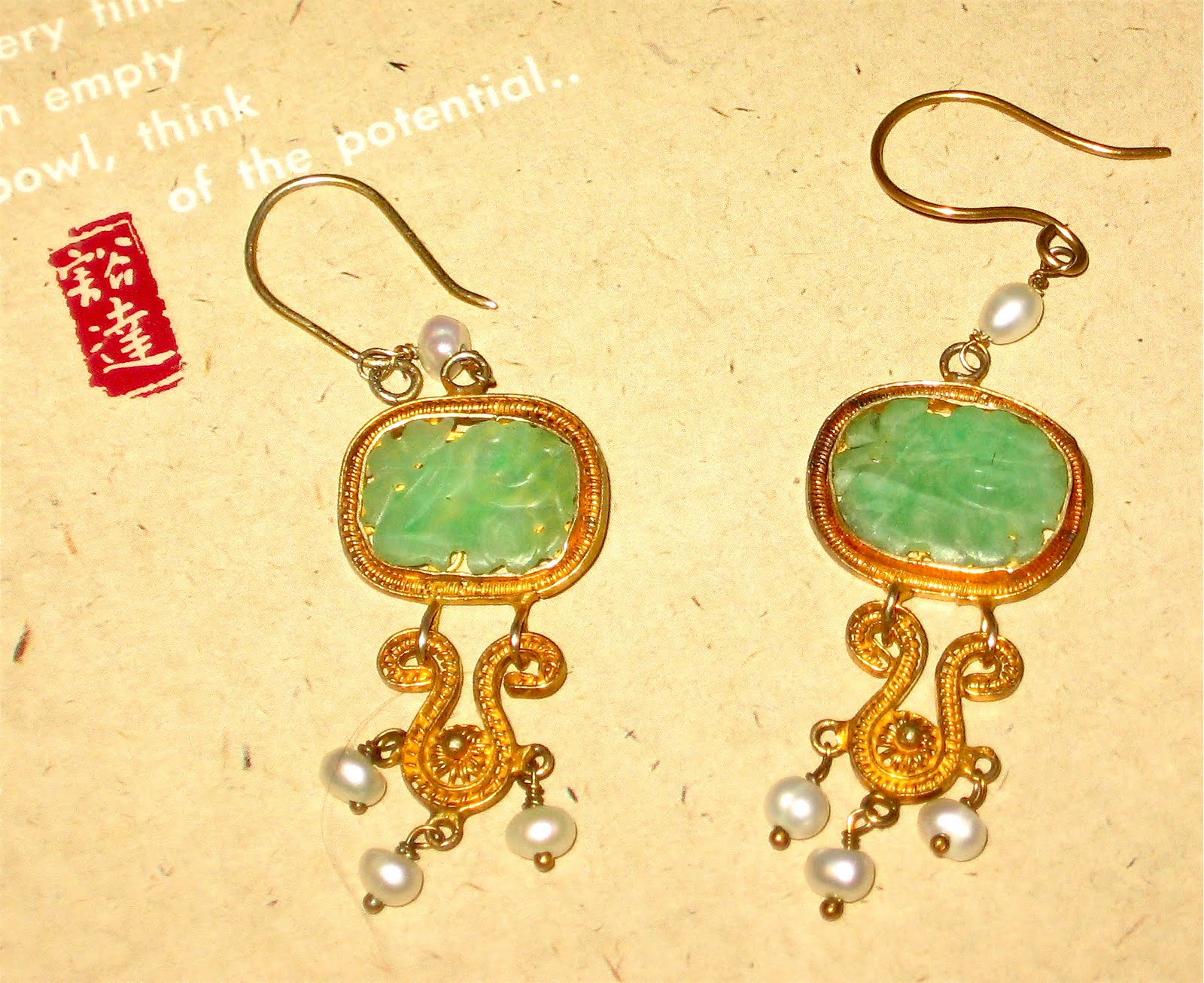
Yongkang Street is full of places that sell cool earrings, both new and old. Be careful for fake antiques sold at real antique prices, though. I bought these gold vermeil and jade beauties there, got them checked and have been told that yes, they are the real deal and probably came off of an old Chinese headdress (the big kind with dangly bits that brides used to wear and that I personally think brides should still wear because they RULE). Tai&Vin is also great to browse in this area - it can get very expensive but some of their items are affordable - it depends on whether you're buying just nicely made earrings or earrings made from real jade and antique pieces.
That Turkish earring guy (sometimes a woman works there and I'm not sure who owns it) at Tianmu International Square weekend flea market. Whenever the area across from the big stationery store in Shi-da opens for a little artisan's market, you can also find them. They sell beautiful "Turkish" (not sure if they really are - who cares) earrings in a variety of colors and shapes, screened and engraved with mehndi-like patterns.
Shi-da night market - I completely love the guy who sells cheap but gorgeous enamel earrings on the busy street in the market - another woman near the big stationery store sometimes sells them too, along with watches. At NT150 each, I couldn't help but build a collection!
Earrings above by Aliko Chen (found her in Shi-da and have not seen her since)
The weekend market at Red House - I haven't been in awhile but I assume it's still around. I bought these beauties there - the chain goes through your piercing and they hang that way. They're well-weighted and don't slip. You can find a lot of cool stuff here - and some of the same jewelry makers (and some who just sell cheaper jewelry that you can wear for fun) can also be found in the mall under Caesar Park hotel approaching Taipei Main Station.
Chinese Handicrafts Market on Zhongshan Road - I know, such a cliche, but they sell cool stuff like this. Well, I made the little puffy stars, but the two cloisonne earrings are from the handicrafts shop. Check out the selection at the National Palace Museum gift shop on the top floor, or wade through bins of ugly faux-silver-abalone earrings for one piece of pure gorgeousness on the first floor.
The Indian import store in the Wuchang Street covered market (Wuchang Street east of Bo'ai, near/across from Zhongshan Hall) - with earrings starting at NT100, you can't go wrong. The styles are ethnic, sometimes overwhelming, and very colorful. Also, extremely cheap: these are wear-for-fun earrings, not investment pieces. Also the best place to get earrings in copper tone if you're into that (I am).
Anyway, that's my fun post for the weekend - enjoy!

 What I want to know is who throws a hot dog, complete with ketchup, into the toilet.
 Someone put sunglasses on her dog and took him to Da'an Park.
 A sculpture near the SOGO in Tianmu. For serious. What were they thinking?
 What's funny about this - if I have to tell you - is that "big brother octopus" is "predicting" that it is dangerous to park or drive your car on train tracks.
 I love this building. I can't figure out where it is, but I can see it from the HQ of one company I teach at near Raohe Night Market - from the mountains, it seems to be north of Bade Road. Someday I'll set out on foot to try and get a better photo. From the 1950s tailfin balconies to the color scheme to the weird cement artsy touches, I just adore it. I'd want to live there if it were nearer the MRT.
 I wonder what we'll see from this up-and-coming young political star, Mayor Chen! (found in a used bookstore).
 Baby Panda Tumor Go!