Monday, July 16, 2018

Like a Zen koan: a review of The Stolen Bicycle

unnamed-4
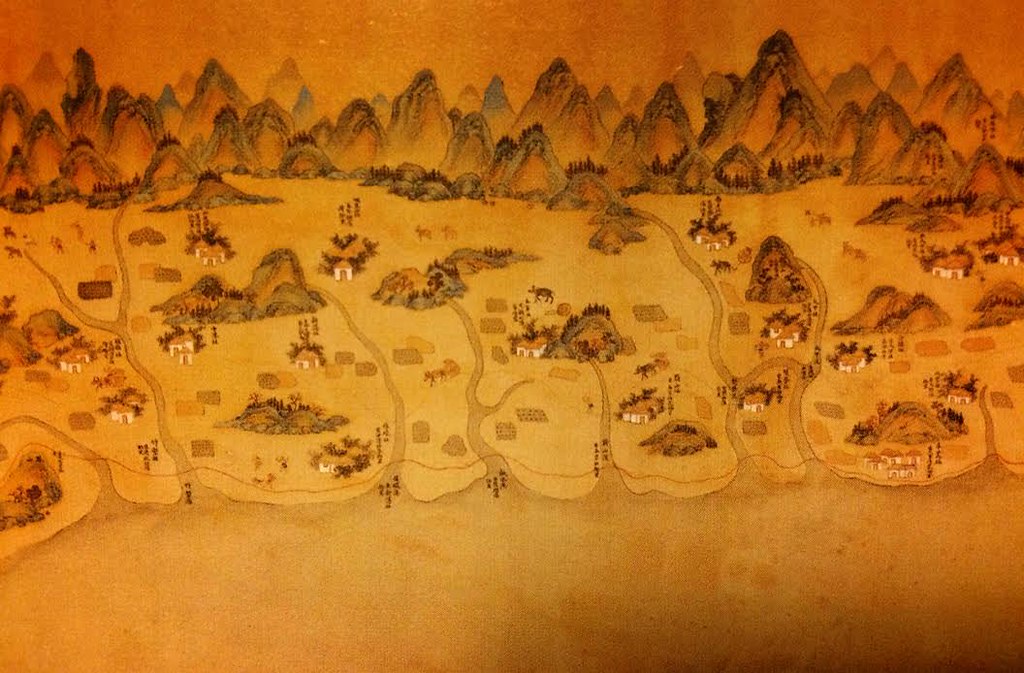
Qing-era map of Taiwan, coastal view. From Jerome Keating's The Mapping of Taiwan
(I literally just took a photo of the page)


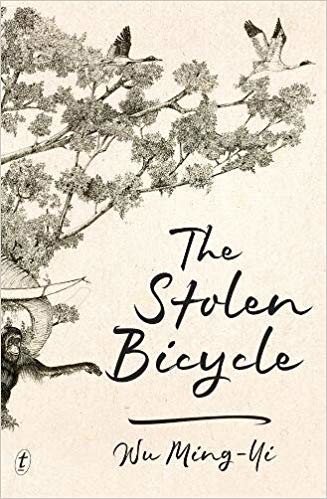
I'm not sure what to make of The Stolen Bicycle, and I suspect that's exactly how Wu Ming-yi intended it.

I mean, I'm not even sure if the story follows linear time or not. The basic plot - the unnamed youngest son of a family whose father disappeared thinks he might be able to find his father if he can find the bicycle that went missing with him - does have something of a timeline. Nothing else does, nor is it meant to: because memories both individual and collective simply don't do that. That's what they are - scattered memories of scattered people, sometimes sharing with each other. To call them flashbacks would be reductive.

The thing is, not only does he find the bicycle fairly early on in the narrative - meaning that the story put forward in the synopsis is not the story at all, but the bicycle hadn't been stolen. His father had taken it when he left. And he had known that when he set out. Of course, that's the point. There are other stories: break-ups that lovers never quite get over, the story of elephants at the old Japanese zoo near Yuanshan and their march from Burma, a war photographer's ride down the Malayan peninsula on an old Japanese military bike. Past stories of stolen bicycles, at least one of which returned. Some stories conclude, some don't. People die or are damaged, some beyond repair. Others can be refurbished. The characters trudge on.

So what is the point? I don't think Wu intends to tell us: we are meant to meditate on this almost scrap-book like collection of memories, like journal entries, interspersed with notes on the history of bicycling and zoo animals and World War II in Taiwan, along with the occasional diagram. Like Shizuko's three-dimensional side-perspective map of the Taipei Zoo, you're not meant to see it as a treasure map to X or as a plot from a bird's eye view, but as though you are flying past it on a helicopter (or maybe approaching it from the Maokong gondola, which is explicitly referenced as not having been built yet when the map in question was drawn).

Or like those old maps of the Taiwan coast, that show the shore from the perspective they'd have approached it, from the beach back to the mountains which create the spiky horizon past which nothing can be seen.

I don't mean to imply that the book has no themes - although I've just spent several paragraphs waffling about without saying what they are. There is discussion of how lives, just like bicycles (or elephants) wear out with use: and those bicycles are like our beasts of burden. Some parts get rusty, others jammed, others fall apart, some parts need replacing. Some bicycles - like lives - completely crap out and are scrapped. Others, with tender care, can be refurbished. In Taiwan, the local bicycle industry started out by importing from Japan, then imitating it, then creating its own models.

There are butterflies - a fictionalized memory within a memory - linked to Taiwan's handicraft history (though I have never seen a "butterfly wing collage" myself). The more butterfly lives that are sacrificed, the more beautiful the result.

And there is World War II: a lot of lives were sacrificed in that. Was the result, when it comes to Taiwan, beautiful?


51QpH18JY-L._SX325_BO1,204,203,200_

I don't know how else to describe The Stolen Bicycle except in these scraps of thought, and I'm leaving a lot out (I still don't understand the scene that was either in a flooded basement or the bottom of a river, nor the relationship between fine craftsmanship and wild jungle animals - though I am sure there is one). I can't imagine it was meant to be any other way.

So if this review is a bit weird, forgive me. The book is a bit weird too.

I liked it, though. It rattles around in your head after reading, like a very long Zen koan. It's not meant to make perfect logical sense, I guess. It's Taiwan from a littoral view. It seems intent on pushing you to think in paradoxes, to reach a point where you can intuitively grasp an answer that is logically impossible.

Sunday, July 15, 2018

Improve English education in Taiwan with this ONE WEIRD TRICK!

My work in Taiwan is dominated by adult students who ask for help with accent training. They need to do business with Koreans, Japanese, various speakers of Southeast Asian languages, Australians, Latinx people, Indians or various Europeans.

You see, all their teachers have been from an "Inner Circle" country (UK, Ireland, US, Australia, Canada, New Zealand). They are therefore most used to those accents, North American ones in particular. They might meet people with those accents, but for business, there is a real need to better understand other Englishes.

My life in Taiwan is unfortunately punctuated by people bloviating about how racism in the English learning industry is somehow acceptable because of "choice" or "the market" or something (their arguments don't make much sense, because they are constructed mostly to avoid confronting uncomfortable issues rather than as stand-alone opinions).

They might try to say that this is acceptable because of some sort of subjective "clarity" of certain accents, although of course how clear an accent is depends in great part on how exposed you are to it compared to other accents (these people are not exactly experts in second language acquisition).

Some pontificate on how it is preferable to be taught by a "native speaker", usually with a very poor understanding of second language acquisition or what being a "native" or "non-native" speaker might actually mean. There is even less recognition that many people in India, Singapore, Nigeria, the Philippines (and more) are, in fact, native speakers, let alone questioning why they aren't recognized as such.

(The answer is racism, by the way. But that's hard for Johnny McBackpacker to admit when it casts doubt on his strongly-held opinion that "the market" is the Fairest Arbiter Of Them All.)

My life in England is characterized by mostly non-native speaking classmates, all of whom are fluent in English, and all of whom know more about the pedagogy of how to teach English than the average Johnny McBackpacker.

Sure, they have accents. But many of them have the accents that my adult students say they need to better understand for their work. Every last one of them is qualified to teach in Taiwan, but many if not most would struggle to get hired here.

We talk about all sorts of things, not least of which is the idea of English as a lingua franca (ELF) or English as an international language (EIL). Most English learners speak regularly with other non-native speakers, some perhaps almost entirely so, especially if they are using English in business or academia.

Back in Taiwan, the consequences are not surprising - all that learning of English from Canadians, Brits and Americans (the so-called 'preferable' native speakers) has actually put those students who tell me they need help with accents at a disadvantage. They get to work and realize, oh, all that time I spent with Teacher Becky listening to dialogues between Tim and Karen, but I actually have to communicate with people who don't speak like Becky, Tim or Karen. I have to do business with Sandeep and Cheng and Fumiko and Nnedi and Abdurrahman and Lupa. 

Of course, most people making hiring decisions are not educators. Even if they realize that they are actually disadvantaging their learners by not providing the English education many instrumentally-motivated Taiwanese learners are likely to need, they don't care. "It's the market." And the market wants white - even Inner Circle "native speaker" teachers who aren't white struggle to get hired.

And I just can't help but think, if y'all hired fluent English-speaking teachers from around the world, ensuring that most learners through their time studying English were exposed to a variety of Englishes, maybe not so many adult learners would come to me asking for help, which I have trouble giving with my Standard American accent. Maybe if we hired more English teachers whose usage represented the speakers and Englishes our learners would actually be communicating with, we wouldn't have this problem.

I mean, I don't want to say "duh", but...duh?

Saturday, July 14, 2018

My latest for Ketagalan Media: an interview with Lord of Formosa author Joyce Bergvelt

When I do interviews, I don't just decide which items to include and edit responses for length. I don't even just shift topics around, although doing so is important to bring out something 'more' than just questions and answers. I also sit back and think about the responses and, in whole or at least in great part, what story they come together to tell.

This was relatively easy to do in my recent interview with Lord of Formosa author Joyce Bergvelt for Ketagalan Media.

In this case, they tell an entwined tale of the dangers of not knowing the history of one's own country and those who would seek to use that history to further their own political ends: in the case of the Dutch, a history of colonization (important now more than ever as right-wing nationalism creeps further into European politics, if it ever really left). In Taiwan, a history that includes invading forces from China.

So, while it might seem out-of-place to start with a narrative about the KMT's 12-point sun at the gate of Tainan's Koxinga shrine in an interview that has nothing to do with the KMT, if you read to the end, you'll see why it makes sense.