”He has a devil inside him,” Chthonic guitarist Jesse Black Liu says of Freddy Lim, the subject of German filmmaker Marco Wilms’ latest documentary, Metal Politics Taiwan. But he’s also a suited-up politician, elected to the national legislature.
In my review of the film, I make the case that Freddy is Taiwan and Taiwan is Freddy - that the country, too, has a devil inside it.
Metal Politics Taiwan will screen again this Saturday at the Urban Nomad Film Festival. Get tickets here.

Wednesday, May 23, 2018


Tuesday, May 22, 2018
The Rectification of Colonial Names
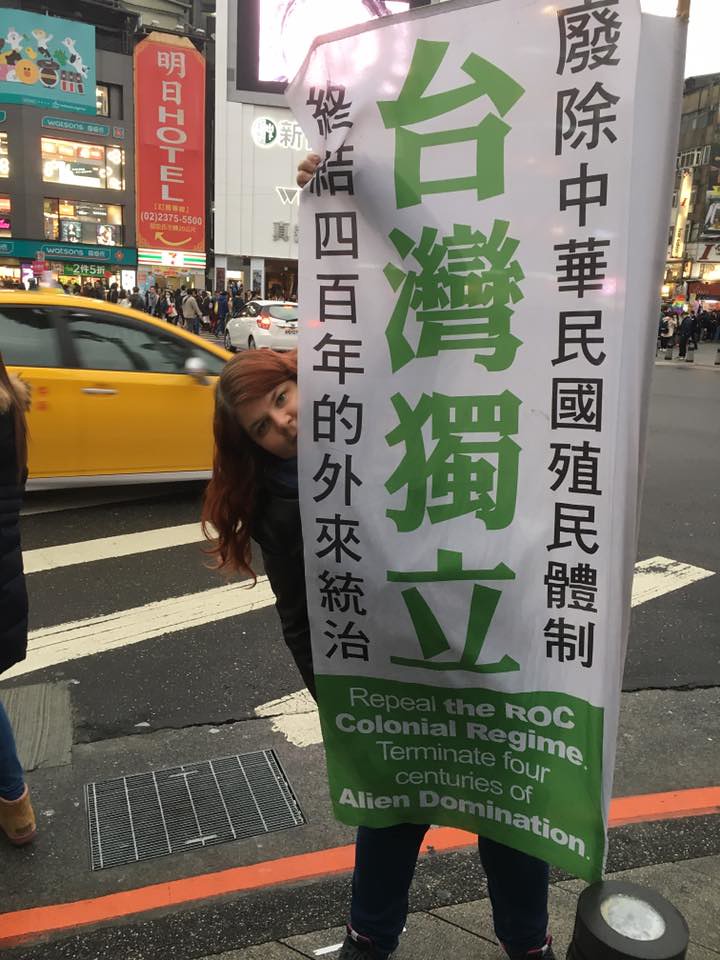 |
| This is talked about in Chinese, but not so much in English. |
Everyone agrees that the Japanese era was a colonial one and nobody disputes that the Dutch era was colonial, as well. This is true in all languages: English, Mandarin, Taiwanese, Hakka, any given indigenous language.
It's not new in political discussions in Chinese and Taiwanese to label the Qing era and the ROC era as "colonial", as well. It happens occasionally in English too: see here and here. Yet I've noticed that in English, such references still seem quite rare. The more nonfiction I read about Taiwan in English the more I notice this: the Dutch and the Japanese are "colonial", but the Qing and the ROC are rarely referred to as such. The way we talk about them lends these regimes legitimacy, a sense of being less "foreign", or a sense that if the colonizers come from China, they are somehow not just as colonial as any other invading force. They are simply "the Qing" or "the Qing era" or "the ROC on Taiwan" - as though they belong here, or it is their destiny, or Taiwan is somehow conceptually a part of China and that somehow makes it acceptable.
Calling the two Chinese regimes in Taiwan "colonial", however, is an idea I agree with. The Qing and the ROC came and extracted what they wanted from Taiwan rather than attempting to rule it as an integral part of their territory. The Qing used it as a place from which to take resources rather than a place to develop by pouring resources in - exactly what a colonial power does. At their best, they treated it as a mere defensive perimeter, a "ball of mud beyond the pale of civilization" (海外泥丸,不足為中國加廣) that they controlled simply to keep other invaders who might cause trouble for China out, not a part of China itself (only in the last decade or so of their rule over Taiwan was Taiwan upgraded to individual province).
The Qing had to be convinced it was worth taking, and the whole notion that China could rule lands beyond its natural borders (mountains, desert and sea) is actually quite modern. The Ming and everyone before them believed China's borders ended at the sea, and therefore that 'Island of Women' populated by 'savages' was simply not Chinese.
The argument put forward to the Qing by Shi Lang was not "hey this should be a part of China" but "you can use this island to cultivate sugar, rice and wood and hunt deer and it's a good defensive barrier." You know, a colonial argument. They didn't even bother taking over the whole island or to map the eastern half until some other colonial power (Japan) showed a stronger interest in it. Or, in other words, they treated it like a colony.
This treatment of Taiwan hurts us even today. When it comes to the ROC, the main argument against the idea that they too are a colonial power is a historical one: Taiwan used to be a part of China under the Qing, and therefore it can't be considered 'colonial' in the same way as the two were 'historically' united.
Otherwise, the only difference between Japan or the Dutch and the ROC is that the ROC comes from the same country as the ancestors of many Taiwanese. Even if this were definitively true (with many Taiwanese children born to a foreign parent these days - looking for a clear source on that - and Taiwan's genetic makeup being more similar to Southeast Asia than China, I doubt it is), it doesn't matter. If your only argument for being a legitimate government is "we're the same ethnicity" (whatever that means - ethnicity is a cultural construct, not a scientific grouping based on genetics), you simply do not have an argument. Ethnicity doesn't determine political destiny. We figured that out in the 20th century and it's time to apply a more modern understanding of what it means to be a nation to Taiwan.
I mean, what do we call a foreign government that takes over a piece of land and declares itself the sole legitimate government of that land without the consent of the local population? We call it colonialism.
That same power extracted resources from the land it rules - as the ROC did by gobbling up resources, putting its own in charge of large state monopolies under a command economy, expropriating land (much of which was taken for their own benefit), and using revenue from Taiwan - at one point over 90% of it - to fund the building of a military that could accomplish its real goal: "retaking the Mainland". At no point was it concerned with ruling Taiwan for its own sake. You can see that legacy in the haphazard and "who cares this is just a backwater" infrastructure development - if you could call the crumbling craphouses they built even that - that still plagues Taiwanese skylines. As Taiwan took a generation to recover from the economic double-blow of World War II and the KMT invasion, the KMT itself grew rich. As they hunted down and murdered a generation of local Taiwanese leaders and intellectuals, they themselves grew in stature and power.
What do we call such a system? Colonialism.
This is doubly true when the people are at no point allowed to vote or exercise self-determination as to whether they'd like to keep that government (even if elections are held within its framework - that's not the same as voting on the fate of the system as a whole). That it came from China makes no difference. It's still colonialism.
So why aren't we, English-speaking supporters of Taiwan, calling the ROC era, the era in which we live, the "ROC Colonial Era"? Why are we not calling it what it is?
These two ideas are intertwined: if we call the Qing era by what it really was we strike a blow against the 'historical' argument for the ROC not being 'colonial' as well. If the only other time China held Taiwan was also colonial, there is no basis for a non-colonial Chinese government in Taiwan.
In short, why aren't we more commonly telling the truth about Taiwan: that since the 1600s it has, with almost total continuity, been a colonial territory of three countries: the Netherlands, Japan and China (twice)?
I know I've got a tough hill to climb on this one: I'm still riding people's butts about not calling China "Mainland China" or the "Mainland", even among people who are pro-Taiwan. We are ceding semantic ground we really ought not to be ceding to the CCP and to annexationism in general (related: can we please stop calling it 'reunification' or even 'unification'? It's annexation. Make your names for things reflect reality). The fewer linguistic footholds we give for justification of annexation by China, the better.
But if we can't even kick that ridiculous 'Mainland' habit, I wonder how long it will be before we start using English to make reality plain.
China's designs on Taiwan are just as colonial as anyone else's. The only non-colonial government of Taiwan can come from Taiwanese self-determination, which entails voting not just within an "ROC" system Taiwan didn't choose, but voting on the fate of that system.
Until then, we live in a colonial state.
Friday, May 18, 2018
My formal application for China's "Taiwan Separatist Blacklist"
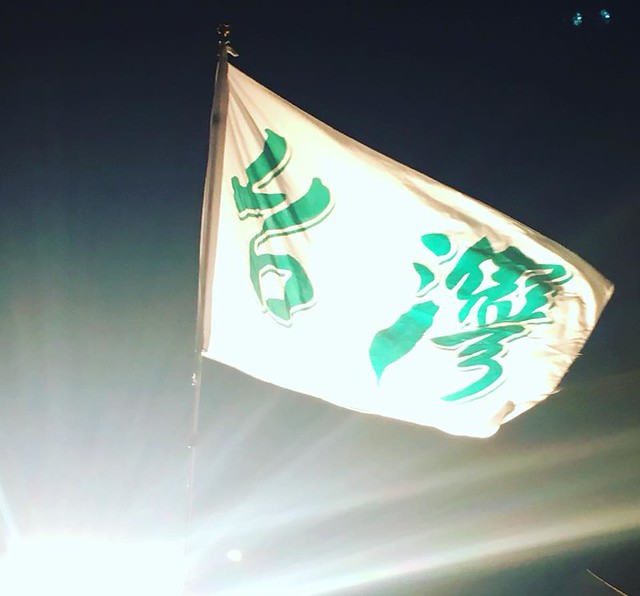 |
| I am quite serious. I want to be on China's blacklist. |
Update: we have a Facebook group! Join us, and apply for China's competitive "Taiwan Separatist Blacklist" position today!
Dear China:
Dear China:
Please consider my application for the position of "blacklisted person" on the "Taiwan separatist blacklist". I learned of this exciting opportunity in The Diplomat and feel that I am a perfect fit for the role. I have the qualities you are looking for in a suitable candidate: I am hardworking, driven and committed to the cause of Taiwanese independence. I mainly contribute through writing, but have been involved in other pro-independence activities which I would be delighted to discuss in further detail.
In terms of personal attributes, I not only support full de jure Taiwanese independence, but also hold many other positions that make me an excellent candidate for the blacklist. I support ending the government of the "Republic of China", which I view to be a colonialist state, and replacing it with a more appropriately-structured "Republic of Taiwan" (or any other suitable name that does not include "China"). I hold progressive values and believe that this vision of the Republic of Taiwan include democracy, human rights (including marriage equality) a fair and independent judiciary and suitable aspects of a social democratic state. Furthermore, I view the Republic of Taiwan as a multicultural entity, based on shared values rather than ethnicity, which has fully come to terms with its unique history as a colonial and settler state. While this history intertwines with China's at several key points, I do feel it to be separate and unique to Taiwan.
As a result, I bring to the table not only a strong support of Taiwanese independence, but progressive values which many candidates may lack and which (despite the requirements being somewhat vague) I understand your organization holds in particularly high regard when considering successful applicants to the blacklist.
On a personal note, it has always been my dream to be blacklisted and banned from China, and selecting me for this coveted position on your blacklist will be a culmination of my work as a writer to this date.
In terms of personal attributes, I not only support full de jure Taiwanese independence, but also hold many other positions that make me an excellent candidate for the blacklist. I support ending the government of the "Republic of China", which I view to be a colonialist state, and replacing it with a more appropriately-structured "Republic of Taiwan" (or any other suitable name that does not include "China"). I hold progressive values and believe that this vision of the Republic of Taiwan include democracy, human rights (including marriage equality) a fair and independent judiciary and suitable aspects of a social democratic state. Furthermore, I view the Republic of Taiwan as a multicultural entity, based on shared values rather than ethnicity, which has fully come to terms with its unique history as a colonial and settler state. While this history intertwines with China's at several key points, I do feel it to be separate and unique to Taiwan.
As a result, I bring to the table not only a strong support of Taiwanese independence, but progressive values which many candidates may lack and which (despite the requirements being somewhat vague) I understand your organization holds in particularly high regard when considering successful applicants to the blacklist.
On a personal note, it has always been my dream to be blacklisted and banned from China, and selecting me for this coveted position on your blacklist will be a culmination of my work as a writer to this date.
As the writer behind Lao Ren Cha (老人茶), a blog which is in English, not Chinese, and my status as commentator rather than activist, I understand that my professional credentials for this highly sought-after position on your blacklist might not be as illustrious as others. However, I can assure you, what I lack in qualifications I more than make up for in passion and vigor. If selected for your prestigious blacklist, I can assure you I will more than live up to expectations as a supporter and perhaps agitator for Taiwanese independence.
Sincerely,
Jenna Cody
Lao Ren Cha
Wednesday, May 16, 2018
It's not the name, it's the helplessness
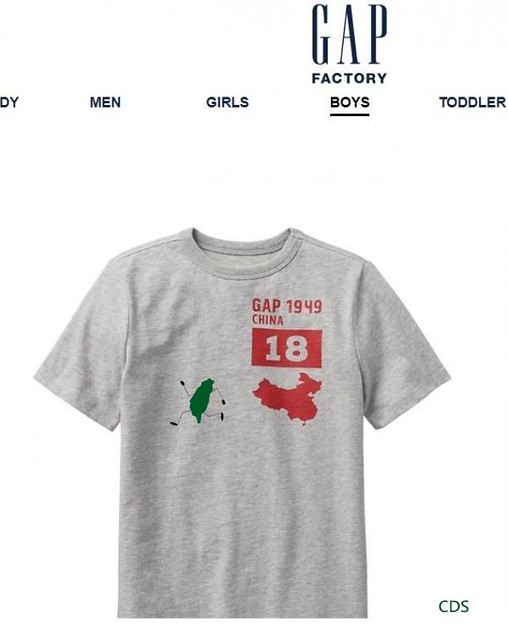 |
| Not entirely accurate, but funny |
Another day, another instance of the Chinese government being assparrots.
First, the Gap sells a really cool t-shirt that shows a map of China that doesn't include Taiwan (the picture above is a photoshopped joke version by a friend - the real one didn't include a Taiwan running away or the year 1949), and then apologizing for printing a map of China with "incorrect borders".
The borders are entirely correct (even in areas where I don't think they should be, such as Tibet and Xinjiang).
But, of course, selling t-shirts in China is more important than having a spine, and I can't even really bother to argue against that because it's about as useful as farting in a stiff breeze. T-shirts are going to matter more than values, principles or ethics for as long as I'm alive, most likely, and when I am consumed by rats or worms, they will continue to matter more than what is right.
Then, Air Canada - wobbly jellyfish to the last - changes Taiwan on their destination list to "Taipei, CN". Of course that destination does not exist. It's like trying to book a flight to Heaven, or Hell, or Oz, or wherever the Care Bears and Smurfs live. A wonderland of CCP revisionism. An imaginarium of a less just world.
"Travel everywhere with us," one of their Facebook posts says. Everywhere, it seems, except Taipei, Taiwan.
"Get your friends to travel together," another one says (on their Chinese-language Facebook page). Sure, let's travel to China (since apparently Taiwan doesn't exist), to get on our knees and pleasure Xi Jin-ping because watching him make his O-Face matters more than correct geographical labeling.
People have started petitions. Great. I went and trolled Gap on Facebook because I have nothing better to do with my time, the universe is cold and uncaring and not only are we all going to die, it won't even matter that we lived in the first place - tiny germs on a speck of dust hanging in a vast, rock-and-gas filled amoral vacuum that will also cease to exist one day. But, trolling Gap is fun so there's that.
This follows a string of "Orwellian nonsense" that's been going on for years as China acts like a massive baby - the tenderest snowflake there is - at the mere mention that a democratic nation called Taiwan exists. It's nothing new.
Of course, it hurts not that China does this - China's gonna China - but that the rest of the world caves in. That they are such cowards and hypocrites. They give in to fantasy land. Their actual moral compasses are about as sturdy as a cheap shit Gap t-shirt made in China.
And it hurts even more that there's so little we can do about it. We sign petitions as the rats get ready to gnaw our bones. We make snarky Facebook posts. Perhaps we contact our elected representative, who also cares more about t-shirts than principles. We gnash our teeth and feel upset, and it happens again and again as the vast coldness of space whirls around us, unaware.
From dust we came and to dust we shall return, but in the meantime, you really should sign the petition. I guess.
Subscribe to:
Comments (Atom)