Just wanted you guys to know that I've updated my post on an English-speaking OB-GYN in Taipei, as my old clinic has closed and Dr. Wang seems to have stopped practicing (I suspect she retired). You can get information for Dr. Hsieh here - I've just edited the old post as the old information was no longer relevant.
If anyone else has other recommendations or experiences to share, feel free to comment or contact me personally (I'm pretty easy to find on Facebook).

Thursday, May 23, 2019


Wednesday, May 22, 2019
Gym Recommendation: The Key
Over the past few months I've been gearing up to write my dissertation, and was feeling a bit blue about having lots of reading to do because I didn't want to sit like a slug on the couch doing it. A friend recommended The Key, them my husband joined and liked it, and I thought: there are surely exercise machines I could use while reading, even if it's just a bit of light elliptical or stationary bike.
I knew I could do this at the local municipal gym (which is not far from my house), but never seemed to make it down there - in part because the one in my district is in an odd location that isn't too close to anything else I need or want to do. Before The Key, none of the paid gyms really appealed to me either: either they always seemed crowded, or they were too heavily skewed toward weight training, or they were too expensive and only had annual memberships available (I travel often so don't necessarily want to pay for a month when I won't be around.)
Or, in one memorable instance, I had already heard some concerning things about the management at another gym and they way they treated people and interacted with the expat community - only to have those concerns abundantly validated recently. I didn't want to give money to a place that wasn't welcoming to everyone.
So, I joined The Key. From their Facebook page:

It currently costs NT$1500/month (renewable monthly so you cancel if you won't be in town and then return), is conveniently located near other places I often go (just north of Zhongxiao Dunhua) and at the nexus of useful transport hubs, has a big-enough room of cardio exercise machines (not just a preponderance of weight training equipment, which isn't useful to me while I'm trying to get reading done) and has a decent cafe on-site - with discounts for members - as well as a comfortable rooftop relaxing space accessible to members.
I certainly recommend it for everyone, but especially for women. Most importantly, I've never once felt judged or unwelcome as a...um, plump woman who isn't even necessarily there to lose weight the way I have at gyms in the past. Management is friendly and always accessible if you have questions or issues and they make a real attempt to remember their clients' names and faces. Overall it's just a place where I think women can feel comfortable. It's hard to put that sense of 'comfort' into words, but it's there.
The space is nicer and more inviting than the municipal gyms (though I'm happy those exist), with big windows looking out over leafy Dunhua Road. The actual gym portion of the space is above the cafe starting on the 2nd floor, so nobody on the street can see you huffing and puffing away but you can look out at the scenery. There's good wifi and free water. There are lockers (bring your own lock) including ones you can rent longer-term as well as changing rooms and showers which are clean and well-maintained.
Most of the cardio machines come with televisions and USB plugs, so you can watch TV or Netflix while you work out if you're not a hardcore nerd like me. The displays can be set to a number of languages, including English, and are fairly easy to use. They have classes where you can learn how to use the weight-training equipment (and other classes too, as well as personal training, but I'm there to work out as I read so I haven't explored those yet). There are English speakers on staff.
The space is tall and narrow as it's designed to fit into the building it occupies, but they make the most of it with an elevator so changing floors isn't too much of a pain.
So yay, The Key! If you're looking for a place where you can work out without feeling judged or potentially discriminated against or just want a place that's more conveniently-located, this is the place for you.
Note: I was not asked or paid to write this post. The opinions expressed in this review are my own.
I knew I could do this at the local municipal gym (which is not far from my house), but never seemed to make it down there - in part because the one in my district is in an odd location that isn't too close to anything else I need or want to do. Before The Key, none of the paid gyms really appealed to me either: either they always seemed crowded, or they were too heavily skewed toward weight training, or they were too expensive and only had annual memberships available (I travel often so don't necessarily want to pay for a month when I won't be around.)
Or, in one memorable instance, I had already heard some concerning things about the management at another gym and they way they treated people and interacted with the expat community - only to have those concerns abundantly validated recently. I didn't want to give money to a place that wasn't welcoming to everyone.
So, I joined The Key. From their Facebook page:
It currently costs NT$1500/month (renewable monthly so you cancel if you won't be in town and then return), is conveniently located near other places I often go (just north of Zhongxiao Dunhua) and at the nexus of useful transport hubs, has a big-enough room of cardio exercise machines (not just a preponderance of weight training equipment, which isn't useful to me while I'm trying to get reading done) and has a decent cafe on-site - with discounts for members - as well as a comfortable rooftop relaxing space accessible to members.
I certainly recommend it for everyone, but especially for women. Most importantly, I've never once felt judged or unwelcome as a...um, plump woman who isn't even necessarily there to lose weight the way I have at gyms in the past. Management is friendly and always accessible if you have questions or issues and they make a real attempt to remember their clients' names and faces. Overall it's just a place where I think women can feel comfortable. It's hard to put that sense of 'comfort' into words, but it's there.
The space is nicer and more inviting than the municipal gyms (though I'm happy those exist), with big windows looking out over leafy Dunhua Road. The actual gym portion of the space is above the cafe starting on the 2nd floor, so nobody on the street can see you huffing and puffing away but you can look out at the scenery. There's good wifi and free water. There are lockers (bring your own lock) including ones you can rent longer-term as well as changing rooms and showers which are clean and well-maintained.
Most of the cardio machines come with televisions and USB plugs, so you can watch TV or Netflix while you work out if you're not a hardcore nerd like me. The displays can be set to a number of languages, including English, and are fairly easy to use. They have classes where you can learn how to use the weight-training equipment (and other classes too, as well as personal training, but I'm there to work out as I read so I haven't explored those yet). There are English speakers on staff.
The space is tall and narrow as it's designed to fit into the building it occupies, but they make the most of it with an elevator so changing floors isn't too much of a pain.
So yay, The Key! If you're looking for a place where you can work out without feeling judged or potentially discriminated against or just want a place that's more conveniently-located, this is the place for you.
Note: I was not asked or paid to write this post. The opinions expressed in this review are my own.
Monday, May 20, 2019
Despite some unfortunate headlines, media coverage of Taiwan recognizing same-sex marriage is exactly what we needed

Pro-equality activists have been talking about the tangential benefits of same-sex marriage (or better yet, marriage equality) in Taiwan for years, most notably that it would be a massive boost to Taiwan's international visibility. Just imagine the international media coverage, all focused on Taiwan, especially if we're the first in Asia, we've been saying since...forever.
Last Friday it happened. We laughed, we (happy) cried, it was the feel-good legislation of the year. And just like we said, the rainbow explosion wasn't limited to Taiwan. Every major media outlet around the world - not just the ones in Western nations - carried the news.
Let's put that into perspective. After 2014, when I mentioned "the Sunflowers" to my friends in the US, I was met with blank stares. I may as well have been talking about actual sunflowers that you can grow in a garden. This time, I don't think I have a friend or relative in the world who hasn't heard the news. Taiwan did something huge, and it mattered to the news cycle that it was the first country in Asia to strike a blow for equality.
Wait, what was that I just said? First country?
Reading most English-language media, unfortunately, that word has been avoided with the most, um, ductile of language choices (please enjoy some links to examples). First place in Asia. The island's parliament. Taiwan's parliament...in historic first for Asia. First in Asia.
First what in Asia? It seems nobody is willing to clarify. Or if they are, it's a 'state' (how is that different from a country?) or a 'self-ruled island'.
Of course, a few incompetent dipclowns (like the World Economic Forum) kind of soured it by calling this country "Taiwan, China", The Guardian called Taiwan a country on Instagram then issued a correction that it was a 'state', and now seems to have taken the post down (I can't find it to link it), and of course the Chinese media gonna Chinese media and whatever.
I propose, however, that the good reporting on this issue (and reporting that is good for Taiwan) has far outstripped the few geographically-challenged dumbos.
First, plenty of media did call Taiwan a country. USA Today called Taiwan a "country" via the Associated Press. The Chicago Tribune used it in their headline too, as did Quartz. The New York Times didn't use that word in their title, but they managed to find a quote to help them slip it in, and CNN did too. Bloomberg managed to stick it into three separate quotes the day before the vote (good job!), and a Bloomberg-affiliated video on Youtube uses the word "country" and so did DW. ANI (from South Asia) called Taiwan a "nation", Bustle called it a "country". Here is The Economist using it in their first paragraph and The Washington Post using "nation" towards the top of the article. There are surely more - there are only so many articles on the same topic that I can read.
That's a lot of major media calling Taiwan a 'country' or a 'nation' and a lot of readers who will now understand that Taiwan is indeed a country. Nothing at all to sniff at.
Look beyond the English-language media, and it gets even better. On Twitter, Pierre Baubry noted that most French media called Taiwan a country:
Most French media yesterday used "country" to describe Taiwan.— Pierre-Yves Baubry (@pybaubry) May 18, 2019
Bilan de la journée d'hier dans les médias français : Taiwan a fait la une, et le mot "pays" s'est imposé largement pour le décrire, d'Ouest France à France Culture, de BFM TV à Euronews, de Têtu à RFI... 😊
...and that lines up with my admittedly shallow research (the sub-headline in Le Monde called Taiwan a 'country'). It's the same in Spanish. No, really. There seem to be very few outliers, and even this one references the word "country" within the first paragraph.
But you know what? That's not even the best part.
The best part is that almost every single one of these stories, whether they called Taiwan a 'country', 'nation', 'place', 'state', 'island' or nothing at all ('first in Asia!'), focused on Taiwan itself.
Not its relationship to China. Not what China thinks about Taiwan. Not China's reaction. Taiwan. The deliberations of Taiwan's legislature. What Taiwanese voters and demonstrators think. What President Tsai did. Taiwan's domestic political situation. China was a non-entity, as it should be, seeing as it's a totally different country. I mean, our buddy Ralph "I hate Taiwan but still write about it" Jennings framed his piece in relation to China but...well. Who cares - at least this time - if one guy buried the lede?
What I mean is, for once, the international media mostly reported on Taiwan the way they should have been all along.
When China was mentioned, it was either in passing without any of that 1949 claptrap, or it was to compare Taiwan favorably to China. Yay!
From the Washington Post:
In neighboring China — which asserts sovereignty over Taiwan — popular LGBT microblogs were censored online in the wake of Taiwan’s 2017 high-court ruling. The social media platform Weibo was criticized last month for restricting LGBT hashtags.
Taiwan has shown that “traditional culture is not against LGBT culture,” said Jennifer Lu, coordinator of the rights group Marriage Equality Coalition Taiwan. “That’s the message we want to send to the world.”
Another great thing? All of the amazing soundbites from Taiwan being reported around the world, which focus specifically on the progressive conversation happening here. From the Washington Post:
Tsai, the president, voiced her support of the legislation in a Twitter post, saying that Friday marked “a chance to make history and show the world that progressive values can take root in an Asian society.”
And another one from WaPo correctly pointing out that this has long been an issue in Taiwan, correctly delineating Taiwanese activist history as continuous and robust:
Chi Chia-wei, a gay rights activist for more than 30 years, said he was “very, very happy” to see Taiwan legalize same-sex marriage, calling the process “a strong demonstration of our democratic spirit.”
From the New York Times:
“Taiwan has become the first country in Asia to legalize same-sex marriage,” it said, “successfully striding toward a new page of history!”
Human rights activists said they hoped Taiwan’s vote could influence other places in Asia to approve same-sex marriage.
From The Guardian:
“What we have achieved is not easy,” said Victoria Hsu, the founder and executive director of the Taiwan Alliance to Promote Civil Partnership Rights. “The law will not be 100% perfect, but this is a good start and this is a major step to end discrimination based on sexual orientation. Now the law says everyone should be treated equally no matter who you are, who you love.”
In another Washington Post piece, properly situating Taiwan as a progressive leader in Asia:
The vote in Taiwan helps “signal it’s not an East-West thing or global North global South thing,” Knight said. Officials in Brunei will have a hard time defending such harsh anti-homosexuality legislation, he said, “when the map of the Asian region is moving clearly in the opposite direction."
From The Economist:
In Asia, Taiwan has long stood out as a bastion of gay rights. The annual gay pride parade in Taipei, the capital, draws tens of thousands, many from overseas.
You guys, this is the kind of reporting that gets the world to wake up and notice Taiwan. This is how we show everyone not only that human rights are not an east-west issue (or a Global South/Global North one, though I would not say Taiwan is in the Global South developmentally), but that Taiwan is a bastion and a leader in Asia. This is how we show them how vibrant Taiwan's democracy really is, and that in fact a lot of interesting things take place here that they probably had no idea about, because the media never bothered to report on it.
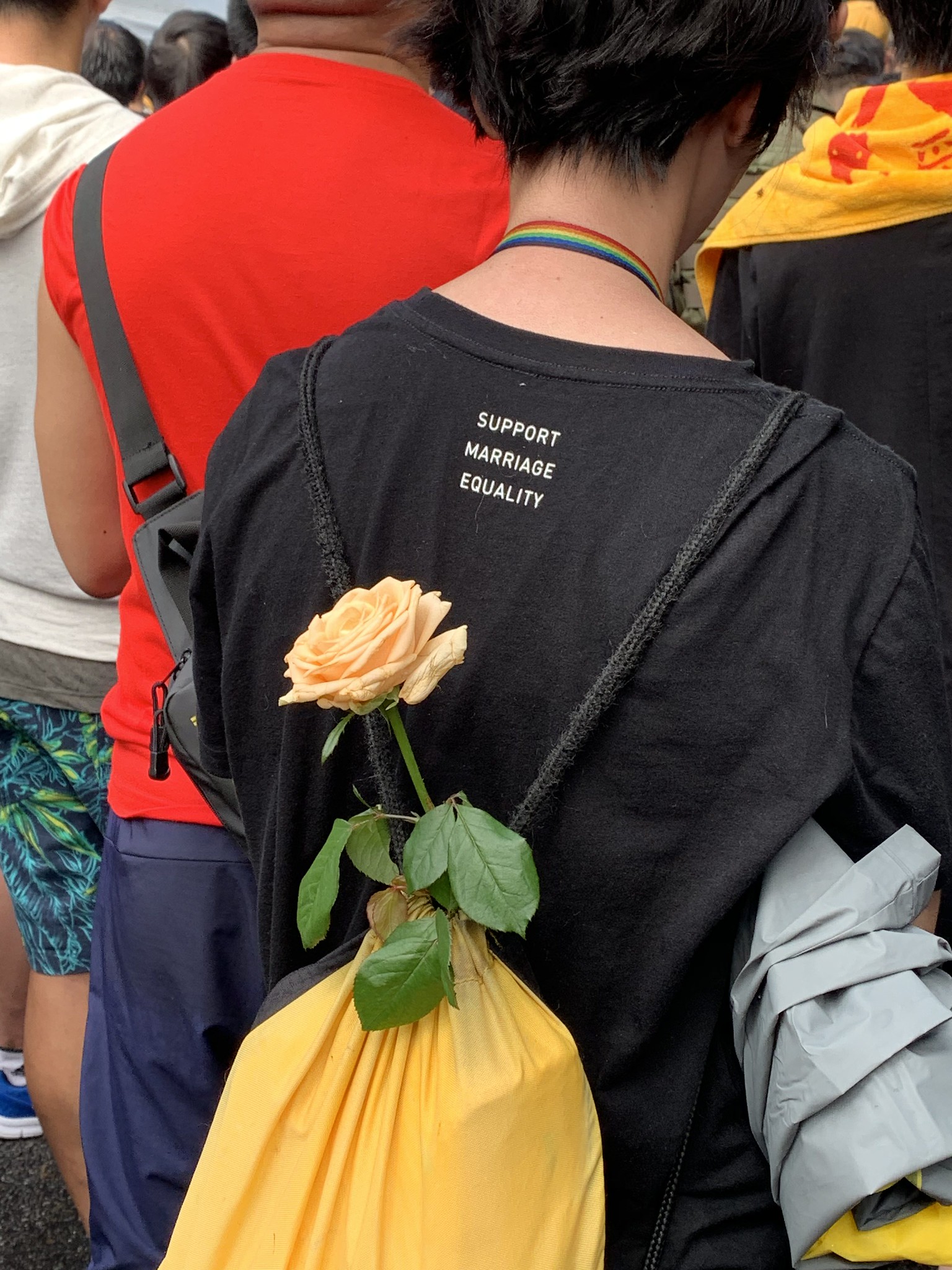
For that, I'm willing to overlook a few weaklings who wouldn't dare to just write "country" (and a few purposeful jerks like the World Economic Forum).
Overall, this is a win for Taiwan. Taiwan the country, Taiwan the regional leader, Taiwan the bastion of progressivism (at least by Asian standards).
Now, how do we get all those journalists to keep it up?
Saturday, May 18, 2019
What it meant to be an ally when Taiwan became the first Asian country to legalize same-sex marriage

I wrote a longer reflection yesterday in which I wandered through many thoughts and emotions on yesterday's historic legislation. For this post, I want to highlight one thing that I think is important when you support an issue or social movement, but aren't a part of the group that that movement affects most deeply. That is, I want to talk about what it meant to be an ally standing in the crowd yesterday (yes, there is a little repetition between the two posts). Let's start here:
The level of civic engagement continues to impress me so much, and proves that Taiwan cannot be grouped so easily as a stereotypical 'Confucian', 'collectivist' society with wholly conservative values. It may be true that many young Taiwanese won't engage with their more conservative elders on these issues, but it's not true that they won't find other ways to oppose the old order of unfairness and inequality and a million -isms and phobia that those elders represent.
One of the arguments of the anti-gay camp is that ideas like marriage equality are 'Western' or 'foreign' and go against Taiwan's 'traditional culture' (they say 'Chinese' but I won't.) You know, all that Confucianism and collectivism and filial piety and what not. It's not that those aren't real facets of the culture, it's just that the whole culture cannot be reduced to them, nor can the actions or beliefs of any individual be explained wholly through them. People are not slaves to whatever aspect of their culture someone has decided explains their motives, and culture isn't static anyhow. 20 years ago you could have said the same thing about American culture.
Of course equal rights have been a part of Taiwanese culture for some time now, and there is no incompatibility with Taiwanese culture (any incompatibility which seems to exist has been invented for political purposes).
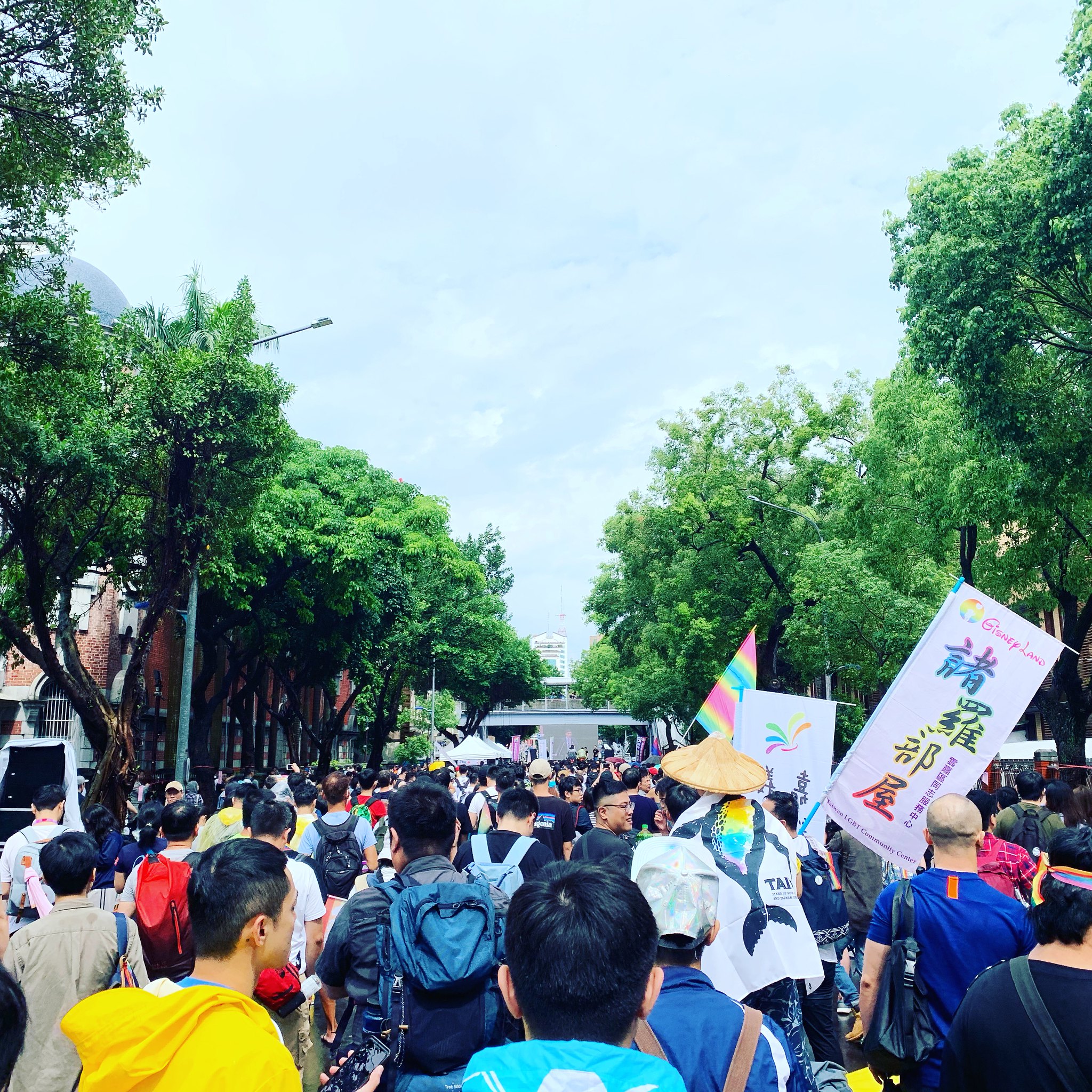
So it really mattered that the people in the front rows and on stage, the crowds on camera were overwhelmingly Taiwanese. If 'marriage equality' is not compatible with 'Taiwanese culture', what were all those people who are Taiwanese and exist within a Taiwanese cultural milieu doing there?
Or as President of Taiwan and my current crush Tsai Ing-wen put it:
Good morning #Taiwan. Today, we have a chance to make history & show the world that progressive values can take root in an East Asian society.Today, we can show the world that #LoveWins. pic.twitter.com/PCPZCTi87M— 蔡英文 Tsai Ing-wen (@iingwen) May 17, 2019
It's important to keep repeating this, because that same opposition keeps accusing the pro-equality movement of doing the same, when it emphatically has not. The side that stands for equality has allies who stand with them. The side that stands against equality has foreign actors trying to help manipulate a certain outcome in Taiwan. And they are the ones who invented that 'goes against traditional Taiwanese culture' nonsense.
Marriage has meant many things in Taiwan over the centuries, including plural marriage, family-alliance marriage (that is, not love marriage) and marriage to ghosts. In China, there is a clear cultural tradition of homosexuality (at least among the upper classes).
It's actually a reductive neo-essentialist perspective - which is inherently Western - which turns so-called 'traditional values' into culturally static and immutable obstacles, a view one tends to take of cultural facets viewed from afar without full understanding. That almost every young person in Taiwan is pro-equality and yet still just as Taiwanese as their grandparents, however, shows that this outsider essentialist view of Taiwan is wrong.
As an American who was in Taiwan for most of the culmination of the marriage equality movement in the US and so unable to participate (again as an ally - I'm straight and cis), it felt important to be a part of the support to make it happen in Taiwan, because it's my home. I have a place here too. What happens in Taiwan affects me.
And that place was being part of the crowd. Not onstage like a reverse Katy Faust, not a key part of the movement or even vital to it, but a participant who adds her physical presence to the movement. Foreigners were there lending their support too, but it's Taiwanese who led this, Taiwanese who made up the majority of that crowd, and Taiwanese who won. We just stood by them, and that was a meaningful place to be.
As an ally, I've reconsidered my own feelings on the Executive Yuan bill which passed yesterday - after being initially upset and disappointed, it became clear that Taiwanese LGBT groups and the local LGBT community were supporting it, and to be a good ally, I should follow their lead.
Let's stop telling Taiwan what its culture is, while we're at it. Let's quit it with the "but Taiwan is like this" or "Taiwan can't do that, because culture and reasons" or "but Taiwan is so Confucian and collectivist". Pish. Instead, let's be allies and let them tell us.
It's a humbling, meaningful and impactful place to be. I recommend trying it.
Subscribe to:
Posts (Atom)