Tuesday, April 6, 2021

Review: The Lost Garden

As with the fictional garden in the title of this novel, it's hard to know where to begin with Li Ang's 1990 classic, not always clear which path you're on, nor where it will bring you, nor where or whether exactly it ends. If other writers use framing devices, spiraled time or narrative parallels in their work, Li Ang turns her story into a literal garden path. 

Li Ang 李昂, not to be confused with the famous film director, is the pen name of Taiwanese feminist writer Shih Shu-tuan 施淑端. Well-known in Taiwan, most notably for her 1983 novel The Butcher's Wife, very few of her works have been translated into English. She's known for her frank engagement with politics and criticism of the KMT, her feminist critiques of patriarchy in Taiwanese society, and her even more frank exploration of psychosexual themes and female desire. 

The two main stories -- the first of protagonist Chu Yinghong's childhood in the garden with her spendthrift father Chu Zuyan, worried mother and household staff, the second of Taiwan's booming real estate market and the seedy nightlife of the nouveau riche that boom created -- gracefully curve around toward each other, then away in a series of figure 8s, or infinity symbols, or two garden paths that intertwine in places but may or may not connect at the other end. 

Yinghong's childhood is partly the honey-hued memories of a child: the gossip of the staff, looking through carved windows shaped like vases, her father spending time in different parts of the garden, her mother's perfumed nightgowns. And it's partly the dark undercurrent of Taiwan's White Terror: her father had been sent to prison, only freed because it was thought he would die, and is still being watched. 
Smaller stories wend themselves away from this central path as well: how the garden came to be, the odd names of some of the pavilions, such as "Flowing Pillow", the flowers themselves, a teacher at school, a fire deliberately set, her father's purchases, something Yinghong once wrote in an essay which places her character as the inheritor of Taiwan's older and often crueler history. Some are dead ends, some meander back into the story. Some look as though they are going toward one pavilion but then turn abruptly toward another. 

On the other path, an adult Yinghong resolves to win the affections -- marriage, though perhaps not love exactly -- of real estate tycoon Lin Xigeng, despite his known carousing and previous marriages. Metaphorically, the story works: Lin is the 1970s "Taiwanese Dream", the new real estate boom, the Asian Tiger moneymaker. One reviewer described him as seeming like a 'white phoenix' rising from the ashes of the old Taiwan Yinghong knew, as well as Gatsby-like in his chasing of his gold-plated dreams. I'm not so sure about that, as Lin doesn't appear to have any sort of inner life; if he does, from Yinghong's viewpoint we get no sense of it. The main thing she seems to want from him is the funding to renovate her family's garden.

That, and sex. Li Ang explores the different ways their sex life manifests, and the feelings it engenders: trepidation, titillation, desire, dissatisfaction. There is perhaps a sense that she ends up trading her sexuality for an unsatisfying marriage to a fundamentally unappealing man in order to get what she wants for her family's legacy, which is tied up in a curse handed down from one of her ancestors. At the end, Yinghong realizes exactly what it is the curse has taken from her. 

Before that, though? Reader, there is quite a bit of blowjob. It is...how do I say this -- very much a lot. These pages explore Yinghong's inexplicable combination of desire and reticence or even perhaps revulsion, and they are exceedingly graphic. To this reader, that much time spent with an unappealing man's penis also felt like the literary equivalent of an unsolicited dick pick. I suspect, subtextually, this might have been intentional. 

Everything about Lin and his 'set' is portrayed as crass: superficially glittering (in one venue the ceiling is literally spray--painted gold) but ultimately cheap. Where she begins to see a marriage with him -- the old and the new together -- as a path forward for a modern Taiwan, she ends by realizing that she alone is the true inheritor of Taiwan's past, and he is means to an end. Look for this in one of the final scenes: he may carry on affairs and act like he's king of the island, but in that garden he is lost without her. 

That Chu Yinghong is portrayed as more sympathetic than Lin Xigeng (who feels more like a cardboard cutout than a man -- that is, a cardboard cutout with an exceedingly annoying penis that just keeps popping out whether you want it to or not) is the inevitable result of a narrative that contains semi-autobiographical elements. Li Ang, after all, was born to a wealthy Taiwanese family in Lukang which stood against the KMT. 

The garden path I most enjoyed meandering down was the political one. Rather than explain in dull detail how Li Ang uses botanical metaphors to achieve this, I'll share a passage: 

Ignoring objections from elders in the clan, Father went ahead with his plan. He disagreed with their practice of imitating Mainland garden architecture, including planting similar trees; the saplings they had taken so much trouble to find on the Mainland would not necessarily thrive in Taiwan. 

‘Why plant trees that won’t do well in the local climate? It’s better to grow indigenous trees and flowers,’ Father continued in Taiwanese. ‘Your children may be born in the year of the dog or the pig, but they’re still your own flesh and blood.’

Pines from the frigid zones baked in the harsh sun of central Taiwan for nearly half the year and lost the resilience of evergreens in the snow, where deciduous trees wither till the spring. They manage to put forth anemic needles on shapeless branches. The pines were dug up and replaced by star fruit trees. 

The star fruit trees came in mature forms, though many leafy branches were trimmed for the transplanting process. When spring arrived, tender, green, delicate leaves sprouted with impressive vitality. With the autumn wind came blankets of red flowers, so tiny they weren’t particularly attractive by themselves, but the concentration of many shades of red presented an eye-catching yet sorrowful beauty, especially when blown off to the ground by strong winds. The ground was covered with small flowers, like blood-red tears. 

With the arrival of winter, the tears disappeared, as if they’d shed their last drops of blood, and were replaced by small star fruit hanging on the trees like tiny green stars....but soon afterward, the starlike fruit began to fall, until not a single one was left. This time Medan explained that the newly transplanted trees needed time to recover from the uprooting and branch trimming before they could properly nourish the fruit.


Oof, right?

Comparisons are drawn to many of the historical gardens and homes across Taiwan. You can see in the description of the garden and the family that inhabits it -- as well as its placement in the distant suburbs of Taichung -- something of the Wufeng Lin family mansion. In the 'old Taiwan' aesthetic and silted-up port, you see Li Ang's hometown, Lukang. In the meandering garden paths and pavilions, perhaps a shade of the Banchiao Lin family garden. 

These implicit comparisons invite the reader to consider the ways such old families have shaped Taiwan, especially when Yinghong is asked why she chose a private management trust for the Chu garden rather than donating it to the government. Notably, the Lin Family Garden in Banchiao chose to work with the government (which is why the entry fee is so low). The Lin Family Mansion in Wufeng chose to continue private management. 

Chu Yinghong explicitly addresses this, asking why she'd give her family's garden to the government that oppressed her father. 

It's a good question, and teases out the ways that politics, money, cultural heritage and love (or lust) can shape individuals, families and a nation.

Monday, April 5, 2021

Updates! Get yer hot, fresh updates!

Untitled


This is just a quick maintenance post to showcase some updates I've made. I've been going through my pages (pinned to the top of the main page) and updating them one by one, with the Best of Taipei page getting the most love. The blog roll and Books About Taiwan pages have received minor updates. Look for Indian Food in Taipei to be updated shortly with reviews of Moksha, Nataraj and Janny Curry House.

I've given this post about the temple to Chiang Kai-shek in Hsinchu a thorough overhaul, as well, as I had the opportunity to visit not long ago. I've included important things like a name and an address for the temple, which I hadn't bothered to do before because I was a terrible blogger. 

This also feels like a good time to make a post pointing out that I've been writing for Taipei Magazine for awhile now. I never bothered to mention it because I had thought the content was print-only. It turns out it's available online, so I'll be linking to it more. That's professional work that I do for pay, so the tone and content will be different from Lao Ren Cha

Here are a few of my favorite pieces for them: 

Of Paper and Leaves: Extraordinary Taipei Oases

Pick Up Your Weapon, Even If It's A Pen: a conversation with Taipei illustrator A ee mi

Flowers for All: recommended routes for flower-viewing day outings in Taipei


Finally, this is a good time to announce that I'm considering changing platforms. I like the features of Blogger that allow me to have pinned pages at the top and a sidebar archive, but the formatting is a mess. If you've ever noticed weird line spacing, font spacing/sizing issues, random font changes or stretched-out photos, this is entirely due to problems with the platform. I want something better and less stressful, as once those issues appear in a post they're difficult to fix.

I don't want to monetize; I do this for free for a reason. So don't worry, I will never move to a platform that will force my readers to pay for content.

I haven't made any decisions yet, but Lao Ren Cha might be moving! 

Saturday, April 3, 2021

Chiayi: Taiwan’s Underrated City

Untitled


Through the years, I’ve written up accounts of my travels to different parts of Taiwan, though not every trip. But through all that, I had managed to spend 15 years in Taiwan making only the most cursory visit to Chiayi city. It’s just not a place I’d thought to spend much time. I was aware that there were things to do there, but the lack of local public transit in what is a reasonably-sized town and the attractions of places I know far better kept getting in the way.

I had an 'errand' to run, really more of an excuse to head to the city and poke around. Knowing my primary destination (the Museum of Old Taiwan Tiles) was small and would not take all day, I also picked out a few other things to do in Chiayi before meeting a friend for dinner in Taichung. I chose a weekend when I knew I’d have to be in Taichung on Sunday, so that my HSR tickets would be reimbursed.


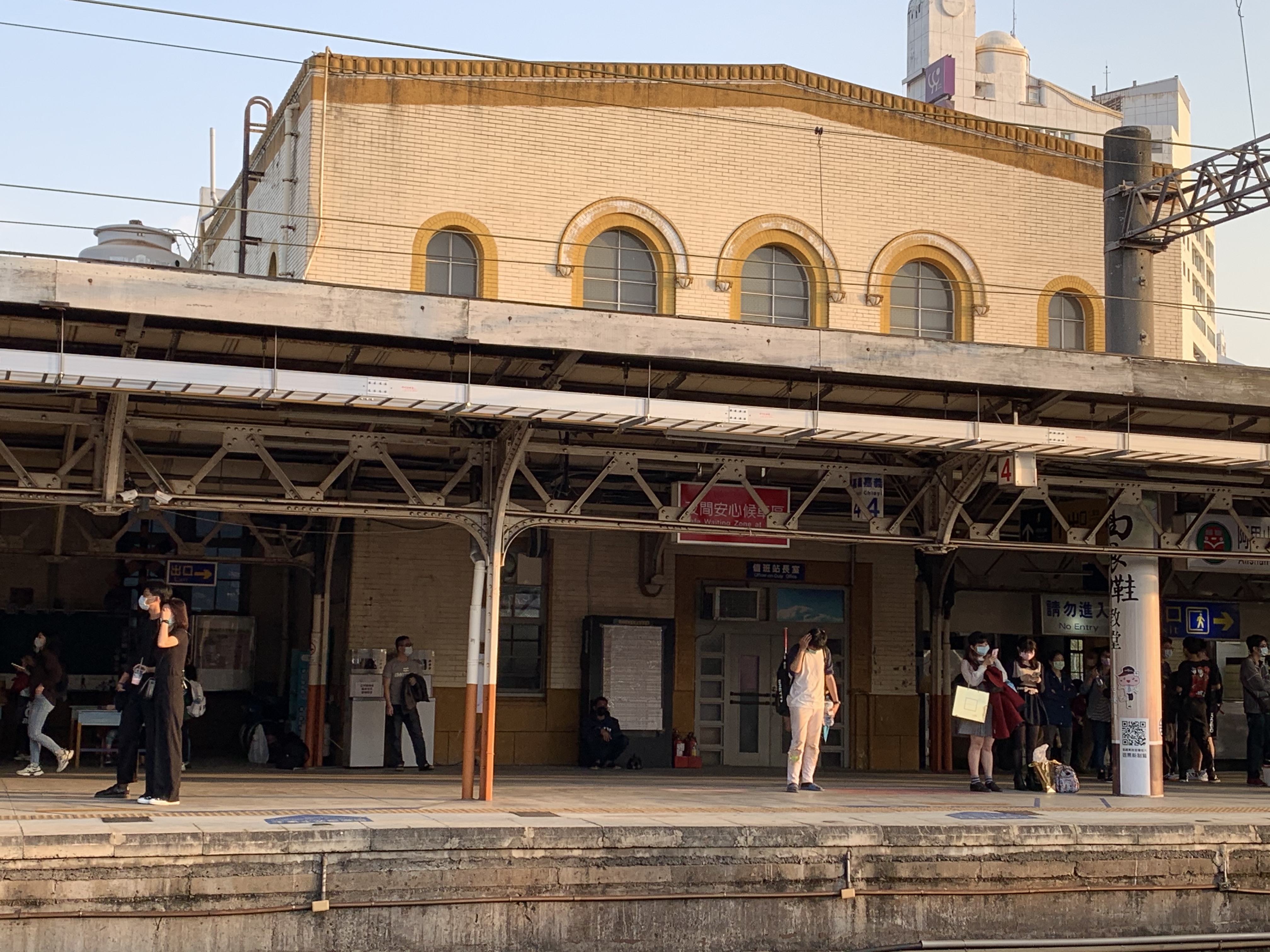
The Chiayi Koji Pottery Museum appears to be permanently closed — a shame, as I had been able to enjoy such an excellent exhibit on it only a few weeks previously in Xuejia. However, I put the City God Temple, the Japanese-era prison, a Japanese residential area (now the “Hinoki Village”) and the Kagi Shinto shrine (now a cultural center, but the building is still intact) on my list. The train station is also worth a quick moment to admire.

Untitled


In addition to the museum, I only made it to the City God Temple and the shrine; there just wasn't time for the prison and old residences, but it was a day well-spent and I now have reasons to return! 


I took the overcrowded but free bus from the HSR station, which is inconveniently far from town. Dropping my overnight bag in a locker at the train station as the regular left luggage counter was closed for lunch, I headed off. The museum is a short but somewhat unattractive walk from the train station. 

I didn't head that way, but I want to point out that near the train station, just behind the tracks, is a neighborhood called Fanzigou 番子溝 which translates literally to "Savage Ditch" -- I bet there's not much to see there now, but I suspect that's where the border ditch would have been between Indigenous and Han territory, perhaps not that long ago.


The Museum of Old Taiwan Tiles 臺灣花磚博物館


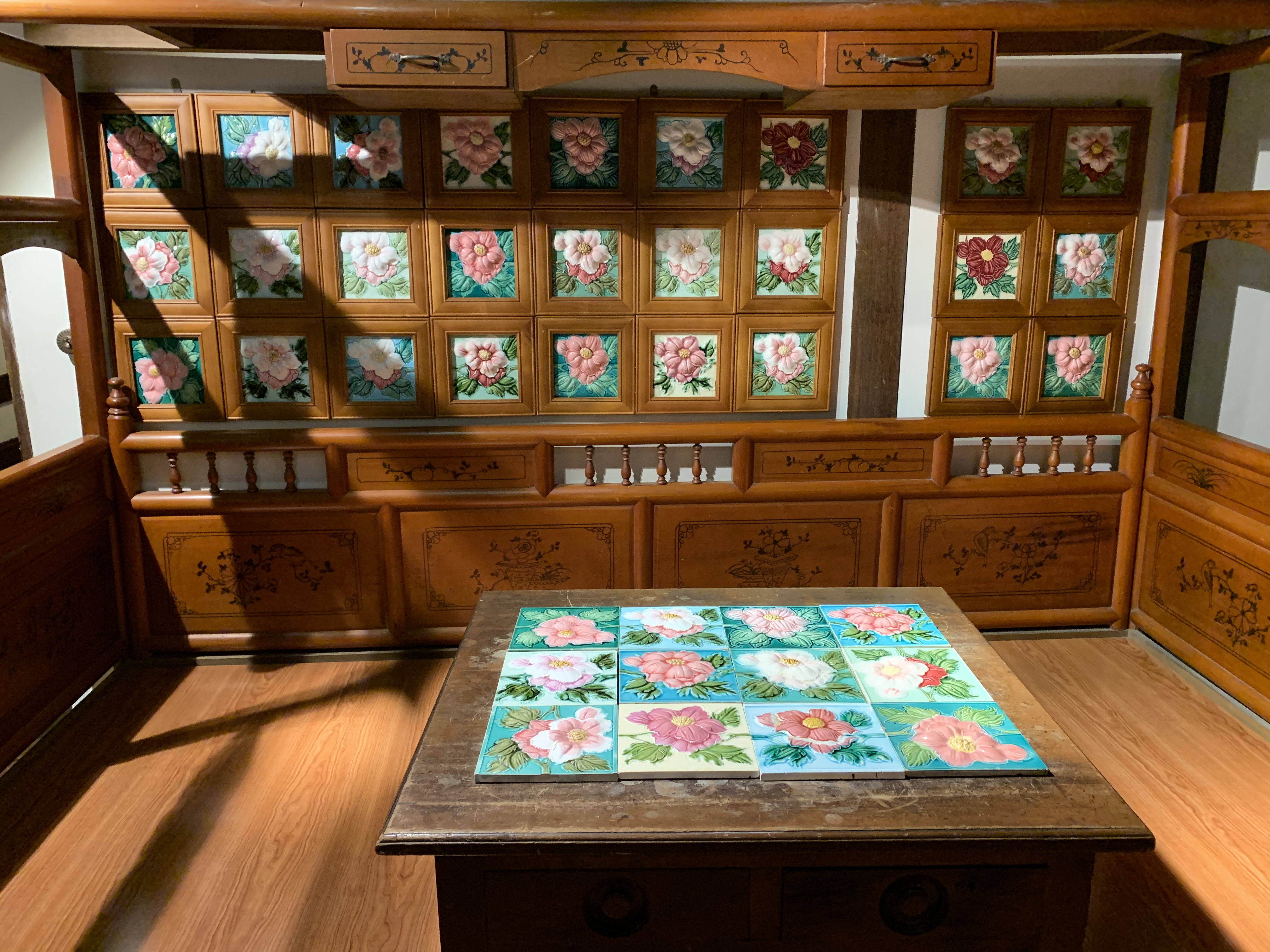
Recently, I’ve come to really appreciate the work of the Museum of Old Taiwan Tiles, which produces its own Taiwan-made Majolica-style tiles. The originals can be found on old farmhouses and mansions across the country (there are some good examples in my last travel post, about Xuejia). The museum/company not only saves tiles from old houses being demolished, but produces both factory-manufactured and hand-made tiles, as well as a variety of products using the tiles or their patterns. Although there are branch shops in both Taipei and Tainan, I resolved to visit the museum’s main location in Chiayi. 


Untitled


I had a mission, too: I knew that they sold bathroom mirrors with tile borders, and I wanted one if I could get it in a custom size, to fit my space specifically. The Taipei store in Ximen’s Red House market assured me that the manager, Ms. Liou, would be able to help me with a custom order. 


I had Ms. Liou's Line, but figured that this would be a good excuse to check out the museum itself. Although she isn’t the founder (that would be James Hsu), she seemed involved enough that if I popped down there, she’d likely be around.


Untitled 


The Museum of Old Taiwan Tiles is small but very much worth a visit. Hundreds of vintage tiles are preserved in frames or in rooms furnished with vintage furniture in a lovely old building that was once a timber shop. 


You can touch the vintage tiles, but not buy them (everything for sale is new, but of very high quality — some machine-made and quite affordable, and some hand-painted and far pricier), and there are a few places to sit and just enjoy your surroundings. Many locals come to take posed photos with vintage backgrounds. A few tablets discreetly placed upstairs detail aspects of tile making or the history of decorative tiles in Taiwan; one is bilingual. One can really admire the commitment to preserving the original tiles from structures that have been torn down and incorporating them into the museum, as well as making affordable, newer and made-in-Taiwan versions available for sale. 


Untitled


Fortunately, I did manage to meet Ms. Liou, and indeed discussing the specifications for my mirror didn’t take long as I already knew what size and tile pattern I wanted. It was an expensive purchase, but I think worthwhile to support the museum’s work. They would begin immediate work on my custom mirror, and I could expect to receive it at my door within a few weeks.

Some more photos:


Untitled


Untitled


Untitled


Untitled


Lunchtime!


Untitled


From there, I headed up Minsheng Road towards the City God temple, stopping at Chiahe Turkey Rice 家禾火雞肉飯 for lunch. It’s not famous, but frankly almost any turkey rice place in Chiayi with decent Google reviews are going to be good. 

Another option would be to head back to the train station and walk up Xirong Street 西榮街 or Zhongzheng Road 中正路, stopping to admire the architecture of the Chiayi Pharmacy 嘉義藥局 on the way. I don't know the history of this place, but the Art Deco design is lovely. Then eat at the well-known Yanjing Turkey Rice 眼鏡火雞肉飯 (not sure why it's called Glasses Turkey Rice) before heading across town. I've been that way before, and it's a pleasant walk through atmospheric streets.


Untitled
This is not the Chiayi Pharmacy, just another interesting old building I happened to photograph.


From my direction, I turned on Zhongshan Road towards the center of town. The traffic circle features a golden statue of a baseball player, a tribute to Chiayi’s place in Taiwanese baseball history. There are a few 'circles' on the map near here which also hide some interesting lanes and alleys; just have a nice wander around.


I did quickly come to appreciate Chiayi’s compactness on this walk. If you don’t drive in cities (and I try very hard not to), in a place like this you basically have to go on foot. Fortunately, you can make it from one end of town (the train station) to the other (the Shinto shrine at Chiayi park) in about 45 minutes of determined walking, with only one hill. 


Chiayi City God Temple 嘉義城隍廟

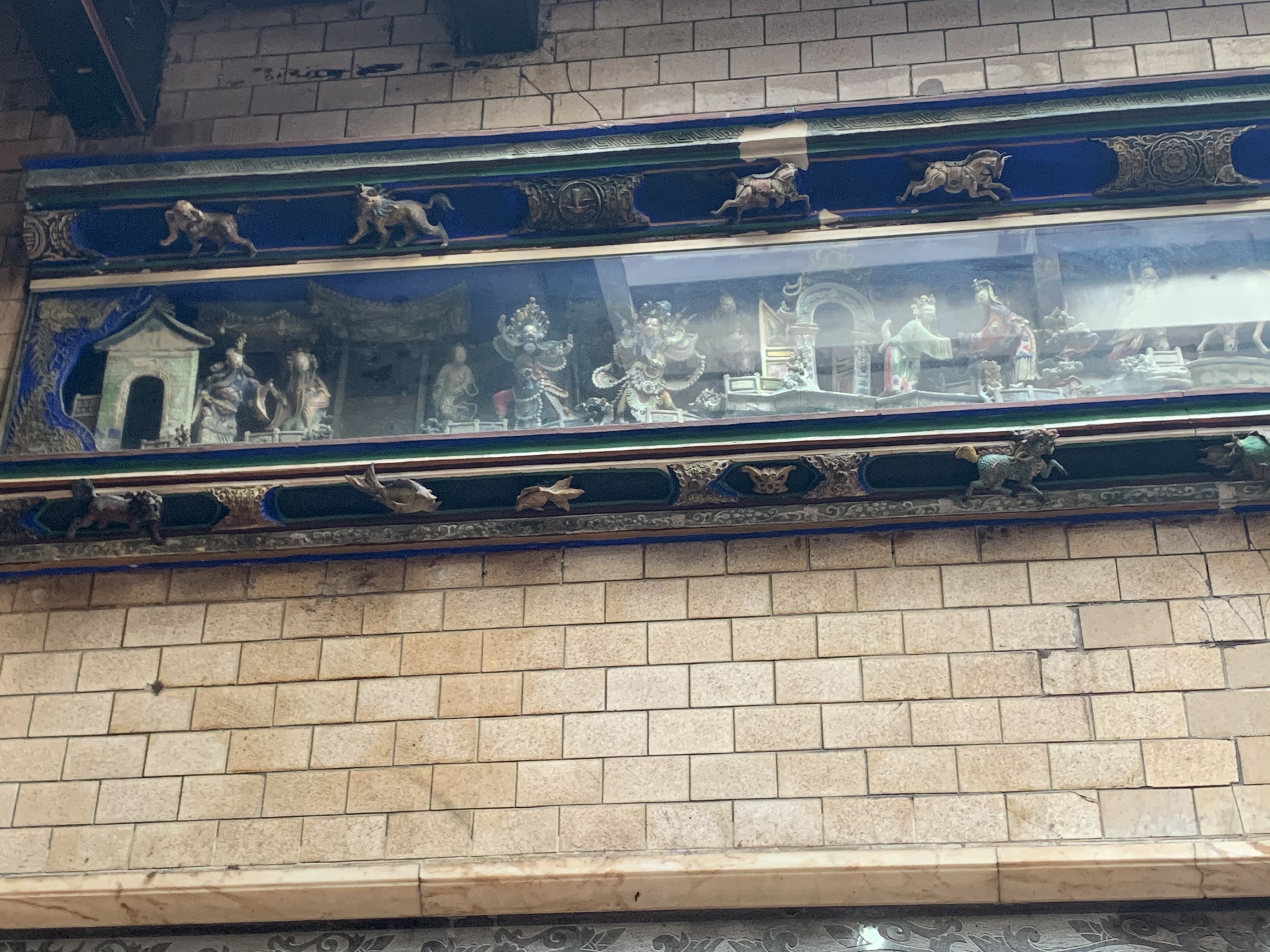
The City God temple is indeed quite beautiful, and situated easily in the most interesting part of town. This neighborhood is worth wandering around in; around the temple and the circle, there are several markets, market streets and streets full of stores specializing in various wares. Not surprisingly, between the circle and the temple is a long street full of shops that sell temple items — tall god heads, incense burners, palanquins, embroidery and more. There is some priceless Koji ceramic work in temple itself, but it’s hard to see as it’s well above human height and behind protective glass. It’s an atmospheric place to spend a few minutes, however, and as with most temples, there are several benches where you can sit and take a rest. 


Untitled

Untitled

Sadly, the priceless ceramic works are difficult to appreciate and photograph


This temple dates from the early 18th century, and is among the most well-known in the area. It was renovated in the Japanese and ROC eras. The aforementioned pottery sculptures of the glaze and type made by Ye Wang 葉王 as well as those from another glazing method, from a different master (Hong Kunfu 洪坤福). If I'm reading the history right -- and I might not be -- the two sculptors' whose work features there (Lin Tianmu 林添木 and Chen Chuanyou 陳專友) -- were respectively the grandson and apprentice of these two great artists.

The temple is one of the few remaining ones where a ritual "atonement for sins" ceremony takes place (with participants wearing symbolic paper "cangues" rather than actual wooden stocks). 


Backstreets and under-appreciated architecture


I recommend first enjoying a wander around the backstreets in this neighborhood, then eventually taking the road that runs along the side of the temple on the left (if you are facing the temple entrance) and staying straight on it. This road will take you directly past the baseball stadium to Chiayi Park. 


An under-appreciated aspect of Taiwan's architectural heritage are its more decorative mid-century houses. You will pass many fine examples on this road; take your time and enjoy them.


Then, hoof it up the poorly-shaded hill past the stadium -- there is a Donutes cafe that is fancier than it has any right to be if you need a pick-me-up, and a few benches on the way up.


Chiayi Park and Relic Shrine 嘉義市史蹟資料館


Soon enough, however, you'll find yourself at Chiayi Park, which overlooks much of the city. The park itself is attractive, and in addition to the former Kagi Shrine, a Japanese Shinto Shrine built in 1915 and renovated in the 1940s. The main hall was turned into a Martyrs' Shrine by the ROC and later destroyed, however the arch remains. The temple office and water purification hall remain and are open to the public as a museum space and historic site. 


Nothing here is in English, and I'm self-conscious about my slow Mandarin reading, so I tend not to read museum signage. However, it was worth a look around. It also houses a cafe and small shop stocked with locally-made souvenirs. 


The cool breezes rustling through the trees at the park and golden late afternoon sunlight on Japanese-era relics gave the whole area a feeling of being lost in time, despite it being somewhat crowded. This is a good place to take a rest after a long and likely sweaty walk. 

The park also houses the Sun Shooting Tower (the design was inspired by an Indigenous myth, though I have to say I don't find it particularly attractive), the Chiayi Confucius Temple and other things to see; a walk around is worthwhile. I was tired, however, and chose instead to drink iced tea the Chinese-style pagoda nearby, admiring the Japanese architecture from afar. 


Had I been planning on dinner in Chiayi, I certainly would have headed to Chu-ju Teahouse 竹居茶樓. I have no idea if the buildings are truly old or not, but it looks stunning. If I hadn't gone alone that is -- it's set up for groups more than individual diners. But I had plans in Taichung that evening, so I called a cab from Chiayi Park, picked up my bag at the train station and grabbed the next available train north. 


A Denouement 


Over the next week, Ms. Liou and I discussed the size, layout and borders of my custom mirror through Line. Soon after that, there was a knock at my door back in Taipei: my very expensive mirror had arrived just before Christmas! It would be New Year's before we could get it hung, but once we did, it tied the whole bathroom together, including the painfully-oudated orange and green tiles that were original to the mid-80s construction of our building. 

It was worth it to not only make my bathroom look intentionally retro instead of just old and cringey, but to support a local business and historic preservation initiative.


Because I haven't spent a lot of time in Chiayi, I'm not able to write the sorts of in-depth posts I can offer for Taipei and even Tainan. However, I enjoyed my time there. The food was delicious and unpretentious, the weather pleasant, the city walkable, and cabs (as well as rare city buses) exist for when the distance is just too far. It's an underrated city; I recommend checking it out for its own merits sometime rather than using it as a stopover on the way to more famous places like Alishan.


Thursday, April 1, 2021

Taiwan Government Unveils New Drought Solutions


APRIL 1, 2021: Amid a worsening water crisis affecting central and southern Taiwan, the Executive Yuan has just released its emergency water creation initiative, to be rolled out immediately in affected municipalities. 


“It was a difficult plan to work out,” said Executive Director of Water Services Hsia Yu-lai, “but we think we have a pretty infallible and fast solution to Taiwan’s water woes. We’re going to do a rain ceremony!” 


The ceremony will involve traditional Taoist ceremonies in strategically chosen temples across Taiwan, with a focus on temples in the most drought-affected areas. After throwing fortune blocks to determine a time amenable to the gods, and finding volunteers from the local temple gangs to help perform the ceremonies, they are expected to begin within the next week.


Government authorities got the idea from Taichung’s Jen Lann Temple, a Matsu temple in Taichung’s Dajia district. 


“I told you someday I would be useful and have a good idea,” Yen Ching-piao’s son, who does something or other in government, said ecstatically. “Maybe now my father will love me.”


The rain dances, which are meant to cause the gods to bring sufficient rain to Taiwan and perhaps, if the offerings are deemed pleasing to the gods, even an early typhoon, will continue until rain happens.


Asked whether longer-term solutions such as dredging and enlarging or deepening current reservoirs and subsidizing the installation of water catchment systems on private and public buildings were also being considered, Hsia demurred. 


“Yes, we could do all of that, although it’s not an issue voters really think about when there’s no water short—huh, what were we talking about again?” he said.


“Certainly raising the utility rate for water usage is out of the question,” added Hsia’s deputy, Mei You-shui. “While doing that would certainly help decrease water consumption and cost to citizens could be ameliorated with the water catchment systems discussed above, that’s hard, and it might mean some people won’t be happy and they might not vote for us, and that’s the worst possible thing.”


Asked whether fixing Taiwan’s water supply issues would create long-term voter loyalty and trust, Mei responded, “Hmmm...mmm. But, it would be very difficult.”


In the meantime, rain ceremonies are seen by the government as a viable long-term alternative as well. 


“After all, the gods are always there,” added Hsia. “So we can always just ask them.” 


This method also has a lot of history behind it. In the decades when the KMT controlled both the executive and legislative branches, their principal water supply strategy was to pray for typhoons. 


“People say those officials might have been mass-murder abetting grifters and nepotists constantly on the make, but boy they sure could get things done,” Hsia said. “Remember the Ten Big Construction Projects? That’s a thing from history.”


“If they could essentially resort to waiting for typhoons and asking the gods for typhoons when none came, there’s no reason why we can’t continue their legacy. This is because of reasons. Also, Hsinchu Science Park.”