Sunday, March 17, 2019

The Battle for the Story of Taiwan: De-centering Oppressive Narratives

Untitled


Spend any time around nerdy academic/historian types (or just socially aware people) and you'll eventually end up in a discussion about dominant narratives. A dominant narrative is basically the I-sound-like-smart-people way of describing the old "history is written by the winners" trope; the stories of those whose experiences don't align with the dominant narrative are "counter-narratives", as they're marginalized from the dominant narrative. (If you're already familiar with what this means, you can skip/skim the next few paragraphs).

These people may, in fact, be a majority of people spread across a variety of groups who aren't "the winners" in history. Considering, for example, that women's experiences are often not accounted for by the dominant narrative of most cultures, nor are those of people of color (or not in the ethnic majority), LGBT+ people and more, it's hard to argue that the "dominant narrative" is the one experienced by the most people; rather, it's the one experienced by the most privileged people.

Or, to give a real life example, in school in the US I learned the dominant narrative of American history. That history was dotted with august men who did brave things and propelled mind-blowing scientific and social advancements. Then, we evolved as a society and began talking about all the women whose contributions had been left out of this story: for instance, if you listen to the dominant narrative on the history of computer science, you'd think the whole field was developed by men, with the first technological advancements in the field by men, and the first coding done by men. That is far from true, however.

Then women's history became a thing, but it was mostly white women's history, so there was a lot of discussion about women not having access to work opportunities or even being "allowed" to work for pay. Of course, that left out women of color and working-class women, who had consistently earned money through labor...and it goes on.

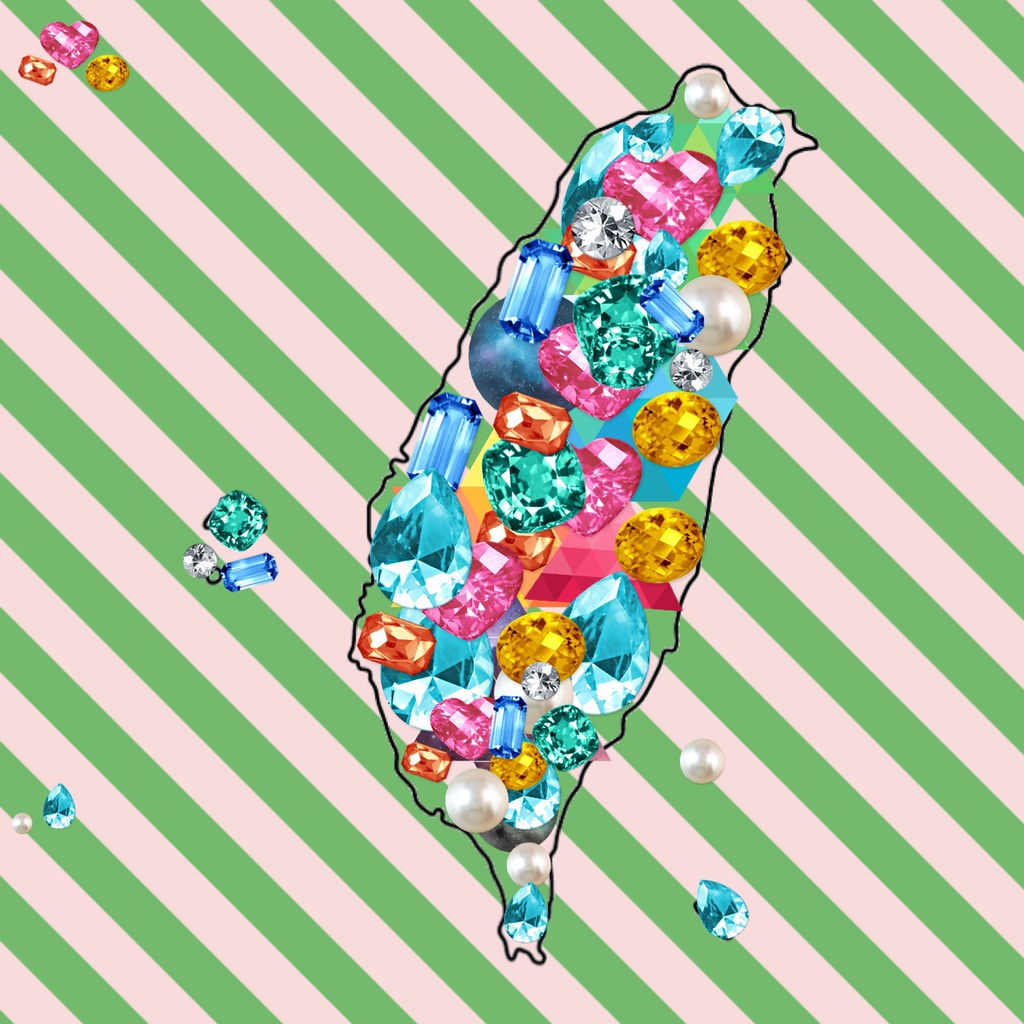
And of course, it's not that the dominant narrative is totally wrong; it's just told as the whole story, when in fact it's simply one facet of the story. It's a cut in the diamond; not the whole damn stone.

I'm probably already losing a few readers here, and that's fine. If you're all "ugh but LOBSTERS" or some nonsense at this point, then do yourselves a favor and go. I won't notice. I'm not aiming this at you.

So, what does this have to do with China and Taiwan? Quick-thinking readers surely see where I'm going with this.

Liberal thinkers in many countries have done a fantastic job of pointing out and attempting to rectify the grip on historical interpretation that the old dominant narratives had. They'll readily point out that this or that telling of our collective cultural tale isn't including enough marginalized narratives.

But then they look across to the ocean at Asia and it's like all of that complex critical thinking just goes out the window; where we were discussing a beautifully-cut diamond with near-countless facets in our own culture, we're back to "it's a rock!" when discussing the other side of the world.

It's the result of a good-faith effort not to look at the world through a white/Western lens, and elevate narratives that are not white or Western, but it does exactly the thing that these same people warn against doing in their own cultures: it centers only the dominant narrative in this part of Asia, and marginalizes every other one. In other words, when de-centering Whiteness and choosing a different narrative, they again reach for the most dominant non-white narrative and there's a battle fought anew to argue for the inclusion of everything that is marginalized as a result of that choice.

And because it's big and populous and powerful (by powerful I mean "it has a lot of money"), that dominant narrative is China's.

Or rather, not even China's - it's the Communist Party of China (CCP) narrative. It's the wealthy straight cis male Chinese narrative. It's the Han narrative (oh, you thought only white people could be ethno-cultural chauvinists who try to erase the counter-narratives of others or pound them into submission as 'colorful' but ultimately obedient 'minority' 'ethnic' groups? You're wrong.)

Don't believe me? Okay, why is it that China relaxing its One Child Policy made the international news but nobody's talking about how the CCP still treats women's bodies as property of the state? Why does Taiwan's path to marriage equality make the international news, but no major Western media outlets seem to link it explicitly to Taiwan's cultural distinctness from China (which is nowhere near any sort of same-sex partnership)? Why do so many Westerners seem to think Chinese culture is so "traditionally" anti-gay when that's just not the whole story? I could go on.

So, when the question turns to Taiwan, that same prioritizing of the CCP/Han dominant narrative gets repeated by well-meaning Western liberals.

The results are devastating.  That same quicksilver liberal who could tear apart the way you looked at the world by pointing out every marginalized narrative in her own culture devolves into insisting - often loudly, even stupidly - on pre-fab garbage like "but Taiwan is China because their official name is the Republic of China!" or "but the Taiwanese are Chinese because historically they come from the same culture and heritage and they have the same history!" or "I don't think Taiwanese independence is a good idea because we need more unity in the world and less nationalism!" or "how can Taiwan be a country when it's not in the UN?"

Or - and this is the most insidious one of all in my opinion, a real rabbit hole - "but China has such a different culture and they conceive of these things so differently, we can't push our Western conception of what it means to be culturally Chinese on them!"

Except that's the CCP's line - we're not Western, your Western morals and ethics and concepts don't work here. It only works for everyone in Asia if the general consensus in Asia is that it's true - but that's not the case. Most Taiwanese don't; having as a population forced their own government to democratize and adopt (albeit imperfectly enforce) the basic tenets of universal human rights, they'd argue for the same freedoms and similar political values to the ones your typical Western liberal espouses (family and social values may differ, however).

So if you adopt that dominant narrative as the only narrative that counts in (ugh) "Greater China", you're just telling people in this part of Asia how to think based on your White conception of how people here should think, which is informed by what the dominant (and authoritarian) narrative in these parts is telling you. That dominant narrative will further imply that in order to "respect Asian values", you need to agree. Or, as a friend put it, the CCP picks apart the Western dominant narrative  - which, to be fair, deserves to be picked apart - but their goal is to supplant it with their own.

It is helpful to that dominant narrative if you - the well-meaning Westerner who wants to "respect different cultures" - don't notice that there is more than one narrative in Asia, and that there are all sorts of marginalized Asian narratives you could also be listening to.


In short, by adopting the CCP/China narrative when talking about Taiwan, you are doing to Taiwan exactly what you'd argue against in your own culture. You are telling people who are trying to express a marginalized narrative - of Taiwanese identity, Taiwanese shared history and its many cultural facets - that their stories don't matter and should not be included, that only what China thinks counts. And you're doing it while believing yourself enlightened; believing that by swallowing the CCP's Story of China and Taiwan, that you are "respecting Asian values and other cultures", when you are doing the opposite.

The KMT/Republic of China narrative functions similarly. If you buy into the "Taiwan's official name is the Republic of China, so they too claim to be 'China'", you're centering the dominant narrative of what a former military dictatorship forced on Taiwan, and ignoring the marginalized narrative of the vast majority of Taiwanese who simply don't believe that to be the case, but feel powerless to change what the government must continue to claim under threat of war. 


I've thought a lot about why this is. Part of it boils down to Asia just being far away and unfamiliar. When you don't have much direct experience of a place or its cultures - maybe one or two trips, maybe reading the news - when you hear a narrative from that unfamiliar part of the world, it's natural to seize on it as the narrative, something you didn't know before, yippee! It's human nature to think of something you've learned to be the last thing you need to learn, or to be as deep as you need to go.

People also have limited time; a Westerner without ties to this part of Asia simply doesn't have room in their daily life to learn more about how things work here, just as I simply don't have the time to delve into the intricacies of North African politics, let alone the narratives within any single North African country, and what marginalized narratives may lie beneath that.

And, of course, learning is a scaffolded process: when the average Westerner may not even be aware that Taiwan and China have two different, sovereign systems of government, it's quite difficult to then make the leap to specialized historical discussions about what was and was not historically considered "China" and why it matters, for instance.

Much easier for the average person to hear a new perspective and decide that it simply and succinctly covers what they need to know. The human tendency to seize on a dominant narrative and accept it because it simply and understandably helps them file away a difficult topic is both natural and global. If you recognize that bias for what it is, it's not even anything to be ashamed of.

The CCP has figured this out: they know people in other countries have limited time and brain space to devote to the full story here. So they expend massive resources to ensure that their narrative is the one everyone hears.

How to overcome it? After years of thinking about this, I'm still not sure, but I have a few pallid suggestions. Like tarps in a cyclone, they are certainly insufficient, and I make no promises as to their efficacy.

Once made aware of the tendency to abandon criticality when faced with a new narrative, most well-meaning people are able to work that muscle in their brain until it's instinctive: meet new narrative, absorb information, ask oneself: is this all there is to the story? There must be more. There's always more.

It's not always necessary to dive in and learn it all; simply being aware that there's a lot more going on underneath any narrative you hear, and that everything you hear may carry with it bias or intent, is often enough to maintain adequate criticality. When discussing Taiwan with people abroad who may be willing to listen, we need to get that muscle working first, but approach our request that one think critically about the narrative they've heard in a way that will be heeded. Keep it brief, and don't be afraid to break out the metalanguage. "De-centering" and "marginalized narratives" are terms that are used so often that they're practically cliché, but they make sense and accurately describe the situation. They're powerful tools when discussing Taiwan with those who are sympathetic to looking at the world through these lenses.


There are so many thoughtful experts, scholars and activists who are knowledgeable about Taiwan, who will pointedly argue for the inclusion of marginalized narratives here. Any contemporary telling of Taiwanese history to such an audience is likely to be met with a barrage of discussions about whether it adequately includes indigenous history, or women's history, or the history of lower-income or rural people. This is fantastic; the battle for the Story of Taiwan as more than the Story of Hoklo Han Taiwan is one we must fight.

And yet, there's also a larger battle we must attend to concurrently; the battle for the Story of Taiwan to be included in the narrative of East Asia, and we've got to keep our eyes on that fight, too. 

Friday, March 15, 2019

Some guy says Taiwanese "separatists" are "deeply worried" by...whatever

Screen Shot 2019-03-15 at 11.09.45 AM
You Taiwan separatists!


Look, don't even bother clicking this link.

The guy who said this is "the head of a semi-official body" - ARATS - that literally nobody in Taiwan takes seriously and exists to promote the exact opposite of what Taiwan wants (and disseminate the exact opposite opinion that Taiwan, as a whole, actually has). He's not important.

I'll summarize it for you: blah blah blah "reunification" blah blah "one country two systems is successful" blah blah blah blah "historic trend" blah blah "degeneration of the great Chinese nation" blah blah blah probably a small wee-wee blah blah "historic trend" blah blah blah.

Meanwhile, how's Taiwan feeling?

According to journalist and more-important-than-that-jade-cabbage national treasure, Chris Horton: 


 So, anyway, here's a point I've made before but want to highlight here.

When people like...this guy go on about "Taiwan separatists", they are implying that these "Taiwan separatists" are a small, loud minority of annoying activists that most people don't support. Or they try to frame it as wayward politicians spouting on about some sort of political nonsense that most people don't actually agree with.

That's just not the case. As a friend put it, "if you define 'Taiwan separatist' as 'someone who believes Taiwan should not be a part of China', then 80%+ of Taiwanese are 'Taiwan separatists'."

They (all those separatists!) elected those particular politicians at the national level in 2016  in part out of a desire to express that will. Some want a specific kind of independence (de jure, or sans Republic of China), but most find sovereignty to be their baseline. If Taiwan is truly sovereign - no, not like Hong Kong, which isn't even all that autonomous, let alone sovereign - they'll take that over a war. Threaten even that sovereignty, though, and you can go to hell


In other words, Taiwan already has "independence" in that it is sovereign, and the vast majority of Taiwanese would like to keep it that way.

In that sense, almost all Taiwanese are "Taiwan separatists". It's not a minority, and it's not limited to people in government.

Does Grandpa here really think that almost all Taiwanese are "deeply worried" - which is what his statement implies? Do his buddies in government really think it's possible to consider somewhere between 11 and 23 million Taiwanese "war criminals"?

Do they really that the CCP has a lot of influence over the Taiwanese people?

No, of course not.

This is just what they have to say to maintain the illusion that "Taiwan separatism" is a niche belief held by a few annoying activists, not the general will of the Taiwanese electorate. They can't let the rest of the world (or their own people) catch on to the notion that Taiwan is a "renegade province" (ahem) not because political forces are keeping it that way against the will of the people, but because most Taiwanese want it that way.

So my message isn't for him - who cares about him. My message is for you, the readers. Don't buy what he's selling. "Separatism" in Taiwan isn't a matter of a few crazy extremists, who can be sidelined, rooted out, prosecuted and (I assume) executed. It's matter of public will. Taiwan is evolving toward it, not away from it, and it's not going away. 


Tuesday, March 12, 2019

Bad reporting, Han Kuo-yu, and racism against Filipinos in Taiwanese society

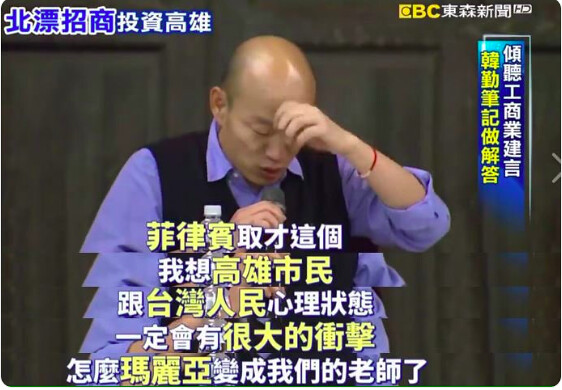
Screen Shot 2019-03-11 at 12.02.45 PM
This meme - not established Taiwanese media -  is the most accurate translation of Han's actual remarks that I've found. 

So, I'm sure you've all heard by now that Kaohsiung mayor Han Kuo-yu is a racist crapsack, but you might not be entirely clear on exactly how much of a racist crapsack he actually is, because it's impossible to figure out what his exact words were from print media. 

In looking for Han's direct quote, I found three different versions in United Daily News, Liberty Times and Storm Media, and decided none of them could be fully trusted. So, I found a video. Here's exactly what he said, with video evidence:


我想高雄市民跟台灣人民的心理狀態一定很大衝擊,怎麼瑪麗亞一下變成我們老師了?

My translation:


I think the hearts of Kaohsiung residents and Taiwanese would be greatly shocked, how can a Maria become our teacher?

'Maria' is a pejorative for a Filipina woman, connoting a woman of humble means who performs domestic labor. It's equivalent to calling them maids - referring to every woman in the Philippines as 'the help'. This particular insult is well-known in Taiwan, where many workers from the Philippines perform blue-collar labor in Taiwan. It's not just a racist word, it's a sexist one too as it specifically denigrates the domestic labor done by foreign women.

That word, "shock" (衝擊) can also mean an assault or lashing - it could just as easily be translated as "would assault the hearts of Kaohsiungers and Taiwanese".

The "...because how can a 'Maria' become our English teacher" is also important to understanding Han's meaning, it implies unlikeliness, impossibility, or mockery. How could The Help possibly teach us?

This is what he means and an accurate translation of his remark makes that clear.

Han goes on to say (from the video linked above, translation mine):


往菲律賓取才我覺得這個在一個克服的過程。... 如果我們從菲律賓引進教英文的師資,高雄的家長能不能接受? 所以我才會用瑪麗亞三個字,來做一個表述,所以我用瑪麗亞三個字不是有其他的意思在。...你為什麼不找美國,澳大利亞,英國的,你為什麼找隔壁菲律賓的?我的意思是說,家長心裡會有一個障礙。可是呢?菲律賓外語人才的輸出,已經很成熟,這個兩個這間,怎麼樣說服高雄的家長? 
Filipino talent, I think this is a process of overcoming....if we introduce qualified English teachers from the Philippines, would Kaohsiung patriarchs/heads of household/old-timers be able to accept it [with the implication that they would not]. So, I can only say 'Maria' it's just an expression, so when I say 'Maria', there's no other meaning....Why don't you find American, Australian, English ones, why do you find people from the nearby Philippines? My meaning is, that's a mental obstacle for these 'patriarchs'/old timers. But? The Philippines sending out foreign language speakers is already very common. Between these two [extremes], how can we convince those old-timers?

This sounds like a reasonable position to take, because it's surely true that there are many racist people in Kaohsiung and Taiwan who would be bothered by or opposed to having teachers from the Philippines in positions of authority and respect in Taiwan, because to them, they are just "Marias".

That doesn't absolve Han of his initial comments, though. First, to say "I didn't mean anything other than that by the word 'Maria'" is about as tired an excuse as "I only used the N-word because I heard it in a rap song, not because I meant something racist."

And it doesn't hold up to even the barest scrutiny as an explanation: he's not quoting anyone in particular when he calls Filipinas 'Marias'. The word came out of his own mouth. He used it offhandedly, like a normal word anyone would use. He didn't adequately signpost his remarks as a quote or description of an attitude, because that's not actually what they were despite his "clarifications" later.

If Han had really meant to describe what Taiwanese think, and make it clear that he disagrees, he wouldn't have said 'Maria' so casually in the first place. This marks him not as an ally, but a concern troll: defending his words as describing what the other side thinks, but showing through his unconsidered language choices that, on some level, he is a part of that 'other side'. Someone who truly wants to change racism against Southeast Asians in Taiwanese society would simply not say "...how can a Maria become our teacher?"

It boils down to his meaning being, "I don't hate Marias, I'm just worried about racism in Taiwan, what with everyone used to them being so poor and being maids and all, it's sad to me that nobody wants those Marias to be their English teachers. I'm just concerned!" 


He didn't say "many Taiwanese unfortunately have an obstacle in their thinking to accepting the idea that teachers from the Philippines could teach them, and that is wrong. We need to persuade them and overcome this obstacle, because there are many qualified professionals, including teachers, from the Philippines." He didn't even say "many Taiwanese think of workers from the Philippines as 'Marias' and that is a problem", which, while a bit gasp-worthy, is at least kind of an accurate description of what some Taiwanese people think.

He said, and I repeat, "how can a Maria become an English teacher?" as casually as an American racist might say "How'd a ________ like her get a nice car like that?" 

(And see how I made it quite clear that such horrid language describes views that exist in the world, but does not reflect my own views? It's not hard.)

At the very least it didn't occur to him that unthinkingly tossing off the 'Maria' epithet might be a problem. That only happens when someone already thinks of a group of people that way, not when they are signaling disagreement or condemnation of an opinion others hold.

And if a leader is caught in such a gaffe and tries to insist that they don't personally feel that way about a particular group, but they're just worried that everyone else does, that's simply unacceptable. Leaders should not inflame societal prejudices, even if they are common; they should be examples of a higher, more forward-thinking standard. 


Let's keep in mind as well that he tows the same 'concern troll' line with marriage equality, saying his real concern is "the next generation" (won't someone think of the children?), not that he is anti-gay, while fraternizing with anti-gay groups


And he didn't even bother to defend his remark until later in the meeting when directly asked about it, or show awareness that 'Maria' is more than 'just an expression'.

If you look at reporting of Han's comments, you get distortions of what he said all over the place (all translations are mine). Some make his wording look a lot worse - from UDN:


引進菲律賓人才,這恐怕對高雄人、台灣人心理衝擊大,因為瑪麗亞怎麼變老師了?
Introducing Filipino talent, I'm afraid (as in, scared - not regretful) that this will be a shock to Taiwanese and Kaohsiung residents, because how can a Maria become a teacher? 

From Liberty Times:


這恐怕對台灣人心理衝擊大,因為瑪麗亞怎麼變老師了?
I'm afraid that this would be a shock to the Taiwanese, because how can a Maria become a teacher?

And from Storm Media, inexplicably making him look better:


韓國瑜認為,確實能夠借重,但必須先克服市民及台灣人民的心理障礙,讓「瑪莉亞變老師」,很多人內心會有衝擊。 
...「我覺得我想高雄市民跟台灣人民,心理一定有很大衝擊,瑪莉亞變成我們老師了,這要克服的過程,這可能心理衝擊很大。」 
Han Kuo-yu believes it is indeed possible to take advantage of /get benefits from [talent from the Philippines], but the psychological barriers of the people of Taiwan must first be overcome - to let "'Marias' become teachers", a lot of people will be shocked.  
"I think / I think that Kaohsiung residents and Taiwanese will be very shocked, Marias become our English teachers, we need to overcome this, this can be a huge shock." 

Storm tried to soften the impact of his words by mashing two quotes together - "Marias become our English teachers" and "we need to overcome this", making it seem as though he said these two things at the same time, when he didn't (which the video makes clear by his different positioning). It also erases the "because how can a Maria become our teacher?" by selectively cutting his quote and replacing "because how can..." (怎麼) with "let" (讓) outside the quote marks. 

In English the reporting isn't much higher quality.

From Focus Taiwan, which offers the most accurate translation:


Responding to a proposal that Taiwan could hire bilingual Filipino white-collar workers at a conference on Wednesday, the mayor said employing "Marias" as teachers would be a psychological shock for Taiwanese.

There's also this from Taiwan News, which is far worse but just translates the garbage from Storm Media above but does so in a way that make Han's comments sound erudite in English, when they weren't particularly eloquent in Mandarin:


In response to this, the Kaohsiung Mayor admitted the Philippines’ abundance of skilled labor could benefit the city, but said its residents would first need to overcome some “internal conflicts.”
“I believe witnessing ‘Marias’ become teachers would cause a clash in the hearts of the people of Kaohsiung, and Taiwan’s population at large. This is something that needs to be overcome; likely a huge internal conflict,” Storm quotes Han.

And the Taipei Times, with what I think is the most inaccurate translation:


Han on Wednesday told a meeting of the Chinese National Association of Industry and Commerce in Taipei that he feared that hiring educated employees from the Philippines as English teachers “would cause a psychological shock for Taiwanese, as people might wonder: How has our Maria become a teacher?” 


Focus Taiwan accurately placed the 'Maria' comment within the attitude of Han, which is the context in which he made it, and not as a description of what he thinks other Taiwanese think. The other two make him sound much better than he actually did, and situate the 'Maria' quip not as Han's own word (which it is) but as a description of something he disagrees with (which is not what he said until pushed - which outs him as a concern troll.) Some translations (like Taipei Times' work) add connotations to the translation - e.g. "wondering" - that are simply not there in his actual words. 

All of these seem so odd to me, because the video of his remarks is publicly available. I'm not even a native Mandarin speaker or a perfectly fluent one, and yet I found and translated it with little problem.

So why do some quotes - like Liberty Times and UDN - make Han's remark seem more shocking than it was (and to be clear, it was quite shocking on its own and did not need to be sexed up)? And why do others - like Storm Media - make it sound like not much at all? How is this unclear and inaccurate media reporting of Han's remarks affecting how Taiwanese think about the incident, and is it distorting public discourse?

In English at least, it is having a distorting effect. Several posts on social media have pointed out that Han's remarks should not be considered offensive, because that's what some Taiwanese really think, based on the Taipei Times and Taiwan News translations.

This makes me wonder how can we even have a real conversation about Han's remarks and racism in Taiwanese society if what we read isn't quoting him correctly.

I'm not sure why Storm Media - which I've found to be typically more reliable - made Han look better than he deserved, and why a pan-green and pan-blue rag each made him look worse. But because the inaccuracies are present across the entire media-political spectrum, it doesn't point to an attempt to polarize the Taiwanese political cleavage.

Rather, I think it's just plain old bad reporting.

I'll finish off with something bad, then something good.

Something bad:


Kaohsiung Mayor Han Kuo-yu (韓國瑜) on Saturday apologized for a recent remark in which he referred to Filipinos as "Marias," saying the term, considered by many to be a racial slur, was a slip of the tongue.
Han was sorry for the misunderstanding caused by his misuse of the term and said he looks forward to future cooperation with the Philippines, it added. 

No, Focus Taiwan. NO NO NO NO NO.

"Maria" is not "considered by many" to be a racial slur. Jesus F. Christ. It is a racial slur. Period. Han Kuo-yu said it, and only tried to insist it was a description of what other people think after he was called to task for it, without ever explaining why he'd throw it out so casually (because there is no explanation that absolves him).

It was not a "misunderstanding". We all understood him perfectly. People in the Philippines understood him quite accurately. And he didn't misuse the term - he used it exactly as it's meant to be used in racist speech.

Just as when my (dearly departed) grandpa referred to "those people" and then insisted, when I pressed him, that he hadn't meant it as an insult but "they're just a different community", I knew perfectly well that that's not what he'd meant. 


But then there's the good thing: when I moved to Taiwan 12 years ago, I don't know that a comment like this would have caused this kind of uproar in Taiwan. I passed more than one "Foreign Labor Go Home" protest, with old men carrying signs. I don't even know if such language was common then, because my Mandarin was crap, and I never heard of anyone raising a fuss about it.

But in 2019, despite some attempts to justify Han's language, the overwhelming response of Taiwanese public discourse is that it is not acceptable to talk this way, and racist speech and actions should not be tolerated.

If Han is correct about how many Taiwanese might think of English teachers from the Philippines - and he is, for some people - the fact that the backlash has been so swift and damning proves that not all Taiwanese think this way.

That said, it doesn't seem to be hurting his approval ratings, although I have long suspected something is really weird about whatever force underlies those ratings which is propping up Han. 


Taiwan has a long way to go - we need to treat immigrants from Southeast Asia better, end discrimination and give them the same opportunities for permanent residency and citizenship that white collar workers (who are largely Western) have - but this is real progress.