Friday, March 15, 2019

Some guy says Taiwanese "separatists" are "deeply worried" by...whatever

Screen Shot 2019-03-15 at 11.09.45 AM
You Taiwan separatists!


Look, don't even bother clicking this link.

The guy who said this is "the head of a semi-official body" - ARATS - that literally nobody in Taiwan takes seriously and exists to promote the exact opposite of what Taiwan wants (and disseminate the exact opposite opinion that Taiwan, as a whole, actually has). He's not important.

I'll summarize it for you: blah blah blah "reunification" blah blah "one country two systems is successful" blah blah blah blah "historic trend" blah blah "degeneration of the great Chinese nation" blah blah blah probably a small wee-wee blah blah "historic trend" blah blah blah.

Meanwhile, how's Taiwan feeling?

According to journalist and more-important-than-that-jade-cabbage national treasure, Chris Horton: 


 So, anyway, here's a point I've made before but want to highlight here.

When people like...this guy go on about "Taiwan separatists", they are implying that these "Taiwan separatists" are a small, loud minority of annoying activists that most people don't support. Or they try to frame it as wayward politicians spouting on about some sort of political nonsense that most people don't actually agree with.

That's just not the case. As a friend put it, "if you define 'Taiwan separatist' as 'someone who believes Taiwan should not be a part of China', then 80%+ of Taiwanese are 'Taiwan separatists'."

They (all those separatists!) elected those particular politicians at the national level in 2016  in part out of a desire to express that will. Some want a specific kind of independence (de jure, or sans Republic of China), but most find sovereignty to be their baseline. If Taiwan is truly sovereign - no, not like Hong Kong, which isn't even all that autonomous, let alone sovereign - they'll take that over a war. Threaten even that sovereignty, though, and you can go to hell


In other words, Taiwan already has "independence" in that it is sovereign, and the vast majority of Taiwanese would like to keep it that way.

In that sense, almost all Taiwanese are "Taiwan separatists". It's not a minority, and it's not limited to people in government.

Does Grandpa here really think that almost all Taiwanese are "deeply worried" - which is what his statement implies? Do his buddies in government really think it's possible to consider somewhere between 11 and 23 million Taiwanese "war criminals"?

Do they really that the CCP has a lot of influence over the Taiwanese people?

No, of course not.

This is just what they have to say to maintain the illusion that "Taiwan separatism" is a niche belief held by a few annoying activists, not the general will of the Taiwanese electorate. They can't let the rest of the world (or their own people) catch on to the notion that Taiwan is a "renegade province" (ahem) not because political forces are keeping it that way against the will of the people, but because most Taiwanese want it that way.

So my message isn't for him - who cares about him. My message is for you, the readers. Don't buy what he's selling. "Separatism" in Taiwan isn't a matter of a few crazy extremists, who can be sidelined, rooted out, prosecuted and (I assume) executed. It's matter of public will. Taiwan is evolving toward it, not away from it, and it's not going away. 


Tuesday, March 12, 2019

Bad reporting, Han Kuo-yu, and racism against Filipinos in Taiwanese society

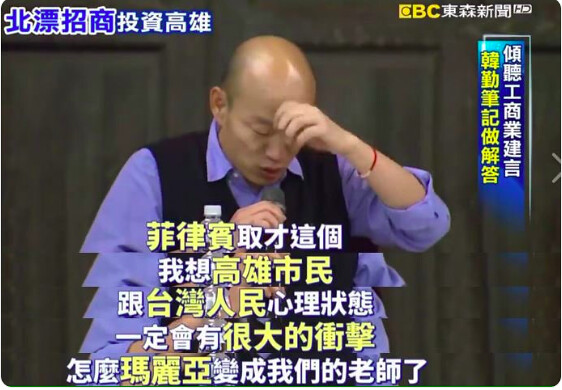
Screen Shot 2019-03-11 at 12.02.45 PM
This meme - not established Taiwanese media -  is the most accurate translation of Han's actual remarks that I've found. 

So, I'm sure you've all heard by now that Kaohsiung mayor Han Kuo-yu is a racist crapsack, but you might not be entirely clear on exactly how much of a racist crapsack he actually is, because it's impossible to figure out what his exact words were from print media. 

In looking for Han's direct quote, I found three different versions in United Daily News, Liberty Times and Storm Media, and decided none of them could be fully trusted. So, I found a video. Here's exactly what he said, with video evidence:


我想高雄市民跟台灣人民的心理狀態一定很大衝擊,怎麼瑪麗亞一下變成我們老師了?

My translation:


I think the hearts of Kaohsiung residents and Taiwanese would be greatly shocked, how can a Maria become our teacher?

'Maria' is a pejorative for a Filipina woman, connoting a woman of humble means who performs domestic labor. It's equivalent to calling them maids - referring to every woman in the Philippines as 'the help'. This particular insult is well-known in Taiwan, where many workers from the Philippines perform blue-collar labor in Taiwan. It's not just a racist word, it's a sexist one too as it specifically denigrates the domestic labor done by foreign women.

That word, "shock" (衝擊) can also mean an assault or lashing - it could just as easily be translated as "would assault the hearts of Kaohsiungers and Taiwanese".

The "...because how can a 'Maria' become our English teacher" is also important to understanding Han's meaning, it implies unlikeliness, impossibility, or mockery. How could The Help possibly teach us?

This is what he means and an accurate translation of his remark makes that clear.

Han goes on to say (from the video linked above, translation mine):


往菲律賓取才我覺得這個在一個克服的過程。... 如果我們從菲律賓引進教英文的師資,高雄的家長能不能接受? 所以我才會用瑪麗亞三個字,來做一個表述,所以我用瑪麗亞三個字不是有其他的意思在。...你為什麼不找美國,澳大利亞,英國的,你為什麼找隔壁菲律賓的?我的意思是說,家長心裡會有一個障礙。可是呢?菲律賓外語人才的輸出,已經很成熟,這個兩個這間,怎麼樣說服高雄的家長? 
Filipino talent, I think this is a process of overcoming....if we introduce qualified English teachers from the Philippines, would Kaohsiung patriarchs/heads of household/old-timers be able to accept it [with the implication that they would not]. So, I can only say 'Maria' it's just an expression, so when I say 'Maria', there's no other meaning....Why don't you find American, Australian, English ones, why do you find people from the nearby Philippines? My meaning is, that's a mental obstacle for these 'patriarchs'/old timers. But? The Philippines sending out foreign language speakers is already very common. Between these two [extremes], how can we convince those old-timers?

This sounds like a reasonable position to take, because it's surely true that there are many racist people in Kaohsiung and Taiwan who would be bothered by or opposed to having teachers from the Philippines in positions of authority and respect in Taiwan, because to them, they are just "Marias".

That doesn't absolve Han of his initial comments, though. First, to say "I didn't mean anything other than that by the word 'Maria'" is about as tired an excuse as "I only used the N-word because I heard it in a rap song, not because I meant something racist."

And it doesn't hold up to even the barest scrutiny as an explanation: he's not quoting anyone in particular when he calls Filipinas 'Marias'. The word came out of his own mouth. He used it offhandedly, like a normal word anyone would use. He didn't adequately signpost his remarks as a quote or description of an attitude, because that's not actually what they were despite his "clarifications" later.

If Han had really meant to describe what Taiwanese think, and make it clear that he disagrees, he wouldn't have said 'Maria' so casually in the first place. This marks him not as an ally, but a concern troll: defending his words as describing what the other side thinks, but showing through his unconsidered language choices that, on some level, he is a part of that 'other side'. Someone who truly wants to change racism against Southeast Asians in Taiwanese society would simply not say "...how can a Maria become our teacher?"

It boils down to his meaning being, "I don't hate Marias, I'm just worried about racism in Taiwan, what with everyone used to them being so poor and being maids and all, it's sad to me that nobody wants those Marias to be their English teachers. I'm just concerned!" 


He didn't say "many Taiwanese unfortunately have an obstacle in their thinking to accepting the idea that teachers from the Philippines could teach them, and that is wrong. We need to persuade them and overcome this obstacle, because there are many qualified professionals, including teachers, from the Philippines." He didn't even say "many Taiwanese think of workers from the Philippines as 'Marias' and that is a problem", which, while a bit gasp-worthy, is at least kind of an accurate description of what some Taiwanese people think.

He said, and I repeat, "how can a Maria become an English teacher?" as casually as an American racist might say "How'd a ________ like her get a nice car like that?" 

(And see how I made it quite clear that such horrid language describes views that exist in the world, but does not reflect my own views? It's not hard.)

At the very least it didn't occur to him that unthinkingly tossing off the 'Maria' epithet might be a problem. That only happens when someone already thinks of a group of people that way, not when they are signaling disagreement or condemnation of an opinion others hold.

And if a leader is caught in such a gaffe and tries to insist that they don't personally feel that way about a particular group, but they're just worried that everyone else does, that's simply unacceptable. Leaders should not inflame societal prejudices, even if they are common; they should be examples of a higher, more forward-thinking standard. 


Let's keep in mind as well that he tows the same 'concern troll' line with marriage equality, saying his real concern is "the next generation" (won't someone think of the children?), not that he is anti-gay, while fraternizing with anti-gay groups


And he didn't even bother to defend his remark until later in the meeting when directly asked about it, or show awareness that 'Maria' is more than 'just an expression'.

If you look at reporting of Han's comments, you get distortions of what he said all over the place (all translations are mine). Some make his wording look a lot worse - from UDN:


引進菲律賓人才,這恐怕對高雄人、台灣人心理衝擊大,因為瑪麗亞怎麼變老師了?
Introducing Filipino talent, I'm afraid (as in, scared - not regretful) that this will be a shock to Taiwanese and Kaohsiung residents, because how can a Maria become a teacher? 

From Liberty Times:


這恐怕對台灣人心理衝擊大,因為瑪麗亞怎麼變老師了?
I'm afraid that this would be a shock to the Taiwanese, because how can a Maria become a teacher?

And from Storm Media, inexplicably making him look better:


韓國瑜認為,確實能夠借重,但必須先克服市民及台灣人民的心理障礙,讓「瑪莉亞變老師」,很多人內心會有衝擊。 
...「我覺得我想高雄市民跟台灣人民,心理一定有很大衝擊,瑪莉亞變成我們老師了,這要克服的過程,這可能心理衝擊很大。」 
Han Kuo-yu believes it is indeed possible to take advantage of /get benefits from [talent from the Philippines], but the psychological barriers of the people of Taiwan must first be overcome - to let "'Marias' become teachers", a lot of people will be shocked.  
"I think / I think that Kaohsiung residents and Taiwanese will be very shocked, Marias become our English teachers, we need to overcome this, this can be a huge shock." 

Storm tried to soften the impact of his words by mashing two quotes together - "Marias become our English teachers" and "we need to overcome this", making it seem as though he said these two things at the same time, when he didn't (which the video makes clear by his different positioning). It also erases the "because how can a Maria become our teacher?" by selectively cutting his quote and replacing "because how can..." (怎麼) with "let" (讓) outside the quote marks. 

In English the reporting isn't much higher quality.

From Focus Taiwan, which offers the most accurate translation:


Responding to a proposal that Taiwan could hire bilingual Filipino white-collar workers at a conference on Wednesday, the mayor said employing "Marias" as teachers would be a psychological shock for Taiwanese.

There's also this from Taiwan News, which is far worse but just translates the garbage from Storm Media above but does so in a way that make Han's comments sound erudite in English, when they weren't particularly eloquent in Mandarin:


In response to this, the Kaohsiung Mayor admitted the Philippines’ abundance of skilled labor could benefit the city, but said its residents would first need to overcome some “internal conflicts.”
“I believe witnessing ‘Marias’ become teachers would cause a clash in the hearts of the people of Kaohsiung, and Taiwan’s population at large. This is something that needs to be overcome; likely a huge internal conflict,” Storm quotes Han.

And the Taipei Times, with what I think is the most inaccurate translation:


Han on Wednesday told a meeting of the Chinese National Association of Industry and Commerce in Taipei that he feared that hiring educated employees from the Philippines as English teachers “would cause a psychological shock for Taiwanese, as people might wonder: How has our Maria become a teacher?” 


Focus Taiwan accurately placed the 'Maria' comment within the attitude of Han, which is the context in which he made it, and not as a description of what he thinks other Taiwanese think. The other two make him sound much better than he actually did, and situate the 'Maria' quip not as Han's own word (which it is) but as a description of something he disagrees with (which is not what he said until pushed - which outs him as a concern troll.) Some translations (like Taipei Times' work) add connotations to the translation - e.g. "wondering" - that are simply not there in his actual words. 

All of these seem so odd to me, because the video of his remarks is publicly available. I'm not even a native Mandarin speaker or a perfectly fluent one, and yet I found and translated it with little problem.

So why do some quotes - like Liberty Times and UDN - make Han's remark seem more shocking than it was (and to be clear, it was quite shocking on its own and did not need to be sexed up)? And why do others - like Storm Media - make it sound like not much at all? How is this unclear and inaccurate media reporting of Han's remarks affecting how Taiwanese think about the incident, and is it distorting public discourse?

In English at least, it is having a distorting effect. Several posts on social media have pointed out that Han's remarks should not be considered offensive, because that's what some Taiwanese really think, based on the Taipei Times and Taiwan News translations.

This makes me wonder how can we even have a real conversation about Han's remarks and racism in Taiwanese society if what we read isn't quoting him correctly.

I'm not sure why Storm Media - which I've found to be typically more reliable - made Han look better than he deserved, and why a pan-green and pan-blue rag each made him look worse. But because the inaccuracies are present across the entire media-political spectrum, it doesn't point to an attempt to polarize the Taiwanese political cleavage.

Rather, I think it's just plain old bad reporting.

I'll finish off with something bad, then something good.

Something bad:


Kaohsiung Mayor Han Kuo-yu (韓國瑜) on Saturday apologized for a recent remark in which he referred to Filipinos as "Marias," saying the term, considered by many to be a racial slur, was a slip of the tongue.
Han was sorry for the misunderstanding caused by his misuse of the term and said he looks forward to future cooperation with the Philippines, it added. 

No, Focus Taiwan. NO NO NO NO NO.

"Maria" is not "considered by many" to be a racial slur. Jesus F. Christ. It is a racial slur. Period. Han Kuo-yu said it, and only tried to insist it was a description of what other people think after he was called to task for it, without ever explaining why he'd throw it out so casually (because there is no explanation that absolves him).

It was not a "misunderstanding". We all understood him perfectly. People in the Philippines understood him quite accurately. And he didn't misuse the term - he used it exactly as it's meant to be used in racist speech.

Just as when my (dearly departed) grandpa referred to "those people" and then insisted, when I pressed him, that he hadn't meant it as an insult but "they're just a different community", I knew perfectly well that that's not what he'd meant. 


But then there's the good thing: when I moved to Taiwan 12 years ago, I don't know that a comment like this would have caused this kind of uproar in Taiwan. I passed more than one "Foreign Labor Go Home" protest, with old men carrying signs. I don't even know if such language was common then, because my Mandarin was crap, and I never heard of anyone raising a fuss about it.

But in 2019, despite some attempts to justify Han's language, the overwhelming response of Taiwanese public discourse is that it is not acceptable to talk this way, and racist speech and actions should not be tolerated.

If Han is correct about how many Taiwanese might think of English teachers from the Philippines - and he is, for some people - the fact that the backlash has been so swift and damning proves that not all Taiwanese think this way.

That said, it doesn't seem to be hurting his approval ratings, although I have long suspected something is really weird about whatever force underlies those ratings which is propping up Han. 


Taiwan has a long way to go - we need to treat immigrants from Southeast Asia better, end discrimination and give them the same opportunities for permanent residency and citizenship that white collar workers (who are largely Western) have - but this is real progress. 

Monday, March 11, 2019

Even policy wonks legitimize China and delegitimize Taiwan

28276990_10156194460261202_3245045011505545453_n


Something very specific has been bothering me about this policy paper on "Taiwan's Democracy and the China Challenge", published in 2018 by Richard Bush and Ryan Hass.

For awhile, I couldn't pinpoint what didn't sit right, but despite seeming like a wonkish paper that ostensibly made recommendations in Taiwan's best interest, it somehow seemed to do the opposite.

After some thought, I've isolated what's wrong. Take a look at some of the language from the very end of the paper, quoted below.

To China, they say:

Take seriously the views of the Taiwan public (however discordant they may sometimes seem) and the centrality of the democratic system through which those views are expressed (despite its weaknesses). If China is ultimately to achieve its objectives concerning Taiwan, that will require fundamental changes, which in some cases will require amendments to the ROC constitution, which in turn can only occur if there is a very broad public consensus that those changes are in their interests. (Emphasis mine).

To Taiwan, among other more reasonable things, they say:
Maintain a consistent declaratory policy of not supporting Taiwan independence and opposing efforts by either side of the Taiwan Strait to alter the status quo.

The problem is that these two pieces of advice take for granted that China "ultimately achiev[ing] its objectives” is seen as a possible fair outcome, but in which the objective of Taiwan must be opposed.

This is a clear double standard, treating Beijing’s goals as acceptable and Taiwan’s as mere provocation, and reframes Taiwanese de jure independence as a goal of the government, not the will of the people.

And it is the will of the people. Data consistently shows support for Taiwan maintaining its sovereignty. This is expressed as "support for the status quo", but everyone knows that the status quo not a permanent solution and cannot hold forever, as China has made it clear that it will invade Taiwan if it must (or if Taiwan takes too long in surrendering everything it has fought for - freedom, democracy, human rights, gender equality, same-sex marriage, all of it).

The status quo also describes a state in which Taiwan is already sovereign. In other words, what these polls show is that Taiwanese want to keep the sovereignty they already enjoy and already see themselves as independent.

Consider this alongside consistent lack of support for unification with China, and this survey showing that a majority of Taiwanese would fight in the event of a Chinese invasion (I don't know how sound or flawed the survey was, but my anecdotal experience supports the results). Consider as well the fact that Taiwanese people are still not given a way to express their desire for independence, as changing the name of their country from "the Republic of China" to "Taiwan" could well precipitate a war with China: an outcome nobody (except possibly China) wants. As I've said before: to tell Taiwan that it cannot change its status due to threat of war, and then to say that their current status as the "ROC" means they must want to be "a part of China" is an insidious and unfair Catch-22.

Put another way:

The ROC provides protective (if misleading) cover, staving off invasion by maintaining the polite political fiction that the Taiwanese have not already declared their wish to be recognized as separate and independent.


How can a policy paper that claims to address challenges to Taiwan's democracy be taken seriously, when China's goals are given legitimacy as something that may be achieved, but Taiwan's are dismissed as hogwash, not even acknowledged to be the will of the people? The CCP's goals are ultimately the will of the party as the Chinese people don't get a say, and yet they are treated as the goals of China. The public will of the Taiwanese people is, in fact, the will of the country (messy and divided as it may seem, on this point things are pretty clear), and yet it is treated as simply the messaging of a few wayward politicians.

This is deeply unfair, if not deliberately misguided. It is not the position of a true friend of Taiwan, and not even reflective of the truth of Taiwan's position.

I can only think that Bush and Hass, despite claiming to care about the future of Taiwan, see the best or only possible outcome to be some sort of integration with China - they are quite willing to ignore what the Taiwanese themselves actually want. Perhaps this is because Bush and Hass don't have to live in the simmering mess of this unresolved conflict, a situation which they and people like them helped create. In any case, they aren't considering the feelings of the Taiwanese themselves.

Further to this, the notion that the necessary "amendments to the ROC constitution" for China to win this cold war require a "very broad public consensus that those changes are in their interests" is a garbage barge of poorly-considered perspectives. I would have expected better from two respected experts.

I cannot imagine any situation - short of the unlikely fall of the People's Republic of China - in which these necessary changes could ever be in the interests of the people of Taiwan, nor any future in which the Taiwanese would agree to them freely. Look at how China is treating Hong Kong: do Bush and Hass honestly think that Taiwan could ever trust China to safeguard their best interests? If so, what rock are they living under? 


Finally, here is what bothers me the most: experts like Bush go off on a writing bender whenever Taiwan so much as pipes up that it would like independence, thank you very much, which isn't even a controversial position in Taiwan (and shouldn't be on a global scale, either, seeing as they already have it). And yet, whenever China starts frothing at the mouth about Taiwan, talking about how it "cannot renounce the use of force" or that "Taiwan and China must and will be reunited", these same people who claim to care about Taiwan are silent. 

Why?

Saturday, March 9, 2019

With doing lots of genocide, Xi Jinping of China keeps with tradition

Untitled
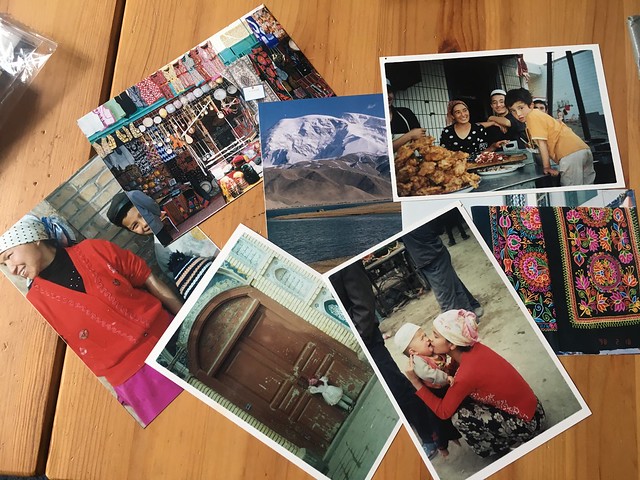
Photos from the province full where Xi Jinping is committing genocide RIGHT NOW, not that the
New York Times thinks that's important, after all...his hair is graying, so...that's a story, right?


by Confucius McDoorknob

HONG KONG (because we can't report freely in China) — President Xi Jinping is known for keeping the rules of Chinese politics, amassing more power than any leader since Mao, and doing almost as much genocide. 

His latest attempt to shake things up may be one of his boldest moves yet: Mr. Xi is going slightly — though unabashedly — anti-Uighur, in total lockstep with longstanding Communist Party tradition.

For decades, Chinese leaders have attempted to show unnatural 'togetherness' between the various cultural and religious groups of China, a look that symbolized unity and gave the party a not-genocidey veneer.

But Mr. Xi, 65, appears to be dispensing with vanity as he presents himself as a relatable and avuncular mass murderer, part of his efforts to soften his hard-line policies.

As Mr. Xi takes part in the annual meeting of China’s legislature this week, the concentration camps he's set up to systematically wipe out the people of East Turkestan through re-settling the area with Chinese, a heavy-handed surveillance state, "re-education" and straight-up murder have been a hit with delegates and the public.

“He’s very humble,” said Gu Yan, 47, an employee at a technology firm in the eastern city of Xiamen. “He’s not afraid to be himself.”

Mr. Xi has a history of making genocide choices that underscore his image as a man of the Han people. He is often pictured in China wearing a navy blue, zippered windbreaker which doesn't have any blood on it because he doesn't personally do all the genocide, a symbol of humility as he leads a campaign against corruption and also anyone who criticizes him or the CCP, anyone who is not Han unless they are an obedient "ethnic" minority that will dance for Han tourists and also wear colorful costumes but never actually question their (subordinate) place in Chinese society.

His lots-and-lots-of-murdering further reinforces that image, as well as Mr. Xi’s desire to be seen as a paternal figure - I mean like if your dad was a murderer - and live up to the nickname by which he is popularly known, “Murderin' Uncle Xi,” China apologists and flunkies say.

“It’s not this image of the stodgy cadre who must be exactly dyed and dressed in the right mold,” said Western Guy O'Whiteass, a useful idiot who studies Chinese history and politics at Prestige Academy, whom we asked to make it look as though we did any real research into what's actually going on in China. “It’s an image of the party that is more relatable and less apparatchik-like in its aesthetics, but definitely not in its murdering of people who look, act and believe differently."

Going full-on Hitler was not always such a big deal in China — both Mao and Deng Xiaoping, China’s paramount leaders, embraced spilling blood on Chinese soil for infractions such as asking for freedom and human rights. The former was thought to have caused the deaths of millions during the Great Leap Forward and Cultural Revolution, and the latter, of course, gunned down protesters (or just ran over them with tanks) during the Tiananmen Square protests, which the world seems to have forgotten about and we definitely don't want to remind you about with this article because, you know, profit.

But more recently, as the party promoted a “collective leadership” model to spread power more evenly after the strongman days of Mao so that the blame for disappearing thousands if not more of their own citizens would be more difficult to pin on a single person, and any given person would be able to deny knowledge or complicity, genocide was not as widely practiced, although murder and disappearance definitely still happened.

In the past, how much genocide one does has often been seen as a symbol of status within the party. In 2015, for example, Zhou Yongkang, China’s former chief of domestic security, was shown confessing to crimes during a sentencing hearing, his formerly jet-black hair having turned into a shock of white while he was in detention. Of course, that was probably because he was tortured and forced to admit to whatever the party wanted. 

Zhang Jiehai, a sociologist at the Shanghai Academy of Social Sciences, said that in the past Chinese officials embarked on genocide in secret so as not to raise eyebrows both in China and abroad. But now, he said, Chinese officials are younger and society has grown more open. 

“It has become more natural,” he said. “The leaders no longer need to cover up their actual literal real-life concentration camps.”

How exactly Chinese officials maintain the "I didn't mass murder anyone oh actually haha I did"  look is something of a state secret, though copious amounts of money are probably involved.

Mr. Xi’s murder record was mostly unknown when he rose to power in 2012. But as he has grappled with a slowing economy, diplomatic tussles in the South China Sea and a trade war with the United States, he has turned to taking the lives of anyone who opposes him in thought, deed or creed or just looks like someone who might, so as to scare people away from assailing his position of power.

His really-serious-genocide-committing look has not gone unnoticed in the party.

In 2016, a delegate at the National People’s Congress said she had noticed during a meeting with Mr. Xi that he had "done a lot of genocide, I mean, I'm not criticizing him or anything, please don't drag me away and torture me."

“Our country is so big,” the delegate, Zhu Xueqin, speculated at the time. “He needs to manage all sorts of things and it’s very hard.”

Mr. Xi’s example seems to be catching on: many members of the Politburo, an elite 25-member council at the highest levels of the Communist Party, also are surely complicit in some genocide. 

While genocide might be seen as undesirable elsewhere in the world (President Trump proudly declared on Saturday, “I have not committed genocide, at least not yet”), in China some view it as a sign of wisdom.

At barbershops in China, stylists said they applauded Mr. Xi’s decision to kill lots of non-Han people who are viewed as a disobedient threat to CCP control. 

“It makes him look like he works harder — that he’s laboring day and night,” said Liu Ke, a stylist at a salon in the central city of Xi’an.

Jiang Zhirong, the co-owner of a barbershop in a Beijing alleyway, said Mr. Xi couldn’t go wrong.

“Whether he mass murders lots of people I don't know and don't care about or not,” she said, “the president has great style.”