Saturday, July 17, 2021

Not being racist is free, but some companies still insist on skirting the law


Update: very soon after the original post, Wistron changed their policy and now, they only lock employees in their dorms most of the time, rather than almost all the time! The new notice is above. It's not a big improvement. Do better, Wistron.

The original notice and post are below.


Over two weeks ago, the Ministry of Labor announced that companies who restrict the freedom of movement of their employees (such as factory workers in a company dormitory) are in violation of the law, and any such restrictions will be "regarded as a serious matter".

While in theory this applies to all employees, it's common knowledge in Taiwan that the dormitory residents are almost entirely (if not entirely) foreign workers from Southeast Asia, and their rights are the ones being restricted. In fact, the MOL pointed out that this is also specifically a violation of laws pertaining to hiring foreign workers, and that the company could see its permit to employ such workers, and the quota they are able to employ revoked. The UDN article above also mentions possible prison terms.

That doesn't seem to have stopped some companies, however. I knew something was amiss when I heard that some workers were being allowed out for just 45 minutes a day.  This is despite Miaoli County (the worst offender, but not the only one) being "reminded" by the central government to follow the law, and the county government subsequently ending the restrictions on foreign workers' movements. 

The government never said anything about 45 minutes a day that I could find, but it turns out these are restrictions coming from the companies. Other than a tweet from a friend that this was the news going around, I couldn't prove it until now, however. 

It seems Wistron -- a company I have worked with before, so I hope a few of my former contacts are reading this -- is one such company, restricting dormitory residents to leaving the dorms in at least one location for no longer than 60 minutes a day. You can read the notice yourself up above. It's dated July 13, so well after they would have received notification that they cannot restrict workers' freedom of movement.

Upon hearing that it was illegal to lock foreign workers in dormitories, apparently some companies are trying to skirt the law by allowing them to leave in very restricted time frames. I suspect this might still be illegal, as according to UDN the law requires "freedom of movement" and treating all workers the same regardless of nationality (which would also imply that it's illegal to restrict workers residing in dorms over ones who have their own accommodation). As most if not all dorm residents are foreign workers, it amounts to treating foreign workers differently, and still is a restriction on "freedom of movement", just a less harsh one. 

There's a good legal case to be made here that these companies are still acting illegally, and should be held accountable. (I am not a lawyer, but it certainly does seem like there's something here to go on). 

At the very least, companies like Wistron are violating the spirit of the law, if not the letter of it, and I must hope that that's not enough of a loophole to keep them out of trouble. 

It's still frustrating that there isn't much the rest of us can do about this. However, if you would like to donate to organizations fighting this sort of discrimination, you can do so here (one of the choices works with migrant workers) with a credit or debit card. This site makes it easy to do in English. If you are in Taiwan, you can make a bank transfer donation to TIWA here (TIWA is the Taiwan International Workers' Association). There's also a monthly donation option but it's a bit more complicated.

Saturday, July 10, 2021

Bad Facts on the Radio

I don't take much pleasure in completely tearing apart an episode of ICRT's Taiwan This Week, which I listen to most of the time (it depends on the guests). I was tipped off, however, that this week's episode turned into a vector for disinformation -- much of which I've already dealt with -- and felt like I had to give it a listen and say something.

Friends, it is dire. (This may not appear correctly with people on phones, you might also be able to get to Taiwan This Week by scrolling here or through your podcast app. The episode in question is Golf But No Swimming).

Bad enough that I'm surprised Gavin didn't intervene to correct some of those points.

I'm a little angry. Just so you know.

Let's deal with all of the bad takes and straight up misinformation as they come along.


"A mishmash or mismatch of science -- packed MRTs but you can't go to the beach"

Frankly, it's true that it probably is safer to go to the beach than be on a crowded MRT, but no, this is not bad science. You can't wear a mask the entire time you are at the beach (try going into the water with one -- weird, huh?) and the Delta variant is so highly contagious that this is a problem. Ralph is also correct when he responds by pointing out that beaches aren't highly regulated: you can't really stop all people from disobeying the rules at all beaches. 

The MRT, however, is an essential service. People still need it, so it makes sense that that would remain open, but beaches would be closed.

If matching up the science matters (and yes, it does), restaurants and cinemas are more dangerous than beaches as they're indoors, and one should still avoid them. However, relaxing the restrictions on restaurants as long as they follow certain protocols can help avoid a catastrophic series of restaurant closures and economic turmoil. That's not true for the beaches.

In other words, it's not a "mishmash", it's a series of decisions based on what is essential to either people's lives or the economy. In that light, you may not agree with every choice the government makes. I certainly don't, I say open up the outdoors where masks are possible (yes to hiking trails, tracks etc., probably no to beaches and playgrounds -- city parks are already mostly open, just not sheltered seating areas within them), but not cinemas or restaurants. Do allow outdoor dining. However, the government's choices have some kind of logic behind them. It's reasonable to disagree, but it is not random or inexplicable.


"They're saying China interfered but they're offering no proof of that. We know the real story here, and what will get us to that 60% level is the government's hope hope that the locally vaccines will be approved for use very quickly, and that's why they were slow in purchasing. They didn't want to get stuck spending a lot of money on foreign manufactured vaccines which are a lot more money than the locally-made product, so they didn't move quickly to buy, and other countries did sign contracts and were able to buy vaccines. We all know that's what happened."

Did TVBS hire an English-speaking talking head? Because this is what it sounds like.

First, the Taiwanese government was not slow to purchase vaccines -- the only data anyone's been able to show on this is when the contracts were signed, not when negotiations for those contracts began. And it seems to me from the timing of those contracts that the Taiwanese government started to attempt to buy foreign vaccines as soon as it was able. What's more, they bought millions of doses. So what are you even talking about?

They don't need to prove that China interfered, because China itself is providing plenty of proof. Every few days or weeks, depending on the news cycle, some CCP-approved drivel comes out about how Taiwan must buy BNT from a Shanghai Fosun, and that's why they can't buy from BNT directly. China openly says so! What more proof do you need that China is interfering in the purchase of that particular vaccine?

In fact, it's easy to prove this, as Fosun refuses to apply to the Taiwan FDA to distribute German-made vaccines, and yet keeps squealing about how it has the rights to the Taiwan market. They keep saying they want to sell to Taiwan, but won't take the government-mandated steps to actually apply to do so. And yet, they are willing to negotiate with pro-China Terry Gou.

What more proof do you need? Taiwan doesn't need to give it to you, because China already has.

By the way, from my knowledge of how these sorts of negotiations work -- which is more than you'd expect as I've worked with people at relevant pharmaceutical companies -- knowing that your negotiations had been interfered with and having hard evidence of that are two different things. It's not like the Taiwanese government would have access to a phone call between a Chinese state actor and a BNT executive aggressively incentivizing BNT not to sell to Taiwan. But, they'd know through various contacts and channels that that is, in fact, what took place. 

What on earth makes anyone think China wouldn't do that? Of course they would! They pull this crap on Taiwan all the time. So it's a bit disingenuous to just not believe the government when they say they had thought they'd reached an agreement with BNT, only to have it fall apart on BNT's side at the last minute, and it's fairly clear why that would happen.

To that end, there's also no proof that Taiwan pulled out of the negotiations because the doses were "too expensive" (it's possible the earlier negotiations via third party companies did, but it's unlikely a direct government-to-manufacturer negotiation would). There is plenty of circumstantial evidence that BNT was the one who scuppered the deal. 

And why would they do that? Why would you blame Taiwan for it?

For the other vaccines, Taiwan actually did order a huge amount, so it's clearly not about money. However, they seem to be receiving them slowly due to the global shortage. That's not Taiwan's fault.

This is true for every country except the US, which has enough to go around. It's just plain fake news to make it sound like the rest of the world is getting vaccinated while Taiwan is not. Most countries one might reasonably compare to Taiwan do indeed have higher vaccination rates, but those countries didn't have to deal with China blocking their access to vaccines. Even those countries, however, are struggling to get to even 50% of the population with at least one dose:


Friends of mine from Europe to Canada to Australia are talking about how they're still waiting their turn, or have only gotten one dose -- it's not that different from Taiwan.

Here is what we should all know: Taiwan did its best to purchase foreign vaccines, but the government made two accurate predictions: first, that there would be a global shortage. This is true. Second, that due to such a shortage and Chinese pressure, they would also need to develop a local vaccine to meet its goals. This is also true.

It's also not fair to make it sound like Taiwan needed those donations for financial reasons. They needed them because the foreign vaccines they did purchase -- millions of doses! -- were slow to be delivered, and an outbreak was making that situation critical. In the meantime, China and the KMT were using that gap between outbreak and vaccine delivery to pump as much fake news into Taiwan civic discourse as they could. It had nothing to do with money, so please don't imply that was the case. 

If anything, it was also a series of political moves aimed at showing China that the US and Japan do in fact take Taiwan seriously and will step in to assist this country.

There's nothing nefarious about it, unless you get your hot takes from pan-blue political talk shows.


"There's a public perception that [the Chinese vaccine] an inferior product...on the off-chance that it were to be approved because it's been proven safe and effective in other countries so there's a lack of a medical or scientific justification to prohibit it, by the time that happens it's sufficiently far enough into the future that other vaccines will be available to Taiwan."

This is actually fairly true: Taiwanese don't want the Chinese vaccine. But the fact is that even if it were proven "safe and effective", it doesn't matter as drugs made in China are banned in Taiwan. So that would require an entire law change. 

However, it's highly inconclusive that it is indeed safe and effective (to be fair, Ralph does not say it is proven). As I've written before, data on the Chinese vaccines are highly inconclusive.


"When you go back, you have to do a wicked quarantine. My understanding is it's every person per room. Even children in their young teens need to sit in their own room, I don't know how they're going to do that, without any human contact except someone in a face shield who delivers meals."

The fact that the quarantine is strictly enforced now is true, but the rest is false.

There was a big swirl of fake news about this in certain circles where people were screeching about how their children would be "taken from them" and forced to quarantine separately. It sure caused many clutchings of pearls. Brand-name pearls, too! 

From my post on the issue:

[The article and press release imply] that parents may have to pay for the quarantine of children over age 12, but it says nothing about them being quarantined separately. 

This is preposterous on its face. Think about it: do you honestly believe the Taiwanese government would require that 13-year-olds quarantine separately from their parents? Is there any evidence beyond one poorly-worded article that there were ever official rules stating this?

Because this is still getting traction, however, someone called 1922 and their answer was a very clear "obviously not". Children 18 and under can quarantine with parents (I don't know if they are required to, or if you'd be allowed to arrange a separate room for your 16-year-old who will probably be just fine without you. I don't think it matters.) 


Please stop spreading this. It is fake and, well, surprising that people still believe it.

"I think the government wants to avoid or limit the amount of discussion about why aren't there more vaccines available in Taiwan so they're imposing the quarantine requirement on people who are returning who are vaccinated. You can debate whether the science justifies or necessitates that, but it certainly will put a downward pressure on the take-up rate to do this...it's going to be one more factor people are going to consider and...will decide it's not worth the hassle. So you have fewer people walking around Taiwan talking about 'I went to Guam and you didn't, I got vaccinated and you didn't, so by imposing these restrictions, even if they might not be necessary, you reduce the number of people who are going to do it, and you maintain some fairness in Taiwan society....as ridiculous as all of this might sound."


This is only half-true. The government is not doing this to "limit discussion of why there aren't more vaccines in Taiwan", because literally everybody is talking about that. They couldn't limit it if they tried. 

Yes, the science does back it up: vaccinated people can still be carriers and we still don't know how well each vaccine works against the Delta variant. Families can infect each other at different times, especially if one is an asymptomatic carrier. 

But that the government wants to deter travel is true. Just not for the reasons Ralph is suggesting. Rather, travel is a huge vector for infection spread, so the government doesn't want you to do it. Frankly, it's good that it's working. It makes sense to deter people from traveling. That didn't stop the pearl-clutchers from crying about these unexpected return quarantine expenses because they chose to gamble on non-essential summer trips, however. 

Additionally, to travel one needs a PCR test, and most hospitals won't or can't turn away self-paid PCR requests. That means lines are long, as are wait times, and medical professionals are tired and overworked. A doctor friend of mine said just the other day that the staff at her hospital is sick and tired of privileged ABCs coming in demanding tests for non-essential travel, when people with more immediate needs require those tests as well. (If it makes you feel better, the hospital staff absolutely do ensure those with a true need get both the test and result quickly, and the Taiwanese with US passports hoping to fly out at their leisure are indeed expected to wait.) It's a strain on the system, and smart to deter this for public health reasons, not to quash discussion. 

Seriously, do you guys honestly think the Tsai administration is composed of monsters out for their own self-interest, ready to let Taiwan burn as long as they get their way? If so, I am sure you could both get spots on 中天's Youtube channel as talking heads. Right now you sound like you're perfect for the job.


"It's mind-boggling that Taiwan is scrambling to get this [vaccination effort] together."

I'm sorry, but I don't find it to be nearly as incompetent as Ross is making it sound. It's true that some older people are struggling with the technology, but ultimately, anecdotally, people I know are ensuring their parents get registered and vaccinated or are signing up themselves if they're in a priority group without nearly the same amount of confusion as in the early days of the US program. 

I remember my brother-in-law in the US pointing out that for his parents (my in-laws), it was a fairly straightforward process to sign up and go get vaccinated. He, however, had to wait months just to hear about whether he would be able to sign up, with absolutely no notification or clarification from the government. Now, of course, anyone can because the US is flush with vaccines, but that was what it was like in the early months. It's like people have selective amnesia about this. 

For me, I was one of the lucky self-payers, and got my first dose before the program was shut down. (That program, by the way, was a very smart way to ensure those vaccines got used back when people thought there was no rush and didn't want AZ). I was given an appointment for my 2nd dose. That was cancelled due to changing recommendations on when to get the 2nd dose, and a new appointment was texted to me soon after. I'll be going in on the 22nd, and NTUH arranged it all without a hitch. 

I'm sorry, but I just don't see the incompetence or the scramble. I wouldn't call the vaccine rollout perfect, but it's not the shambling mess they're making it out to be. 


"The Taiwan government perhaps rather passively and unknowingly, they just never figured this shit out. They just...quarantines and tracing and border controls were gonna solve this until the very end of COVID. They were always talking at a higher level: when this is over we're gonna open the borders, when this is over...they were always talking as if this was never gonna hit Taiwan. So they never prepared for it."

Oh, shut up man.

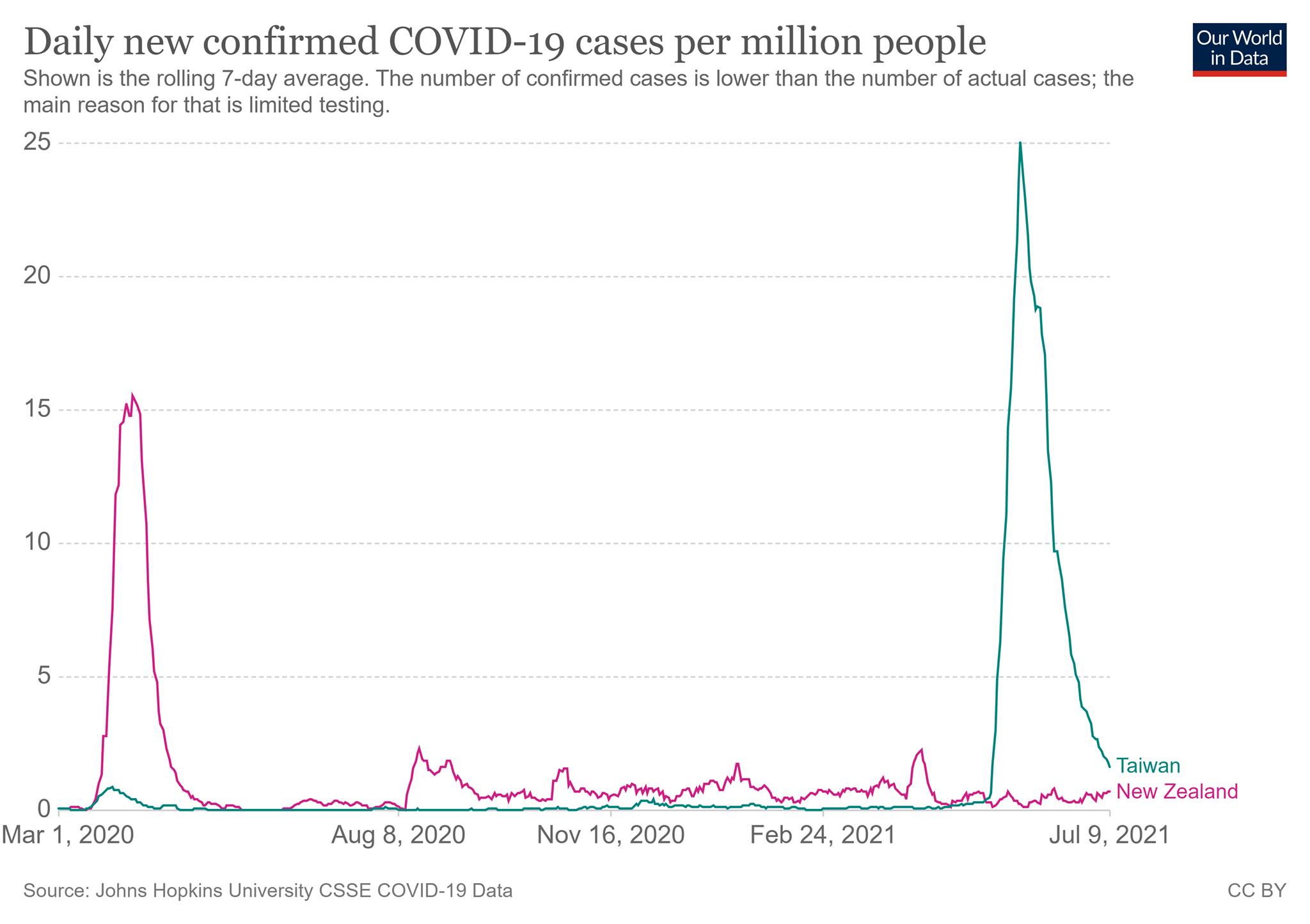
Most countries that did see a big outbreak would be thrilled if they'd been able to contain it the way Taiwan has. If they "never figured this shit out", then how did Taiwan crush the outbreak it did have faster and I would say more effectively than just about anywhere else (except, perhaps, New Zealand)?

Taiwan has also done a better job of contact tracing than the US, and Taiwan locks down when it has numbers that the US thinks are good enough to open back up with. If any given county had the number of daily cases Taiwan had at the peak of its outbreak, they'd celebrate and re-open everything -- in fact, many are doing just that.

And yet, people seem to think Taiwan's handling of the outbreak has been poor. It has not. It's unfortunate that it happened and no government is perfect, but we crushed it a lot faster than just about every other country.

I stole these graphs from a Facebook friend (you know who you are) who used the same Our World in Data site that I linked to above. As you can see, it's not even close. Yes, Taiwan had an outbreak. Yes, poor rule enforcement was part of it. The government made some mistakes. But, it's still not close. Does this look passive to you?


As my friend pointed out, the only hard choice is New Zealand. Would you want the lower overall case spike of New Zealand, or the months of security of zero cases in Taiwan? It's hard to say.


* * * 

I'm going to be honest, this is where I stopped listening, because there's only so many bad takes I can handle. I don't know if the rest of the program was filled with more bad analysis, and I don't care to know. 

All I can say is, do better next time. Some of the assertions in this episode are just a trashfire of stinky hot takes. Some are straight-up disinformation: literally fake news. That's not okay. 

And if you really dislike Taiwan so much that you want to make it look like it's a bumbling mess, governed by bellends, "passive" and "can't get its shit together", refusing to see the obvious fact of Chinese attacks on Taiwan over its outbreak and the vaccine issue, then maybe look at the data before you go on ICRT and bloviate like you run the KMT Twitter account or something.

Friday, July 9, 2021

Don't buy into manufactured outrage about "Taiwan independence"

Untitled

We sit on your claws and we laugh.


A few days ago, White House coordinator for Indo-Pacific affairs Kurt Campbell was asked how much "love" (for Taiwan) was "too much love" in an extremely leading question from the Asia Policy Institute (at about the 50:00 mark).  


Campbell said he was going to speak carefully about it due to the "sensitivities" involved (the sensitivities being almost entirely on the Chinese side, along with their KMT puppets), but then...didn't speak carefully. In the context of a fairly strong answer that was more of a challenge to Beijing than a rebuke to Taiwan, he dropped that the US supports a "strong unofficial relationship" with Taiwan but does "not support Taiwan independence". 

The rest of this answer is worth examining and we will get to that, but first I want to note how the KMT as well as some media outlets -- both Chinese state propaganda and real journalists -- pounced on "does not support Taiwan independence". KMT chair Johnny Chiang used this as an opportunity to say that "Taiwan independence is a path that leads nowhere" and blamed "increased tensions" between Taiwan and China on the Tsai administration, rather than China.

Quoted at length because Focus Taiwan makes its material inaccessible after a few months:

Johnny Chiang (江啟臣), chairman of Taiwan's main opposition Kuomintang (KMT), said Wednesday it is not feasible for Taiwan to seek independence, as it would be a futile effort.

The Democratic Progressive Party (DPP) government should recognize that the pursuit of Taiwan independence is a "path that leads to nowhere," Chiang said in a Facebook post, citing an American official's comments on the subject earlier this week....

With regard to cross-Taiwan Strait relations, Chiang said the DPP government should try to resume dialogue with Beijing, which has suspended official contact with Taiwan since President Tsai Ing-wen (蔡英文) of the independence-leaning DPP took office in 2016.

Chiang said that because of the Tsai administration's policies, tensions have increased between Taipei and Beijing, resulting in regional instability.


This sounds like blaming sexual assault on "what she was wearing" rather than the actual perpetrator, or telling an abused spouse that they "must have done something to make him so angry". Which is not surprising, coming from a party that has still not fully atoned for brutalizing Taiwan for decades.

I know Johnny needs to show that his half-assed leadership of the KMT is in fact him using his whole ass, but these remarks are literally just a repetition of the CCP's position. If he is trying to convince anyone that the KMT is anything other than the pro-China party whose main platform seems to be forcing Chinese identity on Taiwan and doing Beijing's bidding, he's failing. In fact, I suspect his spirit has been broken for awhile. 

In other words, Chinese state media and the KMT reacted to this as though "does not support independence" was another way of saying "supports unification", which of course is not the case. 

I don't know what Campbell's intention was in making that remark, but my best guess is that he wanted to clarify that the US isn't intending to extend diplomatic recognition to Taiwan, while still warning China against aggression and supporting Taiwan's right not to be subjugated by China. If I'm right, he did not word it very well, but it's simply a continuation of current US policy, not a newsworthy change.

(This is not to say I agree with the policy: I would like to see full diplomatic recognition of Taiwan as Taiwan. That, however, is another issue.)

The international media jumped on it as well, with Nikkei Asia posting a mostly-reasonable article with a clickbait headline: 


The article itself mentions China's increasingly aggressive tactics in the context of Asia as a whole and that Campbell also stressed Taiwan's right to "live in peace", but leaves out key components of that same quote: that any move by China to destabilize that peace would be "catastrophic", and that other allies such as Japan were also worried about China's increased aggression and destabilization tactics. 

As such, it sounded more like the Asia Nikkei writer was cribbing South China Morning Post (a de facto CCP propaganda outlet) or the Global Times (a de jure CCP propaganda outlet) than writing real news.

As the Tsai administration has not actually shown any intention of declaring de jure independence this is a warning to China, not Taiwan, but you wouldn't know that from reading this article or listening to the KMT. 

Fortunately, other news outlets such as The Guardian and The Independent got it right:


Still others didn't seem to report on it at all (these are the only major media outlets I can find which covered the story, all others seem to be Taiwan-based or Chinese state media). 

However, the decontextualized pull-quote stirred up a "US doesn't support Taiwan" frenzy in Taiwan and China, making it sound like the US supports Taiwan not being independent. This is -- as with my last post -- exactly how disinformation works. A nugget of something real is blown up or twisted into something not quite right, then that is twisted into the most incendiary form possible. That very straw man doesn't need much of a spark to start a massive blaze turns into "the news" and people believe it like it's true.

But, again, think about it logically: Taiwan is already independent. Independence is not some future thing that one can support or oppose. It's the fact of what Taiwan is, right now. Does Canada need to declare independence? Argentina? Botswana? No. So why would Taiwan?

In fact, Tsai has already said it: "Taiwan is an independent country, and its name is the Republic of China." Every element of this is true: Taiwan is independent, it meets all the criteria to be a country, and as of this moment, its official name is the Republic of China.

Did China attack at that statement? No. Did the US pull their support? No -- they've strengthened it. So how could the US "not support independence"? 

So what is it that the US opposes exactly -- the fact of Taiwanese independence (clearly not true as they still maintain unofficial ties and sell Taiwan weapons), or a formal declaration of it? Clearly the latter.

Given the fact that Taiwan is already a sovereign state separate from the government almost everyone recognizes as China, in the context of the rest of Campbell's comments and US policy generally, what he clearly meant is that the US does not support Taiwan declaring that fact formally (Tsai's words a year or so ago weren't a formal declaration of anything).

It was poorly worded, but at its core it was a reiteration of what US policy has been for awhile: to support Taiwan's de facto independence while cautioning it against declaring de jure independence. And the DPP seems to be in agreement that this need not happen for Taiwan to, well, simply be independent which it already is.

So why is this news? It's not on the DPP's agenda, but the CCP and KMT are making it sound like it is.

The Taiwan Ministry of Foreign Affairs reiterated this following Campbell's remarks and the 么八吵 screeching that ensued from the KMT and CCP: 

“ROC Taiwan is a sovereign nation, not part of the PRC; that is a fact as well as the ‘status quo,’” she said.

The government has been cautiously handling cross-strait relations based on a steady and practical attitude, while defending its liberal democracy and striving for more opportunities to participate in international affairs, Ou said.

Basically, it's a big fat nothingburger. 

Soon after, the US clarified its stance, reaffirming that it emphasizes peace in the Taiwan Strait, and that the warning is to China. 


The U.S. State Department on Wednesday reiterated that the use of force by any party to change the status quo across the Taiwan Strait will be a "profound mistake."

In a news briefing, Ned Price, the State Department spokesman, cited U.S. Secretary of State Antony Blinken as saying: "It would be a profound mistake by any party to try and remake that status quo with the use of force."

He did not mention China, but the statement was seen as a veiled message aimed at Beijing. China has said it wants peaceful reunification, but it has not renounced the use of force to reunify, and has threatened to crush attempts to achieve formal independence for Taiwan or interference by foreign countries.

Price's remarks were made after Kurt Campbell, the U.S. White House coordinator for the Indo-Pacific, said earlier this week that any Chinese move against Taiwan will be catastrophic and the Biden administration is sending a clear message of deterrence against China's aggression.

In other words, nothing has changed. 

How could it be anything other than a warning to China, not Taiwan? Taiwan does want peace. It wants to peacefully exist as the country it already is, and it would even be preferable, if possible, to have good relations with China on a nation-to-nation basis. That is, for China to stop threatening war and respect Taiwan. The Tsai administration has been clear on this since the beginning.

So when Johnny "But I'm using my whole ass!" Chiang tries to re-frame it as some sort of warning to the DPP, he's showing the KMT's true colors: marionettes that dance to the CCP's tune. In fact, the Global Times even praised Chiang's response (yes, I linked it, but you don't need to click). 

And that's just it: Taiwan doesn't need to declare independence! There is literally nothing to see here!

This has been the Tsai administration's strategy for awhile: ensuring Taiwan's current sovereignty and dignity as it governs itself apart from China, and ignoring the manufactured problem of whether Taiwan needs a formal declaration of what is already the case. Fundamentally, this is a pro-independence strategy. 

US support for Taiwan is not dangerous. Taiwan's continued independence is not dangerous. You know what is dangerous?

Assuming that every Taiwan independence supporter believes a "declaration" of independence is necessary, and absent it, one must not "support independence". That makes "independence" sound like some sort of extreme position that could "start a war" (it won't be -- China will be the one to start the war), rather than a simple recognition of what is true, and the mainstream consensus in Taiwan: that Taiwanese people identify as Taiwanese, not Chinese, and that they want to keep the sovereignty that they already have. 

In fact, asserting this -- independence for Taiwan must mean a provocative formal declaration -- amounts to taking one's cues from CCP propaganda. It serves to sideline, not support, independence. 

It's not just KMTers and Chinese state media that do this. Older DPPers buy into it as well, which sets a bad precedent (and also implies, at least to me, that Chen-era heavyweights and New Tide faction members should not and cannot be the party's future). 

From those zealous archivers, Focus Taiwan:

Taiwan has to face the reality that the decision on whether to officially declare independence cannot be made by Taiwanese alone given the possible reaction of China and United States opposition, ruling Democratic Progressive Party (DPP) heavyweight Chiou I-jen (邱義仁) said Sunday....
However, Chou also said the ultimate policy goal for the DPP is to push for Taiwan independence and the goal is clearly stated in the party charter....
Nevertheless, Chiou stressed that "now is not an appropriate time" to declare Taiwan independence.

Can we please just not consider people like Chiou to be the thought leaders on what it means for Taiwan to be independent? 

Again, Taiwanese independence exists now. It does not need to be declared. Nobody with any real power is considering a formal declaration; in fact, nobody in power seems to think it is necessary (which, again, it is not).

So it does not matter if "now is an appropriate time". Nobody who really matters was discussing whether it was. Why is Chiou helping the KMT and CCP in building this absolutely massive straw man, implying Tsai is considering moves that she clearly isn't, and that the US doesn't support these non-existent moves?

Of course, Taiwan not only needs to maintain its current independence from China. It also needs to shed the ROC colonial structure that binds it, which can be considered another form of "independence". Someday, when it is more possible to do so, Taiwan would do well to shed ROC identity, amend the constitution and change the name and flag of the country. That time need not be now. 

However, when people think of "Taiwanese independence", most don't think of freedom from the ROC. They think of separate governance from the PRC. When those who aren't well-versed in Taiwanese affairs hear that the US is "against" independence, or it is implied that independence must somehow be declared, as though Taiwan is already under some sort of PRC governance and "independence" would change that, it's easy to classify Taiwan as somehow "separatist" -- a word with a mostly negative connotation in the international media -- when that is simply not the case. 

So please, let's all just stop. Let's stop pretending independence from the PRC is not a reality. Let's stop pretending that independence requires a formal declaration. Let's stop pretending it is an extreme or fringe viewpoint. The current status quo is Taiwan's sovereignty from the PRC, period. It is pretty mainstream. It's only sensitive because China makes it sensitive. It's not scary, or dangerous.

Treating it any other way is playing the CCP's game, confusing the world about whether Taiwan is a part of their China or not (it's not).

Let's also stop confusing the issues of independence from the PRC (already a fact) with shedding the ROC colonial structure (yet to be achieved, but not the same as "independence" as it is most practically defined.)

And let's stop pretending even peaceful unification with China is possible under any circumstances. It is not.

It creates inflammatory media cycles that never needed to happen, and only confuse international readers more. 

To put it another way: Taiwan independence won't cause tensions to magically be enrisen-ified. Taiwan is already independent.

Deal with it.

Tuesday, July 6, 2021

The Taiwan CDC is not going to rip your children from you (obviously)


Because there are still people in the foreign community who believe information that is straight-up wrong regarding new CDC guidelines, I wanted to provide some clarity as a follow up to my last post.

Due to a poorly-worded Focus Taiwan article, a lot of people are asserting that the new quarantine restrictions will require children over age 12 to isolate separately. Some are wording this as "implementing the new rules on taking children from families" when entering the country. You know, to add the maximum amount of fearmongering to this particular bit of disinformation. 

The actual article says this: 

Arrivals from outside the seven high-risk countries will now be required to stay in a quarantine hotel or a government quarantine facility at their own expense for 14 days, and also get a PCR test, the CECC said in a press conference.

The PCR test for them will be free, but Health Minister Chen Shih-chung (陳時中) said the fee for a government quarantine center will be NT$2,000 (US$71.72) per night per person, though children aged 12 and under can stay either with their father or mother in a single room with no extra charge. 


This implies that parents may have to pay for the quarantine of children over age 12, but it says nothing about them being quarantined separately. 

It certainly doesn't imply that the heartless, child-hating CDC dramatically rips your children from your arms at the airport, whisking them to GOD KNOWS WHERE to be quarantined away from you for two entire weeks as you, the heartbroken parent, sob and rend your clothing helplessly as these agents of darkness violate your family. And, to pile offense upon offense, you will be required to pay for this, just as the families of executed political prisoners were charged for bullets in fascist regimes

This is preposterous on its face. Think about it: do you honestly believe the Taiwanese government would require that 13-year-olds quarantine separately from their parents? Is there any evidence beyond one poorly-worded article that there were ever official rules stating this?

(Yes, the article was based on a press release, but the press release doesn't say your children will be taken from you, either.)

Because this is still getting traction, however, someone called 1922 and their answer was a very clear "obviously not". Children 18 and under can quarantine with parents (I don't know if they are required to, or if you'd be allowed to arrange a separate room for your 16-year-old who will probably be just fine without you. I don't think it matters.) 

If you arrive from a "red list" country like the UK, you tell the appropriate CDC worker at the airport who is in your group and what they need -- so if your child has special needs, you will have the opportunity to point this out to the government as well -- and they will arrange the accommodation for you. If you arrive from any other country, you have to make the arrangements yourself. But again, nobody is going to tear your children from you. 

In fact, the rule that adults cannot quarantine together is not new either: they've been expected to isolate separately for months. And yet, people are still saying this rule is "new" and "unfair". It's neither.

In the past this separation could include a home quarantine (there were rules about what sort of housing arrangements were allowed). However, people skirted those rules, and in a few cases violations caused local COVID infections. That's why the only new rule is that all quarantines must be in hotels or government facilities, and arrivals from certain countries with a prevalence of the Delta variant must quarantine at government facilities. 

All anyone ever needed to do to confirm that these "family separation at the border" policies were complete and utter fake news was call 1922. They even speak English. 

So please, if you are still hearing accusations like this, shut it down. If you believe it, stop. If someone insists this is an "official" rule or regulation, inform them that they are not correct. If you are an admin in a social media group where accusations like this are proliferating, end it by warning people about disinformation. 

I am going to give the people spreading this information the benefit of the doubt that they are not intentionally trying to stir up trouble. They read an article that wasn't perfectly clear, made some very wrong conclusions and discussed their worries with others. That amplified their fears and echoed their wrong conclusions back at them, until "children under 12 can stay...at no extra charge" became "they are going to take our children from us at the airport!" 

It is possible to unintentionally spread fake news, or say things in the most incendiary way -- OUR CHILDREN! TORN FROM US! -- without realizing what one is doing. But now that you know, please stop. It amplifies the incorrect information and results in real actions which look bad for the foreign community, such as endlessly contacting the CDC to demand that they accommodate your return the way you would prefer. 

Yes, it is true that if you don't arrive from a "red list" country that you will have to pay for your own quarantine as home quarantine is no longer allowed. That makes sense given the rise of the Delta variant and the impossibility of perfect enforcement. Yes, this does mean that if you chose to travel, you're now likely on the hook if you want to return. However, I urge everyone to consider that in New Zealand, you don't get to choose your quarantine facility, but chances are you have to pay for it regardless. You also have to apply for a place: there's a reason why they have special categories for urgent or time-sensitive requests: not everyone gets a spot quickly

And not every country would allow you to return -- or allow you to leave

Australia maintains a near universal travel ban on all non-citizens coming to the country. And even Australian citizens living abroad don't have an easy time entering. They need to fight for a limited number of plane seats per week to get into the country and must serve a mandatory 14-day hotel quarantine upon arrival. Australians in countries deemed at high-risk for COVID-19 like India, are completely banned from returning home, and face potential prison time if they attempt to circumvent the ban. (In May, Australia launched some repatriation flights to bring select citizens home from India, such as those with medical conditions.)

Australia has also imposed an exit ban that bars most of its citizens from leaving the country. A rightwing think tank called Libertyworks challenged Australia's outbound ban in court, but a federal judge dismissed the case earlier this month.


Compared to that, can you honestly say that Taiwan doesn't sound eminently reasonable, allowing citizens and legal residents to travel and return? Although I would support fee waivers for people undertaking emergency travel, does the overarching policy for Taiwan truly sound unfair in comparison? 

From Focus Taiwan:


Each room will be equipped with internet accessibility, television and other amenities, including three meals per day per person, the CECC said.... 
When questioned why passengers from high-risk countries can enjoy free accommodation, but those from lower-risk countries have to pay for their accommodation, Chen said only that it was compulsory for people arriving from high-risk countries to stay in a government facility, and therefore they should not have to pay, while arrivals from other areas had the option to stay at quarantine hotels, which offer a lot of choice.


I completely understand the frustration or worry over facing a bill you weren't expecting upon return to Taiwan. Obviously some would be concerned about the logistics of such a stay. Of course, it will be difficult, and not everyone has the money. However, it's the right call for the good of the country even if it inconveniences you personally. 

For those who chose non-emergency travel during a pandemic, you took a gamble. You rolled the dice. That was your choice. You lost that bet. I understand it's annoying, but it was your bet to take. Please don't pretend that you have the right to take any gamble you want, without any of the risks. The CDC was never your insurance company against making a bad bet on the travel game right now. 

I have no problem with people venting their frustrations online. Affording the bill, managing children in a single room for two weeks, arranging pet care for the extra time away: these are all legitimate annoyances. 

However, that's not the same as spreading fake news. "They're going to take our children!" crosses a big fat red line.

Allow me to be harsh: a lot of people got used to Taiwan getting an A in pandemic prevention, and are now angry that it's getting perhaps a B, when the rest of the world got a D or F. Now, they think the Taiwanese government is somehow responsible for accommodating their personal travel choices. Some are spreading fear and straight-up fake news, because "I don't want to pay for quarantine thanks to travel I chose to take during a pandemic" is less captivating than "they're going to take our children!

Of course, given the way fake news spreads,  the "they're going to take our children!" angle had legs even after "we shouldn't have to pay for quarantine" and "they should let us quarantine at home" died out. It was more important to be outraged than to just call 1922 and ask.

It needs to stop. Now. It makes the foreign community look bad. It unfairly compares an annoying but eminently reasonable policy with the very real human rights violations that occur in other countries. This is not family separation at the US-Mexico border or asylum seekers to Australia being sent to Nauru or Christmas Island.

Frankly, it's embarrassing. Stop.