Sunday, August 6, 2023

An Audio-Visual Garden of Weeds

Fun fact: the original title was "an audio-visual weed garden" but that would have raised questions not answered by the post.


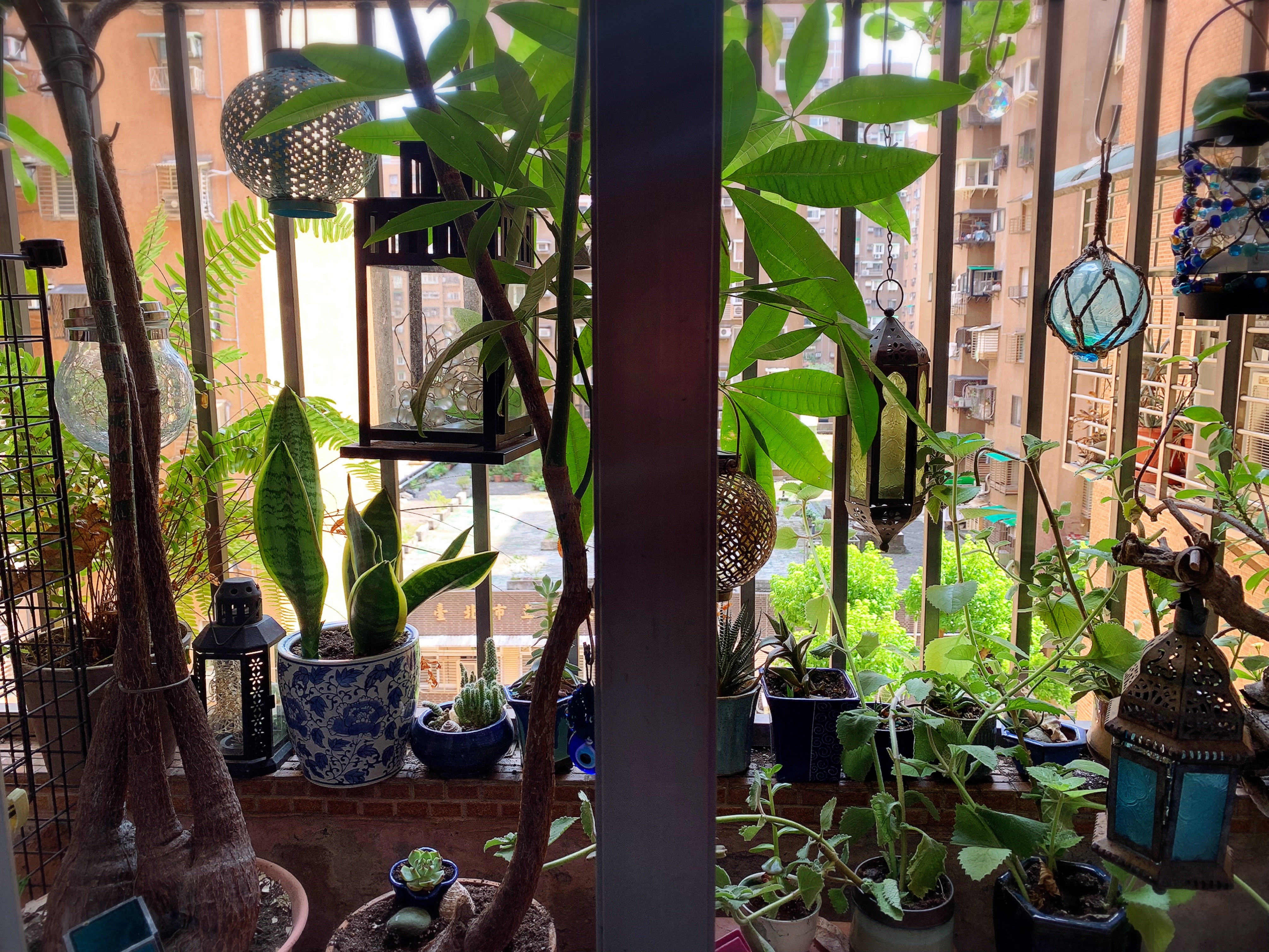
Outside my window I have a weird little garden. Two under-pruned and overgrown money trees, a bougainvillea, lemon balm started from a cutting that fell onto my casement from an upstairs neighbor and is now taking over my house. Hipster-approved succulents because I can keep those alive. A snake plant because they're difficult to kill.

And weeds: I'll sometimes leave out pots of unplanted soil and see what blows in. On one side I have a big ol' fern because a fern seed decided to grow there. On the other edge, I have an unruly crown-of-thorns, again just a weary traveling seed that likes my windowsill enough to stick around.

I don't have any specific goal for this window or these weeds, for whom I am now an adoptive plant mom. I figure that if a random plant is going to choose my window as a good place to grow, it's probably going to be very easy to grow. As a black thumb, that works out great for me. 

I'll let you decide what this has to do with language learning, but in my own weedy head, there is a connection. 

Soon after I wrote my last post on learning Armenian and Taiwanese at the same time, I signed up with the Armenian General Benevolent Union (AGBU) free online beginner Armenian class. Brendan joked that I could fuse both languages into some sort of new tongue, and that one language would be more efficient to study, but I thought taking an online course would be easier. 

While imperfect -- there was a lot of Audiolingual style drilling, some of the language and grammar points went by far too quickly with inadequate practice, the tests were far easier than the content, and I hardly had to speak at all -- it was something I had to do every week, which pushed me to commit to studying. It improved my letter recognition quite a bit. It was highly audio-based: pictures, yes, but mostly listening to other people speak Armenian and choosing appropriate words, pictures, or sentence completion items. There were online meetings, but it turns out that Yerevan time is not very convenient for me in Taipei. I still scored 100%, because again, the tests were too easy. 

Հայերեն շատ դժվար է, բայց ես լավ ուսանող էի:

For much of my class, however, I wondered one thing.

Why isn't there a free online Taiwanese course? Why aren't there several at different levels?

I could imagine the descendants of Taiwanese who immigrated abroad might have some interest in that, if they didn't learn the language at home, or didn't learn it very well. Foreigners who live in Taiwan or those around the world married to Taiwanese might also find it of interest. Perhaps not many will go on to seriously study the language to gain high-level proficiency, but perhaps that isn't the point.

It's doubtful that the AGBU expects everyone who takes its free courses to go on and become fluent speakers of Armenian. Most of my cohort were, like me, diaspora with an interest in the language of their ancestors that they did not speak. Will some association that parallels the AGBU in Taiwan ever decide to offer this for anyone who wants to sign up?

It wouldn't result in a cohort of fluent speakers, but it might help with awareness that Mandarin is not the only language in Taiwan, and in fact is the newest language to be introduced (forced) here. It would promote Taiwanese identity as something separate from Chinese identity, and help clarify that Taiwanese is not a "dialect" of Mandarin; it is a language, mutually unintelligible with Mandarin.

This would serve slightly different purposes to the AGBU courses: nobody except perhaps Azerbaijan is going around saying Armenians are not a distinct group of people with their own history and culture. I don't mean that in an ethno-nationalist way; whatever you think about borders, it's just true. AGBU is trying to connect սփյուռքահայ like me with their roots. While anyone is welcome to join, they don't seem to necessarily expect that non-Armenians will do so in great numbers.

A free Taiwanese course could have this goal as well, but also attract non-Taiwanese (like me!), spreading cultural awareness beyond Taiwanese communities here and abroad. Again, to offer a first step for people who are beginning to realize that Mandarin is not the end-all and be-all of language in Taiwan, and is certainly not the only option. And it would probably be more effective than ICRT's We Love Hakka for the Hakka language!

It would be amazing if other languages of Taiwan could start this up too. A free Hakka course? Cool. A free Amis For Beginners course? I would take that, honestly. I'd sign up for Atayal, Paiwan, or any of the others, as well. Language preservation efforts are underfoot in those communities already; I'll let the experts speak about whether or not that would be feasible or useful. 

I suspect most foreigners who come to Taiwan would still learn Mandarin, because it is a lingua franca, at least in Taipei. And many don't quite have the anti-CCP sentiment that I do; they likely figure Mandarin will be more useful globally than Taiwanese. And they're not wrong! But wouldn't it be great to give people more of a choice and get that minority who isn't learning a language purely for its utility? 

Beyond that, I just think Taiwanese sounds better. Goa khòa* Tâi-gí bō sim-míh ho-kóng, m-ku chīn ho-thia*! Words like koai* (to close) and cha-hng (yesterday) are fun to say because they're almost entirely pronounced in the nose. It's also much better than Mandarin at short replies. I don't know how to write these, but the ho, heh and hei-a are much more fun than “是的” and "好"! And I'd much rather say chhong-sía than 幹嘛. It packs more of a punch.

Honestly, for Taiwanese, the hardest part was finding a teacher. I started when I did because that was when a freelance teacher was recommended to me. Some of the Mandarin centers offer Taiwanese -- a friend of mine took a course at TMI, but they aren't widely advertised and I can't vouch for their methods.

In fact, a big problem with both Armenian and Taiwanese is that teaching methods are quite outdated. TESOL has been going on for years about communicative approaches -- this is a broad set of methodological principles that can involve Natural Approach, immersion, lexis-based or task-based methods -- and Mandarin seems to have just now figured out that communicative approaches work better over time than drills and tests. You may remember (?) that I quit Shi-da's Mandarin Training Center many years ago, mostly for this reason. I simply could not with those old Practical Audio-visual Chinese textbooks, lack of authentic speaking practice and demented over-testing. Nevermind their blue bent, and  that I got sick of the heavy lean towards standard PRC Mandarin. 

But my Armenian textbook, which I'm working through now that my course is over, is still a fully grammar-based notional syllabus that only hints at certain functional uses for the language. The design makes it readable, it doesn't overload with new vocabulary, it explains grammar fairly clearly, and has review built-in. But fundamentally you're still doing exercises and translations before creating your own sentences. The dialogues are inane ("How are you today?" "I'm not good." "I am good. And where is the French Embassy?") but it still hasn't taught me useful things for actually visiting Armenia like, say, "how much is it?" or "I'd like lahmaçun, sarma and a Coke Zero, please". 

My Taiwanese textbook is even worse, made bearable only by my lovely teacher, who adds as much actual language practice as she can and only tests rarely. It was typed out, likely by hand, sometime in perhaps the 1980s and doesn't appear to have been updated. It's Maryknoll, created by Christians to teach missionaries, and as such it does weird things like teach you the words for minister, priest, nun and monk before you ever learn how to address a woman (the minister's wife, however, makes an appearance early on. Lots of wives in this book, not many single women who aren't nuns).

There are essentially no comprehension tasks; it's composed almost entirely of a dialogue (some weirder than others), extensive vocabulary notes, and then some grammar notes. There are a few translation exercises at the end of most units. My comprehension is tested only because my teacher tests it. The book never does. 

The actual materials are really no better (and are in some ways worse) than the old Practical Audio-visual Chinese books that I hated so much, but I'm more motivated to learn Taiwanese -- yes, it's political -- and I like my teacher more. She doesn't go around like my old MTC teacher being all "我們中國人"! In fact, I think she'd rather drop dead than say anything of the sort.

Though the whole "we Chinese" business was my MTC teacher's right to say -- we can all identify how we please -- that's not how I feel about Taiwan, and to me that's not a helpful way to gain a closer perspective into Taiwanese culture, society and language. 

Other materials exist: my friend who took a Taiwanese course at TMI used 生活台語 and called it "okay". Chieh-ting Yeh (a friend of mine) and Alice Yeh wrote Harvard Taiwanese 101. Phillip Lin's highly inconcise Taiwanese Grammar: A Concise Reference is a solid reference material. 

Not a lot beyond my Eastern Armenian coursebook exists for Armenian. Reviews call it "innovative", and I was touched that when you buy it, the author mails you a copy herself from Yerevan. But really, it's just the best of a very limited field of otherwise terrible textbooks. 

Neither textbook, Armenian or Taiwanese, seems to have much in the way of visual aids. For Taiwanese, it's a good thing I speak Mandarin, as my teacher won't use English, because the book will pretty much never support you with pictures. On the upside, learning Taiwanese has been the biggest boost to my Mandarin in years. Have you tried to learn a third language through your second language? It's a real trip.  You get better at both. It helps that my teacher is a fierce gossip, offering all of her political opinions and deets on her annoying neighbors.

The result of these two modes of study -- one online weekly with a teacher, and one almost entirely at home or in a cafe by myself -- have led to two very different areas of proficiency in each language. My Armenian writing is so much better because all I really do is write. I have a much bigger lexicon because it's easier to look up whatever I want to know. With Taiwanese it's always a question of whether and how a tone changes, and whether it's rendered in some obscure character I can't really read, or Pėh-ōe-jī. I'm more limited to whatever is covered in the unit. 

And the current Taiwanese unit, by the way? "Would you like a smoke?" "No thanks, I don't smoke." "If you won't smoke, then please have a banana!" 

But with Armenian, I can hardly speak. I know what it should sound like from growing up hearing it, but I don't have anyone to practice with, and I won't for awhile. The grammar is complex enough (it has cases! Like Latin! Murder me, please!) that I have to stop and think before I create even a sentence. Taiwanese as fairly smooth grammar, so it tumbles out more easily. It helps that I can use it on a mostly daily basis.

My Taiwanese lexicon is much smaller, but I'm a far more proficient speaker. And yes, I know how to ask how much something costs, and I'll likely understand the answer. 

The main issue as I navigate my two baby languages is lack of extensive reading. I'm not exactly a Krashenite; I don't believe that extensive reading and listening are the only keys to fluency. But they are one very important key to fluency, and one I'll also admit I've fallen down on vis-à-vis Mandarin. In Taiwanese it's just a lack of literature I can read. My Armenian reading is much better,  but nowhere near the ability to actually read what interests me -- a key issue with the idea that extensive reading for pleasure is the only meaningful way to gain fluency. What if you can't yet read what you would normally read for pleasure? It's the eternal question of adult beginners who aren't engaged by materials for children but can't yet read, say, a novel. 

As I wrote the last time I covered this subject, I fill that void with music. It does work; I can look up lyrics so I know what is being said, and gain a clear idea of how the language sounds and flows together. It's not enough, but it'll do for now. It's a good thing I genuinely like the sound of Fire EX, because they comprise most of my Taiwanese listening practice now, with Ladaniva doing a lot of heavy lifting for Armenian. 

All of this leads me down a winding, weedy path of where to go next, and why. Like a pot of dirt left out to the elements, I don't have specific goals for either language. Whatever grows there, grows. I'm learning one language for heritage reasons, the other mostly for political and cultural ones. Or rather, both are political, if you take the view that choosing to learn a language at all, especially not for utilitarian reasons, is a fundamentally political act. If I wanted to learn a language that would be helpful in Armenia but more broadly useful, I'd have chosen Russian. Any foreigner in Taiwan can tell you that the language of greatest utility is Mandarin. I've decided I don't care. 

Even my Taiwanese friends will sometimes say they aren't concerned with whether their children learn Taiwanese because it's "not useful". It is, though! What about befriending your elderly neighbors? Getting people to like you in the south? Sealing a sale or contract where relationships matter? Making a clear point about the cultural and historical distinctness of Taiwan? Not necessarily wanting to be understood by Mandarin speakers? Those are all technically uses.

One language I might be able to use in daily life soon (I've already started incorporating it), the other may never be used that way. For Taiwanese, I may never achieve full fluency, but I might be able to use it in a majority of my daily interactions, and it does make a point. Maybe that point is this white lady is crazy. Maybe it's hey, there are foreigners in Taiwan who care about the country beyond a place to live well and make money. Maybe. After all, my Taiwanese teacher has said all of her students are foreigners. None are local Taiwanese. She charges a bit more than a typical tutor, and still has clients. Clearly, the interest is there. 

For Armenian, who knows. I find myself at a խաչմերուկ -- an intersection. There are a lot of weird things about this language that I want to better understand. Which bits seem to have non-Indo-European origins. Words like խնձոր (khndzor, or apple) came from somewhere, and no one knows exactly what the Hayasa/Urartu/Ararat people spoke. Why does every other language in the region call a couch a sofa, divan, settee or canapé, but Armenian calls it a բազմոց (bazmots)?  

Here's what I envision: perhaps never full fluency, but online classes once I get my dental situation sorted out (don't even ask). Then, a savings account. Approximately ten to fifteen thousand dollars. In...let's say...2025? I hop a flight to Yerevan, rent a short-term apartment, sign up for language classes and a conversation partner, and go live my life in Armenian for three months. If I save, I can probably afford three months, no? There are all sorts of things I missed the last time I went to Armenia, including the extremely old and fascinating dragon stones, cuneiform tablets, petroglyphs and weedy, overgrown fortresses.

I have a hankering for the unspeakably ancient, and now I can do that հայերենով --  in Armenian. 

Brendan's already on board with this, and would come to see me off. After all, he liked Armenia too. 

Friday, July 21, 2023

The 1992 Consensus is fake and Terry Gou sucks

Untitled

Terry Gou, showing his entire ass on the fabricated "1992 Consensus"


It's sort of a "thing" for Taiwanese leaders and presidential hopefuls to publish opinion pieces in major American newspapers. The purpose isn't just to raise international awareness but to make the case to the world, in English, for why they should lead the country or why their vision for Taiwan's future is in the world's best interests. 

I'm not sure many would-be leaders of other countries find it important to do this, but Taiwan is in a unique enough geopolitical position that, right or wrong, Taiwanese leaders feel the need to garner not just local but global support and justify both themselves and -- frankly -- Taiwan's continued existence to the world. 

So far, William Ching-te Lai has had his moment in the Wall Street Journal. WSJ's subscription fees are far too high, but it can be read with a translation here (on Facebook) and a summary on RTI. It's pretty standard, an attempt to project stability and maturity as the DPP seeks to transition from a Tsai administration to one headed by Lai. Stability matters to the party named -- possibly apocryphally -- "troublemakers".  It's not a fair description: like or dislike the DPP, the only thing "troublesome" about them is that they have consistently championed Taiwanese identity and their fundamental perspective on Taiwan now mirrors the majority consensus. Basically, okay, cool. But not that interesting. 

As far as I know the KMT's Hou and TPP's Ko have not published anything similar -- I've been busy and in poor health recently, so if I've missed something let me know -- but Foxconn chairman, Guy Who Wants To Be President and all-around massive asshole Terry Gou has, in the Washington Post. Again, you can read a summary on RTI, including a response by the Ministry of Foreign Affairs.

It's exactly what you'd expect: we need the One China framework as a means to push forward talks with China, accepting the 1992 Consensus as a standing and valid framework, and pursuing peace by negotiating directly with China. He insists this is how Taiwan can preserve all it holds dear and China need not be an enemy -- forgetting of course that China has made it clear that their only goal is to annex Taiwan, there are no "talks" or bargains that will change this goal, and that we already know what happens when China promises to respect local governance...thanks to watching the tragedy of Hong Kong.

Overall, I have little to say about this that Michael Turton hasn't already said on Twitter. Turton points out that Gou's policy position was the standard between 2008 and 2016, under Ma Ying-jeou. You know, the least popular elected president in Taiwan's admittedly short democratic history. That policy not only failed -- China did not back off its ultimate subjugationist goal, the economy did not improve, and "talks" led basically to trussing up Taiwan to prepare it for annexation -- but it wasn't popular, either. 

In fact, to me that's one of the key points: Gou tries to make "abandoning" the "One China framework" the actions of an errant DPP, a political ploy. He completely fails to register that Taiwan does not pursue talks under a "One China" framework because the people of Taiwan do not want it. The vast majority do not want to be part of China. Most consider the status quo to be sufficient qualification to consider Taiwan independent. A large majority do not identify as Chinese at all, and those that identify as both almost always prioritize Taiwanese identity. Almost no one identifies as solely Chinese, and almost no one wants to move toward unification. 


This isn't the dastardly DPP's doing. It's the general consensus of the Taiwanese electorate. 

I recommend reading the whole thread, but here's my favorite bit: 


Indeed, history has no such examples of states successfully surviving by allowing themselves to be swallowed by an expansionist neighbor. 

There's another thing worth talking about though. It's referenced often but, to my mind, not broken down enough. Gou leans strongly on the 1992 Consensus, supposedly an agreement reached between representatives from Taiwan and China that both sides agreed that there was indeed "one China", and provided a basis, apparently perpetually, for cross-strait interaction.

So let's talk about the 1992 Consensus, or more accurately, why the 1992 Consensus is a fabrication. It's utter horseshit. Made-up. Not real. Fairy dust. A joke. Bupkis. 

Gou's article unwittingly acknowledges this: 

The current Democratic Progressive Party leadership has only made the situation more tense. Under the so-called 1992 Consensus, Taiwan and China agreed to accept the framework of “one China” — although the parties have differing interpretations of that term — and held discussions that over the years resulted in a number of productive agreements. 

If the two sides cannot agree on what the term "one China" means, then they fundamentally did not agree to accept the same framework. They can't even agree on what the framework is. So, that's not a consensus!

If you can't agree on the meaning of a term that defines your framework, then saying "we agree to the framework" is meaningless, both functionally and semantically. For there to be a consensus on "one China" of any sort, the two sides would have needed to agree on what "one China" means. They didn't. So, no consensus:

According to the piece from the former deputy chair of Taiwan’s Mainland Affairs Council (MAC) and deputy chair of the Straits Exchange Foundation (SEF), they “reached a consensus with respect to the content of the agreement, but the Mainland insisted on putting the ‘one China’ principle in the preface of the agreement, but Taiwan strongly opposed this provision.”

“The agreement” referred to above is a 1991 negotiation on document authentication and registered mail between the two countries, basic communications. But the PRC insisted that even something so trivial and basic include the PRC’s “one China” definition. The KMT side rejected that.

Kao’s discussion observes that at the November 1992 meeting in Hong Kong both sides made five proposals but each rejected the other’s ideas. The KMT side followed up with three more proposals, but those too fell on deaf ears. The PRC delegation returned to the PRC.

“Therefore,” says Kao, “no consensus was reached during the 1992 talks as the negotiations broke down.”

China has not even said that they agree that there are, or can be, "differing interpretations" of the term "one China"! For the two sides to say that they agreed in 1992 that there was such a thing as "one China" but the details of what that is need to be worked out, well, that would be some kind of agreement, though not a full consensus. But they didn't even do that -- you can't say "the two sides disagree on the interpretation but there is a consensus" when the two sides don't even agree that it is possible to disagree on interpretation!

Even the Mainland Affairs Council recognizes that China has never agreed with either the KMT's interpretation or even the possibility that such an interpretation could exist:

The MAC indicated that, during the formal meeting between the leaders of the two sides on November 7, President Ma directly told the Mainland leader that the consensus reached by the two sides in November 1992 was that "the two sides of the Taiwan Strait insist on 'one China,' but differ as to what that means, and each side could express its interpretation verbally." This position accords with the ROC Constitution. President Ma has been consistent in his stance on the "1992 Consensus of one China, with respective interpretations." The core of this position is to highlight the ROC's sovereignty and Taiwan's dignity. The Mainland should seriously and pragmatically face up to this. [Emphasis mine.]


If China "should...face up to" what the 1992 Consensus means, then it has not actually accepted the KMT's definition of what the consensus even is. If you can't agree on the content of a consensus, it is not a consensus.

All this assumes that the agreement took place at all. Meetings were indeed held in 1992. But it's telling that there is no documentation from that time saying there was indeed a consensus reached, or what it was. The term itself did not entire the lexicon until 2000, when it was fabricated by the KMT operative to, in his words, "decrease tensions" (more likely it was fabricated to try and hurt the DPP's election prospects). 

Lee Teng-hui was president in 1992 when this "consensus" supposedly took place. What did he say about the guy who made up the term?

Su made the remarks yesterday in response to Lee who, during a Taiwan Solidarity Union seminar on Monday, said that the so-called "1992 consensus" was a fiction.

"Little monkey boy's trying to make up history," Lee said of Su, daring him to respond on the matter.


I know the KMT stopped respecting Lee Teng-hui a long time ago, but "we don't like that that guy turned out to be pro-Taiwan" isn't good enough reason to discount his view on the matter. Lee was indeed the unelected president when these meetings happened in 1992 (direct presidential elections began in 1996). He surely would have known of any true "consensus" arising in 1992. 

This is, of course, why nothing I've found written about Taiwanese history or democratization between 1992 and 2000 mentions the supposedly "historic" consensus. Odd, if said consensus actually happened, and was as important as the KMT and Gou insist it is.

He directly said it did not, and called the guy who made up the term a "little monkey boy"! 

The final reason why the 1992 Consensus is a fiction isn't so much that it never existed (though it never did), but that even if it did, it was an agreement reached not between Taiwan and China, representing the will of their respective populations. It was a meeting between the KMT and CCP -- political parties in power, but not elected. If we're being generous and saying it was two governments, not two parties, that met in 1992, it still doesn't matter.

China has remained a dictatorship but Taiwan, notably, has not. Agreements reached by the KMT dictatorship before democratization cannot and should not be forced on Taiwanese in perpetuity, in a democratic system where they have the right to reject the work of past dictators. The people of Taiwan never agreed to this "one China" framework. They were never given a say. Now, they have a say in their own government, so it's wrong to insist that all of the One China nonsense set in motion by the KMT must be forever binding. 

Why should it be? I can't think of a single good reason. If the people of Taiwan don't want it, then that should be that. I think after the disaster of Ma's administration and the success of Tsai's, and the fact that polls consistently show low support for pro-China rhetoric, shows that the electorate does not want "one China" anything. 

If they did, then that might be different. But they don't, and probably won't -- ever again, if they ever did. This isn't "because of the DPP'" or something the DPP brainwashed people into thinking: changing perspectives on sovereignty and identity have famously not followed electoral trends. If anything, the trends have brought the DPP to power, not the other way around.

That, again, assumes there actually was a consensus, leading to a framework. To repeat, there wasn't.  The only thing we can say with certainty is that representatives of the KMT and CCP dictatorships held meetings in 1992 -- not even the outcome of those meetings is clear. 

So if it's such garbage, why is Gou spewing it in the Washington Post? This is clearly not for Taiwanese, who mostly think the 1992 Consensus is not a real thing (because it isn't), or they believe it's real because they have to in order to keep their faith in the KMT. I kind of understand this: if your family gave up their life in China to flee to Taiwan with the Nationalists, it must be difficult or impossible to admit that they based their entire lives in Taiwan on a lie about the horror that the KMT really were. 

Taiwanese also know that no, "Beijing, Washington and Taipei" do not "share responsibility" for current tensions. They're not Washington Post readers predisposed to believing that the US is terrible so China must be alright, and Taiwan sure sounds troublesome. They're caught in this conflict, and they know exactly who is to blame: Beijing, and Beijing alone. They know who the provocateur is: Beijing, and Beijing alone. Not Taipei for simply wanting to govern itself in peace, and not Washington for thinking, finally, after all these years, Taiwanese have this right.

Gou is saying this for low-context or low-information readers, who might not care who becomes president of Taiwan, but might be persuaded that there's popular support for a "one China framework" in Taiwan (there isn't), and that this Terry Gou fellow therefore talks sense, unlike those DPP troublemakers. He's banking on the average American reader's lack of context to peddle some 1992 Consensus street drugs: after all, if you're a low-context reader talking to other low-context readers at a dinner party or happy hour, you sure sound smart if you know what the "1992 Consensus" even is! You probably didn't even think about whether Taiwanese wanted this or why the chairman of Foxconn is saying it in the Washington Post to get your attention at all. 

In doing so, he wants to show the KMT leadership that he can command US attention, because this man still wants to be president, even though he'd be terrible at it (his own workers hate him; do you really want to be a citizen under his leadership?)  The KMT still peddles 1992 Consensus snake oil, so this must sound like music to them as their own candidate falters in the polls and doesn't seem to be trying to win the election at all. If not to replace Hou outright, Gou at least wants a VP nod, or some other candy. 

WaPo probably should have fact-checked this better, but frankly, they were never going to. If someone like Gou sends them an opinion piece, they'll publish it because it seems like just "opinion", and he's prominent enough. Even if they tried, there isn't enough clear information on the 1992 Consensus out there: I could see a low-context fact checker deciding it might be a real thing, and letting it stand. 

So it's our job as informed readers to sniff out horseshit when we see it. And what Gou is trying to sell you is absolutely that. 

Thursday, July 20, 2023

What Asian Americans think of their ancestral homelands, other Asian countries, and the US


Bit of a ponderous title, I know, but I'm writing this quickly. Lots of cool data just dropped from Pew on how Asian Americans feel about their homeland, other countries in Asia, and the US. 


You can read all of the data here, including some interesting parts on whether Asian Americans would move (or move back) to their homelands -- most wouldn't -- what immigrants vs. those born in the US think, and who different groups think will be the leading economic power in the coming decade (most still posit that it will be the US, China is a distant second.)

I want to focus on the things I find interesting. Pew, of course, won't speculate on reasons for the data unless they're direct responses from those surveyed. I, however, can do what I like! Just be aware that this is my opinion, and I'm just as capable of being wrong as any other person.

Some of the data is unsurprising: just about every group views their ancestral homeland more favorably than any other group. Taiwanese, South Koreans and Japanese view their own homeland more favorably than anywhere else listed, but that's not necessarily true for every group, with (for instance) Chinese Americans viewing the US, Japan, South Korea and Taiwan more favorably than China. This doesn't shock me: I could imagine viewing democratic nations with advanced economies favorably if you or your ancestors came from China -- famously unevenly developed, and certainly not free and democratic. 

Taiwanese have very highly favorable ratings of Taiwan, which is fantastic to see. There's a narrative about that Taiwanese are running away from the "ghost island" because life is getting harder for the middle class, real estate prices are skyrocketing, wages stagnating, and career opportunities curtailed. Perhaps -- Taiwan is hardly perfect -- but that's not reflected in how Taiwanese Americans feel about Taiwan. 

There is data on how Chinese Americans view China and Taiwan broken down by whether they're immigrants or US-born, but not Taiwanese Americans. That data is interesting, and I'll show it here, but not really what I want to focus on. 


Also unsurprising is the overall negative view of China, even among Chinese Americans. No other group shows this. Even Vietnam, the Philippines and India are favorably looked upon by those with that ancestry....but not China! China is not only widely disliked by Chinese Americans, but Asian Americans in general. 

It's also interesting to me that Chinese Americans view Taiwan more favorably than China (62% vs 41%). With all the influence operations coming out of China, backed by massive amounts of money and government support, it must be a blow to the CCP that Chinese Americans still don't like China very much, and in fact Taiwan -- which isn't even trying to court them! -- ranks higher than their own ancestral homeland. 

What's more, despite the CCP's attempt to portray the US as well as Asian democracies, especially those with advanced economies, as cesspools of crime, divisiveness and misery, Chinese Americans not only view them more favorably than China, but also think the US will continue to be the leading economic power in the next decade. Although Chinese Americans rank China's potential to be the world's top economy higher than any other group, it's still not a great result for China. 

Again, The Media has already created my reaction for me.


While Chinese Americans view China more favorably than any other group does, it's still just 41%. That's quite a bit lower than their favorability towards those aforementioned democracies with advanced economies. 

All I can say about this has already been expressed in song. (I prefer the cover, even though I've heard Radiohead hates it). 

In addition, as my glee is unbridled, please enjoy this gif of China disseminating non-stop hate at the US, Japan and Taiwan and then getting their comeuppance:


Also unsurprising is how unfavorably Taiwanese Americans view China: although other groups' favorability toward China is quite low, Taiwanese Americans really round out the pessimism at 2%. 

Gee, I wonder why. 

South Koreans being the only group to view Japan unfavorably was predictable. I'm more interested in how Japanese and Taiwanese view each others' countries. Again unsurprisingly despite the history of Japanese colonialism in Taiwan, Japanese and Taiwanese show an affinity for each other. 

Taiwanese rate Japan better than the US, and comparably with Taiwan. After the US and Japan, Japanese view Taiwan most favorably. Living in Taiwan this doesn't really shock me: Taiwanese generally seem to be very into Japan, much more so than Korea despite modern South Korean soft power. I do still hear Taiwanese in Taiwan say they like the refinement of Japanese culture and the cleanliness of Japan, but find Koreans "arrogant" or "hot-tempered". I don't particularly agree with that -- in general I enjoy visiting South Korea -- I'm just reporting what locals have said to me. It's not surprising that it would spill out into an immigrant population. 

Basically, Taiwanese like K-pop, Korean dramas and Korean fashion. But as a country to visit, they overwhelmingly seem to prefer Japan. I have been told outright that this is a cultural affinity thing (plus, in general, kanji is readable to Taiwanese whereas Korean is not.)

There's a popular deep blue-red (KMT/Chinese) narrative that Taiwanese love Japan because of some sort of colonized mindset. You know, the dog trained by its master loves its master or something. This also pops up in far left Taiwanese discourse, though perhaps not as much. I don't think it's true: ask just about any Taiwanese if they think Japanese colonialism was a good thing, and they'll say no -- colonization is never "good". But, a lot of Japanese culture seeped into Taiwan in those 50 years, and I can understand a certain perspective that Japanese colonialism, while not "good", was better than the Qing colonialism that came before, and the KMT colonizers that came after. 

Yes, the Qing and the Nationalists were/are both colonizing entities on Taiwan. That they came from China and most Taiwanese can trace some or all of their ancestry to China does not matter (and when the Qing arrived, most Taiwanese actually could not say their ancestors were Chinese. Qing settler colonialism changed that). Their mentality was -- and in the case of the KMT, is -- that of the colonizer, and they treated Taiwan like a colony. Some deep blues still do. 

Here's something I wonder about: of the three "favorable" Asian countries -- Japan, South Korea and Taiwan -- views of Taiwan are the least favorable, though still clearly over 50%. I would have expected more dislike for Japan overall given their history of colonialism across Asia, but it doesn't play out here. China, the contemporary aggressor, gets a lot more hate (ha ha!) than the historical Japanese empire. South Korea makes sense as they've become a soft power powerhouse. 

That could be the same of Japan -- it's easy to forget the atrocities of the Japanese empire when there's a new villain in town, and when post-war Japan has been a major exporter of soft power. 

This might also have something to do with Chinese influence operations spewing disinformation about Taiwan that other Asian Americans are picking up on, but given their overall negative view of China, I'm not sure I can support that notion. However, it might play a role, given that positive views of China go up as educational attainment goes down: 

Asian Americans with higher levels of educational attainment often feel more positively about the places they were asked about than those with lower levels of formal schooling:

When it comes to views of India, 42% of those with a postgraduate degree have favorable views of the country, compared with 35% of those with a bachelor’s degree and 27% of those with less formal schooling.

The pattern is reversed, though, when it comes to China. Asian Americans with lower levels of education tend to feel more positively about China than those with more education. [Emphasis mine]. For example, 17% of those with at least a bachelor’s degree have positive views of China, compared with 23% of those who did not complete college.


For India, I can see this. To many, it may look like just a "poor country" (again, not a reflection of my opinion, just a common one I've heard). Get a bit more educated about the world and you'll see that it does have a real, if flawed, democracy and a pretty vibrant progressive/left movement. And it's simplistic to call it "poor". Like China, it's complicated.

Honestly, having lived in both countries, I enjoyed India far more, and happily return every few years for a visit. There's a vibrancy to India that China lacks. If I never go to China again, I'll be fine with it. 

There is a persistent narrative that Taiwan is less successful than the other Asian Tigers and not quite as nice as Japan. This could have something to do with it -- it doesn't look as shiny as South Korea or Japan for sure (Japan was not an "Asian Tiger" but, given similar levels of development, I'm counting them here). 

I don't agree with this: Taiwan has better universal health insurance, solid purchasing power and better wealth equality. Although other countries do outstrip Taiwan in some indicators, all that really tells me given the wealth equality gaps in those countries is that the rich have more, and can do more. I still think there's an argument to be made that despite its faults and imperfections, Taiwan might just be the most successful of the advanced Asian democracies where it really matters. 

I don't have much else to say, and I know this is an abrupt conclusion, but I suggest you go read all the data for yourself. It's pretty interesting! 


Wednesday, July 19, 2023

The thought-terminating cliche of "Have you been?"

DSC03951

A random picture from my travels because yes, I probably have "been" -- but how much does that really matter?


It feels like the ultimate conversation ender, and I'll admit I've used it myself. When debating (well, Internet Shouting) with someone about, say, the brutality of the Chinese Communist Party or the status of Taiwan or just about geopolitical issue, it's both easy and satisfying to shoot back at a hostile interlocutor: "have you even been to China?"

Or India, or Venezuela, or Turkey, or whatever country's particular situation is being discussed. 

I'm certainly guilty of this, because, when it comes to the sorts of Geopolitical Internet Shouting Matches I tend to get into, I actually have been to just about any country I might get into a "discussion" about (again these aren't really discussions, at least, they're not carried out by people who are actually listening to each other). Yes, I've been known to relish the moment when Shouty Guy asks it of me. 

Have you ever been to Taiwan? Yes, for the past 17 years, and I'm here right now. 

All you Westerners living in Taiwan don't even know what China is like! Perhaps, but I used to live there and have returned more recently than you'd think for someone with my political views. 

You don't know the real China! It's not just Shanghai and Beijing! Okay, but I lived in Guizhou, so of course I'm aware of this; my experience outside the major cities is why my opinion of the Chinese government is so grim in the first place.

You act like you know what's going on in Xinjiang, but have you ever even been there? Yes. Admittedly it was awhile ago, but I did once travel overland between Urumqi, Kashgar, Karakul Lake and Hotan. I have probably spent more time and covered more ground in Xinjiang than just about anyone asking this. From the way Uyghur people felt about the government foisted upon them even back then, I absolutely believe they're being subjected to a cultural genocide now. 

On the other hand, anyone I'd ask the same question to has almost certainly not had such on-the-ground experience. It's not that people who've spent time in a place will automatically have more thoughtful or nuanced views -- I've met some real dunderheads who've spent decades in Taiwan and yet have gotten the whole country astonishingly wrong -- but one can usually tell from the actual language used. If it reads like they got their opinion from either United Front talking points or major international media, tempered not at all by personal experience, then you're usually talking to someone whose opinion is formed more by what they want that country to represent vis-a-vis their own worldview than anything else. You know, that China is great because they are claim to be socialist or communist, and just look at their high-speed rail network! It must be a paradise that validates everything I want to be true about how the USA is terrible and therefore China must be great! That sort of thing. 

There's a problem with the "have you been?" narrative, though. It's not that real-world personal experience doesn't matter -- it does. But it's also the worst kind of thought-terminating cliche. If you can throw down on who's spent more time somewhere, and that person "wins", then it's not really an argument at all, let alone a discussion. It's the geopolitical equivalent of "climate change isn't real because we had a really cold winter here last year" or "vaccines are dangerous because I know a kid who got a vaccine and then was diagnosed with autism!" It's anecdotal, empty-headed shouting.

I don't want to "win" an argument about the CCP because I've been to China and the other guy hasn't. I want to win it because I'm right! (If I am indeed right, which of course I think I usually am -- we all do. Human nature.) I don't want to win an argument about Taiwan because I've lived in Taiwan for 17 years. I want to win it because my observations about Taiwan are more accurate than the other guy's.

It's not that my experience in these countries doesn't matter, it's that it's not the only thing that matters, and perhaps not even the most important thing.

Because it's a thought-terminating cliche, it circumvents the much thornier issue of who is actually right, or at least closer to being right. I know more than one foreigner in Taiwan (hell, more than one Taiwanese person in Taiwan) who has beliefs about Taiwan that I find to be utterly asinine. For instance, I do know people here who believe that Taiwan's only path forward is through some kind of "One China" framework. That person might have spent years or even their entire life in Taiwan, and yet they'd be wrong compared to, say, someone who's never been here but believes (rightly) that Taiwan has the right to determine its own future and poll results consistently show that most Taiwanese do not consider themselves Chinese.

Let's take one of my favorite stupid Twitter arguments as an example. Some dipshit venture capitalist who's been in China for maybe a year posted about how great China was, citing driverless vehicles and some super-smart kid he met. He insisted the genocide in East Turkestan (Xinjiang) was highly questionable because it wouldn't be practical or good for the economy to erase Uyghur culture or disappear Uyghur people. Drew Pavlou -- a divisive activist who gets a lot of attention -- challenged this guy (to be clear, so did I). 

He shoots back at Pavlou some variation on "have you been to China?" 

Because, of course, Chad Brosephson McVenture-Capital was there at that moment (posting on Twitter through an illegal VPN without seeming to realize it was illegal, to boot), and Pavlou's never been to China. He couldn't go even if he wanted to, because he's gotten the Chinese government's attention. 

Here's the thing, though. Like him or not, Pavlou was right and the venture capitalist douchebro was wrong. It really didn't matter who'd spent time in China and who hadn't. We have sufficient documentation of the CCP's various and horrifying brutalities to know he's right, and the douchebro had...a few months of Rich Person Life in China, and an anecdote about a smart kid. 

As usual, I had a bit of a trump card on this guy, because he might've spent time in China but I've spent more, and probably seen a greater swath of the country. I absolutely speak better Mandarin and have most likely read more history. 

But again, I don't want to "win" because I speak better Mandarin than That Guy, either. I want to win because his anecdotes aren't helpful and his opinions ridiculous, based on exactly zero documented evidence.

I have seen that tactic play out -- oh so you've been to [Country] but do you speak the language? -- and I find it similarly unhelpful. Of course it helps to have communicative competence in the language of a country one is discussing. Certainly it can promote deeper understanding, and I respect it. But it's possible to be fluent in Mandarin yet wrong about China. It's not enough. I know people who speak terrible Mandarin or none at all who, nevertheless, have a more accurate view of the Taiwan-China situation than foreigners I know who speak beautifully and are married into local families, but have swallowed the TVBS deep-blue pill because it's what their in-laws watch.

"Have you been?" does help to root out the drive-by opinionators, the people who only care (or claim to care) about issues like Taiwan's sovereignty because it validates some other belief they have about the world: usually that the US, or capitalism, or the military industrial complex are good or evil or what-have-you. They've not only never been to Taiwan, never met a Taiwanese person and certainly don't speak Mandarin, but whether or not they actually care about Taiwan is debatable, if not outright doubtful. 

I'll never say that personal experience is useless, or that we shouldn't even consider whether someone has been to a place or speaks the language when evaluating whether or not their opinion has merit or deserves attention. As such, I'll probably never purge "have you been?" from my own lexicon. 

Certainly, because I've built a life and made a material commitment to Taiwan, I'm not terribly interested in the opinions of people in the US who think someone like me should have this or that perspective. If they want to move here, maybe I'll care (though honestly, I probably wouldn't), but if they want to preach from Washington DC or wherever about Taiwan, what it needs and what challenges it faces, well -- so what?

But I am going to challenge myself to use it less, and focus on the actual merits of someone's argument more. At the same time, I'll keep a closer eye on whether what I'm trying to say makes sense, or whether I'm leaning too hard on "well I've been to East Turkestan/China/ Taiwan/India/Armenia/Turkey/wherever, and you haven't! And if you have, I've spent more time than you, or have better language skills than you!"

Only by looking at the actual merits of an argument can we see that someone like -- say -- Drew Pavlou is actually correct about China, and Tyler McTechbro is wrong even though he's been.

It's not that actually having been to a place doesn't matter, but it's too simplistic, and we can do better.