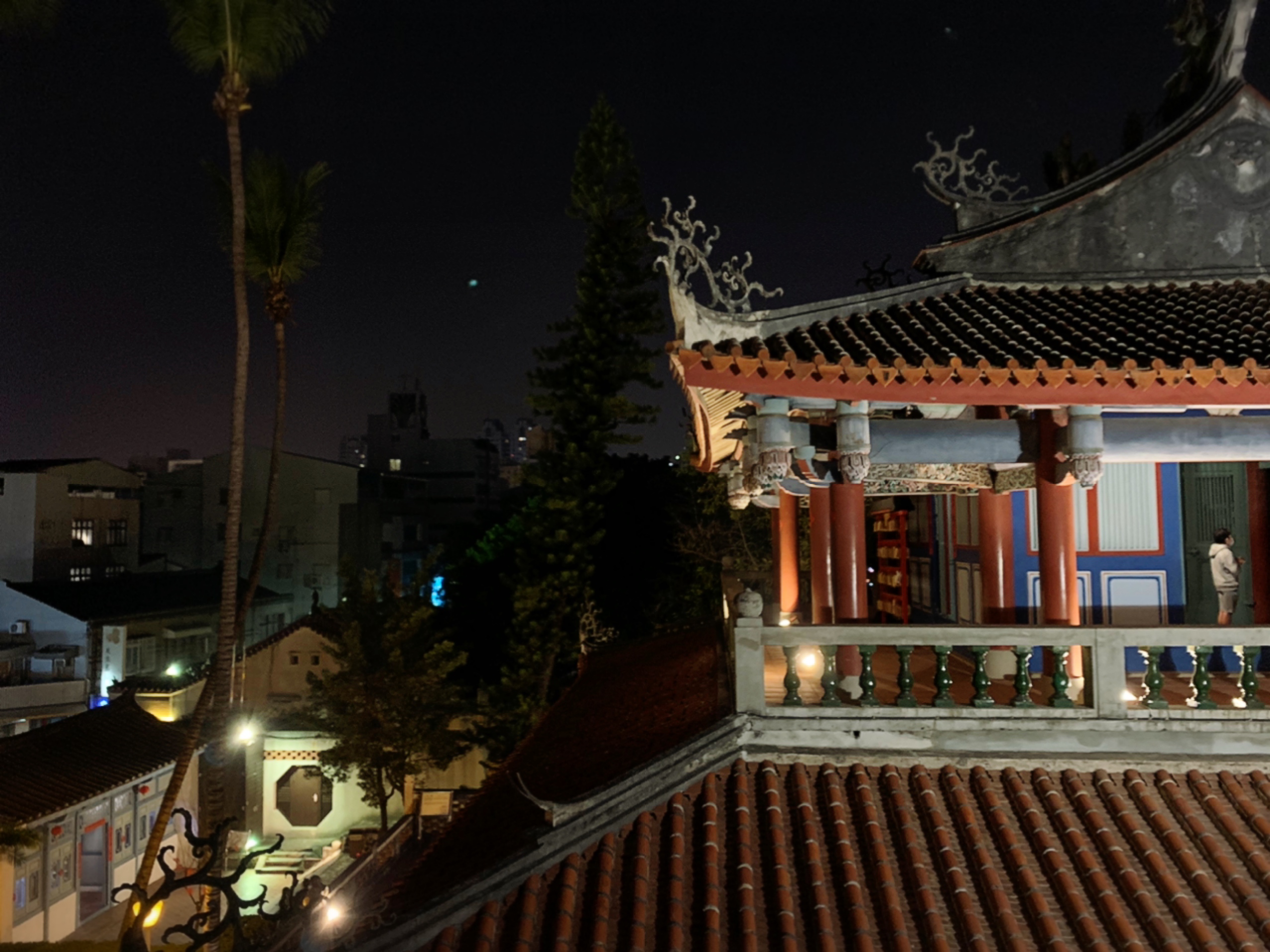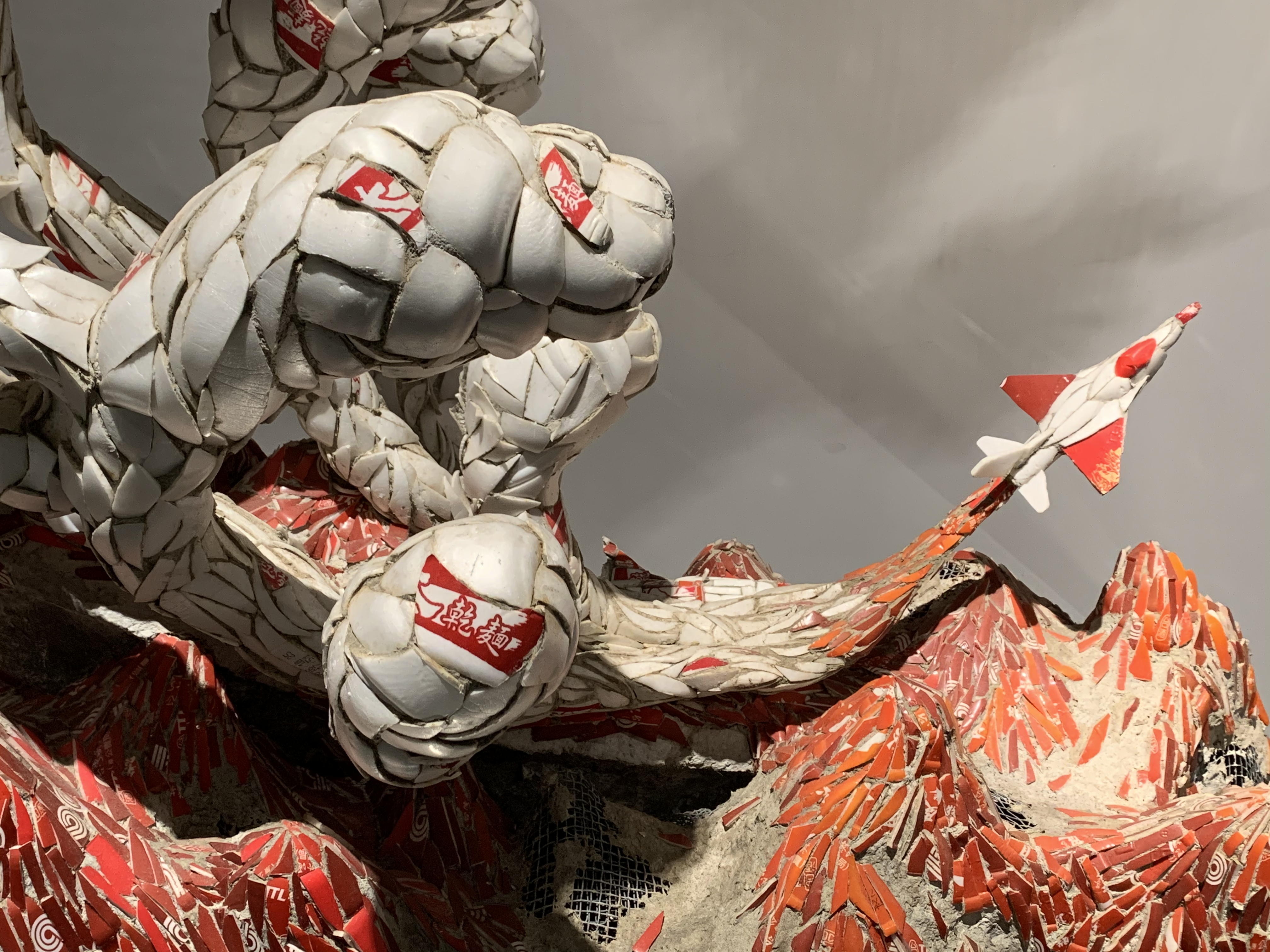
From a recently-closed exhibit at Tainan Art Museum
In a typical apartment in greater Taipei, my student and I chat about her week before looking at her school work and IELTS preparation. If an interesting subject comes up we dive a little deeper, to give her some practice articulating independent ideas. Even when I know things she doesn't, I prompt her to make rational guesses to get there on her own. She's pretty good at this and can communicate with very little problem, understanding and responding to natural spoken English at a fairly natural pace.
The tests she takes at her prestigious Taipei high school mostly consist of multiple-choice gap fills of complex grammar and lexis into long paragraphs, or translation. She's good at this too -- better than I would be in a foreign language -- but sometimes they include lexis she's never learned. I ask how her teacher conducts English class. "She has us read the paragraphs out loud. Then she translates them into Chinese for us, and we take notes on the parts we don't understand in English." Does she ever make you speak at all? "Sometimes to answer a question, like what's the answer to #3." Does she ever speak to her peers in English? "Never." Has she ever been asked to express a single idea, or even a sentence, that she created in her own head? "Absolutely not."
She takes a lot of these tests, as preparation for The Big Test. Or rather, Big Tests, because they appear to proliferate like tumors in a failing organ. Not a single one of these tests, Big or Small, includes any sort of actual foreign language communication.
In the part of Taipei that exists in the ether (that is, an online community), someone theorizes that English proficiency in Taiwan is low because Taiwanese are "shy" and "embarrassed" to make mistakes, speak out, take risks, whatever. That certainly is an easy explanation: things could be better, but, you know, culture.
Seven years ago this month, a group of activists stormed their own parliament, occupying it for weeks in order to protest the undemocratic passage of a trade pact. They barricaded doors, shouted, set up systems to stop the occupation from devolving into chaos, and held their ground until someone from the government responded. Some estimate that between 200,000-500,000 Taiwanese took to the streets to support them (my personal estimate is toward the higher end; I was in that crowd.)
That occupation and the rally it inspired was unusual in its size, but Taiwanese people have been heading downtown to scream at their government ever since they could do so without getting shot (and sometimes even when they couldn't). That doesn't sound very shy or embarrassed to me.
So this points to an issue not with culture, but with the tests. My student, the great communicator? The exams don't test that. If communication is the goal, they lack basic content and construct validity, because they do not test for communicative competence. There are no oral exams and the written portion is minimal.
But the tests really matter in ways we can't dismiss -- they determine not only what schools you can attend, but what you can major in. Although they are worthless, the doors they open aren't: it's no wonder people take them seriously.
This curdles into negative washback. I can only speak authoritatively on English language proficiency, where the exams don't test communicative ability. So every school curriculum, almost every teacher syllabus, every class, every page of pointless multiple-choice and gap-fill homework, every metastasization of mock tests before the Big Test(s) all aim to help students not to learn English, but to do well on the test. And then people wonder why English is treated like a school subject rather than a communication tool.
Think of all the bad teaching, kids not learning, parents' traditional thinking, Taiwanese don't like to communicate in English, schools don't teach critical thinking, student don't think English class is useful that you hear. They're like nausea, tiredness and chronic pain: they're all symptoms stemming from the same source: the tests.
The tests are the tumors. You can treat the symptoms -- we need better coursebooks! More teacher training! -- and there might be some improvement, but it won't excise the cancer that's causing the problems.
But that's culture too! I hear you shouting. It's, y'know, Confucian! Traditional! That's how culture works -- it happens once in ancient history and then it never changes!
But it's not. Research among English language teachers in Taiwan has shown that they are aware of more modern teaching methods, and elementary school teachers are more willing to implement them. Junior high and high school teachers also report willingness, but say that the necessity of preparing students for the major exams is the key reason why they don't do so. Researchers studying English language teaching programs in Taiwan also point out that English teaching curricula and government initiatives are based on outdated assumptions of how and why English is taught and learned. (Incidentally, I have met Drs. Kao, Tsou and Chen, and they all strike me as an exceptional scholars. If you care about English learning in Taiwan, you should be paying attention to their work.)
Anecdotally, I know that Chen is right about schoolteachers being open to communicative teaching approaches in principle. One of my jobs entails working with them; to be fair, the ones who sign up are a self-selecting group of particularly engaged teachers. As we collaborate, it becomes clear that they're already familiar with the core concepts underpinning communication and core-skills oriented professional development. And yet they're also frustrated. With large class sizes and looming exams, how can any of it be practically applied in the classroom? They'd love to teach towards better English language communication, but how can they when that's not on any of the tests, and the tests really matter?
If it was "the culture" holding Taiwan back, then these teachers' responses would have been quite different, or at least based on different reasoning, and Taiwanese voices would not be advocating for updated approaches to English teaching.
Everything they recommend -- better materials, more classroom resources, orienting foreign language education toward an English as a Lingua Franca, more professional development for teachers -- is useful and necessary. But again, these are treatments for symptoms. Teachers don't teach language communicatively because of the looming exams the students must take. English is treated as a school subject because the test makes it one. Teaching approaches and attitudes toward English are symptoms. The test is the tumor.
It's hard to justify the notion that test-driven learning is somehow endemically Taiwanese. "Ancient" Confucian-style learning did include a great deal of memorization, but the student-teacher relationship also mattered, and the test of true brilliance wasn't whether the mature student could regurgitate what they'd learned, but whether they could put it into practice. Koxinga wasn't considered a brilliant general -- his other numerous failings notwithstanding -- because he had read The Art of War. It was because he could use that advice effectively in battle.
Not that it matters. For the period when Taiwan was colonized by the Qing, they did little to develop education in Taiwan. Only the sons of the very wealthy attended Confucian academies, which funneled students into the imperial civil service. "Temple schools" weren't worth much either. Here's Manthorpe in Forbidden Nation telling you how that worked for Taiwan:
There was no encouragement for Taiwanese to re-enter the mainstream of the Chinese civil service, even though tuition was made available in 1686....There is no record of an islander passing the second-degree examinations until 1729. In the entire two hundred years of Qing rule, Taiwan produced only 251 second-degree holders. The third and highest-level civil service examinations were always held in the Chinese capital, Beijing, and there is no record of Taiwanese taking part until 1822, when eleven men from the island sat for the tests; only one qualified to become a government official. As far as can be determined, no Taiwanese civil servant ever worked on the island during the Qing tenure.
Then the Japanese came along and implemented their own educational system, mostly in order to equip Taiwanese to be good workers and obedient colonial subjects, assimilated into the Japanese empire but never co-rulers of their own territory or questioning the Japanese identity imposed upon them. There's a lot of history here, which I'll sum up in a quote about the early Japanese attitude toward education from Tsurumi's Japanese Colonial Education in Taiwan:
The policy was to...avoid creating or encouraging any general demand for higher education among Taiwanese. Gotō bluntly told his education personnel that they must take care to see that Taiwanese did not become educated above their stations in life.
That system turned into one where learning basic literacy and numeracy along with cultural assimilation were the key benchmarks of education. One was never taught to ask too many questions or get too ambitious, although some Taiwanese were able to attain university educations as Japanese rule wore on. When you don't want the general population to think very critically, what happens in the classrooms? The same sort of exam-based regurgitation we see in Taiwan now.
That was the system the KMT inherited when they colonized Taiwan, and to be blunt, they thought it was an excellent brainwashing tool, simply replacing Japanese cultural assimilation with Chinese. The ask-no-questions, just-take-tests orientation was certainly kept in place. I suppose from the KMT's perspective, it saved bullets if people never asked questions in the first place.
What Taiwan has today is essentially that system. Does any of that sound like an education system built from Taiwan's cultural roots? Because to me it seems like a succession of colonizers either ignoring education entirely or imposing their own ideas on what that education should be like. I'm all for immigration, but if immigrants are good for a society, like probiotic yoghurt for your gut, colonizers are carcinogens, like microplastics in your fish.
Do we even know what education through a Taiwanese cultural lens would be like, seeing as it never seems to have been tried? Here's just a taste of what direction this could take:
In addition to being the seventh anniversary of the Sunflower Movement, this month is also the 25th anniversary of Taiwan's first free and full democratic election, a feat that would have been impossible if not for dedicated Taiwanese activists resisting everything that had been shoved down their throats in school. From my student -- the great communicator -- who didn't learn English in school so much as from parents and relatives who spoke it, to these generations of activists who also learned to think critically everywhere but school, it's clear that these ways of learning have a place in the culture here. An education system based on that could be very exciting indeed.
In a society, however, people have a range of beliefs and perceptions. Not long ago, I was talking to a friend in the cafe the Eslite Hsinyi. Her daughter is in high school. and my friend was complaining about the new requirements -- they look at your exam scores but also your "portfolio", which can include just about anything. Things like music lessons or playing a sport tend to fare well.
"My daughter has to do all of that on top of getting good grades and taking the exam!" she lamented. "It's not fair!"
"I agree it's too much, but the problem is the test," I said. "What's unfair about everything else?"
"It benefits rich families. With the test, if you studied hard, you could do well no matter how poor you were. Everyone had a chance."
I pointed out that this had never been true; for English, the test is not only biased towards students who handle rote memorization well and against those who are simply good communicators, but it also privileges the families who can afford the expensive buxibans that prepare their children for it. We discussed the fact that places at Taiwan's top schools are dominated by the children wealthier urban families (I've seen data for this but can't seem to find it; if I do I'll come back and link). If the tests are "fair" and "any bright child who studies hard can succeed", then that gap should not exist. Yet it does.
The belief that the test is "fair" sits alongside the open secret that you need to pay for expensive buxibans in order to access that "fairness". This is also supported by the industry, which carries significant political clout. If parents believe that their own children might not get the maximum benefit from all that "fairness", and a wealthy special interest group benefits from the continuation of that myth, it can be very hard to fight indeed. Cancer usually is.
The result is hours of physically and mentally unhealthy rote learning on a hamster wheel that nobody seems to know how to stop. My neighbor's children come over for an hour a week of English practice. When we met on Tuesdays, they could barely stay awake, even through games they otherwise tended to enjoy. We switched to Wednesdays and their energy levels improved. I asked why one day, and they told me that their math buxiban ends at 9pm on Mondays, and then they go home and do homework. "We went to bed at one-thirty," they said. And when did they wake up? "Six-twenty."
Why? "Because this week we have tests every day." Which subjects? "All of them." Are those the big tests? "No, that's next week." So what are these tests? "Practice."
So when do you actually learn? They shrugged their shoulders. They had understood the question; they just didn't know the answer.
It would be easy to blame the parents for pushing their kids through such an exhausting, expensive and traumatizing system which doesn't even promote core learning skills, the kids who obediently run that treadmill and the teachers who operate the machinery. It would be easy to castigate them all for not valuing "critical thinking". That's too simplistic, however. They're all just trying to survive in a system none of them can change alone. Their attitudes aren't the problem, they're a symptom. The test is the tumor.
This attitude can lead to dark outcomes, as well. Years ago someone asked my advice about her teenage nephew. He lived in a far-flung New Taipei suburb and woke up at 5am every day to commute to school in Taipei, an hour and a half each way. Then he'd go to buxiban in Taipei until 10pm, before slogging home and doing homework until well past midnight. Then he'd wake up at 5 and do it all again. Weekends meant more buxiban, and more homework. The college entrance exams were coming, but honestly, she said, it had been going on for years.
She offered more details about their last meeting, which had concerned her greatly. I can't tell that story without being more specific than I feel comfortable with, but his behavior was worrying enough that I advised that he not only see a doctor, but that his parents do something about the untenable school situation. At best, he was dangerously exhausted.
The concerned aunt fell out of my orbit not long after, and I never found out what happened to her nephew. Regardless of whether my advice triggered any change, I hope he found his way through.
Why does all of this matter now? I could have written this post at any point over the last 13 years that Lao Ren Cha has existed.
Well, I'm a foreign language teaching professional, and Bilingual by 2030 has been in the news of late. It seems everyone has an opinion. Can CLIL (Content and Language Integrated Learning) and EMI (English as a Medium of Instruction) succeed? What does it mean to teach English as a tool rather than a school subject? Should be importing foreign teachers, training local ones or both? What support should other foreign and local languages receive? Why does Taiwan need to improve its overall English proficiency at all? What does internationalization mean? How can we ensure the rich-poor and urban-rural divide isn't deepened? What role do critical thinking skills play? (I'm leaving out some of the less thoughtful takes; not everyone with an opinion has actually read the policy document.)
These questions matter, but every last one of them is asking about treatment of a symptom. If, throughout years of English classes, students are subjected to multiple batteries of tests -- so many tests that they literally don't know when actual learning is meant to occur -- then it doesn't matter if the teachers are foreign or local, trained or not. They will prepare students for those tests. English will be treated as a school subject because the test renders it one. The test is the tumor.
If the goal of the Tsai administration and the Ministry of Education is to improve proficiency and communicative ability, and for Taiwan to be an internationally-accessible country with more global visibility, that won't happen if the assessments of educational attainment don't test proficiency or communicative ability. There are tests that do indeed aim to assess proficiency, such as IELTS. That test is problematic in its own way, but the English language exams students take in public schools don't even try.
It won't matter whether they're pushing general English classes with communicative teaching, or CLIL and EMI. It won't matter that research shows these methods tend to work, especially if they are implemented in earlier grades, although there are several factors influencing this. Students, teachers and parents will resist subject courses in English as long as there's a difficult and competitive test at the end, and preparing for it is slowed down by learning in a second language.
Arguably, the main reason why Taiwanese students spend years in English classes but do not always come out proficient in English comes down to negative washback from the tests. The tests don't assess communicative ability, so communication is not part of the class. The proficiency issues that these methods aim to treat are symptoms. Societal resistance to changing those classroom approaches? A symptom. The test is the tumor.
No initiative -- not Bilingual by 2030, let alone anything that came before it -- is ever going to be successful if it doesn't treat the tumor.
This is arguably also a crucial time for Taiwan. I pointed out on Taiwan Context that one of the main reasons Taiwan needs English isn't to do business, it's to make itself heard on the international stage. In Pedagogies of Hope and Resistance, the teacher-researchers quote the thoughts of their Palestinian students, who say that they want to learn English to communicate with the West, so that people in other countries would know more about Palestine and their struggle. (Data on such perceptions is inconclusive, but anecdotally, I do see a change.)
Although I don't intend to make a direct analogy between Taiwan and Palestine, that same need exists in Taiwan. Palestinian students don't always learn English for job opportunities, and commentators love to point out that most Taiwanese workers won't need it, either. However, other countries -- such as Taiwan's peers, Japan and South Korea --don't need to constantly prove to the world that they are indeed countries. Taiwan does. To communicate that, its most ardent activists need English, and we can't know where those activists will come from until they're already in the education system.
With China inching closer to a long-threatened invasion, that need to communicate complex ideas about Taiwan's history, society and political situation as a country with the world has never been more urgent.
But that's not going to happen as long as the language classes students take are oriented towards a series of tests that don't assess that kind of communicative competence. If you want learners to acquire certain skills and knowledge, the assessments the undertake should test what you want them to acquire.
The problem isn't the schools. It's not the parents, or the students. It's not the teachers. It's not "culture" or "society". It's not "traditional" or "Confucian" views of education or insufficient teacher training (though it's true that university teachers don't generally receive much, and that should be addressed). It's not even Bilingual by 2030 or the Ministry of Education. They all exhibit symptoms but they are not the disease.
It's the test. The test is the tumor.
If the government isn't willing to tackle this, then the tumor will continue to metastasize as we waste time treating symptoms, while telling ourselves that the symptoms are the disease. Then we'll wonder why our organs keep failing.