Sunday, June 30, 2019

Book Review: The Astonishing Color of After

51F1q-O2BsL._SX330_BO1,204,203,200_


The Astonishing Color of After
Emily X.R. Pan


I like to situate my book reviews in the real world - whatever is going on in my life, I try if possible to relate it to what I've read. I do this because I'm not a professional book reviewer, and I want to offer something more unique than a bog-standard review you might read in a newspaper.

As it so happens, I read The Astonishing Color of After - which deals with depression and suicide - during a time when I was (am?) coping with anxiety, mostly related to graduate school. I don't have depression - anxiety is not the same thing - but what drew me in was a line towards the beginning of the novel - the colors around me were all wrong. I was lucky, if only because I was able to see that something was wrong in time to seek professional advice (it turns out that my case is mild and I don't really need anti-anxiety medication if I make a few lifestyle changes - breathing exercises, no social media before bed, that sort of thing). But what really helped me connect with this novel was realizing that while I'd always known intellectually that sometimes brains just don't work the way they're supposed to, I hadn't really understood personally - viscerally - what that could be like, even mildly. Now I do.

The Astonishing Color of After is, theoretically, YA (Young Adult) literature. The writing style is fairly straightforward, the first-person viewpoint character is a teenager dealing with teenage issues and it fits nicely alongside other YA classics. Because of this - and despite it being quite fat - it's a quick read for adults. I didn't realize that when I picked it up, but I'm happy things shook out that way - I'd just finished my dissertation proposal and needed some mental rest with easier prose. It surprises me that it doesn't seem as though this novel has gotten a lot of press among English-speaking Taiwan bibliophiles. I knew when Green Island, Lord of Formosa, My Enemy's Cherry Tree and Wedding in Autumn all came out, but hadn't heard of this book until I came across a copy at eslite. It's a shame, too - YA literature about Taiwan that can be enjoyed by anyone, even if they have no connection to Taiwan, is a niche that needs filling. That kind of soft power helps.

That said, because the narrator is a 15-year-old girl, the prose is written a bit too...muchly. There's explicitness where something might be implied, melodrama where subtlety and implication would suffice. It works, though - the story is told as a 15-year-old might tell it. You can almost envision what the journal entries of the narrator would be like.

Without spoiling too much, the story follows Leigh Chen Sanders, 15-year-old American-raised daughter of Dory Chen and Brian Sanders. When her mother, Dory, commits suicide, Leigh is convinced she's turned into a huge red bird, and eventually seeks answers to her mother's family history in Taiwan. Leigh not only grapples with her mother's death, family secrets and feeling lost in an unfamiliar country, but a father who can barely cope himself as well as a very common teen issue: wanting to do something creative with your life as one of your parents pushes you down a practical path that you are entirely unsuited for.

This struck home for me too. I'm not a teenager anymore, and I'm not in a 'creative' profession (writing is a hobby, not a consistent income source). But along with my dissertation, I've been grappling with exactly why I chose to become a teacher when I don't feel the money I earn really justifies my choice (and don't always feel appreciated in a professional capacity either). I know people think foreign teachers out-earn other professions here, but that's really only true early on. When you hit your thirties, gain experience and professional development and credentials, you start to notice that if you'd gone to work for some corporate machine you'd be earning more by now. But, as with art or music, there are other reasons to choose teaching.

Taipei is rendered as accurately - if generically - as post-smartphone suburban America, and the story is deeply engaging. Pan does a great job of narrating the difficulties Leigh has with Mandarin - a language she is familiar with but doesn't really speak and can't read at all - and Taiwanese, which is incomprehensible to her. The flourish of her Taiwanese mother not really wanting to return to Asia despite her American father being keen do to so - and that same American father speaking and writing fluent Mandarin as his Taiwanese wife avoids her native language - presents a flourish to the story that upends stereotypes readers may have. Frankly speaking, it's a circumstance I've seen play out in real life, and it was interesting seeing it depicted in fiction. It reminded me of how my own grandfather, himself not a native speaker of English, purposefully never taught any of his children Western Armenian. As a result, I never learned it either.

I'm of two minds about Pan's depiction of Taipei. Everything was accurate - the alleys, the doors, the weather, the parks, the house slippers, the apartment shrines, the shops and temples. The depiction of supernatural events fits fairly well within Taiwanese religious beliefs, and the touch that Leigh's mother would visit both a Taoist and a Buddhist temple and not see any problem with that sort of syncretic belief (a fairly common thing to do in Taiwan) was a thoughtful flourish. Leigh's grandparents could be any number of older couples in Taipei city.

But...but. I wish she'd been more specific. Which street with brick arches did she reference? Was it Dihua Street? If so, the temple she described looks nothing like the most famous temple on that street. Was it Longshan Temple? It could have been. But if so, what street? What neighborhood did the Chens live in? Which spot on the North Coast did they actually go to? (Jiufen is referenced but then not much more is said about it or what the scenery is like.) One thing I love when reading novels that take place partly or entirely in Taipei is reading about the author's description of very specific places that I can go visit, if I like. When Pai Hsien-yung talks about Longjiang Road and a park which is obviously 228, I have specific mental images I can conjure up to give life to the story. There's something to be said for referencing a generic residential lane, a generic neighborhood park - the Chens could be anyone and there's literary merit to that - but I like my fictional Taipei to be grounded in a reality that I can personally reference.

I was intrigued by the very common Taiwanese family story of the Chens - a grandmother born in Taiwan and growing up in poverty, and a grandfather who came with the ROC military from China. Leigh's grandmother speaks Mandarin and Taiwanese (her grandfather's linguistic background is less clear). When we start to see flashbacks of Leigh's mother's life in Taiwan, one reference concerns her marrying someone "Chinese" (me: not Taiwanese?) but later that's references as "Chinese or Taiwanese". Which...huh.

There's a lot of digging that could be done into family political dynamics there, a lot of engagement in that particular issue that Pan - and by extension Leigh - could have pursued. But it's left there; there's no further discussion of issues of Taiwanese linguistic, historical or cultural identity. I suppose that'd be a bit much for a YA novel not necessarily marketed only to readers familiar with Taiwan, but it would have been interesting to explore.

Where the novel does a little better is discussing Taiwanese religious beliefs and superstitions, especially regarding ghosts and the afterlife, and Ghost Month in particular. Although I wish the novel had actually gone to Keelung for Ghost Month after explicitly referencing it, beliefs about ghosts roaming the earth and burning items for them to use in the afterlife, I think foreign readers will find these descriptions interesting.

All in all I'm happy I read The Astonishing Color of After, especially when I did. Its ideas and plot threads came through at a time when they could resonate especially strongly for me, and its clear prose was an inviting fictional place for my mind to escape to when it very much needed an escape.

Even better? I think you can still buy it at eslite!

Wednesday, June 26, 2019

The kids are all right

65325263_10157441334191202_9143348154656096256_n

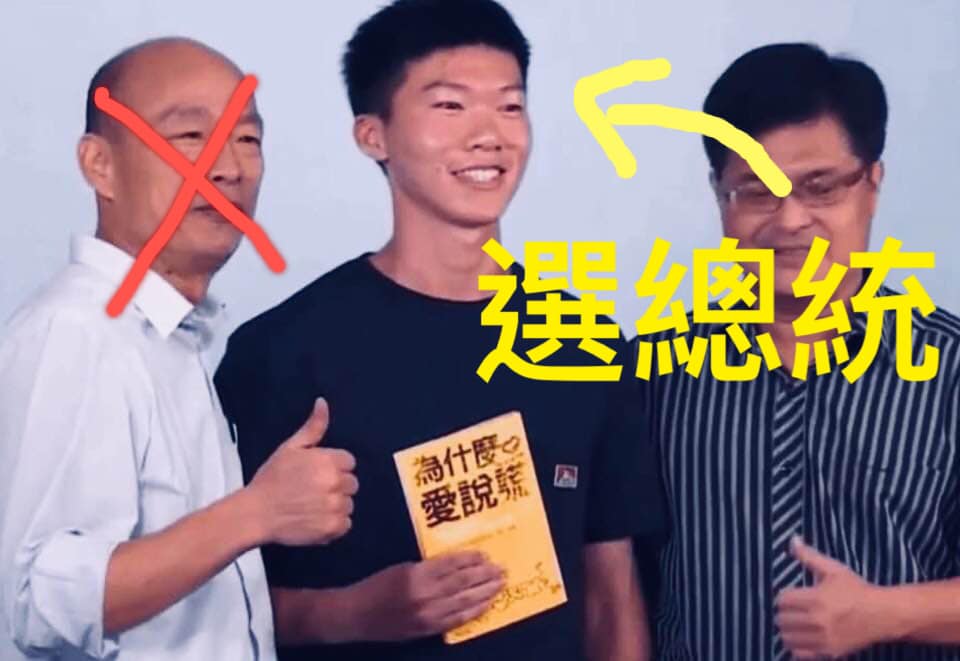
Yes, it's been almost two weeks since I've updated, and no, it wasn't planned. I just really had to get my dissertation proposal in. I was going to jump back into blogging with a few restaurant reviews, a few long-overdue trip reports, a book review...you know, the sorts of things that a person who's just spent the past two weeks deeply stressed out might post. But no, some kids in Kaohsiung decided to be awesome, and now that has to come first.

I have a jumble of thoughts about these kids - who are old enough to have been my kids in a very different timeline, which is super weird because I totally want to buy each of them a Taiwan Beer like an old friend or Cool Aunt. I love how creative they are, how willing they are to take public risks to say what they think, and how thoughtful and full of integrity they are at that age. How civil the points they are making are - there is nothing uncivil about telling the mayor to finish his term, or pointing out that he lies. He does lie. It's speaking truth to power at an admirably young age.

I mean, damn - I was a total dipshit at 17. To be honest, I'm jealous. If these are our future leaders, we're going to be okay.

My first thought is that if we can keep Taiwan safe - as in, still a functioning democracy and not sold out to China - long enough for this generation and their immediate elders (think Millenial Taiwanese) to be the most influential voting block, then Taiwan will be just fine. A large enough percentage of them are smart enough to see Chinese media infiltration and other nefarious tricks for what they are, and showed up in droves (tens of thousands, not thousands) to protest it. They understand what equal rights really means and are willing to put in the time to physically show up and voice their discontent.

In fact, their way of protesting Mayor Han was creative and ballsy enough, clear and concise yet civilized, that Taiwanese civil life will be made better as more of them grow up to be activists and public figures, or start otherwise contributing to the discourse here. They are quite literally doing what their parents and grandparents won't, seeing things their ancestors are too naive (or wrongheaded, or brainwashed) to see, and noticing that if a public protest against Han is going to be lodged, they're the ones who have to do it. They're doing what their elders should be doing - but aren't - as it becomes clearer that Han is a Manchurian candidate, with a whole host of undesirable puppet masters.

They know the pro-Han, pro-China, pro-KMT media won't report on their rebellion, but they also know their parents and grandparents will be in the audience or see those photos. They're aiming their protest not just at the media, at Han, and Taiwan at large, but at their own elders, in such a way that they can't look away or ignore it. That's just smart.

That's the thing, though - China knows this. The KMT knows this. The unholy China-KMT Union (yes, it is a thing, don't pretend you don't know) knows this. They are perfectly well aware that they will never, ever win the hearts and minds of the youth, so the plan is to rip the carpet out from under the youth before they gain enough political power to stop it. The war (yes, it is a war - yet again, don't pretend you don't know) is escalating because they know their window of potential victory narrows every time an easily-manipulated older person dies, and a more attuned one gets the right to vote. They need to destroy Taiwan's democratic norms and will to resist before that happens, and frankly, we're not fighting back fast enough.

That's not to say every older person is 'easily manipulated', but enough of them are that it's a real problem, and China is absolutely seizing on it.

My next thought concerns this response from Han, from the Taipei Times link above:

“I think it is a great thing when young people speak their mind,” Han said yesterday in response to media queries. 
He has always encouraged young people to express their opinions and will support them under any circumstances, but it is “inappropriate” to tie political issues to an educational event, he said. 
“If students have opinions, they can express them off-stage,” he added. 
Taking a photo on stage with the mayor after receiving an award for graduating with top grades is the “most honorable moment of [a student’s] life” and he hopes such educational events can remain pure, Han said.

First, Mr. Han, if you really thought it was a 'great thing for young people to speak their mind', you wouldn't say that they should do it offstage - in the least effective way, where it won't hurt you at all. You're fine with them saying what they want as long as nobody listens.

Secondly, this whole thing is a massive concern troll - "inappropriate", "it's an honorable event, keep it pure"? Yeah, okay, and I bet you're just "worried about their health" or "don't want them to have any trouble later", too. Whatever buddy.

And, of course, it's absolutely laughable that a politician showing up at an event would say that event should be free of politics. If you want a politics-free event, politicians should not be invited. They are public figures and must accept that they are fair game at any public event. They make it political by being there. Otherwise Han's just saying that his politics - photo-ops with award winning students are inherently a political activity undertaken to make a politician look good - are apolitical, but everyone else's politics 'impure'.

A lot of people are saying that these kids are the brightest, the award-winners, the smart ones - they're not representative of Taiwanese youth as a whole. And yes, they do stand out. But every generational shift and successful social movement has the people at the tip of the spear. That doesn't mean the rest of the spear isn't there, or isn't important.

If anyone knows where I can formally offer to buy every last one of them a beer - yes, even the underage ones though they can have bubble tea if they'd prefer - I'd love to hear it. And I'm not sure I'm joking.

Wednesday, June 12, 2019

Hong Kong residents and Taiwanese gather outside Hong Kong representative office in Taipei

Untitled


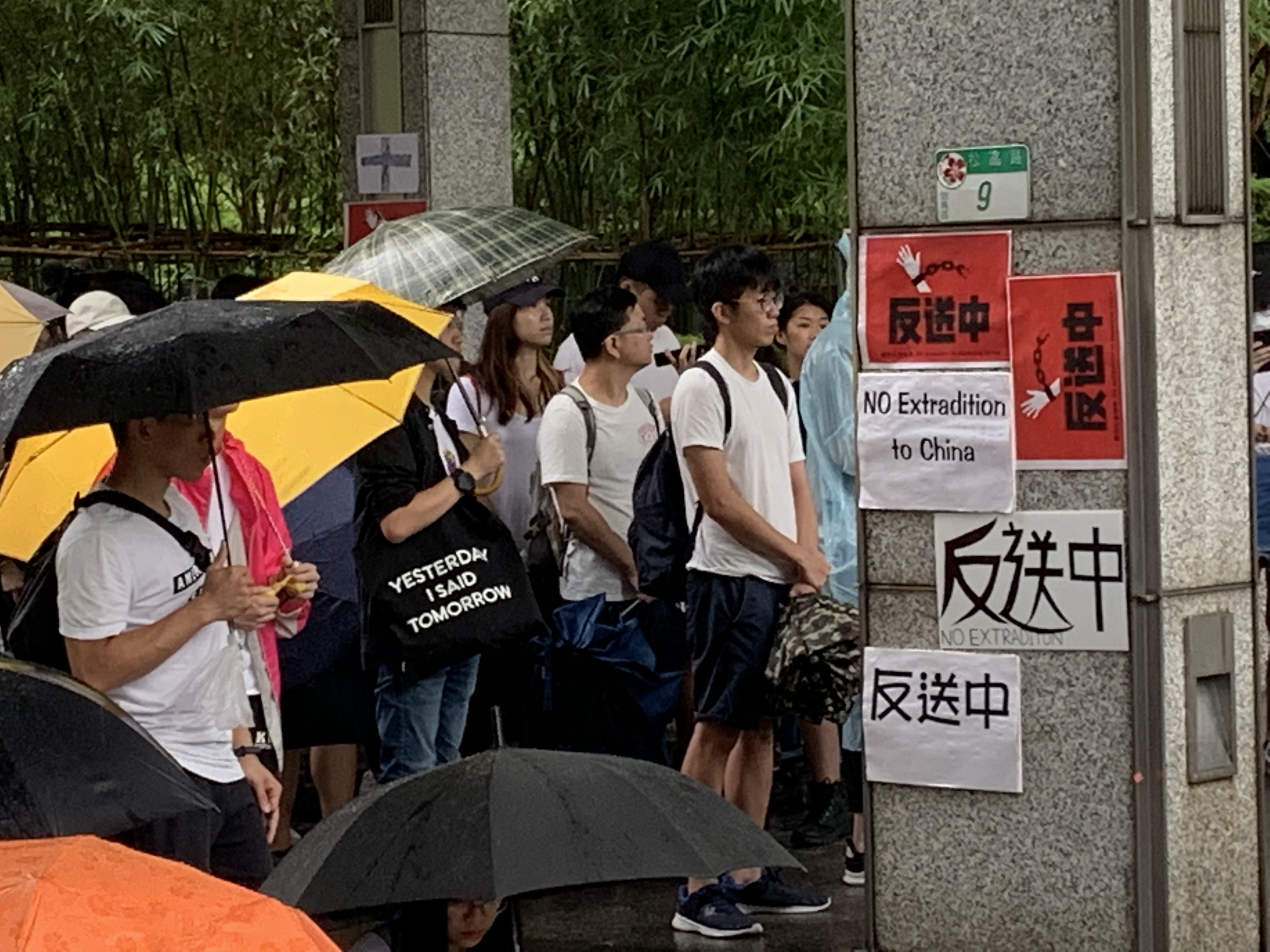
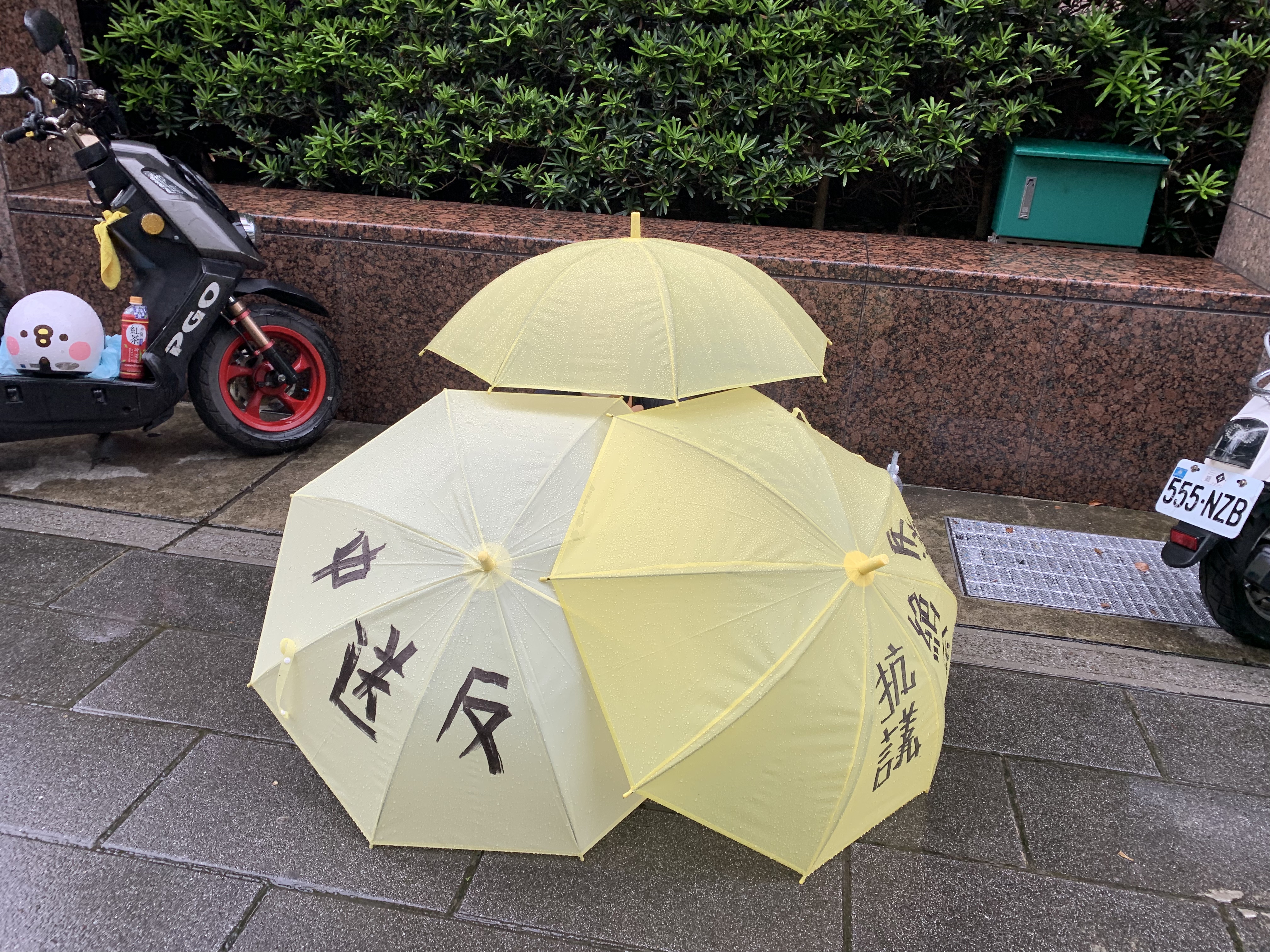
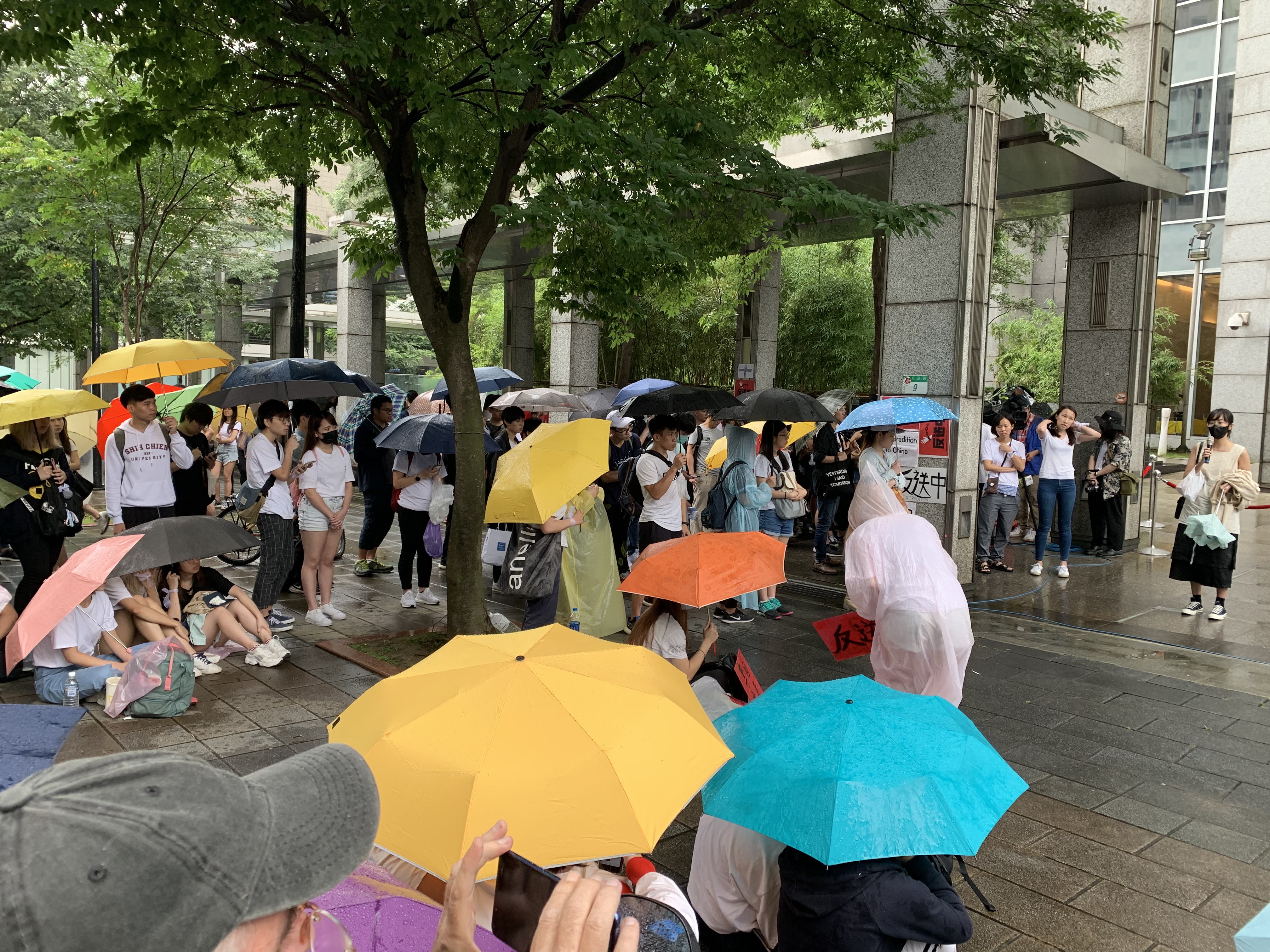
This morning, around the same time that protesters began amassing outside of Hong Kong's legislative council (LegCo) to protest the proposed extradition bill that would allow extraditions from Hong Kong to China, a few hundred Taiwanese and Hong Kong residents gathered outside the Hong Kong representative office in Taipei between Songgao and Xinyi Roads (the office is located in the same building as eslite Xinyi).

I missed the first round of speeches by social activist groups and notable people - including former Sunflower leader Lin Fei-fan - due to work. However, I came by later to find several dozen or perhaps a hundred people still there, braving the worsening rain to continue the demonstration.


Speeches continued after the official line-up had finished, with anyone who wanted the mike able to take it. Longtime expat Sean Kaiteri did so; I did not. In between speeches, a television set up under an awning played a feed of the escalating situation in Hong Kong.


Untitled


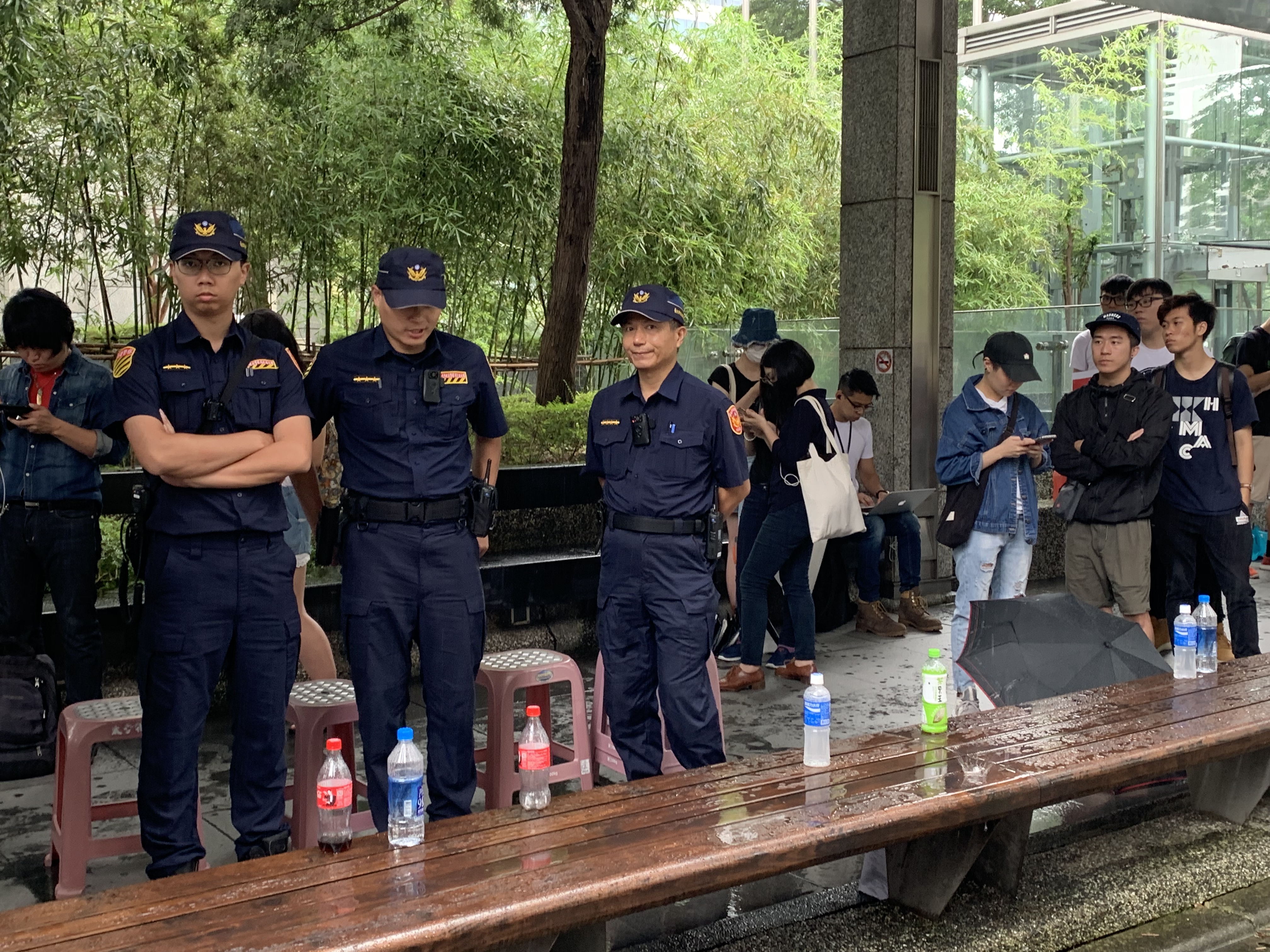
Most of the speeches were in Cantonese, so I couldn't really understand. A huge number of the protesters were also from Hong Kong - mostly students and interns unable to return to Hong Kong to join their friends and fellow citizens in Central. What struck me was that, while anyone with an ARC (Taiwan residency card) does have freedom of assembly - so they actually can participate in protests, just not organize them - it's a bit less clear if some of the students and interns are technically legally able to do so. Some are only here for a few months. Worryingly, there were reports and rumors of immigration police sweeping through. Otherwise, however, the police left the demonstrators alone and some people who appeared to work in the representative office appeared to be watching the demonstration from just beyond it.


Untitled


I had to leave to work on my dissertation, but as far as I know the demonstration is still going on. This isn't likely to end soon and looks like it's getting bad in Hong Kong, so keep your ears open. I suspect there will be more news to come. 


Untitled


Untitled

Untitled